










 500,000+ readers just today.





The DOJ’s Alaska lawsuit.

Good Monday morning. I’m Isaac Saul, nose to the grindstone until Election Day. We’re preparing a fun night of livestreamed coverage on our YouTube channel, including some big-name guests, so keep your calendar clear and prepare to take in the results with us.
In the meantime, we’ve already got our first legal challenge to election results. Kind of. Preemptively. If that sounds odd, then you’ll appreciate today’s breakdown of the Trump administration’s legal challenge in Alaska. Plus, a feel-good Halloween story.
It’s a 12-minute read.
Ari Weitzman, Will Kaback, Audrey Moorehead, Carina Pacheco, Russell Nystrom, Isaac Wood, and Bailey Saul edited or contributed to today’s newsletter.

Corruption, continued.
On Friday, Executive Editor Isaac Saul published part two of his ongoing reporting on apparent corruption in the second Trump administration. This piece examines stories that have surfaced in just the past five months, showing that the self-dealing has only increased since Isaac’s first edition back in May.
The information is the narrative. There is just the reality before us — the simple black-and-white facts of what has been done and what is happening, here, right now. It is remarkable in all the worst ways, brimming with details that, if you care about good governance or honesty or character, might make you angry.
You can read the full piece here.
Quick hits.
- Brazilian President Luiz Inácio Lula da Silva won reelection, narrowly defeating Flávio Bolsonaro. Bolsonaro called for the result to be annulled over a Brazilian Supreme Court justice’s decision to extend voting hours. (The election)
- The White House said it is dropping tariffs on select Canadian imports but adding them to other Canadian products. Sen. Susan Collins (R-ME) first announced the revoked tariffs, which had impacted key industries in Maine. (The tariffs)
- Director of National Intelligence Jay Clayton issued a memo to Secretary of State Marco Rubio warning that Iranian threats against U.S. officials abroad are increasing. (The warning)
- The office of First Lady Melania Trump announced a temporary ceasefire in the Russian-occupied Ukrainian city of Oleshky to allow for humanitarian aid to enter and civilians to evacuate. (The announcement) Separately, Ukrainian officials disputed SpaceX CEO Elon Musk’s claim that SpaceX slowed down Ukraine’s satellite internet connectivity because the country violated Starlink’s terms of service. (The dispute)
- The Justice Department charged two former Federal Bureau of Investigation employees with making false statements to Congress about their involvement in an investigation into former President Joe Biden’s son Hunter. (The charges)

The turning leaves aren’t the only sign the seasons are changing.
Have you noticed more creepy crawlies coming inside looking for a warm place to set up camp? As leaves change and temperatures drop, unwanted house guests (more like house pests, am I right?) can start looking at your home as their new winter getaway.
That’s where today’s partner comes in.
Nixo is a small plug-in device that uses ultrasonic pulses, electromagnetic signals and varying frequencies designed to help deter common household pests, including small rodents and insects, from entering your home. It’s odorless and designed to be safe for people and pets, with no sprays, traps, or messy chemicals.
Don’t let unwanted housemates move in for the season. Protect your family and home today.
Today’s topic.
The DOJ’s Alaska lawsuit. On Thursday, the Justice Department sued Alaska and its Division of Elections director, seeking to preemptively block certification of the state’s Senate election if it is impacted by “voter confusion.” The closely contested race features two candidates named Dan Sullivan; Dan S. Sullivan is the incumbent Republican senator, and Daniel J. Sullivan is a challenger with no party affiliation. The lawsuit alleges that Daniel J. Sullivan entered the race “with the intention of misleading supporters of Senator Sullivan.” Attorneys for Democratic candidate Mary Peltola have asked a judge to dismiss the lawsuit.
Back up: Alaska uses a top-four primary system, in which the four candidates who receive the most votes (regardless of party) advance to the general election. In this year’s Senate race, former Rep. Peltola (D), Sen. Sullivan (R), Sullivan (no affiliation), and Gerald Heikes (R) advanced to the general election; Peltola and Sen. Sullivan received 49.5% and 41.4% of the primary vote, respectively. The state uses ranked-choice voting for federal and state general elections.
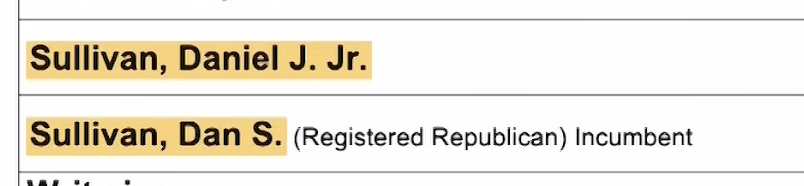
Daniel J. Sullivan, the unaffiliated candidate, is a retired teacher who has not previously held elected office. In May, he announced his candidacy as a Republican, which the Alaska Republican Party challenged. The state’s Division of Elections issued a preliminary finding in June that Sullivan was likely ineligible to run and would be disqualified; however, the Alaska Supreme Court ruled later that month that Sullivan must be included on the primary ballot. To resolve potential confusion over the two candidates, the Division of Elections said the senator should appear with the identifier “(Registered Republican) Incumbent” while the other Sullivan would have “No Party Affiliation.”
The unaffiliated Sullivan has rejected claims that he is running to undermine Sen. Sullivan’s campaign, saying he has long thought about running for office. He has done minimal campaigning, and public records show his campaign has raised negligible funds.
On Friday, President Donald Trump said he directed the Justice Department to file its lawsuit, claiming that Democrats had compelled the second Sullivan to run. The suit similarly argues, “The sole purpose of his candidacy is to benefit the Peltola campaign by reducing the number of votes for Senator Sullivan.” The plaintiffs request that Alaska halt certification until an investigation can determine whether any votes were cast for the wrong candidate.
In their motion to dismiss the suit, Peltola and the Democratic Senatorial Campaign Committee say the action is part of “a nationwide attack on free elections by the federal government” and “an unprecedented pre-emptive strike on democratic elections.” Sen. Lisa Murkowski (R-AK) also questioned the Justice Department’s suit, writing on X, “Alaskans don’t need any help voting for their preferred candidates, and the State of Alaska has already handled this by clearly distinguishing the candidates on this year’s ballot.”
Today, you’ll read arguments from the right and left about the suit, followed by Executive Editor Isaac Saul’s take.
|
What the right is saying.
|
The Wall Street Journal editorial board wrote about “exposing ‘Decoy Dan’ in Alaska.”
“Democrats pulled a dirty trick by enlisting a decoy, Daniel J. Sullivan, to run against Republican Alaska Sen. Dan S. Sullivan. Now they are indignant that the Trump Administration on Thursday filed a lawsuit that calls attention to their subterfuge,” the board said. “Democrats deny they are behind the ruse, but their fingerprints are all over it. Daniel J. Sullivan voted for Democrats in the prior three presidential elections and for Democratic nominee Mary Peltola when she ran for the House. There’s evidence that a Democratic consultant also helped launch his campaign.
“Polls show the Senate race within one or two percentage points. That means the election could be decided by a few thousand votes or less,” the board wrote. “Alaska’s convoluted ranked-choice voting system increases the risk of voter confusion. The lawsuit is a legal Hail Mary, but its real purpose before the election is to educate Alaska voters now beginning to pay attention about the Democratic trick. Who’s really undermining trust in elections?”
In Cato at Liberty, Walter Olson argued the suit is “abusive in its intentions.”
“[The suit] borders on frivolous because it attempts to stretch a federal statute, the National Voter Registration Act (NVRA), beyond recognition by snipping language from the law’s preamble and treating it as if it creates vast and open-ended new duties that the federal government can enforce on states,” Olson wrote. “That is not a natural reading of the text, nor is it one that courts have taken. If accepted, it would suddenly federalize many issues of local election administration.”
“It invites suspicions of bad faith by omitting any acknowledgment that Alaska’s printed ballot labels one of the two Sullivans distinctly as ‘incumbent,’ thus helping dispel confusion for a reasonable voter. In so doing, Alaska has addressed the hazard without walking into a different hazard (curbing voter choice by striking an otherwise qualified candidate),” Olson said. “The issue in question is one for the Alaska Supreme Court to decide under Alaska law, and the Alaska court did just that.”
In RedState, Ward Clark said the race “just got more complicated.”
“[The Justice Department] appear[s] to be judging the unknowable intentions of Daniel J. Sullivan in deciding to run for the United States Senate. That’s more or less what the Alaska Division of Elections did last summer, and that didn't work then. I doubt it will work now,” Clark wrote. “I happen to believe that Daniel J. Sullivan did precisely what this lawsuit maintains — he ran as a spoiler, to try to muddy the waters and siphon votes away from the incumbent. But the Alaska Division of Elections can’t read minds, and neither can the U.S. District Court for the District of Alaska.”
“There’s a matter of principle here, and the thing about principles is that they must be applied in the same way in every case,” Clark said. “In this case, no matter what we suspect about Daniel J. Sullivan’s motivations (and I'd bet money on them), the only thing that matters here is that Daniel J. Sullivan followed all of the legal procedures and requirements to run for this office. He did so.”
|
What the left is saying.
|
In Vox, Ian Millhiser wrote “Trump is trying to overturn an election that hasn’t happened yet.”
“Sen. Sullivan will be identified as a ‘Registered Republican’ and as the ‘Incumbent,’ so voters will be told which Dan Sullivan to vote for if they wish to reelect the one who is actually a senator,” Millhiser said. “Additionally, Alaska uses ranked-choice voting… So an Alaska voter who wants to reelect the Dan Sullivan who is actually a senator, but who is confused as to which Dan Sullivan is the incumbent, can simply rank both Dans Sullivan as their top two choices.”
“Even if Trump’s Justice Department had a persuasive argument that leaving not-Senator Sullivan on the ballot is illegal, they should still lose Alaska because they waited too long to file the case,” Millhiser wrote. “[The Supreme Court has] read this ‘Purcell principle’ quite expansively to forbid federal courts from issuing election-related decisions in the months leading up to an election… If Purcell means anything, it must mean that a federal court cannot force Alaska to kick a candidate off the ballot mere days before a federal election.”
In the Election Law Blog, Rick Hasen argued “the Major Questions Doctrine alone should doom [the suit].”
“[The] DOJ grasps at straws to find some power, any power, contained in a federal statute to give it the authority it demands: to block the certification of a U.S. Senate winner in Alaska until a court can (somehow) investigate possible voter confusion over candidate names,” Hasen said. “The federal government does not even rely upon the part of a law that gives the federal government any power. It instead relies upon some vague statements of purpose of the National Voter Registration Act about the importance of election integrity.”
“Did Congress in the preface to a law about voter registration give DOJ roving power to block state election certification — and presumably other state election processes — in the name of promoting the integrity of the electoral process?” Hasen asked. “The claims to federal power are as ludicrous as they are dangerous. Accepting them would fundamentally change how elections are conducted in America, and shift power away from the states and Congress… to the executive branch.”
In CNN, Aaron Blake said the lawsuit “should raise eyebrows.”
“[The suit signals] a very notable willingness by Trump’s DOJ to engage in highly questionable behavior to try and put its thumb on the electoral scale,” Blake wrote. “[It is] not at all clear how an investigation would ever ascertain how many votes Sen. Sullivan lost due to voter confusion. This issue has already been litigated extensively in court, and the Alaska Supreme Court ruled in June that the Daniel J. Sullivan was qualified for the ballot. So this looks like an effort to inject doubt if Peltola wins.”
“And then there’s Trump outright saying he directed his DOJ to file the lawsuit, which carries obvious implications for him politically. That’s not surprising at this point… but it’s still highly problematic,” Blake said. “The 2020 election showed that lawsuits don’t need to succeed to have an impact. Trump’s many wild and false claims of mass voter fraud whipped his supporters into a frenzy… Even absent threats of a violent uprising, these kinds of legal efforts could deliver a pretext for other extraordinary action related to the election.”
|
||||
|
||||
|
Reminder: This is where we share a personal opinion. If you have feedback, criticism or compliments, leave a comment or reply to this email.
|

President Trump was always going to cast doubt on the results of the 2026 midterms.
For six years now, I’ve been writing about the various ways the president and his allies have questioned the integrity of our elections. And when they lose (or expect to lose) races they care about, those questions evolve into outright challenges.
The president refused to accept the 2020 election results when he lost, and he even refused to accept the margins by which he won elections in 2016 and 2024. It’s equally likely he will not accept whatever happens to his preferred candidate in 2028, presuming he doesn’t attempt to find a legal pathway to a third term (and I don’t think he will).
So I wasn’t exactly surprised to see the Department of Justice announce its preemptive lawsuit about the results in Alaska. Nor was I surprised to see Trump say openly that he had instructed the DOJ to file the lawsuit, a confession that would have been a monthslong scandal in any other administration. And yet…
And yet.
The situation in Alaska is quite preposterous.
Over the summer, The New York Times sent a reporter to meet “candidate” Daniel J. Sullivan, and it discovered the following: Daniel J. Sullivan has never before run for office. He has voted for the Democratic candidate in the last three presidential elections and has never voted for Sen. Dan Sullivan, the Republican incumbent he’s running against. He attends “No Kings” protests and is politically active against the Trump administration.
Despite that, he registered as a Republican just two days before he filed to run in the Senate race. Later, when corresponding with the Division of Elections about his candidacy, he gave his name as “Dan S. Sullivan,” despite his middle name starting with a “J” (Sen. Sullivan’s middle name just happens to start with an “S”). He chalked this up to a “typo,” even though the “J” and “S” are on opposite sides of the keyboard (if it were actually a typo, I’ll leave it to you to decide what kind of galactic coincidence it is that the typo produced an “S”).
On his campaign website, the challenging Sullivan uses a similar Alaskan flag theme as the Republican incumbent, with the same color schemes and stars. Yet, on Daniel J. Sullivan’s website, there are no policy positions outlined.
He is not campaigning.
He is hardly raising money.
He doesn’t seem to be trying to win at all.
So: Does anyone actually think this is anything but an attempt to undermine Sen. Dan S. Sullivan? I don’t see any reason to pretend. Daniel J. Sullivan hired the longtime Democratic consultant Amber Lee to help him file (again, as a Republican — and again, with the same name as the sitting Republican senator). When asked about this by The Times, he demurred, saying he didn’t want to talk about it because of ongoing litigation. He conceded that he figured his name would offer “an instant megaphone” for his campaign, though he hasn’t used that megaphone to do much campaigning, if any. The duplicitous candidate has played coy, but his intentions seem transparent.
Now: How big of an impact will this have on the election? My guess is very, very little. This is a ranked-choice election, so Daniel J. Sullivan is likely to be eliminated after the first round (assuming no candidate gets to 50% immediately). Even in an election where only a few hundred thousand people will cast votes, I have a hard time imagining a scenario where the challenging Sullivan will make a big difference. I’m also happy to cede that only the least informed voters here will get confused, and even then they can still simply vote for both Sullivans. Kudos to Alaska’s election officials, who — recognizing they can’t remove Daniel J. Sullivan from the ballot — have done a great job making sure everyone knows who is who:
None of this adds up to an election that has been compromised, or an election whose results are preemptively corrupted. The DOJ insisting an election result not be certified before the election takes place, in the event its preferred candidate loses by a certain number of votes, is ludicrous and dangerous. The annoying truth is that there may actually be some genuine Daniel J. Sullivan voters out there. Every election has protest votes (my dad is a poll worker in Pennsylvania, and he has to stay late counting ballots for Mickey Mouse and Donald Duck every year). If Republicans and Democrats can’t win a vote from disaffected Alaskans over a pretend candidate like this, that’s more a party problem than a Daniel J. Sullivan problem.
And yet.
I can’t focus all my ire on the Trump administration. I have plenty to spare for Daniel J. Sullivan, who is clearly trying to siphon votes from the Republican Party and upend the already sensitive ranked-choice voting election in Alaska.
To be honest, I’m exhausted by these dirty tricks and the partisans who defend them. In Texas, right-wing activists generated a totally made-up “mental health crisis” story about James Talarico and seemed to send out fliers and texts pretending to be trans organizations. All the while, they’ve run AI-generated ads of Talarico scribbling notes in a Bible and reading made-up passages. They do this instead of honestly campaigning on the issues or promoting their candidate to the electorate. Republicans and Democrats are both running fake news websites boosting their own candidates. Republicans and Democrats are both putting money into the other party’s primaries to fund candidates they think they’ll beat in a general election, rather than spending on their preferred candidates.
It goes on and on and on like this — cheap, dirty, lame political plays from people who can’t win with an affirmative message about what they’ll do. And that’s to say nothing of the gerrymandering or robocalls or vicious and desperate personal attack ads permeating this year’s midterms.
So, do I worry about the Trump administration preemptively challenging an election result before election day? Of course. I’m gearing up for a long, arduous, infuriating post-election series of denials and conspiracy theories that I’ll have to write about here. But also, in this specific case, I think Republicans’ frustration is warranted. In fact, I blame Daniel J. Sullivan for giving Trump a politically defensible reason for challenging the election results. Democrats would be just as mad, and probably just as litigious, if a Republican voter with the same name as their incumbent candidate got on the ballot as a Democrat with the help of a Republican operative in a competitive Senate race while not actually campaigning, running on any specific issues, or even trying to win.
For all of that, Daniel J. Sullivan — like election deniers and political tricksters trying to corrupt an otherwise functioning electoral system — deserves our scorn.

Take the survey: What do you think of Sullivan’s candidacy and the DOJ suit? Let us know.
Disagree? That’s okay. Our opinion is just one of many. Write in and let us know why, and we’ll consider publishing your feedback.
Don’t let your house become a winter basecamp for unwanted house guests.
Small rodents and insects are looking for a warm place to nest as the seasons change.
Protect your home and family with Nixo: a small plug-in device designed to discreetly deter unwanted guests without the mess, beeping, or harmful sprays.
An easy, plug-and-forget addition to your pest-prevention routine.
The extras.
- One year ago today we had just published Isaac’s assessment of the state of the country.
- The most clicked link in our last regular newsletter was the new episode of Suspension of the Rules.
- Nothing to do with politics: Explore nearly 32,000 colors and their unique names.
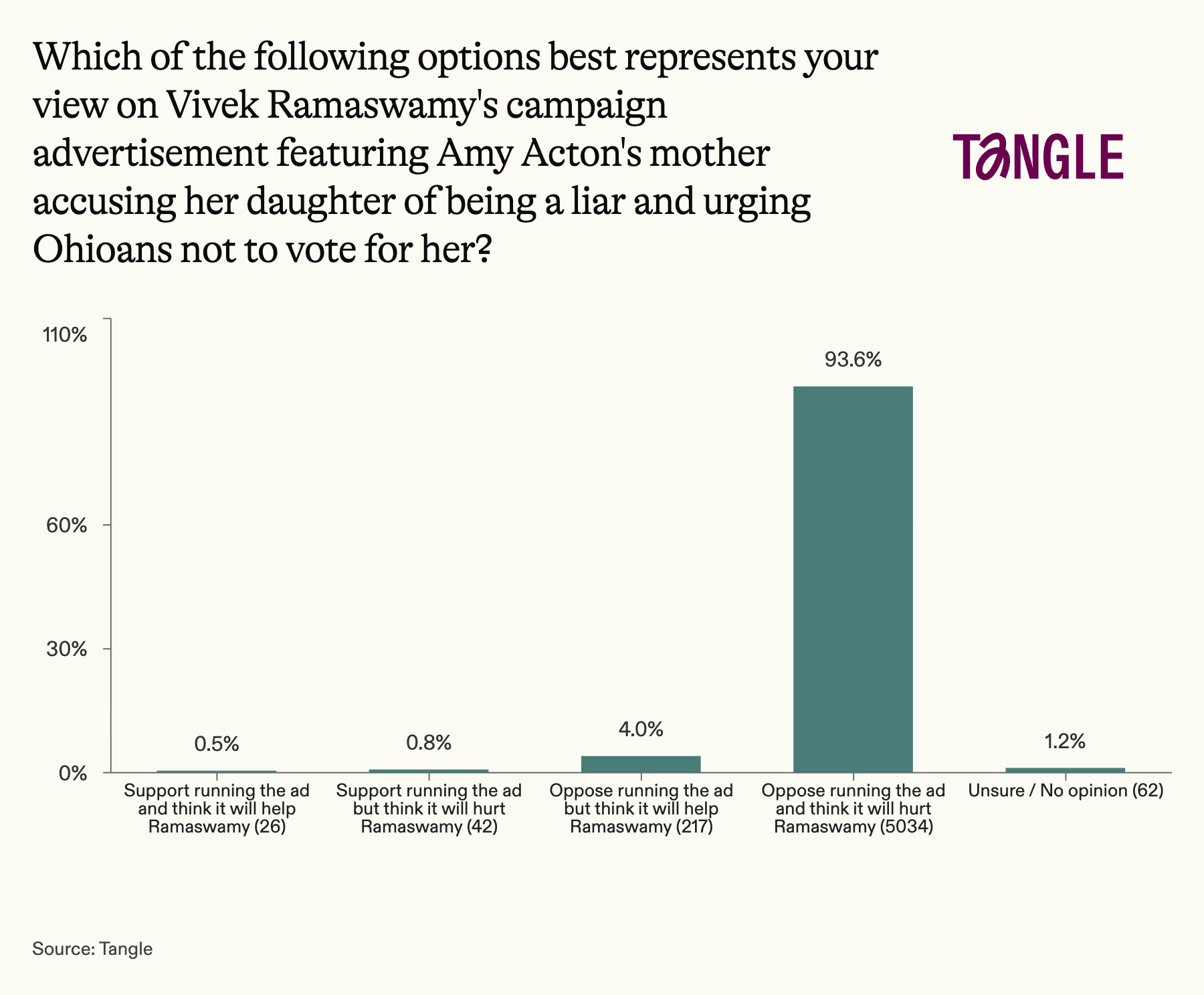
- Our last survey: 5,381 readers responded to our survey on Vivek Ramaswamy’s campaign ad featuring Amy Acton’s mother, with 94% saying they oppose running the ad and think it will hurt Ramaswamy. “There is no excuse for any candidate to exploit a childhood tragedy of his opponent,” one respondent said. “It’s refreshing, albeit in a sad sort of way, to see that perhaps there is actually a limit to the morally defective character people are willing to tolerate,” said another.
Have a nice day.
Ahead of Halloween, Advocate Health children’s hospitals in Illinois and Wisconsin held their annual NICU Halloween Costume Contest, helping parents and newborns in intensive care units participate in the holiday. Hospital staff worked closely with parents to pull off the costumes while keeping the babies well cared for; costumes included Harry Potter, Pennywise, a spa-goer, and a lion. “You’re already worried, and you’re trying to be there for your kid,” one parent said. “So, when you have a contest with him, it makes you forget that you’re in the NICU.” People has the story (and pictures).