


















Signup for the free Tangle Newsletter
Processing your application
Please check your inbox and click the link to confirm your subscription.
There was an error sending the email
A stylized graphic of a person walking with a briefcase, a person in graduation attire, and a family of three

Is the global fertility decline a crisis?

What an aging population and fewer young people could mean.

Various Trending Posts this week

CMS Administrator Dr. Mehmet Oz and Vice President JD Vance in the Eisenhower Executive Office Building — September 22, 2026
House Minority Leader Hakeem Jeffries (D-NY) stands behind Speaker of the House Mike Johnson (R-LA) | Tom Williams/CQ Roll Call/Sipa USA, edited by Russell Nystrom
AP Photo/Matt Slocum, edited by Aidan Gorman

Is President Trump okay?

I asked the same question about Biden in 2021.

Members-only posts

A stylized graphic of a person walking with a briefcase, a person in graduation attire, and a family of three

Is the global fertility decline a crisis?

What an aging population and fewer young people could mean.
AP Photo/Matt Slocum, edited by Aidan Gorman

Is President Trump okay?

I asked the same question about Biden in 2021.
Graphic by Candida Hall and Aidan Gorman

Donald Trump

AP Photo/Matt Slocum, edited by Aidan Gorman

Is President Trump okay?

I asked the same question about Biden in 2021.
A USPS Collection Box next to a Snohomish County ballot drop box in Bothell, Washington | M. Scott Brauer/ZUMA Press Wire
President Donald Trump and UFC CEO Dana White during the "UFC Freedom 250" event | SAUL LOEB/Pool via REUTERS

Daily From the Newsletter

A stylized graphic of a person walking with a briefcase, a person in graduation attire, and a family of three
Mississippi State quarterback Kamario Taylor throws a pass against South Carolina
CMS Administrator Dr. Mehmet Oz and Vice President JD Vance in the Eisenhower Executive Office Building — September 22, 2026
House Minority Leader Hakeem Jeffries (D-NY) stands behind Speaker of the House Mike Johnson (R-LA) | Tom Williams/CQ Roll Call/Sipa USA, edited by Russell Nystrom
Tangle founder Isaac Saul (left) and Editor-at-Large Kmele Foster (right) chatting during a team retreat in Maine. Photo: Michele Teodori
Chinese President Xi Jinping and U.S. President Donald Trump at Joint Base Andrews in Maryland | REUTERS/Jonathan Ernst, edited by Russell Nystrom
Winchester College chapel buttresses, 1980s | Mark Draisey, edited by Candida Hall
AP Photo/Matt Slocum, edited by Aidan Gorman
An illustration showing vials of Ozempic and a syringe | Science Photo Library
President Donald Trump, Danish Prime Minister Mette Frederiksen, and Greenlandic Prime Minister Jens-Frederik Nielsen at a signing ceremony in New York City
CNN correspondent Kaitlan Collins reports from the briefing room at the White House on Jan. 28, 2025
The Bab el-Mandeb Strait connecting the Red Sea to the Gulf of Aden as seen from the orbiting Gemini-11 spacecraft | NASA

Get daily articles in your inbox.

Tangle - unbiased news for busy people.
Processing your application
Please check your inbox and click the link to confirm your subscription.
There was an error sending the email

From YouTube

How Jack Smith’s Basketball “Scandal” Fell Apart
The Jack Smith Revelation Nobody's Talking About
Jack Smith Was Accused of Perjury Over THIS?
The Problem With Hasan Piker’s US vs al-Qaeda Comparison
When a Parent’s Values Clash With a Child’s Education
Why the Iran War Will Drag Past the Midterms
Can Trump End the Iran War Before the Midterms?
“You shouldn’t be here!” Trump singles out CNN, Kaitlan Collins on his way to address UN.

Topics

President Donald Trump

SCOTUS

55

Iran

38

President Donald Trump

Joe Biden

151

United States President Joe Biden

Israel

68

United States Congress

SCOTUS

55

Tired of one-sided political news? Get a 360-degree view of the biggest stories.

Political news is broken. We’re fixing it. We're a non-partisan politics newsletter that gives you a 360-degree view on the news. No spin. No clickbait. Opinions from the left, right, and center so you can decide. Join over 500,000 independent thinkers in 55+ countries. Unbiased news for busy people.

500,000+ subscribers reading today.

500,000+ subscribers and growing daily

Busy folks who want clear, unbiased news.

99% of our subscribers keep coming back

Less than 1% of readers unsubscribe.

Awarded “Center” Media Bias Rating

Rated Center by AdFontes and Allsides.com

4 Free and 2 member newsletters weekly

A consistent set of news and reader content.

You will always get:

What the left is saying What the right is saying Tangle's take on the story

Is the global fertility decline a crisis?

By Audrey Moorehead • Oct 2, 2026
View in browser A stylized graphic of a person walking with a briefcase, a person in graduation attire, and a family of three

In June of this year, Syracuse University — a private New York college known for its top-tier graduate programs and storied men’s basketball team — announced that it was on track to miss its enrollment targets for fall 2026. Undergraduate tuition makes up the bulk of the university’s revenue, and as a result of the enrollment shortfall, Chancellor J. Michael Haynie said the university would consider reworking programs and downsizing staff.

Haynie cited a multitude of factors for the drop in new students, including tightening foreign visa programs. But he also framed it in the context of a long-anticipated decline in U.S. higher education enrollment — a decline not brought on by rising prices, changing attitudes or fewer visa students, but something simpler, stickier and maybe more surprising: a baseline decline in the number of college-aged Americans. 

Higher education experts have expected an “enrollment cliff” based on this decline since at least 2016, when K–12 school class sizes were already decreasing. In 2024, the Western Interstate Commission for Higher Education (WICHE) predicted that the number of high school graduates would peak in 2025 and decline through at least 2041. Fast-forward to this June, and the announcement from Syracuse led some to declare that we had finally reached the “demographic cliff.”

They might be right: The enrollment decline presents a major challenge, already causing universities to cut programs, lay off staff, and in some cases shut their doors. Combined with other headwinds academic institutions are facing, the U.S. higher education system will almost certainly look radically different 20 years from now than it does today. But while the demographic cliff is hitting colleges and universities hardest right now, its impacts won’t be constrained to education. An aging population, fewer young people, and eventually a declining overall population will have major effects on a world that relies on younger populations for economic output.

Amid all this, a serious debate has emerged over the birth rate decline in the United States. These debates have only intensified in recent years, with the rise of the pro-natal movement both within and outside of the Trump administration. And as with nearly all public policy issues in our polarized era, concern around the issue has immediately become hyperpoliticized.

This bifurcated response does a disservice to an issue that deserves serious attention. Because the fertility rate is declining, and that decline will impact all of us — and soon. The question, then, is what we should do.

The data.

While most of us likely think of fertility as a person’s ability to have children, fertility is also a demographic term that refers to the number of births a woman actually has. From there, demographers use a few different metrics to parse fertility data.

The general fertility rate (GFR) measures the total number of births per 1,000 women of childbearing age in a given place. GFR is useful for its simplicity and immediacy — by looking at the GFR in New York City over the past five years, for example, policymakers can anticipate early education costs and attempt to design maternal care policies. But GFR isn’t useful as a predictive measure for future births because it cannot account for how other demographic factors, like the age distribution of the women in the cohort, affect the number of births.

Some demographers have recently begun using more specialized fertility metrics to predict population change. The effective fertility rate (EFR) accounts for the number of children who survive into adulthood, and the completed fertility rate (CFR) measures the average number of children women have had by the end of their childbearing years. EFR gives a fuller understanding of historical trends in various locations; CFR provides a more comprehensive understanding of a given generation’s fertility trends.

The most commonly used term, and the one you’ve likely seen if you read about fertility casually, is the total fertility rate (TFR). TFR measures the average number of children that a woman will have over her childbearing years (usually defined as ages 15–49), based on current birth trends. Researchers bucket women into five-year age bands — 15–19, 20–24, etc. — and use that information to create a weighted average for the number of children each woman will have throughout her life. 
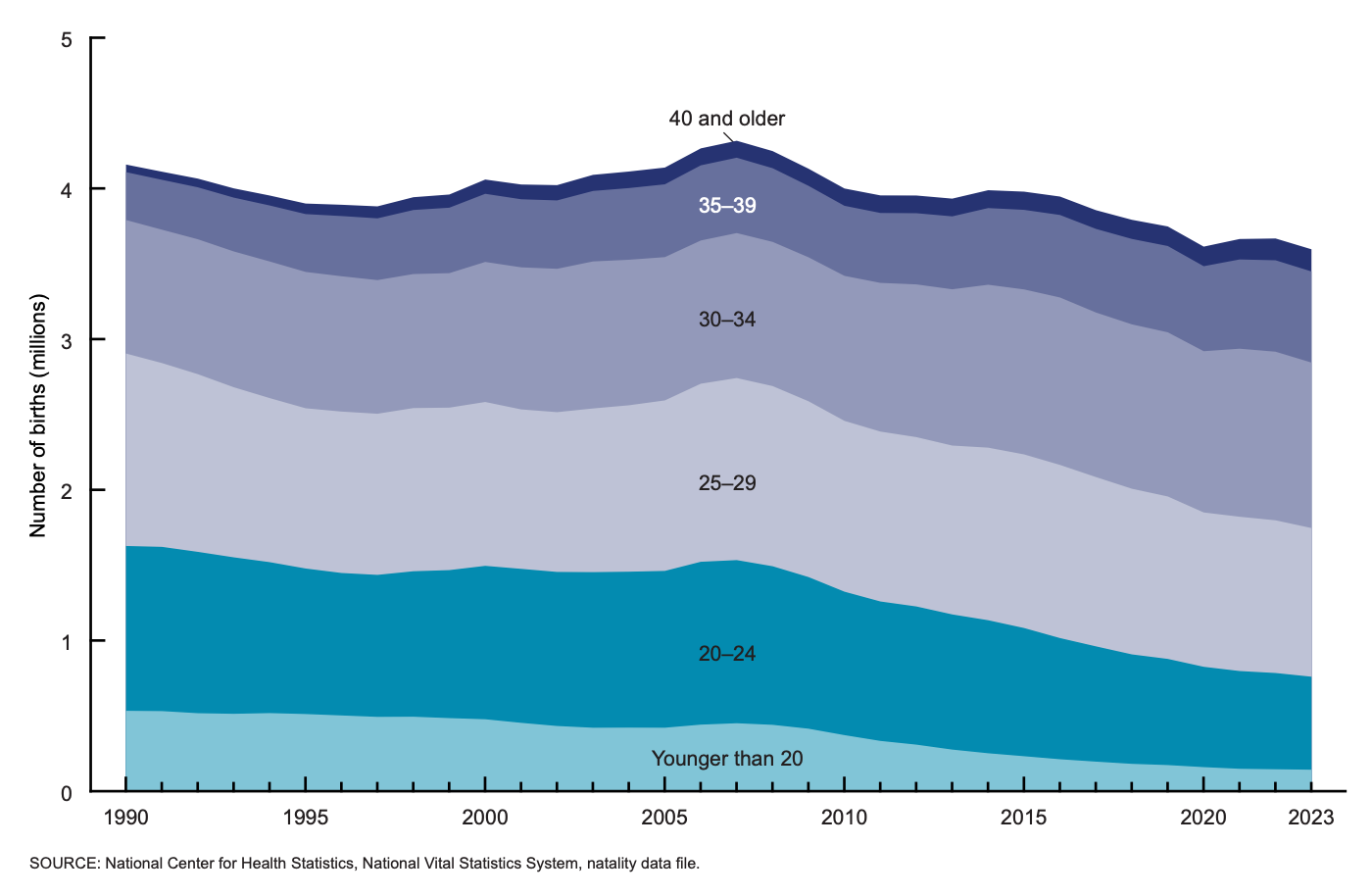
Number of births, by maternal age group: United States, 1990–2023
Number of births, by maternal age group: United States, 1990–2023 | National Vital Statistics Report, CDC, March 2025

Finally, you might also have heard the term “replacement-level fertility rates,” which usually refer to the number of children the average woman must have to keep the population level exactly constant. In developed countries like the United States, the replacement rate is usually 2.1 births per woman. It’s slightly above two to account for children who don’t survive to adulthood; nations with a higher child mortality rate have a correspondingly higher replacement rate. Notably, the replacement rate doesn’t actually describe whether or not a population is growing — a population that’s reproducing at a rate lower than replacement could still grow, especially if mortality rates are low, healthcare access is good, and immigration is high. However, replacement rates are useful for determining whether a population might eventually start shrinking.

According to United Nations data, the global fertility rate is 2.2 children per woman. The countries with the highest fertility rates are mostly African countries — Chad, Somalia, the Democratic Republic of the Congo, and the Central African Republic sit at 6.0 births per woman — while the regions with the lowest are Macao and South Korea, at 0.6 and 0.7 births, respectively. The United States, meanwhile, has a TFR of 1.6. The numbers vary from country to country, but consistent across the data is a simple fact: The fertility rate is in decline, both in the United States and around the world.

What do we do?

To calibrate a response to the fertility crisis, three questions immediately arise: What does it actually mean that fertility is declining? Why is it in decline? And can — or should — we try to reverse it?

What subscribers are saying:

"The Tangle newsletter is my favorite email of the day. When it arrives, I stop what I'm doing and dive in. For the first time in a long time I enjoy reading the news again."

Jennifer, Paducah, KY

"Dangerously close to becoming the highlight of my day."

Pranav, New York, NY

"Ike Saul's bipartisan newsletter is so worth the subscription. I am always genuinely excited when it hits my inbox."

Jill Thaw Senior Editor for The Athletic

"All those hours and all that work have resulted in something special."

Cate Matthews Senior Editor for TIME Magazine

"The only newsletter I'm reading daily."

Brendan, Madison, WI

"Most of my news consumption makes me feel like I'm getting yelled at. Tangle reduces the temperature and gives me information in a relaxed, level-headed way from a variety of perspectives. It's pretty rare that reading the news makes me calmer. But Tangle makes me calmer. It makes me feel like I can take a breath."

Will Leitch Founding Editor of Deadspin, a contributing editor at New York Magazine

“Tangle is restoring my trust in news and media. Any good argument looks at both sides. Any good news source looks at both sides and digests an objective viewpoint for its viewers. Tangle does this in every report.”

Alexis, Kansas City, Kansas

“Tangle helps me be a better citizen -- understanding the facts of the day's most pressing issue, understanding it from multiple perspectives, and learning about issues that might otherwise slip by me. It's my daily must-read.”

Sean McComb 2014 National Teacher of the Year

“My favorite read of the day. Tangle is reflective, nuanced, and self-aware. It challenges my beliefs and broadens my horizons. Reading Tangle makes me feel better informed about the country and world.”

Adam, San Francisco, California

"A smart political newsletter that's heavy on reader interaction and answering questions, and adds a dose of positivity to the political grind.”

Jonathan Tamari National politics reporter for The Philadelphia Inquirer

“As a right-leaning, Libertarian, Trump supporter I catch myself only listening to ideas I want to believe. I find the Tangle arguments that lean left are well reasoned and thought out, allowing me to broaden my thought processes.

Todd, Manchester, NH

"I truly believe that the more people read Tangle News, the less polarized and contemptuous of each other we’d be."

Zach Elwood Author of How Contempt Destroys Democracy