





Happy Wednesday, Tangle readers. This is Associate Editor Carina Pacheco, and while it’s a picturesque early fall day here on the East Coast — sunny and clear with just a hint of chill in the air — today’s edition is taking us somewhere much chillier: to the Arctic island of Greenland.
In addition to the freshly inked deal between the U.S., Denmark and Greenland, we have an under-the-radar story about AI air-traffic control and a heroic ten-year-old.
It's a 12-minute read.
Ari Weitzman, Isaac Saul, Will Kaback, Russell Nystrom, Isaac Wood, Audrey Moorehead, and Bailey Saul edited or contributed to today’s newsletter.Too busy to read? Push play instead!

Quick hits.
- In a speech to the United Nations General Assembly, President Donald Trump said he is weighing whether to “annihilate the Islamic Republic and do it quickly, never giving them a chance to kill and destroy people and countries again.” He also said he believes Iran will strike a deal with the U.S. to end the war after the midterms. (The speech)
- Vice President JD Vance and Centers for Medicare and Medicaid Services Administrator Mehmet Oz announced that the Trump administration has canceled approximately 750,000 people’s coverage under Affordable Care Act healthcare plans, alleging that they were improperly enrolled in the healthcare marketplace. (The announcement)
- President Trump announced his support for a ban on U.S. diesel exports as fuel prices continue to rise. (The proposal)
- Sen. John Curtis (R-UT) called on the Senate Judiciary Committee to subpoena Donald Trump Jr. and Hunter Biden to testify about their business activities and connections to foreign entities. The request follows reports that a Russian oligarch paid for part of Trump Jr.’s wedding celebrations. (The request)
- The Justice Department indicted a former U.S. Postal Service worker who allegedly discarded roughly 300 mail-in ballots he was meant to deliver for Utah’s primaries. (The indictment)
Eight Legal Ways To Pay Off Debt Like The Rich Do (Most People Ignore #6)
The wealthy rarely pay off debt the slow way — they settle it, freeze the interest, or tap equity instead of grinding through minimum payments for years. Whether you’re buried in credit card interest, behind on taxes or sitting on home equity you haven’t touched, there’s a legal strategy built for your exact situation — and most people never get past #6, the one that combines two or three of these at once. It takes about 30 seconds to see which ones apply to you.
Today’s topic.
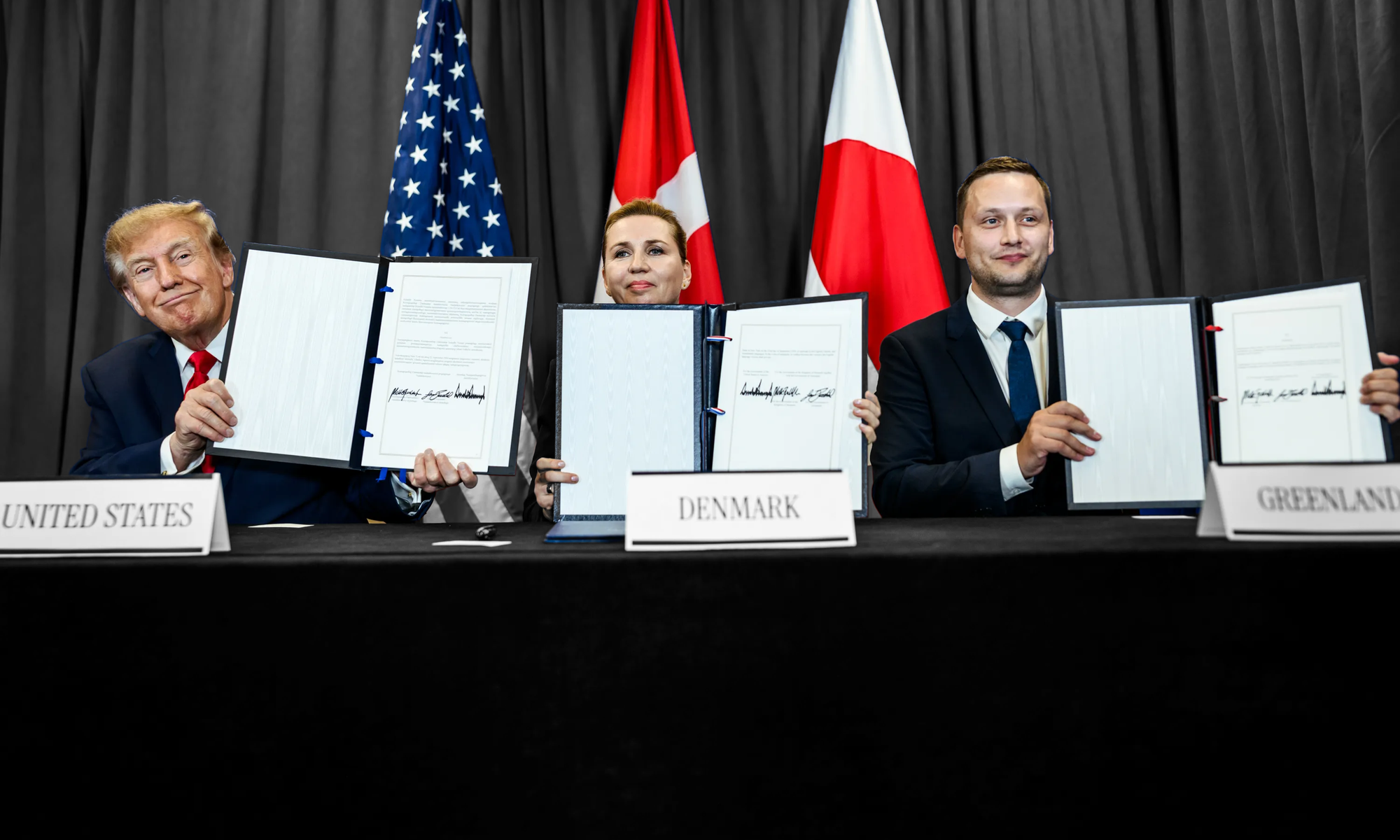
The Greenland deal. On Tuesday, President Donald Trump signed a defense agreement with Denmark and the semiautonomous territory of Greenland. The three-party compact was signed in New York City, concurrent with a United Nations General Assembly meeting, and it follows several months of statements from President Trump about the United States increasing its control over the island territory.
Back up: In his first term, President Trump proposed buying Greenland and has returned to the idea in his second, citing the territory’s vast natural resources and its strategic geographic positioning for trade and national security. In January, Trump escalated his efforts to acquire the island, explicitly declining to rule out the potential to use force and threatening to impose tariffs on European nations that opposed the move. Denmark’s and Greenland’s leaders have rebuffed the president’s efforts to acquire the territory.
Trump announced the agreement on Friday, saying on social media that it would give the United States “permanent control” over Greenland’s security and “other needs.” The deal extends the United States’s existing authority on the island, with new specifications that allow the U.S. to build more military bases and forbids any non-NATO state from military or civilian investment without U.S. approval. Additionally, the text of the deal specifies that the agreement would remain in place if Greenland declares independence from Denmark, should the territory decide to pursue it.
Denmark and the United States have had a defense agreement over Greenland dating back to 1951, which allows the U.S. to build and maintain military bases on the island, while giving Denmark sovereign control. The U.S. currently operates one base in Greenland, Pituffik Space Base in the northwest, which has roughly 150 personnel.
At the agreement’s signing, President Trump said the deal will lead to a “tremendous relationship” between the three parties. “We will have the complete ability to do what is necessary to defend the American continent and also Europe and other places,” he said. “No U.S. adversary will ever be permitted to establish a military presence in Greenland anymore.”
Critics of the deal said that President Trump incurred significant diplomatic costs in pursuing the agreement. Torrey Taussig of the Atlantic Council said it is “unlikely to quiet concerns European allies have over America's broader commitment to [NATO].”
We’ll get into what the left and right are saying about the deal below. Then, Associate Editor Carina Pacheco gives her take.
|
What the left is saying.
|
In USA Today, Chris Brennan suggested the president “could’ve had this Greenland agreement all along.”
“As always, Trump's announcement ran long on bluster and short on details. Here's the part he left out — everything Trump now claims as a win was available to him 20 months ago on the very first day of his second term,” Brennan wrote. “It was also available for Trump during his first term, when he floated the idea of buying Greenland before threatening to take it by force in his second term after his threats were rebuffed by Greenland and Denmark.
“Greenland and Denmark have existing, non-expiring security agreements and treaties that have always allowed for an American military expansion in Greenland, the world's largest island, which has significant strategic value in the Arctic Circle,” Brennan said. “Trump's rhetoric about Greenland has been all braggadocio and bombast. That has destabilized America's relationship not just with Greenland and Denmark but across Europe and around the world… Trump is trying to sell an embarrassment as a win.”
In The Atlantic, Isaac Stanley-Becker said the deal “appeared to satisfy all parties but came at a great cost.”
“The promised ‘future deal’ appears to be here. It builds on a Cold War agreement between the U.S. and Denmark and includes no transfer of territory to the United States,” Stanley-Becker wrote. “Instead, it envisions the kind of expanded U.S.-military access and multilateral cooperation that leaders from Denmark and Greenland said was available all along, and doesn’t threaten to blow up the security architecture that the U.S. has helped maintain for nearly 80 years.”
“The new agreement will also include Greenland and bind all three parties to a more permanent U.S. presence,” Stanley-Becker said. “[Statements from Greenland and Denmark leaders] were positive but restrained, reflecting the pain inflicted by this saga. Europeans found it difficult to decipher Trump’s motives — or to understand whether they were about to be attacked or simply trolled… Washington may have achieved its security objectives. But it has lost something else: trust among its hosts.”
The Economist argued “the harm has been done.”
“The arctic is a safer place for America and its allies today. Due credit must go to President Donald Trump,” the writer said. “In these cynical times, it is a relief when war-talk turns out to be bluster, but not grounds for a medal. By Mr. Trump’s own previously stated standards, the deal falls short… He has settled for what amount to reworded lease terms, with demands for ownership quietly dropped. Mr. Trump calls the new agreement a ‘dream come true’ for America, which he says now controls Greenland’s security and ‘all other needs’ in perpetuity.
“There will be no cost to America as it develops a ‘large military presence’ in Greenland, he adds. It remains unclear what he means by that, for Denmark, a country of 6 million people, is not about to foot the whole bill for America’s Arctic garrison,” the writer said. “America’s desire for Arctic bases (and Europe’s need for American help to deter Russia) resolved this particular presidential tantrum. But gibes asking why America should defend foreign soil cannot be unsaid. The transatlantic bond is growing colder and far more transactional. Mr. Trump wanted Greenland to be part of his legacy and so it will be. Just not as he imagined."
|
What the right is saying.
|
The Washington Times editorial board wrote “Trump cement[ed] his status as master dealmaker.”
“Initially, the president spoke of the United States taking over the world’s largest island. That led to accusations of gunboat diplomacy. Mr. Trump’s critics missed his modus operandi, which usually starts with the big ask and then settles for something more modest and achievable,” the board said. “Greenland’s strategic importance cannot be overstated. Control of Greenland affects control of the Arctic. Whoever controls the Arctic will probably win a future world war.”
“The deal is a win all the way around. Denmark could never hope to defend the territory from a hostile takeover bid. Greenland is vital to America’s security interests, and Greenlanders need help extracting their valuable mineral reserves. As important as getting America in is keeping Russia and China out. There can be no doubt of the hostile intentions of either nation,” the board wrote. “For either hostile power to secure a foothold in Greenland would be disastrous. Mr. Trump’s masterful deal precludes that.”
In UnHerd, Tom Rogan suggested the agreement will offer “protection against foreign threats.”
“It strongly appears that Trump has abandoned his always-foolish demand that Greenland be brought under American sovereign control. That demand was incompatible with America’s moral obligation to support the will of free peoples, and its political obligation to Nato allies,” Rogan wrote. “While this concord could have been reached with far less acrimony earlier in the Trump administration (existing agreements with Denmark already grant the US military extensive access to Greenland), it still represents a positive development.
“There is no question, after all, that Russia and China pose significant and growing threats in the Arctic High North. These nations seek to exploit the region’s natural resources and expand their Arctic military footprints,” Rogan said. “These ambitions are intolerable from an American perspective, and Friday’s deal helps address these concerns by facilitating a rapid, wide-ranging U.S. military buildup. That presence will boost the U.S. military’s freedom of action and increase Nato deterrence credibility… This agreement provides a mutually beneficial resolution to a contentious issue.”
National Review’s editors called the saga “Trump’s costly Greenland play.”
“To be clear, Trump was right about one big thing: that Greenland merited much more attention than it had been getting… The island is a potential back door through U.S. defenses and a key North Atlantic vantage point,” the editors wrote. “Given the limited resources Denmark has at its disposal to defend Greenland, an agreement to upgrade the U.S. presence needed doing… Asking politely to upgrade the existing agreement might well have delivered just that — and done so without creating all the geopolitical self-harm.
“Unfortunately, Trump went about defending the U.S. strategic interest in a different way, and that was the wrong way. The core of the problem has been that, despite his own nationalist instincts, the president is oblivious when it comes to the national sensitivities of others,” the editors said. “If and when an agreement is concluded, the best way to maximize its benefits to the U.S. will be to repair the diplomatic damage that this episode has caused by rebuilding a deeper relationship with Denmark and Greenland.”

- The Greenland saga is a reminder to take Trump seriously but not literally.
- We saw this with NATO, when his threats to back out successfully pushed member nations into stronger commitments.
- Now Trump has strengthened our ties with Greenland and NATO, securing a deal that improves our national security.
When President Trump announced the deal between the United States, Greenland and Denmark, I was taken aback. I’d almost completely forgotten about the semiautonomous island, but sure enough, one utterance and the memories of Trumpian threats of invasion and annexation all came flooding back.
It reminded me of a very important lesson that we’ve been hearing about the president for a long time: take Trump seriously, not literally.
Now, I admit that it would be nice to be able to take a president both literally and seriously, and to not have to guess which of his statements should be taken at face value. But alas, we live in interesting times, and the defining political character of the century is a showman by trade. If the past decade-plus has taught us anything, it’s that we have to put up with a little… drama.
This administration’s foreign policy has a recurring pattern: Trump puts out an outlandish, maximalist demand, which is met with an outsized emotional reaction from his political opponents. Behind the scenes, negotiations and deliberations ensue, and the end result is much more “normal” than the original, more absurd demand. The left decries the process that got us to the end result and laments the embarrassment they feel about our president, while Trump’s supporters focus on the wins in the deal and mock the left for overreacting. Rinse. Repeat.
To illustrate my point, let’s look at Trump’s relationship with NATO.
Trump has scrutinized the U.S.’s outsized NATO spending since the ’80s, and that rhetoric has been present in each of his presidential campaigns. He charged other member nations with “ripping off” the U.S. with delinquent payments and even hinted at the possibility of not defending NATO allies if they hadn’t “fulfilled their obligations.” He doubled down on that possibility during his first term, and even suggested that he would withdraw the U.S. from the alliance (which would require approval from Congress).
Trump’s grievances are well founded: The U.S. has been financing the alliance’s defenses at disproportionate levels, accounting for approximately 66% of total NATO spending in 2024. Of course, that’s partially due to our significantly larger economy, but many member nations have historically skimped on the 2014 pledge to contribute at least 2% of their GDP. I’m speculating here, but I’m sure our media-focused president wasn’t taking too kindly to allies criticizing him in the press, bragging about their national social safety nets, then relying on the good old American military safety net for their continental security. If I were Trump, I’d be pretty sick of the geopolitical version of “for breakfast we’ll do something cool like have a cigarette then like a bar of chocolate, then we go to work for like one half hour, two half hour” — especially when my country’s taxpayers were subsidizing their national security.
In his second term, Trump continued a campaign of rhetoric against his NATO allies. He publicly criticized low-spending members, leveraged his threats to not honor NATO's collective defense principle, and teased withdrawing from the alliance completely. By last year, all 32 members had complied. This is no small feat, considering that only five members met the 2% target in the last pre-Trump year of 2016 (and only 11 met it in 2023, the year following Russia’s invasion of Ukraine). At the 2025 NATO Summit, the alliance formally adopted a 5% of GDP target for 2035 — also a Trump proposal.
I suspect Trump’s threats to leave NATO were a negotiating tactic and not something he’d ever follow through on; nor do I think the U.S. would ever fail to come to the aid of an ally. But the upside of Trump’s maximalist strategy is that you never really know, which makes him a difficult but imposing negotiating partner. This maximalist strategy has certainly bruised some relationships and garnered plenty of negative press that the president might pay for politically, but with NATO he got what he wanted: a stronger shared defense budget. So the two worst-case outcomes were avoided; we’re still in NATO, and everyone is contributing more money. Kumbaya, right?
Trump proved that his maximalism and unpredictability are powerful forms of leverage. And that leverage is heightened further by the sensationalist tendencies of the mainstream media, which often ignores the contextual pattern that any clear-eyed Trump-watcher could see coming a mile away. I understand this dynamic creates tension for the media whose job it is to report on the president, but how many more examples are required to understand how Trump operates? I liken his approach to an angry teenager slamming the door and yelling, “I’m running away!” — it’s always less of an actual plan and more of an opening bid designed to extract maximum concessions. Treating Trump's theatrical tendencies as incompetence and lunacy misses most of the story.
That brings us back to Greenland — that big, beautiful icy island with its wonderful colorful houses and immensely strategic geopolitical positioning.
Trump had shown interest in Greenland in his first term, but American presidential interest in acquiring the territory dates back to at least 1946. Just after the Second World War and at the start of the Cold War, President Harry S. Truman proposed buying Greenland outright. Denmark promptly rejected his $100 million offer.
The island is the last piece of the puzzle that encircles the Arctic, along with North America, Northern Europe, and Russia. It sits at a vital marine intersection and is rich in rare earth minerals. Russia and China are striving to assert dominance in the Arctic by developing military bases, research ships and energy initiatives in the region, edging up against Alaska, Scandinavia, and Greenland.
In late 2024, then-President-elect Trump declared that “the ownership and control of Greenland is an absolute necessity” for “National Security and Freedom throughout the World.” Then, in the first joint address to Congress of his second term, Trump did not mince words when he said that the U.S. will achieve that control “one way or the other.” A few months later, Trump refused to rule out the use of military force.
The media — as well as the leaders of Greenland, Denmark, and NATO — took Trump very literally.
And of course, when taken literally, the threats — to invade a sparsely populated ally that’s also technically a member of NATO — were bizarre. But these Trumpisms, at least to me, were transparent — a negotiation tool rather than a real threat — and I would have thought, over 10 years into the Trump era, that others, too, would learn to exercise some discretion when analyzing his Truth Social posts. Though the U.S. has owned and operated a military base in Greenland since 1951, Trump believed we needed an increased military presence to address the perceived threats from adversaries — Greenland is simply too strategically imperative to risk.
To state the obvious, Trump’s chaotic strategy was not bulletproof. He lost political capital and may, at least to the literalists, look like he “settled” for a deal he had initially approached much more aggressively. But his strategy ultimately paid off.
If we look at this deal in terms of the end result, instead of what was threatened along the way, here’s what we come to: The U.S. gets expansive, exclusive rights to stand up and expand new military installations; Greenland’s companies are promised first looks for any contracted work; and Washington wields explicit authority to approve or block foreign investments in Greenland's rare earth minerals. And if Greenland ever does become independent, the deal already approves a continuation of the U.S.–Greenland agreements and locks the new government into NATO. From the signing on Tuesday, it appears that each participant is happy with the end result, making it an even more reassuring outcome for the U.S., Greenland, Denmark, and NATO alike — but we’ll all have to suspend our disbelief when Trump doesn’t describe it modestly on Truth Social.
|
||||
|

Take the survey: What do you think of the deal? Let us know.
Disagree? That’s okay. Our opinion is just one of many. Write in and let us know why, and we’ll consider publishing your feedback.
Under the radar.
On Monday, the Federal Aviation Administration launched an initiative to leverage artificial intelligence to address protracted challenges with air-traffic control. The $875 million software overhaul will install the Strategic Management of Airspace, Routes and Trajectories (SMART) system, which will use AI to survey planned airline flights, weather, wind, and other variables to suggest flight-schedule changes to mitigate the risk of delays. SMART will first be deployed at the three major airports in the Washington, D.C. region, with plans to expand in the near future. Transportation Secretary Sean Duffy said the system will make airline operations more efficient and lower the cost of flying. Separately, the National Air Traffic Controllers Association has yet to take a stance on SMART, saying in a statement that it “has not been involved in the design, testing, or implementation of SMART and therefore cannot speak to its effect on the air traffic control workforce at this time.” NPR has the story.
Discover eight legal ways to tackle debt smarter
Stop wasting years on minimum payments. Discover 8 legal debt payoff strategies, including the one most people miss: combining multiple strategies to save time and money.
→ See which strategies could apply to you.
The extras.
- One year ago today we covered the Trump administration’s new H-1B visa requirements.
- The most clicked link in our last regular newsletter was our special deal for Tangle members with Incogni.
- Nothing to do with politics: Take a look inside the newly opened Lucas Museum of Narrative Art.
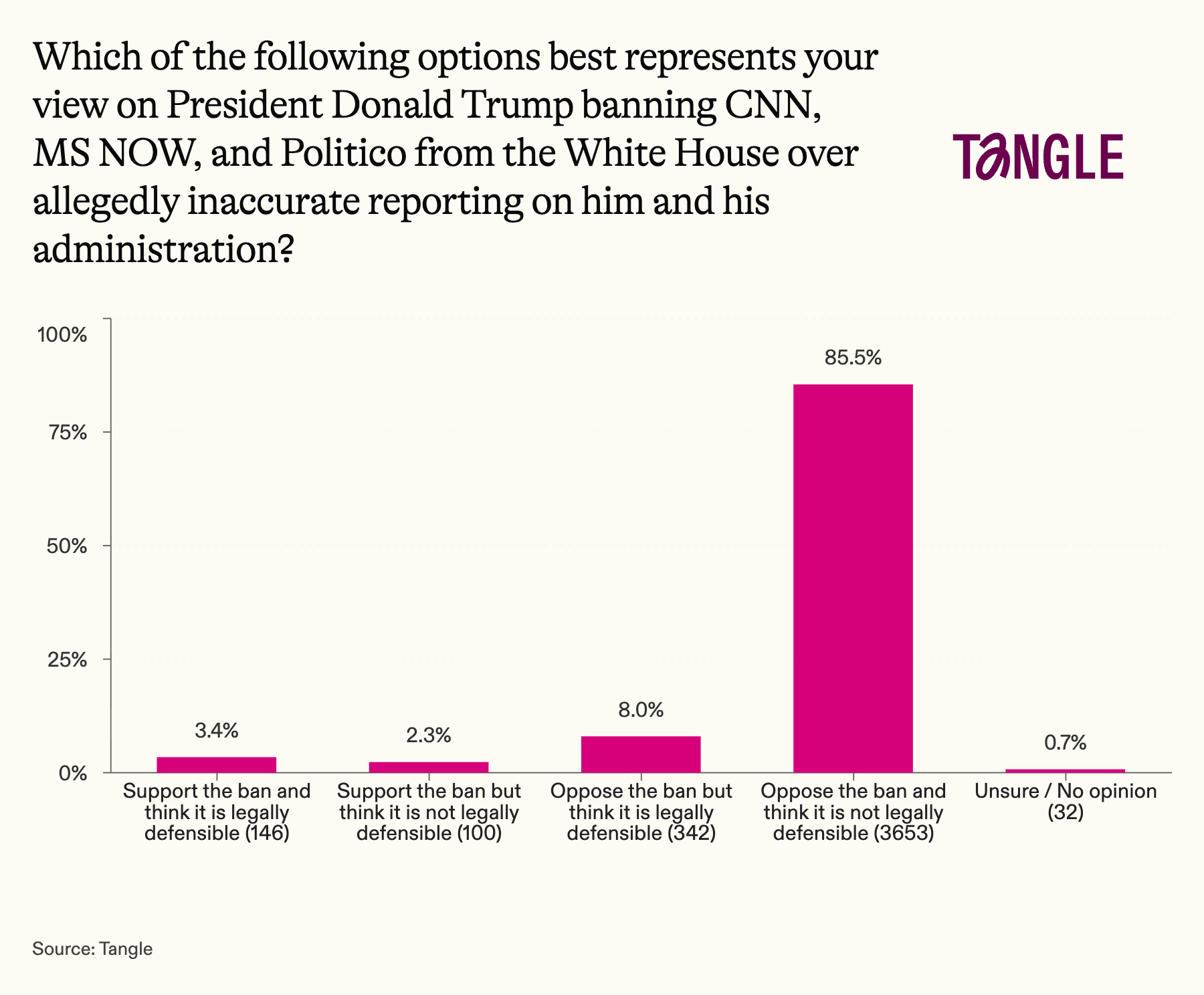
- Our last survey: 4,273 readers responded to our survey on President Trump banning CNN, MS NOW, and Politico from the White House, with 85% saying they oppose the ban and do not think it’s legally defensible. “It’s about as authoritarian and un-American as you can get,” one respondent said. “MSM brought this on themselves by reporting half-truths or flat-out lying about things,” said another.
Have a nice day.
On September 16, Major Metzger received a Carnegie Medal, North America’s highest honor for civilian heroism, in recognition of his actions during a dangerous ski lift incident last year. Metzger, now 10 years old, was enjoying a day at the slopes with his six-year-old friend Bryce Rader when Rader suddenly began slipping off his seat on the ski lift. Metzger grabbed his friend before he fell, and his two-handed grasp became the only thing separating Rader from a 16-foot fall. Ski mountain employees arrived about four minutes later and rescued the child, but Metzger kept hanging on until they did. “Major is just an outstanding young man,” Bruce Rader, Bryce’s father, said. “He’s brave to be able to do what he did on such short notice, immediately. He saved my son’s life.” WAVY has the story.
Member comments