Note: You are reading a preview of a members-only Friday edition. To read it in full, you’ll be asked to subscribe.
In June of this year, Syracuse University — a private New York college known for its top-tier graduate programs and storied men’s basketball team — announced that it was on track to miss its enrollment targets for fall 2026. Undergraduate tuition makes up the bulk of the university’s revenue, and as a result of the enrollment shortfall, Chancellor J. Michael Haynie said the university would consider reworking programs and downsizing staff.
Haynie cited a multitude of factors for the drop in new students, including tightening foreign visa programs. But he also framed it in the context of a long-anticipated decline in U.S. higher education enrollment — a decline not brought on by rising prices, changing attitudes or fewer visa students, but something simpler, stickier and maybe more surprising: a baseline decline in the number of college-aged Americans.
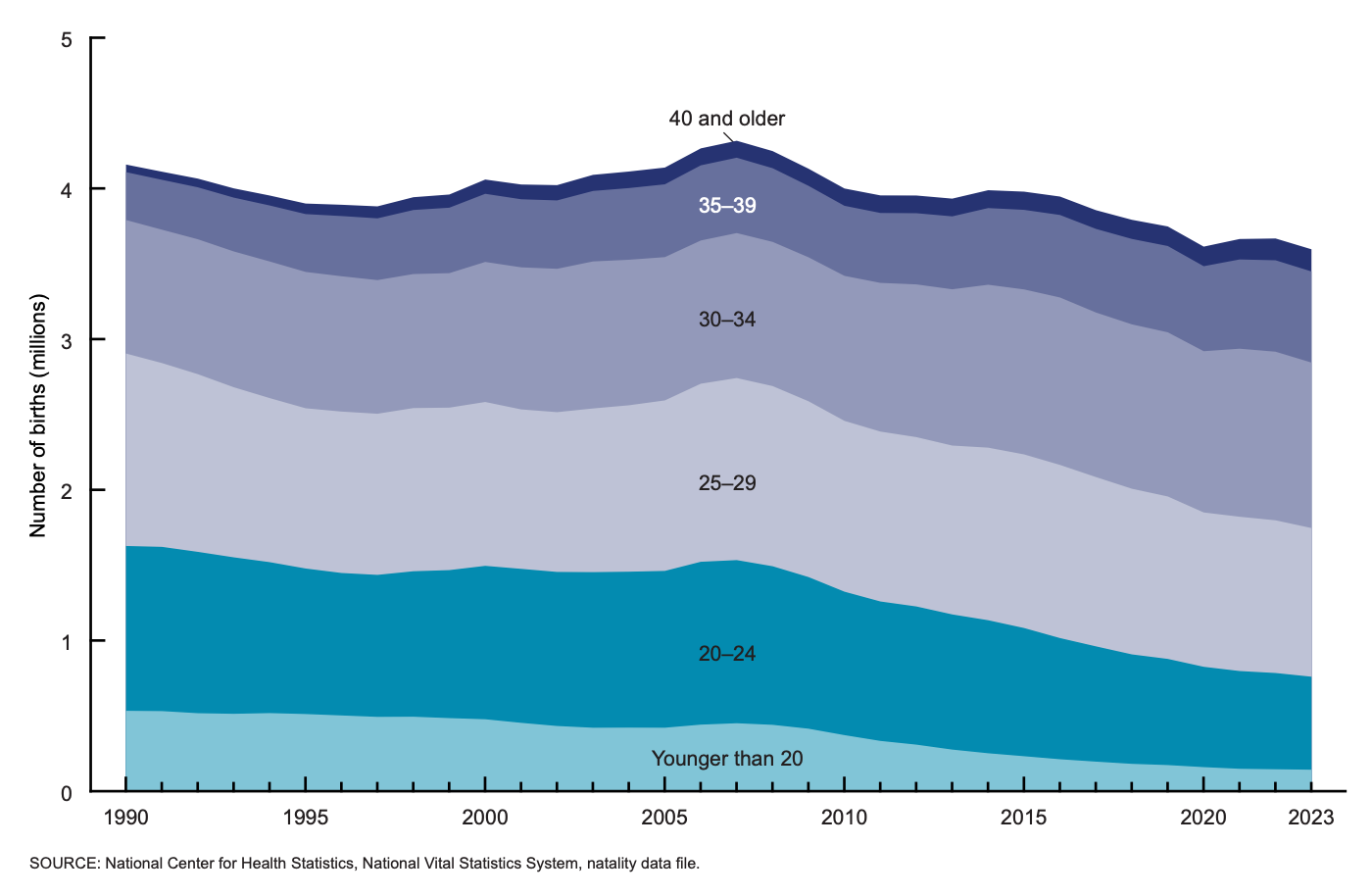
Higher education experts have expected an “enrollment cliff” based on this decline since at least 2016, when K–12 school class sizes were already decreasing. In 2024, the Western Interstate Commission for Higher Education (WICHE) predicted that the number of high school graduates would peak in 2025 and decline through at least 2041. Fast-forward to this June, and the announcement from Syracuse led some to declare that we had finally reached the “demographic cliff.”
They might be right: The enrollment decline presents a major challenge, already causing universities to cut programs, lay off staff, and in some cases shut their doors. Combined with other headwinds academic institutions are facing, the U.S. higher education system will almost certainly look radically different 20 years from now than it does today. But while the demographic cliff is hitting colleges and universities hardest right now, its impacts won’t be constrained to education. An aging population, fewer young people, and eventually a declining overall population will have major effects on a world that relies on younger populations for economic output.
Amid all this, a serious debate has emerged over the birth rate decline in the United States. These debates have only intensified in recent years, with the rise of the pro-natal movement both within and outside of the Trump administration. And as with nearly all public policy issues in our polarized era, concern around the issue has immediately become hyperpoliticized.
This bifurcated response does a disservice to an issue that deserves serious attention. Because the fertility rate is declining, and that decline will impact all of us — and soon. The question, then, is what we should do.
The data.
While most of us likely think of fertility as a person’s ability to have children, fertility is also a demographic term that refers to the number of births a woman actually has. From there, demographers use a few different metrics to parse fertility data.
The general fertility rate (GFR) measures the total number of births per 1,000 women of childbearing age in a given place. GFR is useful for its simplicity and immediacy — by looking at the GFR in New York City over the past five years, for example, policymakers can anticipate early education costs and attempt to design maternal care policies. But GFR isn’t useful as a predictive measure for future births because it cannot account for how other demographic factors, like the age distribution of the women in the cohort, affect the number of births.
Some demographers have recently begun using more specialized fertility metrics to predict population change. The effective fertility rate (EFR) accounts for the number of children who survive into adulthood, and the completed fertility rate (CFR) measures the average number of children women have had by the end of their childbearing years. EFR gives a fuller understanding of historical trends in various locations; CFR provides a more comprehensive understanding of a given generation’s fertility trends.
The most commonly used term, and the one you’ve likely seen if you read about fertility casually, is the total fertility rate (TFR). TFR measures the average number of children that a woman will have over her childbearing years (usually defined as ages 15–49), based on current birth trends. Researchers bucket women into five-year age bands — 15–19, 20–24, etc. — and use that information to create a weighted average for the number of children each woman will have throughout her life.
Finally, you might also have heard the term “replacement-level fertility rates,” which usually refer to the number of children the average woman must have to keep the population level exactly constant. In developed countries like the United States, the replacement rate is usually 2.1 births per woman. It’s slightly above two to account for children who don’t survive to adulthood; nations with a higher child mortality rate have a correspondingly higher replacement rate. Notably, the replacement rate doesn’t actually describe whether or not a population is growing — a population that’s reproducing at a rate lower than replacement could still grow, especially if mortality rates are low, healthcare access is good, and immigration is high. However, replacement rates are useful for determining whether a population might eventually start shrinking.
According to United Nations data, the global fertility rate is 2.2 children per woman. The countries with the highest fertility rates are mostly African countries — Chad, Somalia, the Democratic Republic of the Congo, and the Central African Republic sit at 6.0 births per woman — while the regions with the lowest are Macao and South Korea, at 0.6 and 0.7 births, respectively. The United States, meanwhile, has a TFR of 1.6. The numbers vary from country to country, but consistent across the data is a simple fact: The fertility rate is in decline, both in the United States and around the world.
What do we do?
To calibrate a response to the fertility crisis, three questions immediately arise: What does it actually mean that fertility is declining? Why is it in decline? And can — or should — we try to reverse it?
This post is for paying subscribers only
Sign up now and upgrade your account to read the post and get access to the full library of posts for paying subscribers only.