






Sign up for the Free Tangle Newsletter Highly curated unbiased news for busy, open-minded people.
Processing your application
Please check your inbox and click the link to confirm your subscription.
There was an error sending the email
Voting rights activists in front of the Supreme Court during oral arguments in Louisiana v. Callais | Sue Dorfman/ZUMA Press Wire, edited by Russell Nystrom

Various Trending Posts this week

The Supreme Court on January 26, 2022 | Bryan Olin Dozier/NurPhoto, edited by Russell Nystrom
President Donald Trump speaks at a press briefing following a shooting during the annual White House Correspondents’ Dinner on Saturday | REUTERS/Jonathan Ernst, edited by Russell Nystrom
Photo by Ryan Linton, Wikimedia CommonsThe National Cathedral in Washington, D.C. | Photo by Ryan Linton, Wikimedia Commons, edited by Russell Nystrom

Not everything is Christian nationalism.

How Christians think about their politics.

Members-only posts

Soldiers help each other during the 1980 Iran–Iraq War | Bhavya Mathur, Wikimedia Commons

The Sunday — April 26

This is the Tangle Sunday Edition, a brief roundup of our independent politics coverage plus some extra features for your Sunday morning reading. What the left is doodling. What the right is doodling. Suspension of the Rules On this week’s episode, Isaac, Ari, and Kmele discuss the Virginia redistricting
Photo by Ryan Linton, Wikimedia CommonsThe National Cathedral in Washington, D.C. | Photo by Ryan Linton, Wikimedia Commons, edited by Russell Nystrom

Not everything is Christian nationalism.

How Christians think about their politics.
Photo from Jo Madnani | Edit by Candida Hall

The Sunday — April 19

This is the Tangle Sunday Edition, a brief roundup of our independent politics coverage plus some extra features for your Sunday morning reading. What the right is doodling. What the left is doodling. Suspension of the Rules On this week’s episode, Isaac, Ari, and Kmele talk about growing divides

Donald Trump

Opposition party leader Peter Magyar waves a Hungarian flag in celebration after incumbent Prime Minister Viktor Orbán conceded defeat in the country's election.
A photo of the Strait of Hormuz taken from the International Space Station
Russell Vought, director of the Office of Management and Budget (OMB), in front of the White House on July 7, 2025 | Al Drago/Pool/Sipa USA, edited by Russell Nystrom

Daily From the Newsletter

Voting rights activists in front of the Supreme Court during oral arguments in Louisiana v. Callais | Sue Dorfman/ZUMA Press Wire, edited by Russell Nystrom
The Supreme Court on January 26, 2022 | Bryan Olin Dozier/NurPhoto, edited by Russell Nystrom
Acting U.S. Attorney General Todd Blanche speaks as FBI Director Kash Patel stands by his side during a press conference | REUTERS/Annabelle Gordon, edited by Russell Nystrom
President Donald Trump speaks at a press briefing following a shooting during the annual White House Correspondents’ Dinner on Saturday | REUTERS/Jonathan Ernst, edited by Russell Nystrom

Sunday Special Edition

Members-only - Get Access

This is the Tangle Sunday Edition, a brief roundup of our independent politics coverage plus some extra features including reader additions for your Sunday morning reading.

Soldiers help each other during the 1980 Iran–Iraq War | Bhavya Mathur, Wikimedia Commons
Photo by Ryan Linton, Wikimedia CommonsThe National Cathedral in Washington, D.C. | Photo by Ryan Linton, Wikimedia Commons, edited by Russell Nystrom
Signs on the April 21 redistricting referendum in Virginia | Kendall Warner/The Virginian-Pilot, edited by Aidan Gorman
New York City Mayor Zohran Mamdani and Deputy Mayor Julie Su announce the first site identified for the City's municipal grocery store program.
FBI Director Kash Patel, Lt. Gen. James Adams, Director of National Intelligence Tulsi Gabbard, Lt. Gen. William Hartman and CIA Director John Ratcliffe
USS Spruance intercepts the Iranian-flagged cargo ship Touska in the north Arabian Sea | CENTCOM/Handout via Reuters, edited by Russell Nystrom

Sunday Special Edition

Members-only - Get Access

This is the Tangle Sunday Edition, a brief roundup of our independent politics coverage plus some extra features including reader additions for your Sunday morning reading.

Photo from Jo Madnani | Edit by Candida Hall
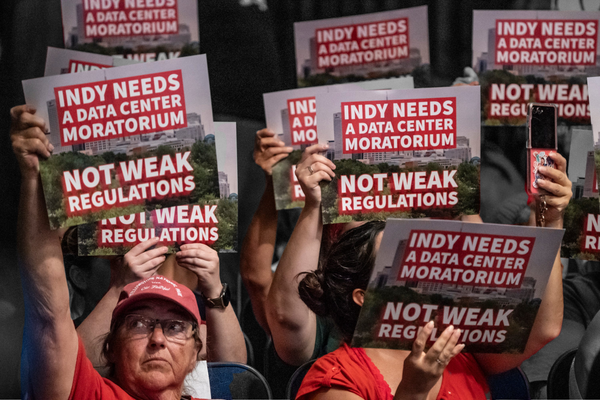
A Google engineer at a Google Data Center in 2012 | Connie Zhou/Google/ZUMAPRESS.com, edited by Russell Nystrom

Get daily articles in your inbox.

Tangle - unbiased news for busy people.
Processing your application
Please check your inbox and click the link to confirm your subscription.
There was an error sending the email

From YouTube

Security camera footage shows suspected WH Correspondents’ dinner shooter charging through security.
Trump evacuated from White House Correspondents’ Dinner after shots fired.
👉 Why Hundreds of Chinese Ships Are Off Argentina’s Coast
Trump’s Numbers Are Crashing… Now What?
Why Hundreds of Chinese Ships Are Off Argentina’s Coast
Steve Hilton: How to Fix California
Swalwell, Gonzales, and the Politics of Consequences
Are Social Media Companies Finally Being Held Accountable?

Topics

President Donald Trump

Israel

65

Iran

30

President Donald Trump

Joe Biden

149

United States President Joe Biden

Israel

65

United States Congress

Tired of one-sided political news? Get a 360-degree view of the biggest stories.

Political news is broken. We’re fixing it. We're a non-partisan politics newsletter that gives you a 360-degree view on the news. No spin. No clickbait. Opinions from the left, right, and center so you can decide. Join over 500,000 independent thinkers in 55+ countries. Unbiased news for busy people.

500,000+ subscribers reading today.

500,000+ subscribers and growing daily

Busy folks who want clear, unbiased news.

99% of our subscribers keep coming back

Less than 1% of readers unsubscribe.

Awarded “Center” Media Bias Rating

Rated Center by AdFontes and Allsides.com

4 Free and 2 member newsletters weekly

A consistent set of news and reader content.

You will always get:

What the left is saying What the right is saying Tangle's take on the story

A major SCOTUS ruling on voting rights.

By Audrey Moorehead Apr 30, 2026
View in browser Voting rights activists in front of the Supreme Court during oral arguments in Louisiana v. Callais | Sue Dorfman/ZUMA Press Wire, edited by Russell Nystrom

I'm Isaac Saul, and this is Tangle: an independent, nonpartisan, subscriber-supported politics newsletter that summarizes the best arguments from across the political spectrum on the news of the day — then “my take.”

Are you new here? Get free emails to your inbox daily. Would you rather listen? You can find our podcast here.

Today’s read: 14 minutes.

🗳️
The Supreme Court significantly weakened Section 2 of the Voting Rights Act, but stopped short of entirely striking it down. Did the Court get it right, and what effects will the ruling have?

Suspension of the Rules.

Isaac, Ari, and Kmele take on partisan gerrymandering and the Supreme Court’s decision on the Voting Rights Act in the latest episode of Suspension of the Rules. After you finish reading today’s edition diving deep on the topic, check out the latest video for more discussion — plus an exploration on the recent assassination attempt against President Trump, the White House ballroom, and a dramatic “fight me, bro” challenge issued by a former Tangle interview guest. Watch the new episode here!

Quick hits.

  1. The Federal Open Market Committee voted to keep interest rates unchanged at a range of 3.50%–3.75%, with four members dissenting from the decision. Federal Reserve Chairman Jerome Powell also said he will stay on as a board member after his term as chair expires in May, citing concern over political pressure from the Trump administration. (The updates) Separately, the Senate Banking Committee voted 13–11 along party lines to advance Kevin Warsh’s nomination to be the next Federal Reserve chairman. His nomination now heads to a confirmation vote in the full Senate. (The vote)
  2. Defense Secretary Pete Hegseth testified before the House Armed Services Committee, facing questions about the cost of the Iran war, the ongoing threat to U.S. service members, and his firing of former Army Chief of Staff Gen. Randy George. (The testimony) Separately, Acting Pentagon Comptroller Jules Hurst III told the committee that the cost of Operation Epic Fury has been approximately $25 billion, with munitions making up a majority of those costs. (The figure)
  3. The Florida legislature approved a new congressional map that is expected to net Republicans four additional seats in the U.S. House. The new map is expected to draw several legal challenges. (The map)
  4. The House voted 235–191 to reauthorize Section 702 of the Foreign Intelligence Surveillance Act for three years, sending the measure to the Senate ahead of a Thursday renewal deadline. (The vote)
  5. The House voted 215–211 to advance a budget framework that would allow the Senate to use the reconciliation process to fund Immigration and Customs Enforcement and Customs and Border Protection. (The vote)

Today’s topic.

Louisiana v. Callais. On Wednesday, the Supreme Court ruled 6–3 that Louisiana must redraw its congressional map, finding that one of the state’s majority-black districts was unconstitutionally gerrymandered based on race. The decision weakens — but does not strike down — Section 2 of the Voting Rights Act (VRA), which prohibits voting practices that discriminate on the basis of race or color. In the wake of the decision, several states could move to redraw their congressional maps based on the Court’s guidance, an effort that is expected to benefit Republicans. 

We covered oral arguments in this case in October.

Back up: Louisiana’s original congressional map (drawn after the 2020 census) included only one majority-black district. After a group of black Louisiana voters challenged the map for violating the VRA, a lower court ordered the state to draw a second majority-black district. A different group of voters then challenged the revised map, claiming it relied too heavily on race; a lower court blocked the map as an illegal racial gerrymander, although the Supreme Court allowed it to remain for the 2024 election. The Supreme Court heard oral arguments for the case in October 2025, and the Republican-appointed justices signaled that they were likely to curtail or strike down Section 2.

Writing for the majority, Justice Samuel Alito said unresolved legal questions required the Court to determine “whether compliance with the Voting Rights Act should be added to our very short list of compelling interests that can justify racial discrimination.” Alito wrote that Section 2 only dictates that minority voters have the “opportunity to elect their preferred candidate,” not that the candidate should be given advantages to increase their chances of representing that voter base.

Section 2 is violated, Alito wrote, “only when the circumstances give rise to a strong inference that intentional discrimination occurred.” As an example, he described a situation in which a state’s redistricting algorithm created several different options for majority-minority districts, and the state was unable to justify its decision not to select any of them. “By contrast,” he said, “interpreting [Section] 2 of the Voting Rights Act to outlaw a map solely because it fails to provide a sufficient number of majority-minority districts would create a right that the Amendment does not protect.”

Justice Clarence Thomas authored a concurrence joined by Justice Neil Gorsuch, writing that he would go further than Alito and hold that Section 2 “does not regulate districting at all.”

Justice Elena Kagan dissented in an opinion joined by Justices Sonia Sotomayor and Ketanji Brown Jackson. Kagan wrote that the Court had “completed [a] demolition of the Voting Rights Act,” as the decision “will effectively insulate any practice, including any districting scheme, said by a State to have any race-neutral justification. That justification can sound in traditional districting criteria, or else can sound in politics and partisanship.” Signaling her strong disagreement with the decision, she signed her opinion, “I dissent,” eschewing the traditional, “I respectfully dissent.”

In light of the Court’s ruling, Louisiana Gov. Jeff Landry (R) reportedly plans to suspend the state’s primary elections in May in order to allow state lawmakers to pass a new congressional map. 

Today, we’ll share perspectives from the right and left on the decision, followed by Associate Editor Audrey Moorehead’s take.

What the right is saying.

  • The right celebrates the ruling, arguing race-based gerrymandering is clearly unconstitutional.
  • Some praise Alito’s opinion for establishing strong new precedent.
  • Others say the Court should have struck down Section 2 entirely.  

The New York Post editorial board wrote “[the] Supreme Court signals the end of legalized race-games — hooray!”

“Sixty years ago, Congress imposed intrusive racial concerns in districting as a remedy to once-pervasive and systemic ‘state-sponsored’ discrimination that long thwarted meaningful political participation by black citizens in violation of the 14th Amendment’s equal-protection guarantees,” the board said. “But the civil-rights laws, and America’s social progress, have produced a very different country today, even in the deepest South. All the way back in 2003, in a ruling allowing some continued affirmative action, Justice Sandra Day O’Connor warned that ‘25 years from now, the use of racial preferences will no longer be necessary’ to achieve justice.”

“Note that the high court didn’t completely strike down the Voting Rights Act; it only limited obsessive government use of race when no one can point to any actual wrong to be righted: Some statistical incongruity isn’t evidence of discrimination, period,” the board wrote. “No one is pretending that racism no longer exists, nor that some official recognition of race can still be appropriate: Louisiana still can’t adopt a map that draws bizarre shapes to avoid any natural majority-minority district, for example.”

In The Wall Street Journal, Edward Blum called the decision “a blow against racial gerrymandering.”

“For decades, voting-rights litigation drifted toward a dangerous assumption: that if election outcomes didn’t roughly mirror racial census percentages, something must be legally wrong. Courts and advocacy groups increasingly treated proportional representation as a requirement. States were pressured to sort citizens by race and draw majority-minority districts to hit demographic targets,” Blum said. “The result was predictable and divisive. Gerrymandered maps split cities, counties and neighborhoods, sometimes stretching hundreds of miles to connect distant populations linked primarily by race.”

“Justice Samuel Alito’s majority opinion recognizes that the Constitution ‘almost never permits a State to discriminate on the basis of race’ and reaffirms that ‘strict scrutiny’ applies whenever governments intentionally classify citizens by race,” Blum wrote. “Equally important, the court recognized what has been obvious in modern American politics for years. In many states, race and political affiliation are heavily correlated. The court noted that litigants increasingly attempt to ‘repackage a partisan-gerrymandering claim as a racial-gerrymandering claim.’ To address this problem, the justices imposed significant new evidentiary burdens on Section 2 plaintiffs.”

In PJ Media, Matt Margolis asked “did the Supreme Court’s VRA ruling go far enough?”

“One might think that we could all agree that drawing congressional maps based solely on skin color is racist. But apparently not. The entire premise of race-based redistricting is that black voters must be grouped together to have political power — an assumption that is, at its core, deeply patronizing and racially deterministic,” Margolis said. “[Justice Clarence] Thomas didn’t mince words about the court’s prior adventures in this territory. He writes that ‘today’s decision should largely put an end to this “disastrous misadventure” in voting-rights jurisprudence.’”

“The liberal dissenters, led by Justice Elena Kagan, warned the ruling ‘renders Section 2 all but dead letter’ and accused the majority of stripping away protections for minority voters,” Margolis wrote. “What Kagan frames as a catastrophe, Thomas frames as a correction. One man’s ‘gutting of the VRA’ is another man’s return to what the law actually says. Clarence Thomas has been the most consistent, principled voice on this court when it comes to colorblind constitutionalism, and history keeps catching up to him. He’s not just a national treasure. He’s a man who has been right for decades while everyone else was still figuring it out.”

What the left is saying.

  • The left strongly opposes the ruling, suggesting the majority acted as policymakers.
  • Some say the decision effectively destroys the Voting Rights Act.
  • Others argue the ruling will have catastrophic consequences for minority voters.

The New York Times editorial board wrote “the justices acted as partisans in the voting rights ruling.”

“The Supreme Court’s decision on Wednesday on the Voting Rights Act is a mind-boggling piece of judicial overreach. Six conservative justices voted to weaken the act, in that way substituting their own judgment for that of Congress, which reauthorized the law 20 years ago with overwhelming bipartisan support,” the board said. “The effects will be significant… The officials who make the maps no longer need to worry much about whether they are sprinkling Black voters across many districts and eliminating majority Black districts.”

“It is impossible not to notice the partisan nature of the ruling. The six justices in the majority are the six nominated by Republican presidents, and they have likely made it easier for the party that chose them to hold power in Congress,” the board wrote. “The decision has eviscerated the old standard [of Section 2] because proving intent is extremely difficult. As a result, states will now be able to slice minority voters into small and powerless slivers, as long as they can claim to do so for partisan rather than racial reasons.”

In Mother Jones, Ari Berman called the ruling “a death blow to the Voting Rights Act.”

“The hypocrisy of the Roberts Court is simply astounding… In December, the Court allowed a mid-decade redistricting plan in Texas that was designed to give Republicans five more seats on Trump’s orders to go into effect despite a lower court, with the majority opinion written by a Trump appointee, finding that there was overwhelming evidence of the use of race to draw district lines and disempower people based on the color of their skin,” Berman said. “In Callais, by contrast, the court held that race could not be a factor in drawing district lines because it violated the 14th and 15th Amendments.”

“The Callais opinion is the latest in a long line of cases attacking the VRA — which has been an obsession for Chief Justice John Roberts for more than four decades,” Berman wrote. “[The] decision is much bigger than just partisan politics. The Voting Rights Act of 1965 made America a multiracial democracy. It ended an authoritarian regime in the Jim Crow South that prevented millions of people from enjoying the fundamental promise of equal citizenship under the law. With an authoritarian president now in the White House and the Voting Rights Act a dead letter, America may become a democracy in name only once again.”

In Slate, Richard L. Hasen argued “the Supreme Court’s conservatives just issued the worst ruling in a century.”

“Alito’s opinion eviscerates Section 2 as applied to redistricting. He throws out the Gingles test — while denying he is doing so — and has restored a requirement that plaintiffs prove discriminatory intent when challenging district lines. Only if a computer algorithm would protect minority voters by chance do they have a chance to win such a case. What’s worse, the state can defend their maps by claiming that they were merely engaging in partisan gerrymandering,” Hasen said. “So when, say, Louisiana goes back and eliminates many Black opportunity districts in its state, it can claim it is doing so to help Republicans, not whites. That’s an outrageous proposition given the considerable overlap between those two groups in Louisiana.”

“Alito knows exactly what he’s doing: make it seem like he’s not gutting the Voting Rights Act through technical language, turning both the statute and the Constitution on its head,” Hasen wrote. “The Supreme Court itself has shown itself to be the enemy of democracy. If and when Democrats retake control of the political branches, it will be incumbent on them not only to write new voting legislation protecting minority voters and all voters in the ability to participate fairly in elections that reflect the will of all the people. They will also have to consider reform of the Supreme Court itself.”

My take.

Reminder: “My take” is a section where we give ourselves space to share a personal opinion. If you have feedback, criticism or compliments, don't unsubscribe. Write in by replying to this email, or leave a comment.

  • We should understand the systems in place before we try to change them.
  • The VRA was originally a necessary protection against racial discrimination, but more recently, it has mostly protected us from partisan gerrymandering.
  • If we want to solve the gerrymandering problem, Congress needs to act, not the courts.

Associate Editor Audrey Moorehead: One of the central principles I use to think about politics and change over time is called Chesterton’s Fence. The premise, popularized by Catholic writer G.K. Chesterton in the 20th century, is this: Two people happen upon an unexpected fence as they’re walking along a public path. The first person wants to remove the fence as soon as possible because it blocks their ability to continue walking. The second person disagrees, saying they should investigate why the fence is there before they take it down. For instance, what if the fence is the only thing keeping out a dangerous animal? What if that animal has reproduced? To take down the fence would allow those animals access to the whole countryside, and restoring the fence later would be much harder than exercising patience today.

Of course, the fence might have been put up for a bad reason, too. Maybe someone was trying to lay an illegitimate claim to public property. Or maybe the fence’s original purpose has been served — maybe the dangerous animal died, so now the fence just blocks an empty field. In each of these cases, taking down the fence would be acceptable. But any action would still require understanding why the fence was there.

As a general rule, I exercise this principle when I think about how to go about societal change. I believe that the people who came before me usually had their reasons to structure society in specific ways, and I need to understand those reasons before I try to change society. 

Justice Elena Kagan, writing in dissent yesterday, put forward an excellent explanation of the historical necessity of the particular fence we call the Voting Rights Act (VRA). In the years following the Civil War and the failure of Reconstruction, white Americans in power (particularly in the South) systematically crushed the rights of black Americans. These white Americans put up invidious fences around voting — poll taxes, literacy tests and so on, all principles that they could claim were “race-neutral” — just so they could keep their black neighbors out. Congress, responding to the dire need for change, mandated that those fences be torn down. But the tear-down wasn’t enough. As Justice Kagan noted, “there seemed an endless number” of new, facially race-neutral principles that in practice barred black Americans from exercising their rights. Thus, the VRA was built: a fence that ensured Congress and the courts could have a legal remedy for any and all such obstacles to black enfranchisement.

Justice Kagan’s dissent is harsh, fiery; she writes that way because she believes the Roberts Court is tearing down a fence that is still necessary. For years, Congress and the courts have interpreted Section 2 of the VRA as requiring the examination and elimination of disparate effects against racial groups, not discriminatory intent. And they did this because, as Kagan points out, “It is the rare legislature… that cannot camouflage racial targeting with race-neutral justifications.” But the Roberts Court in Callais reverses that long-understood test, instead requiring that plaintiffs must prove discriminatory intent in order to overturn a racial gerrymander. 

Justice Samuel Alito, who wrote the majority opinion, argued that the Court isn’t tearing down the VRA fence; rather, it’s “updating” long-held standards to more accurately reflect modern realities and the VRA’s original mandate. Essentially, under Alito’s framework, the wild animal of American racism is very, very weak, and therefore a strong fence is no longer necessary to keep it out. Furthermore, Alito sees the ultimate goal as a totally equal, race-blind society. Under his view, the VRA is an example of race-based thinking that was temporarily necessary to combat more dangerous discrimination — but, as discrimination lessens and the VRA gets less necessary, it should be made weaker and ultimately removed entirely.

He cited four central historical shifts: “vast social change… throughout the country and particularly in the South” that had eliminated 1960s-era racial differences in voter registration and turnout; the rise of a legitimately competitive two-party system in the South; the Rucho decision, which declared courts couldn’t make rulings on partisan gerrymandering; and the use of computers to draw maps. All of these developments, Alito held, were proof of enough change that the previous understanding of the VRA and the Gingles racial discrimination test (which assesses whether electoral districts violate Section 2) were now unfairly burdensome on states.

Alito doesn’t argue that racial discrimination never happens; instead, he argues that discrimination explicitly banned by Section 2 must be provably based on race, not merely partisan preference. Partisan gerrymandering is a political question, so courts can’t interfere — plaintiffs need to “disentangle” race from politics in order to successfully challenge gerrymandered maps. This is Alito’s most significant update to the Gingles framework. Now, Gingles can only be satisfied if plaintiffs can prove that lawmakers are intentionally eroding racial interests, not just preserving partisan interests. 

At first glance, this seems logical and fair: The Supreme Court won’t interfere in partisan gerrymandering. State legislatures, unless otherwise told by Congress or a Constitutional amendment, have the (unfortunate) right to try to preserve specific partisan outcomes. This might mean that racial groups will be divided in strange ways, but it doesn’t actually reduce their opportunity to elect a representative of their choice relative to the opportunity of other voters. A black Democrat in a Republican state, for example, is required to have a fair opportunity to elect a candidate of their choice — but only the opportunity of black voters is protected, not the opportunity of Democrats.

Reality is not so easy to disentangle. The Louisiana map at the heart of the case — and maps in much of the South — are proof of just how complicated it can be. In the Deep South, voting is often racially polarized. White voters are overwhelmingly Republican while black voters are overwhelmingly Democrat. I want to believe Justice Alito’s conjecture, that any racial discrimination evident in a partisan gerrymander in Louisiana is pure happenstance, and Louisiana’s original map would have looked the same had those voters been white. But, as Justice Kagan writes, the racial and the partisan factors are impossible to extricate in the Deep South. For a lot of complicated, messy historical reasons, Southern black voters have a demonstrably sharp partisan divide from their white neighbors.

To be totally fair to the Callais majority, it is still possible for plaintiffs to mount successful Section 2 challenges. Some electoral-map experts are already pointing out that mostly nonpartisan local races could be used to show white voters differing from the preferences of black voters for no reason other than race. We don’t know yet how courts will resolve those questions, but they still could be a viable path for suits. As such, while Kagan is right that it’s much harder to mount these challenges, I think she goes too far when she claims that the Callais opinion destroyed the VRA.

Honestly, if you ask me, the racial problems at the heart of this case are mostly a proxy for the deeper, more pernicious problem of partisan gerrymandering. And the actions of the states after Callais came down are sheer proof of that: In my home state of Tennessee, Sen. Marsha Blackburn (now running to become the Republican gubernatorial nominee) called for a legislative special session to eliminate Tennessee’s lone Democratic district at the heart of majority-black Memphis. The Georgia state GOP began calling for similar redistricting. Florida Governor Ron DeSantis (R) declared that Callais invalidated a part of the state constitution that might have blocked the harshly gerrymandered map that just passed Florida’s legislature. And while Republican states are making the moves right now ahead of the midterms, Callais also cleared the way for Democratic states to eliminate Republican districts.

I’m no SCOTUS cynic — I genuinely believe that all of the justices, even the ones whose reasoning I tend to disagree with, are working from intelligently formed, long-held principles of interpreting the law. I’m also consistently skeptical that SCOTUS times its opinions for political reasons, and neither do I think that SCOTUS should consider politics in its decision timing. But I must admit, the timing of Callais feels particularly inopportune — it’s guaranteed to heat up the redistricting fight that’s already swept the nation ahead of this fall’s midterms, and it helps Republican states more than Democratic states at the moment (though that’s not necessarily true long-term).

The VRA was originally an electric fence that protected against racial discrimination. As partisanship has increased over time and strongly correlated with race, it’s become a barbed-wire fence against totally unrestricted partisan gerrymandering. After Callais, essentially only the fenceposts remain — but the deadly animal has reproduced, and its progeny is unrestrained. Now, either Congress builds a new fence, or we all suffer the consequences.

Staff concurrence — Executive Editor Isaac Saul: As much as I appreciate Audrey’s thoughtful, well reasoned analysis above, if Section 2 was the fence stopping all-out partisan gerrymandering, then that should tell us all about the value and importance of keeping Section 2 alive — and about its effectiveness (as Congress intended!) in preserving the constitutional right to equal representation. However you land on the constitutionality of the law, which I of course concede is the Court’s only responsibility here, the reality of what is about to happen is a shameful outcome for our democracy and our country, and we should say that in clear, unambiguous terms. Until gerrymandering of all kinds is restricted, outlawed, or overcome, we will continue moving further and further into a future where our politicians pick their voters, and not the other way around.

Take the survey: What do you think of the Supreme Court’s decision? Let us know.

Disagree? That's okay. Our opinion is just one of many. Write in and let us know why, and we'll consider publishing your feedback.

Your questions, answered.

We're skipping the reader question today to give our main story some extra space. Want to have a question answered in the newsletter? You can reply to this email (it goes straight to our inbox) or fill out this form.

Under the radar.

The Trump administration is reportedly developing guidance for federal agencies to onboard Anthropic’s new artificial intelligence models despite labeling the company a supply chain risk. In February, President Trump ordered federal agencies to cease all use of the company’s technology after it refused to allow the Pentagon unrestricted access to its models, leading to the supply chain risk designation. However, the White House now appears to be changing course as agencies request access to Claude Mythos, the company’s powerful new model. “Any policy announcement will come directly from the President and anything else is pure speculation,” an administration spokesperson said. Axios has the story.

The road not taken.

Our editorial team reached consensus on what stories to cover this week pretty easily — the attempted assassination against President Trump and the two Supreme Court cases in particular were no-brainer selections. Our Tuesday newsletter on the Southern Poverty Law Center (SPLC) indictment was our only difficult choice. We also considered covering the DOJ dropping its investigation into Jerome Powell, cannabis reclassification, and an update on the death penalty that drove a robust internal discussion. The nuances of the SPLC case made it the most compelling choice to unpack, but we now feel more motivated to publish a discussion over some differing opinions on the death penalty sometime soon, too. In a different world, where the Supreme Court didn’t rule on the Voting Rights Act yesterday, that likely would have been the topic of today’s edition.

The extras.

  • One year ago today we covered the Canadian election.
  • The most clicked link in our last regular newsletter was the ad in the free version for FinanceBuzz.
  • Nothing to do with politics: Japan is preparing for summer by announcing a new name for particularly hot days.
  • Our last survey: 1,770 readers responded to our survey on geofence warrants with 37% saying the practice seems unconstitutional and they are uncomfortable with it. “It seems that if the police or FBI have video of the suspect, they have probable cause,” one respondent said. “A search warrant should still be required so that a judge can determine what limits need to be put on for an area to be searched and records which may be seized,” said another.

Have a nice day.

Isambard Kitten Brunel is a regular at Oxford University’s Lady Margaret Hall library. “Issy,” as library regulars affectionately call him, commutes by bus each day with librarian Jamie Fishwick-Ford to provide a much needed service: comforting stressed students. Issy has specific qualities that tailor him to the task; he’s a calm, attentive, hypoallergenic, Siberian forest cat. “He’s had several people come to him in tears,” Fishwick-Ford, Issy’s owner, said. “It can be really tough being away from home for the first time and away from pets you’ve known all your life.” Issy’s comforting services are so in demand that Oxford students now request visits from the famous library cat; his calendar is booked solid through next term. Nice News has the story.

What subscribers are saying:

"The Tangle newsletter is my favorite email of the day. When it arrives, I stop what I'm doing and dive in. For the first time in a long time I enjoy reading the news again."

Jennifer, Paducah, KY

"Dangerously close to becoming the highlight of my day."

Pranav, New York, NY

"Ike Saul's bipartisan newsletter is so worth the subscription. I am always genuinely excited when it hits my inbox."

Jill Thaw Senior Editor for The Athletic

"All those hours and all that work have resulted in something special."

Cate Matthews Senior Editor for TIME Magazine

"The only newsletter I'm reading daily."

Brendan, Madison, WI

"Most of my news consumption makes me feel like I'm getting yelled at. Tangle reduces the temperature and gives me information in a relaxed, level-headed way from a variety of perspectives. It's pretty rare that reading the news makes me calmer. But Tangle makes me calmer. It makes me feel like I can take a breath."

Will Leitch Founding Editor of Deadspin, a contributing editor at New York Magazine

“Tangle is restoring my trust in news and media. Any good argument looks at both sides. Any good news source looks at both sides and digests an objective viewpoint for its viewers. Tangle does this in every report.”

Alexis, Kansas City, Kansas

“Tangle helps me be a better citizen -- understanding the facts of the day's most pressing issue, understanding it from multiple perspectives, and learning about issues that might otherwise slip by me. It's my daily must-read.”

Sean McComb 2014 National Teacher of the Year

“My favorite read of the day. Tangle is reflective, nuanced, and self-aware. It challenges my beliefs and broadens my horizons. Reading Tangle makes me feel better informed about the country and world.”

Adam, San Francisco, California

"A smart political newsletter that's heavy on reader interaction and answering questions, and adds a dose of positivity to the political grind.”

Jonathan Tamari National politics reporter for The Philadelphia Inquirer

“As a right-leaning, Libertarian, Trump supporter I catch myself only listening to ideas I want to believe. I find the Tangle arguments that lean left are well reasoned and thought out, allowing me to broaden my thought processes.

Todd, Manchester, NH

"I truly believe that the more people read Tangle News, the less polarized and contemptuous of each other we’d be."

Zach Elwood Author of How Contempt Destroys Democracy