




I'm Isaac Saul, and this is Tangle: an independent, nonpartisan, subscriber-supported politics newsletter that summarizes the best arguments from across the political spectrum on the news of the day — then “my take.”
Are you new here? Get free emails to your inbox daily. Would you rather listen? You can find our podcast here.
Today’s read: 13 minutes.
Our latest video.
Maritime issues have been a constant in the news this year — from drug boat strikes in the Caribbean to blockades in the Strait of Hormuz. At Tangle, we tend to focus on the issues that involve American vessels or the U.S. military. But Associate Producer Aidan Gorman wanted to dig into a story about what could be the largest fleet on the open oceans: Chinese fishing vessels.
Aidan goes deep on the issue, talking to experts and surfacing the context, in the latest video on the Tangle YouTube channel. Check it out here!
Quick hits.
- The White House announced that Labor Secretary Lori Chavez-DeRemer will leave her position for a role in the private sector. In recent months, Chavez-DeRemer was accused of misusing federal funds for personal expenses and having an affair with a member of her security team, prompting an inspector general probe. Deputy Labor Secretary Keith Sonderling will serve as acting secretary until a replacement is confirmed. (The departure)
- President Donald Trump set an informal deadline of Wednesday evening for U.S. and Iranian negotiators to reach a peace deal, saying it is “highly unlikely” he would support extending the current ceasefire if no deal is reached by then. (The comments)
- Federal Bureau of Investigation Director Kash Patel filed a $250 million lawsuit against The Atlantic, alleging that the magazine defamed him in a report claiming the director has engaged in excessive drinking and erratic behavior. (The suit)
- The Supreme Court agreed to take up a case challenging Colorado’s restrictions on funding for Catholic preschools due to the schools’ refusal to admit students based on their or their parents’ sexual orientation or gender identity. (The case)
- Virginians are voting on a referendum on whether to temporarily approve a new Congressional map expected to give Democrats a 10–1 advantage in the U.S. House, part of a broader mid-decade redistricting push by Democratic- and Republican-controlled states. (The referendum)
Keep Your SSN Off The Dark Web
Every day, data brokers profit from your sensitive info — phone number, DOB, SSN — selling it to the highest bidder. What happens then? Best case: companies target you with ads.
Worst case: scammers and identity thieves breach those brokers, leaving your data vulnerable or on the dark web. It's time you check out Incogni.
It scrubs your personal data from the web, confronting the world’s data brokers on your behalf. And unlike other services, Incogni helps remove your sensitive information from all broker types, including those tricky People Search Sites.
Use code TANGLE today to get an exclusive 55% discount on unlimited removals from anywhere that exposes your data.
Today’s topic.
Congress’s temporary FISA reauthorization. On Friday, the House and Senate passed a short-term renewal of Section 702 of the Foreign Intelligence Surveillance Act (FISA), reauthorizing the law until April 30. Republican leadership pivoted to the stopgap measure after a group of 20 House Republicans voted against an 18-month extension that President Donald Trump had endorsed. Congress is now expected to debate adding new privacy measures to the law before next Thursday’s deadline.
Back up: FISA was originally enacted in 1978 as a framework for gathering physical and electronic foreign intelligence. In 2008, Congress added several amendments to the law, including Section 702, which enables U.S. intelligence agencies to collect and analyze information on non-citizens abroad for foreign intelligence purposes without a warrant. While U.S. citizens cannot be directly surveilled, their data may still be collected when they interact with a foreign surveillance target. U.S. officials have credited the program with aiding operations against terrorist leaders, but critics argue it has allowed for warrantless surveillance of Americans. Congress reauthorized the program for two years in April 2024.
On Wednesday, President Trump endorsed a “clean extension” of Section 702, writing, “While parts of FISA were illegally and unfortunately used against me in the Democrats’ disgraceful Witch Hunt and Attack in the RUSSIA, RUSSIA, RUSSIA Hoax, and perhaps would be used against me in the future, I am willing to risk the giving up of my Rights and Privileges as a Citizen for our Great Military and Country!”
On Thursday, GOP leadership put forward a five-year extension with new provisions specifying that only Federal Bureau of Investigation attorneys could allow intelligence queries on U.S. citizens and requiring the Office of the Director of National Intelligence to review such cases. That proposal failed, prompting the 18-month and 10-day extension votes.
Lawmakers from both parties have sought more meaningful reform to the program. Sen. Ron Wyden (D-OR) called for “clos[ing] a loophole in federal law that allows the government to buy Americans’ location data without a warrant” and adding protections against using artificial intelligence to conduct mass surveillance. Rep. Thomas Massie (R-KY) offered three amendments that would create new warrant requirements, bar “reverse targeting” (surveilling a non-American as a means to gather intelligence on their American associate), and restrict access to information held in private data centers and other electronic communications systems.
If Congress fails to pass an extension by April 30, the program can continue operating through March 2027, since an intelligence court recertified it last month. However, GOP leaders have indicated they will try to reach a deal on a long-term extension in the next week.
Today, we’ll break down the debate over extending Section 702, with views from the right and left, followed by Executive Editor Isaac Saul’s take.
What the right is saying.
- Many on the right support extending Section 702, saying it is a critical intelligence tool.
- Some argue the program has been abused and should be repealed.
- Others note that prior reforms to the program have been working as intended.
National Review’s editors argued “reauthorize FISA Section 702 — again.”
“The threat of international terrorism may not be as visible and visceral to the public as it was 25 years ago, but with the United States currently at war with the leading state sponsor of terrorism, this would be an especially inopportune time to let the legal authority for this crucial function lapse,” the editors wrote. “Where Section 702 and its predecessors become controversial is that surveillance of the communications of foreigners abroad may sweep in their conversations with Americans. Of course, this has a parallel in domestic law enforcement, where even searches or surveillance with a proper warrant can sweep in communications with people other than the target of the warrant.”
“If Section 702 is not reauthorized, the executive branch will be back in the legal no-man’s-land it inhabited before 2008… the legal safeguards would lapse, and rank-and-file members of the intelligence and law enforcement community could face uncertainty about whether they would face legal jeopardy for doing their jobs,” the editors said. “It’s a curious situation that Congress has to keep revisiting this issue on increasingly compressed timelines… when so many other laws, programs, and powers of the executive branch are authorized in perpetuity no matter how unpopular or obsolete they grow.”
In The Dispatch, Patrick G. Eddington made “the case for letting FISA’s Section 702 expire.”
“No person on U.S. soil should be the subject of intelligence collection under FISA in the first place unless they are in direct contact with a known or suspected terrorist or foreign spy. And if they are, that itself is probable cause to get a warrant for investigative purposes under the Fourth Amendment,” Eddington wrote. “Yet it’s known that information on millions of innocent Americans is swept up and stored for years via Section 702’s digital dragnet.”
“If FISA were to revert to its pre-9/11 legal form, the Justice Department and U.S. intelligence community could still collect foreign intelligence information on foreign entities, including terrorist organizations. The attorney general would still be authorized to conduct warrantless surveillance on an emergency basis but would be required to report such surveillance to the FISA Court… within 24 hours,” Eddington said. “In other words, if Section 702 expires for a time, it wouldn’t be the end of FISA. But it would force a badly needed reckoning with its abuses — and provide Congress with time to agree on a bill that would preclude such abuses in the future.”
On the Senate floor, Sen. Chuck Grassley (R-IA) called for “reauthoriz[ing] FISA Section 702.”
“Section 702 is an essential national security tool. That law is responsible for over 60% of the intelligence in the president’s daily brief. Section 702 enables our intelligence and law enforcement communities to thwart attacks before they occur,” Grassley said. “It gives our military a strategic edge, allows us to hunt down foreign terrorists and rescue hostages and helps us defend critical infrastructure from cyberattacks. More recently, Section 702 has enabled more than 90% of CIA-driven synthetic drug disruptions abroad and prevented a mass casualty terrorist attack at a Taylor Swift concert overseas.
“So, there’s no doubt that this is a powerful, critical tool to protect Americans. But there’s also no doubt that powerful tools like this require strong oversight and accountability,” Grassley continued. “Two years ago, the Reforming Intelligence and Securing America Act, RISAA for short, added critical and successful reforms to Section 702 in response to some abuse and overreach… In the last public audit, the FBI achieved a 99% compliance rate with its U.S. person queries, which have also decreased sharply overall in recent years. The reforms that we imposed in RISAA are working. If it expires, so do its civil liberties protections and many of its oversight mechanisms."
What the left is saying.
- Most on the left oppose Section 702’s “back door” surveillance of Americans.
- Some say Congress has a small window to pass bipartisan reforms.
- Others reject claims that intelligence agencies use the program responsibly.
In Just Security, Ryan Goodman explored “guarding FISA Section 702’s ‘back door.’”
“Section 702 allows U.S. intelligence agencies to collect the email, text, and phone communications of foreign nationals located outside the United States. As a byproduct, Americans’ communications are caught in the net as well. Subject to limitations that Congress introduced in 2024, the FBI can dip into that vast database to look for derogatory information on Americans,” Goodman said. “That ‘back door,’ allowing access to Americans’ communications, is ripe for abuse especially in the context of the administration’s campaign to paint ‘antifa’ as an international and domestic terrorist threat.”
“Failure to maintain Section 702 would be a tragic outcome. Specifically, the loss of the core surveillance program — the interception of communications of foreign actors abroad who pose real threats — would amount to ‘the worst intelligence failures of our time,’ as the President’s Intelligence Advisory Board (PIAB) explained in 2023,” Goodman wrote. “A solution that fits the problem is to require the Justice Department to obtain a judge’s approval for the FBI to read Americans’ communications. That may be good policy regardless of presidential administrations and whatever one thinks the Fourth Amendment demands.”
In Bloomberg, Noah Feldman wrote “Congress has a rare chance to stop warrantless searches.”
“[Section 702] effectively permits the government to collect the private information of Americans indirectly. And it doesn’t bar the government from buying data that would be unlawful for the government to collect itself or get directly from phone and internet providers,” Feldman said. “A bipartisan bill, the Government Surveillance Reform Act, that would close the most important loopholes in the current law.”
“The bill proposes to close [the ‘back door’] loophole by specifically requiring the government to get a warrant before querying and searching the names of Americans… The bill would also close the so-called data-broker loophole. Longstanding federal law says phone and internet service providers can’t sell customer data directly to government agencies… But no law prohibits the government from buying the same exact information from data brokers,” Feldman wrote. “Congress should pass the Government Surveillance Reform Act, and the president should sign it. This moment of bipartisan agreement might not last.”
In The Hill, Rep. Pramila Jayapal (D-WA) argued “FISA 702 endangers your privacy.”
“Protecting Americans’ constitutional rights while operating this surveillance program is only possible when key oversight and auditors within executive branch agencies are able to operate independently from the federal government and the president,” Jayapal said. “While this Department of Justice’s actions have been particularly egregious, administrations on both sides of the aisle have routinely violated Americans’ privacy rights and conducted surveillance on millions of people without any warrant or justification.”
“The FBI has a long and troubling history of spying on Americans. From the inception of the agency, we have seen disturbing surveillance of Martin Luther King Jr., anti-Vietnam War protestors, environmental groups, and regular U.S. persons. And we’ve seen how quickly surveillance abuse can spiral out of control when oversight and safeguards are torn down,” Jayapal wrote. “Section 702 of the Foreign Intelligence Surveillance Act has been misused by administrations on both sides for too long to collect the private, sensitive communications of Americans. Congress must not reauthorize it without real reforms and protections.”
My take.
Reminder: “My take” is a section where we give ourselves space to share a personal opinion. If you have feedback, criticism or compliments, don't unsubscribe. Write in by replying to this email, or leave a comment.
- I opposed Section 702 authorization under Biden, and I still oppose it today.
- Fear of bad actors should not justify a blanket authority to violate our rights as Americans.
- Even if Congress reauthorizes Section 702, I believe our intelligence agencies should learn to operate within these constraints.
Executive Editor Isaac Saul: When President Biden signed legislation to reauthorize Section 702 in 2024, I criticized the extension.
My message then was simple: If intelligence agencies want access to the communications of American citizens, they can get a warrant. Two years later, my opinion remains as straightforward as that.
Believing that warrantless access to American communications is illegal doesn’t mean there are no good arguments for it. Yes, the United States faces a multitude of threats from abroad, and giving our intelligence agencies more latitude to do their jobs is one way to try to keep the country safe. In that vein, some of the writers advocating for this extension have compelling points and unconvincing points. National Review’s editors argued (under “What the right is saying”) that, given the threat posed by Iran, “this would be an especially inopportune time to let the legal authority for this crucial function lapse.” I find this argument entirely unconvincing. It is always an inopportune time, in the eyes of Section 702 supporters, to remove this tool. Fear of foreign threats created this framework in the first place, so of course that same fear can be used to require keeping Section 702 in place. And if letting it expire is never an option, then we’ll never really know whether we can live without it (and law enforcement will never learn to operate without it).
Holding the line on civil liberties requires some level of bravery, bravery we exercise all the time while defending our own rights. A dozen witnesses might watch someone commit a crime, but that doesn’t mean the state gets to imprison that person without a trial. The accused are innocent until proven guilty. Staying committed to this ideal means that some innocent citizens will face harm when some criminals go free — living with that requires bravery.
Similarly, we all understand that bad people will try to do bad things, and that Americans’ right to privacy provides secondary protections against surveilling those bad actors. It takes a level of bravery, then, to say that the right to privacy is more important than constantly looking out for bad guys. Just as we live with the consequences of the right to a fair trial, we live with the consequences that the government can’t just listen to an American’s phone call because that person is talking to a non-American target of their surveillance. And just as a judge may keep someone incarcerated while they await trial if they deem that person a public safety threat, a judge may also approve a warrant to monitor an American citizen — if someone shows reasonable evidence they are a threat.
The same National Review editors make a much more convincing argument later in their piece, though, which is that reforms to Section 702 are already having a positive impact. More stringent reporting requirements and a higher standard for recording communications that include Americans have dramatically reduced such incidents. Rep. Jim Jordan (R-OH), who previously opposed a Section 702 extension under Biden and now supports it, said there were 278,000 improper queries of the database in 2023. Yet, post-reform, he pointed out the total number of searches on U.S. persons dropped from 2.9 million in 2022 to 9,000 in the past year. And that’s despite the targeting of foreign surveillance going up from 2022 (246,000) to 2025 (349,823).
Notably, these numbers have produced a lot of skepticism. In March, the Brennan Center published a report claiming the FBI improperly tracked and audited search queries involving U.S. citizens; if true, the numbers from 2024 and 2025 are likely a significant undercount. So while I’m glad to see some reforms implemented, those changes seem like they aren’t enough (or at least warrant further scrutiny).
I also worry about how easily these reforms can be undone. Put another way, “Until we pass a warrant requirement, the government’s powerful surveillance authorities will always be subject to abuse” — that’s what Jim Jordan said in April of last year.
Right now, the most straightforward way to prosecute FISA violations is through the U.S. attorney general. But let’s state the obvious: The Justice Department is becoming totally captured by President Trump, and that’s setting the stage for a more politicized DOJ under future Democratic presidents, too. A presidentially dominated DOJ would never actually prosecute FBI Section 702 abuses. Just as easily as I could believe these reforms are having a positive impact, I could believe the FBI has been on its best behavior to get a long-term extension — or adjusted its behavior to prepare for a repeal — and will go right back to its old ways. This is just one of a dizzying number of ways the president’s demands for loyalty directly and negatively impact American citizens.
The president himself is an interesting case here. After all, he was the victim of maybe the most notorious abuse of FISA in American history, when Carter Page’s contacts with Russia were used as a pretext to target someone in Trump’s orbit. Trump came out against Section 702 in 2024, urging supporters to “KILL FISA, IT WAS ILLEGALLY USED AGAINST ME, AND MANY OTHERS. THEY SPIED ON MY CAMPAIGN!!!”
Now that he’s in office, though, the president’s tune has changed. “I am willing to risk the giving up of my Rights and Privileges as a Citizen for our Great Military and Country!” he said in a Truth Social post last Wednesday.
It’s a somewhat amusing and also jarring pivot. It’s amusing because it really is the most straightforward argument, said out loud in a way a president probably shouldn’t: In order to back Section 702, you genuinely have to believe in giving up your rights and trust our military and intelligence communities to Do The Right Thing. It’s jarring because the president was so adamantly on the other side of this issue just two years ago. A charitable read is that he is now receiving daily briefs with information gathered using FISA (60% of the briefs contain intel from Section 702, according to Sen. Chuck Grassley), and the people around him understand the importance of this information, so he wants it. The less charitable read is just as likely: He is the one who has the power now, and when presidents acquire power they very rarely give it up.
Either way, Trump and Rep. Jordan were right the first time, and I agreed with them then. Their position has changed, but mine hasn’t. One judge, in 2023, described the FBI’s abuses of Section 702 as “persistent and widespread.” If you broaden the abuses of this warrantless surveillance beyond just Section 702, to FISA as a whole, everyone should have a bone to pick: January 6 protesters, Trump’s campaign, Black Lives Matter protesters, pro-Palestine activists who may have faced government surveillance, and even members of Congress. Letting Section 702 expire won’t stop our law enforcement agencies from monitoring and pursuing active threats to Americans, but it will reduce how often they access Americans’ communications without a warrant.
Again: I’m heartened Congress has implemented some strong reforms, even if questions remain about how effective they’ve been. Given that it looks like we’re barreling toward another long-term reauthorization (hopefully with those reforms), I’ll probably have to settle for that win and hope it holds. Yet I’m disheartened that those reforms didn’t go all the way. All the improvements in the world can’t move me off my core position that my communications should never be monitored without a warrant. That’s the kind of fundamental right that should be guaranteed to me in a free country, it’s one Section 702 rules undermine, and it’s one that our intelligence agencies should learn to operate within.
Take the survey: Do you think Section 702 should be reauthorized? Let us know.
Disagree? That's okay. Our opinion is just one of many. Write in and let us know why, and we'll consider publishing your feedback.
Your questions, answered.
Q: I live in Idaho and I just read an article by the Idaho Capital Sun about House Bill 896. On the surface it seems like a good thing to me: “The Attorney General can seek to bar local officials from office for violating states’ rights” seems like accountability for being a bad official and going against your state’s rights.
So now I’m confused, isn’t there already some kind of way that people are held accountable for violating states’ rights? What would this be changing? Why should anyone be exempt from this?
— Sophie from Smelterville, ID
Tangle: All people, including public officials, are subject to local, state, and federal laws. The bill wouldn’t have changed that. However, it would have added a new mechanism for punishing officials who break the law. House Bill 896 would have given the Idaho attorney general the direct authority to sue government agencies, officials, or employees without going through the typical channels of law enforcement and the court system.
For context, Idaho House Bill 896 was drafted in response to the city of Boise’s attempt to sidestep a 2025 state law that prohibits flying any unofficial government flag on public property by making the Progress Pride flag the city’s official flag. Several Idaho House members wanted the state to be able to punish government officials who “willfully” violated the law, and the lower chamber passed the measure in March — however, the Idaho Senate rejected the bill in April over concerns that it would give the state attorney general too much power.
Want to have a question answered in the newsletter? You can reply to this email (it goes straight to our inbox) or fill out this form.
Numbers.
- 2018. The year Congress passed a full reauthorization of Section 702 of the Foreign Intelligence Surveillance Act for the first time, extending the law for approximately six years.
- 65–34. The vote in the Senate’s passage of the 2018 full reauthorization.
- 2024. The year Congress passed a full reauthorization of Section 702 for the second time, extending the law for approximately two years.
- 60–34. The vote in the Senate’s passage of the 2024 full reauthorization.
- 35%. The percent increase in Federal Bureau of Investigation (FBI) searches of U.S. person data collected under Section 702 between December 2024 and November 2025, according to an FBI letter to Congress.
Your Data Gets Sold Before You Even Know It's Gone
Brokers trade your phone number, birthdate, and SSN to whoever pays — advertisers, or worse, identity thieves waiting for the next breach.
Incogni removes your info from all broker types, including People Search Sites, and keeps scrubbing as new exposures appear.
The extras.
- One year ago today we had just published a Friday edition on the SAVE Act.
- The most clicked link in our last regular newsletter was the mass shooting in Shreveport, Louisiana.
- Nothing to do with politics: An unbelievable view of the Earth setting behind the moon.
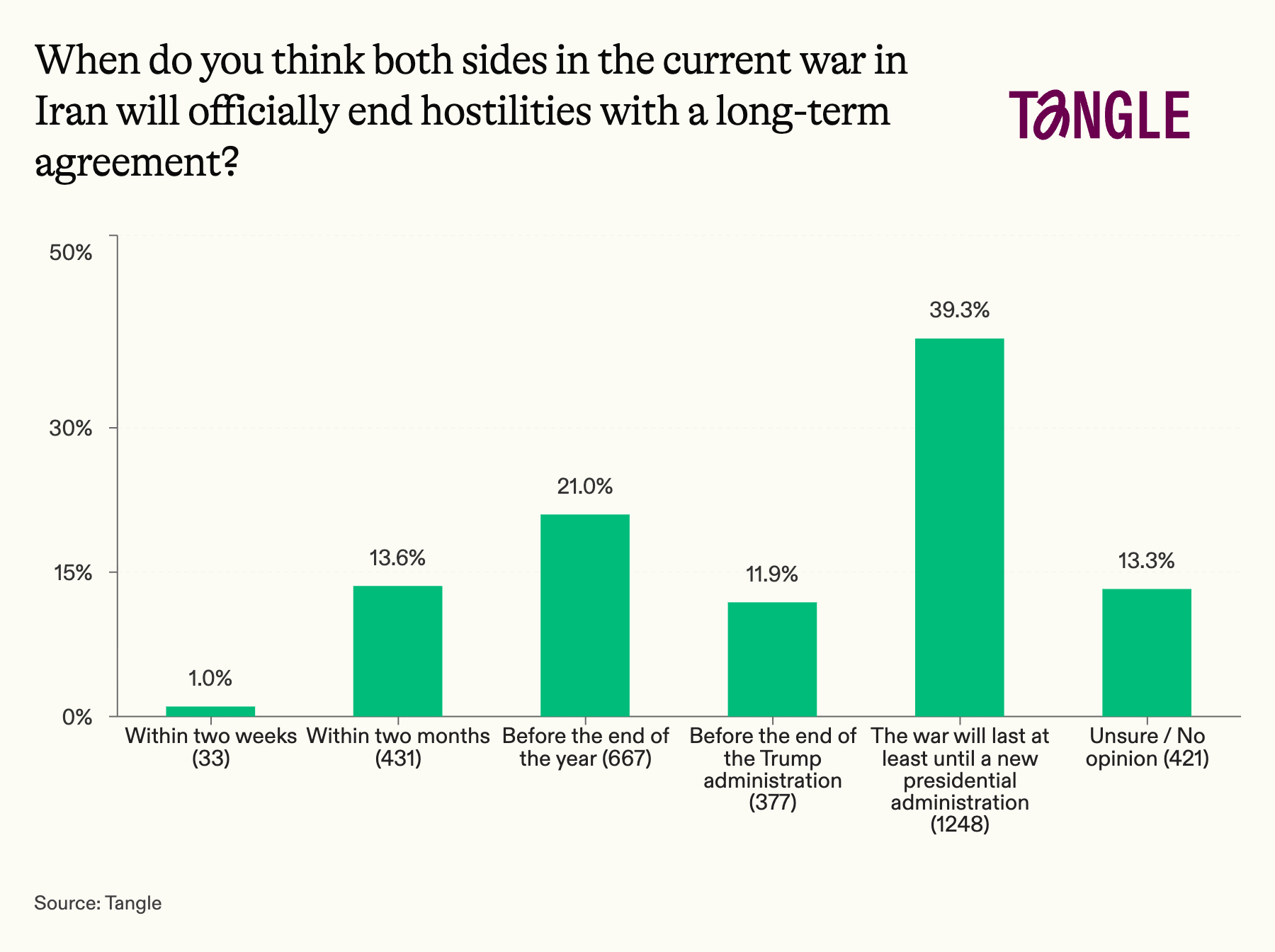
- Our last survey: 2,321 readers responded to our survey on the war in Iran with 51% saying it will last until at least the end of the Trump administration. “The two sides work on very different time perspectives, and the Iranians know it,” one respondent said. “Not until after the mid-terms, but I’m uncertain whether it will be done this year,” said another.
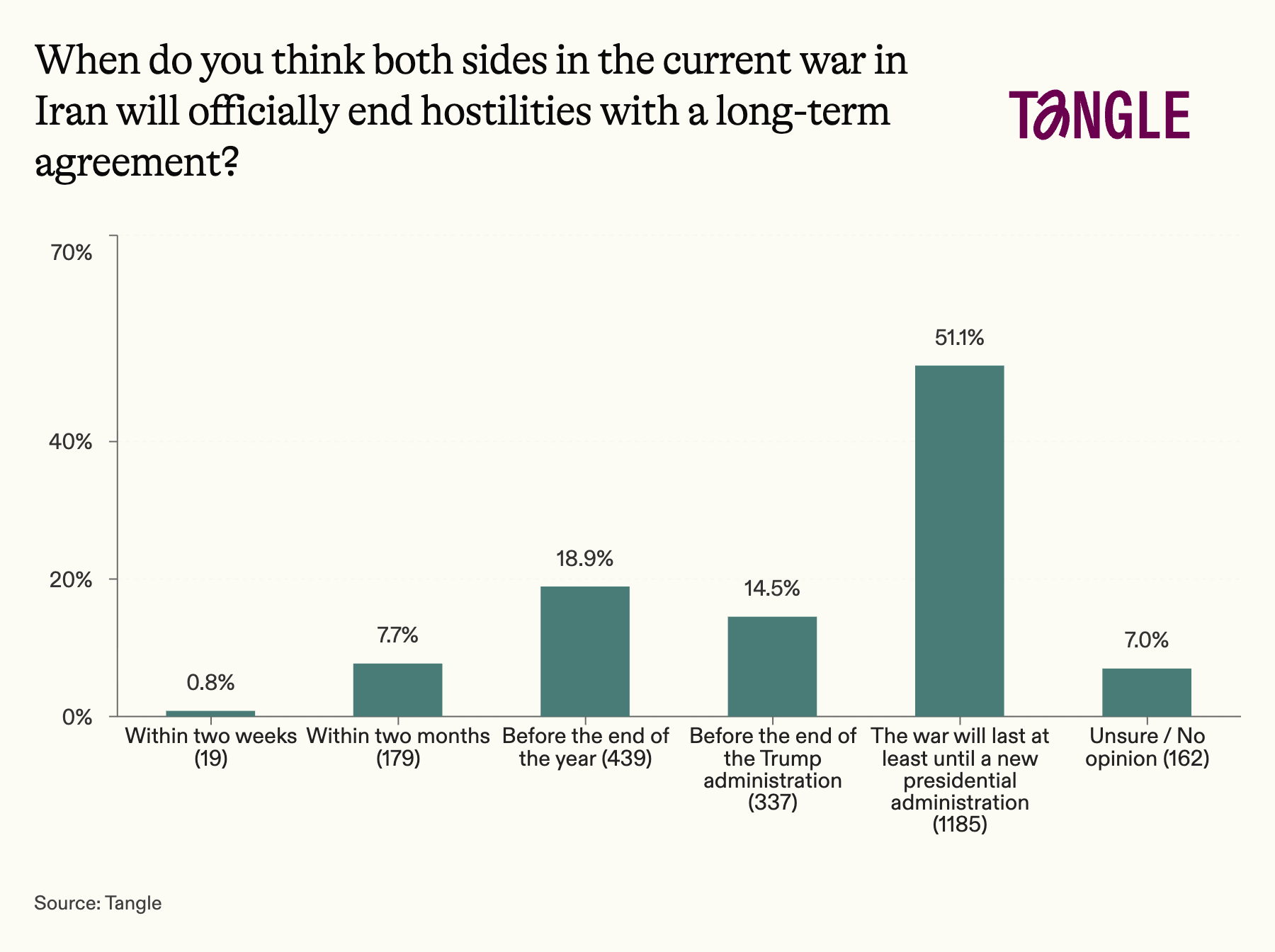
We originally asked this question on April 9, and the results of that survey are included below.
Have a nice day.
The eastern migratory monarch butterfly population has plummeted in recent decades, but two reports published in March show signs of hope from the past year. In one report, scientists found that nine colonies of monarch butterflies in Mexico occupied 7.24 acres of forest during the 2025–26 winter, a roughly 64% increase from the 2024–25 winter. In the second, researchers found that 6.3 acres of the butterflies’ winter habitat were degraded between February 2024 and February 2025, approximately 2.9 acres fewer than the same period from the previous 12 months. While environmental challenges remain, World Wildlife Fund-Mexico Director General Maria Jose Villanueva said the studies offered “promising signs of recovery” for the monarch butterfly population. The World Wildlife Fund has the story.

Member comments