












 500,000+ readers just today.





The Ohio attack ad.
Happy Thursday from Editor Audrey Moorehead. I’m feeling a bit nostalgic. When I was in high school, the administrators started a civics program (sponsored by Tennessee) that featured mock elections during presidential election years to teach students the importance of voting. The program expanded after I graduated, with the county elections office even bringing in voting machines for students to practice with; and for the first time, they’re hosting a mock midterm election today. It brings a tear to this citizen’s eye.
Speaking of the midterms, we’ve got a feature on the latest development in the Ohio gubernatorial race — an attack ad against Amy Acton that’s drawing major controversy. Dive into the details below, then read about fabricated polling numbers and a heartwarming tale of elephant rehabilitation.
It’s a 12-minute read.
Isaac Saul, Ari Weitzman, Will Kaback, Carina Pacheco, Russell Nystrom, Isaac Wood, and Bailey Saul edited or contributed to today’s newsletter.
Suspension of the Rules.
On this week’s episode, Isaac reveals his big board of Senate midterm predictions to Kmele and Ari, who offer a few disagreements. Then, the three discuss the protests and riots in France. Then, are Ari, Isaac, and Kmele as knowledgeable about Europe as a European is about the United States? All that and more on this week’s episode, which you can listen to here and watch here:
The newest episode
Quick hits.
- Russia released Stephen Hubbard, 74, a U.S. citizen who was detained in Ukraine in 2022. U.S. envoy Steve Witkoff praised Russian President Vladimir Putin for the release, calling Putin “a humanitarian.” (The release)
- The State Department ordered some diplomats and their families to leave Saudi Arabia amid ongoing attacks by Houthi militants in the country. (The orders)
- A judge ordered Meta to pay New Mexico $25 billion as a penalty for violating the state’s data-privacy laws. (The judgment)
- The Supreme Court kept in place a lower court’s ruling blocking the Federal Bureau of Prisons from implementing President Donald Trump’s executive order on healthcare for transgender inmates. The order would prevent inmates from receiving hormone treatments and “social accommodations.” (The ruling)
- Early voting in closely watched states has significantly outpaced early voting from the same period in the 2022 midterms. Overall, roughly 13 million mail-in and early in-person votes have been cast nationwide. (The latest)

Hey guys, Isaac here —
Anyone who knows me knows I love good food, and I’m a meat-eater who genuinely enjoys cooking. But between a busy work schedule and having a young kid at home, finding time to grocery shop, pick out a recipe, and get dinner on the table isn’t always easy. I was looking for a more convenient way to make great meals, and I was genuinely using ButcherBox before they became a partner of Tangle.
So, what is it? ButcherBox delivers high-quality meat straight to my door, sourced from farms that raise animals in healthier, lower-stress environments. Having a variety of meat ready to go in the freezer means I always have something worth cooking, even on the busiest nights. And when I’m short on ideas, ButcherBox has easy-to-follow recipes that help me figure out what’s for dinner.
The quality has genuinely impressed me, too. The meat offers higher levels of omega-3s, with no antibiotics, growth hormones, or unnecessary additives. It’s made cooking at home more convenient and helped me put better meals on the table for my family more consistently.
So yes, I’m proud to have ButcherBox as a Tangle partner. And right now, new users receive free NY Strip for a year, Filet Mignon for a year, or Chicken Breast for life PLUS $60 off using code TANGLE.
Today’s topic.
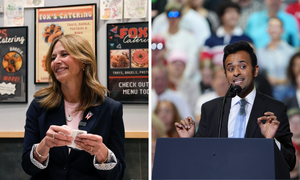
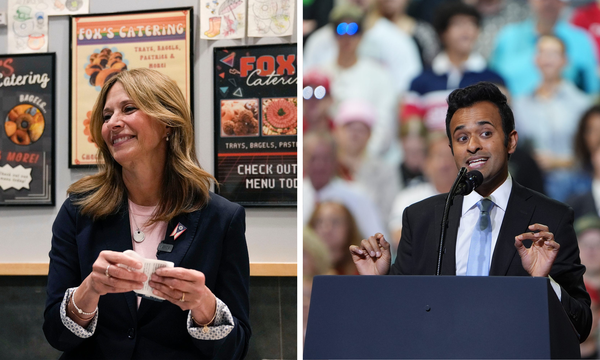
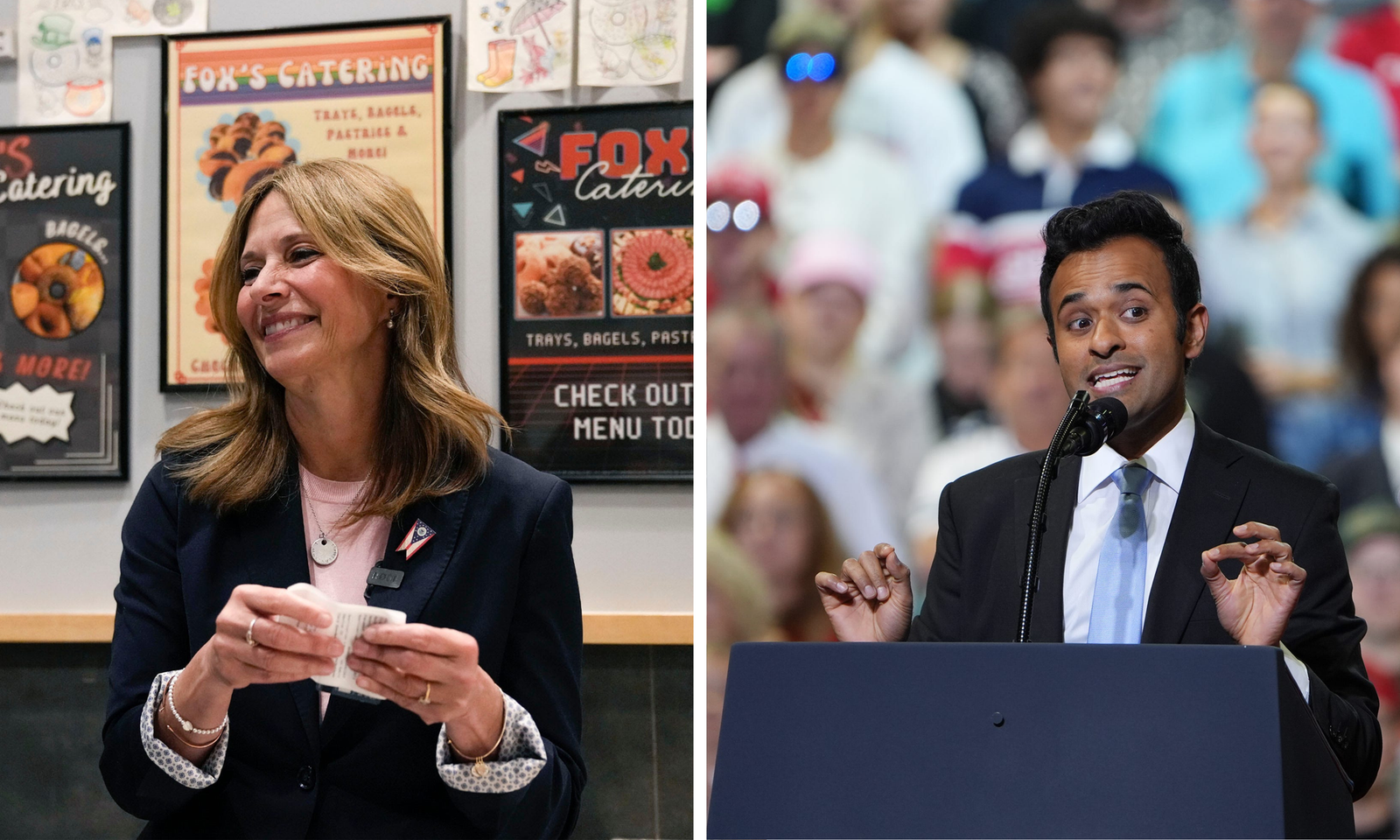
Vivek Ramaswamy’s attack ad. On Tuesday, Ohio gubernatorial candidate Vivek Ramaswamy’s (R) campaign released an advertisement featuring his opponent Amy Acton’s (D) mother, Donna Arthur, accusing her daughter of lying about her childhood and urging Ohioans to vote against her. The ad has generated backlash after Acton’s campaign and news outlets highlighted that Acton’s stepfather, whom Arthur remained married to until his death, was charged with sexually assaulting Acton when she was 12.
Ramaswamy and Acton are running to replace outgoing Gov. Mike DeWine (R). Ramaswamy is an entrepreneur and ran for president in 2024; Acton is a physician and previously served as the director of the Ohio Department of Health. Most polls show Acton with a narrow lead, and Sabato’s Crystal Ball rates the race as a toss-up.
Back up: In 1978, Cledith Arthur was charged with sexually assaulting Acton, his stepdaughter. After he was indicted, he fled Ohio with Acton’s mother; they never returned, and he died in 2004. Acton and her mother have not been in contact since 1978.
On Tuesday night, Ramaswamy’s campaign confirmed it had produced the advertisement and plans to spend $4 million to air it in Ohio. “This is a campaign-ending moment for Amy Acton. The people who know her best keep warning Ohioans about her,” campaign manager Jonathan Ewing said.
In a statement shared by Acton’s campaign, her brother, Philip Stearns, said, “After he was arrested and Amy and I were removed from their custody, our birth mother stayed married to Amy’s rapist until he died. This desperate, disgusting attack reveals exactly who Vivek Ramaswamy is at his core.” In her own statement, Acton said, “Between the ages of 10 and 12, I was sexually abused by her husband, while my birth mother did nothing to protect me. I’ve always known that she was deeply sick and unwell, and it’s sad to see Vivek Ramaswamy exploit her all for his own political gain.”
Democrats and some Republicans, including Gov. DeWine, have criticized the ad in light of revelations about Acton’s mother, calling for the Ramaswamy campaign to pull it from the air. However, on Wednesday, Vice President JD Vance said he was “a little bit disgusted” to see Republicans “whining more about that advertisement than they are about what the congressional Democrats and other Democrats want to do to the United States of America.”
Below are views from the left and right on the ad and how it could affect the race. Then, Editor Audrey Moorehead’s take.
|
What the left is saying.
|
In Slate, Ian Prasad Philbrick said the campaign reached “new depths of depravity.”
“It’s an ugly day in Ohio politics… A mysterious new ad features Acton’s estranged mother, who sided with Acton’s stepfather after she accused him of molesting her,” Philbrick wrote. “Earlier this year, [Ramaswamy] described his candidacy as a chance to elect a governor with ‘a positive vision for our state versus a governor who has none at all other than to complain about what someone else did to her’ — a remark some have read as blaming Acton for her own alleged abuse.”
“This isn’t the first time Arthur has disputed her daughter’s claims… But even Arthur’s version of events does confirm that Acton accused her stepfather of rape, that a grand jury investigated it, and that Arthur visited court ‘to support her husband,’” Philbrick said. “At the very least, the ad is a slimy attempt to weaponize a family dispute. If Acton’s accusations are true, then the ad provides a platform to someone who sided with Acton’s abuser — while also attempting to leverage that abuse for political gain.”
In The Columbus Dispatch, Ray Marcano suggested the ad “will reflect worse on [Ramaswamy] than on Acton.”
“Political operations show desperation when they go from the gutter and venture deep into the muck,” Marcano wrote. “One thing’s clear: Ramaswamy’s campaign should denounce an ad that reaches a new low, but it won’t because, at least for a little while, people will talk about it, and it will force Acton to address it (and she should). But then, the other shoe will drop… Why would a mother attack her daughter in such a public way? Who’s behind the video? Was she paid to appear? Why did she stay with the man who sexually abused a preteen?”
“There will be stories about the recklessness and wretchedness of GOP operatives and how Ramaswamy’s team all but cosigned the latest smear attempt that will reflect worse on him than on Acton,” Marcano said. “The October surprise could sting Ramaswamy instead, as voters wonder why a man who touts integrity lives in a campaign of lies. The hunger for power often leads to the muck. That’s where we are. It’s not a place that’s going to help the GOP.”
In Newsweek, Shane Croucher called the ad “loser behavior.”
“If the morality of the ad isn’t giving Ramaswamy and his team second thoughts, perhaps its real-world political value should, if history is anything to go by,” Croucher wrote. “A Newsweek review of House, Senate and governors’ races found 13 cases, across 12 contests going back to 2000, in which one side used the other candidate's relatives against them: estranged and former spouses, siblings, an aunt, a cousin and now a mother.
“The outcomes are more instructive than the ads. In the 10 cases where the votes have been counted, the side that reached for the family lost seven times. If this was Ramaswamy's Hail Mary, the early evidence says it is being picked off,” Croucher said. “The proof is in the pudding. If polls taken after the ad show Ramaswamy gaining, especially among the independents Marist found breaking for Acton, it will have worked, despite the disgust among many observers.”
|
What the right is saying.
|
In National Review, Kathryn Jean Lopez argued it “is inappropriate content for a political ad.”
“It’s likely to backfire, and it should. It’s amoral and should be a political disaster,” Lopez wrote. “I saw the pro-Vivek ad with Amy Acton’s estranged mother this morning and did what I imagine a lot of people did — looked up who Donna Arthur is and what the backstory is. Acton refers to herself as a childhood sexual-abuse survivor and has talked about being homeless (including in a campaign ad of her own). Her life story includes family-court battles.”
“Common decency should dictate this being off-limits as a line of attack in a political campaign,” Lopez said. “I see all kinds of questioning of the record online. [Acton’s] positions and political record should be enough to challenge her. If political battle can’t be waged within those limits, the competency of your campaign should be in question... October is known for disgusting political attacks, but we cannot be indifferent or tolerant — this must be condemned.”
In The Daily Caller, Adriel Gonzalez wrote “some campaigns would rather air dirty laundry than make their case.”
“Campaigns have decided embarrassing an opponent is easier than making a convincing case against them — and we’re worse off for it,” Gonzalez wrote. “What campaigns increasingly skip is the harder part — explaining why any of the personal jabs matter to the job their opponents are asking voters to let them do… A new ad targeting Dr. Amy Acton in Ohio is a near-perfect case study in the difference between an attack that generates attention and one that gives voters a meaningful reason to reject a candidate.”
“If the goal is to convince Ohioans to vote for Ramaswamy — or at least against Acton — forcing voters to untangle an ugly family dispute is a bizarre way to make the case,” Gonzalez said. “At the end of the day, there’s a difference between exposing something voters should know and exploiting something people will gawk at. We deserve better than to have spectacle passed off as substance.”
In PJ Media, Matt Margolis said the outrage “exposes a blatant double standard.”
“Democrats have discovered a convenient new rule of political combat. A candidate’s family, they now insist, is strictly off-limits, and anyone who drags a relative into a campaign has sunk to a shameful new low. You’ll notice the rule seems to apply only when a Democrat is in the crosshairs,” Margolis wrote. “I don’t know anything about Acton's family history, and I won’t pretend to… What I can say is that the faux outrage from the left over using a candidate’s mother in an attack is peak hypocrisy.”
“There’s definitely a legitimate debate over such a tactic. Still, the left is hardly in a position to be claiming some moral high ground on the issue, because using family to attack a political rival is a pastime of the Democrat Party, and the receipts are easy to find,” Margolis said. “Democrats never objected to this playbook when it served their purposes. Democrats have spent years turning candidates’ own families against them and forfeited any claim to the moral high ground long ago.”
|
||||
|
||||
|
Reminder: This is where we share a personal opinion. If you have feedback, criticism or compliments, leave a comment or reply to this email.
|

Alone in a vacuum, Vivek Ramaswamy’s new ad isn’t uniquely offensive.
In the ad, Amy Acton’s mother sits in a room and somberly tells the camera that she loves her daughter, “but when I saw her lying about her opponent — it’s not easy for a mother to say this — but Amy has a serious problem.” She says Amy has lied about her past and is unfit to serve as Ohio’s governor. She also substantiates her perspective by mentioning her own history, including working on sexual abuse programs in Ohio.
Don’t get me wrong, the ad is nasty and shocking. The idea that a candidate’s mother might oppose their own kid has a way of stopping you in your tracks. And the specific attacks Donna Arthur levels against her daughter are personal; it’s not “Amy’s platform is bad” or “Amy has supported bad policies” but “Amy is a liar.”
It doesn’t sit well with me for one family member to oppose another in a political race, at least in a public attack ad that’s going to air on TV. But despite my taste, I know that using an opponent’s family members in a political attack ad isn’t really anything new. In 2018, The Washington Post catalogued four politicians whose family members had publicly denounced them, either in ads or online; some of these attacks were personal, like the police officer brother of Democratic candidate Randy Bryce highlighting Bryce’s old tweet comparing law enforcement officers to terrorists (and Randy Bryce’s campaign then released a letter from the men’s mother, exacerbating the personal conflicts). As right-wing commentators like Ben Shapiro and Matt Margolis (under “What the right is saying”) are keen to point out, Democrats have not been shy about boosting their opponents’ liberal family members — from the Kennedys to Mary Trump — as they publicly denounce their relatives. It’s an unfortunate fact of our political culture that attack ads get personal; so, in that context, I mostly resigned myself to the ad’s existence.
But Acton’s campaign’s response casts the ad in a whole new light. Acton and her brother each shared that they are estranged from their mother because, when Amy Acton was 12, her mother’s husband was charged with raping her. Donna Arthur then skipped town with her husband after he was indicted for the crime. Court records and a resurfaced 2020 interview with Arthur appear to support Acton’s brother’s version of events. Arthur’s best defense in 2020 was to say “my daughter lied and said my second husband had raped her”; and Arthur admits to leaving town to avoid the heat. She claims in the interview that charges against her husband were dropped but supplies no evidence for her claim; instead, the case appears never to have been resolved after Arthur and her husband fled. All in all, the full picture of Donna Arthur is of a much less trustworthy source than the ad leads an unsuspecting viewer to believe.
When I rewatch the ad after understanding the full context, it evolves from nasty to outright chilling. That Donna Arthur begins the ad by listing her experience developing sexual assault programs feels like a slap in the face. The accusation that her daughter is a liar goes from just personal to plainly vindictive. One stops seeing the ad as “concerned mother speaking out” and starts seeing it as “angry mother lashing out,” and then one ends up wondering, who the heck approved this?
Unsurprisingly, the backlash to the ad has been fierce. Commentators have circled in on the amoral absurdity of using the woman accused of directly contributing to Acton’s childhood trauma in a political attack. At best, the ad is ruthless and insensitive, a product of pure, Machiavellian calculation; at worst, the ad is directly cruel, weaponizing a woman who protected Acton’s alleged abuser in a way that goes beyond political gamesmanship.
The ad initially featured none of the usual, legally required credits for funding, and it hadn’t actually aired anywhere when an Ohio-based political X account posted it online. It was picked up quickly by right-wing influencers, and initially it wasn’t clear if it came directly from the Ramaswamy campaign, which didn’t confirm or deny its involvement. At first, I expected the campaign to quietly distance itself from the ad. I wondered if it was a gamble that had been leaked online to test the waters, and now that the backlash proved the gamble to be a bad bet, it would soon disappear from Ramaswamy’s campaigning. Instead, in the past few days, he has doubled down: He defended the ad, claimed Acton wouldn’t debate him, and argued that Arthur’s lack of support for Acton is “part of a pattern” that proves she isn’t a trustworthy candidate. Then, news outlets reported that Ramaswamy would spend $4 million to air the ad on TV statewide.
Given all this, I’m left with a thoroughly sour taste in my mouth, not unlike the taste I’ve been left with regarding Graham Platner or Max Miller. To be clear, producing a nasty political attack ad is an order of magnitude less severe than abuse or sexual assault itself. It’s cruel and inappropriate, but it’s not on the level of doing another person physical harm. Nevertheless, it reveals a deficiency of character to dig into a person’s history and find their estranged mother to weaponize against them; to see the shocked, outraged reactions it generates and double down is beyond the pale.
Again, under the best possible explanation, Ramaswamy is trying to win this election by any means necessary. Political ruthlessness isn’t an uncommon tactic, especially in a political landscape dominated by Trump’s shadow; the president’s personal vendettas against enemies haven’t stopped him from returning to the White House and have even gained him support in the past. But are the payoffs of that sort of ruthlessness really worth debasing yourself morally? And, not for nothing, the strategies that worked for Trump haven’t always been replicable, and the backlash Ramaswamy has received could portend a total backfire. Rather than dealing the Acton campaign a finishing blow, it seems like Ramaswamy has handed her a new weapon to use against him, enabling her to cast him as an amoral power-seeker.
I find myself thinking about this in relation to the trials Ramaswamy has faced in his own political career. It’s no secret that Ramaswamy has faced severe discrimination as the GOP gubernatorial candidate over his religion and his race; his earnest appeals to commonalities between Hindus and Christians have fallen on the mocking ears of the “Groyper” right.
Ramaswamy’s race and religion have nothing to do with his fitness to be the governor of Ohio. Claims that say otherwise are indefensible. But in the same vein, I would expect him to understand that Amy Acton doesn’t deserve to be attacked for unspeakable things she endured in her childhood. Instead, Ramaswamy is dragging the worst parts of her life into the spotlight, under the flimsy pretense that it’s her character he’s attacking. But now, it seems clear that the ad has backfired, and that it says far more about Ramaswamy’s character than Acton’s.
|
||||
|

Take the survey: What do you think of the ad? Let us know.
Disagree? That’s okay. Our opinion is just one of many. Write in and let us know why, and we’ll consider publishing your feedback.
Numbers.
- $87 million. The approximate amount spent on aired advertising in support of Vivek Ramaswamy as of October 8.
- $25 million. The approximate amount spent on aired advertising in support of Amy Acton as of October 8.
- $28 million. The approximate amount spent on future advertising in support of Ramaswamy as of October 8.
- $15 million. The approximate amount spent on future advertising in support of Acton as of October 8.
Under the radar.
On Tuesday, a group called Wedgewood Polls released a statement saying that it had fabricated its findings as part of an “experimental project” to highlight vulnerabilities in the political polling industry. Political news site FiftyPlusOne said that the announcement came after they reached out to Wedgewood to inquire about its methodology and leadership. FiftyPlusOne, The New York Times, Nate Silver and others had reported results from Wedgewood’s polls, which appeared to mostly favor Democratic candidates. The news marks the second incident in the 2025-26 election cycle of a firm admitting to fabricating poll results. Axios has the story.
How I made cooking at home a whole lot easier.
Between work and life with a young kid, dinner doesn’t always go according to plan — if there’s a plan at all. Having high-quality meat delivered to my door means I can skip the last-minute grocery run, avoid another takeout order, and still put a great meal on the table that I can feel good about. It’s one less thing to think about, fewer nights ordering in, and the peace of mind that comes with knowing I’m serving quality meat to my family.
New users receive free NY strip for a year, filet mignon for a year, or chicken breast for life PLUS $60 off using code TANGLE.
The extras.
- One year ago today we covered the Republican texting scandals.
- The most clicked link in our last regular newsletter was the report on Ramaswamy’s attack ad against Acton.
- Nothing to do with politics: TIME’s best inventions of 2026.
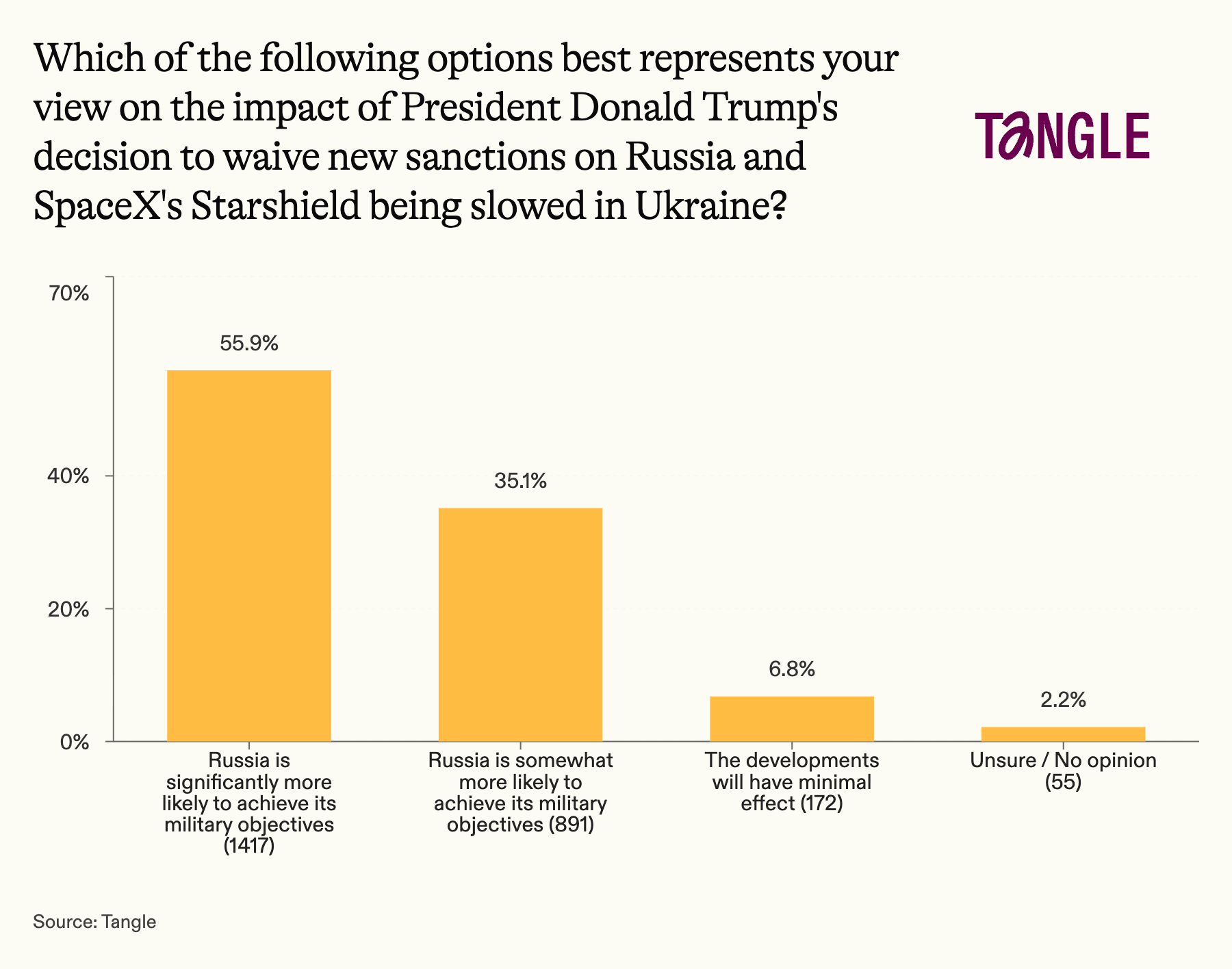
- Our last survey: 2,535 readers responded to our survey on the Trump administration’s pivot away from Ukraine, with 56% saying the latest developments make Russia significantly more likely to achieve its military objectives. “Trump wants the war over so he can take credit for it. He’d rather that Russia get Ukraine like they did Crimea and be done with it,” one respondent said. “I have no problem with Trump meeting with Putin regarding the war… [but he] should not make any agreements without Zelensky,” said another.
Have a nice day.
Baby elephant Nemparwai arrived at Kenya’s Reteti elephant sanctuary sick and injured. At barely a week old, she needed close attention to rehabilitate — and keeper Dorothy Lowakutuk provided just that. Reteti is a flagship sanctuary that seeks to provide opportunities for locals to be part of conservation efforts. Lowakutuk and her team care for elephants as they heal from injuries or sicknesses, or until they can survive alone in the wild. “[The elephants] made me understand how I should lead: not by intimidating, and not by fighting. Leadership has to grow from inside you, and then you’re chosen by your good deeds, not your bad ones,” Lowakutuk said. Positive News has the story.