





This is Managing Editor Ari Weitzman, writing to you on another bright and clear Tyrsday morning for today’s edition about the protests and riots in France. I happened to be in Paris when my Pittsburgh Steelers won the Super Bowl in 2010, so I’m hoping for the best there as the French capital prepares to welcome the Steelers this weekend.
I’m being light-hearted, but the current turmoil is serious. We’re going to give the issue the total Tangle treatment, then get to a home distilling law heading back to court and a story about a kindhearted teenager.
It’s a 13-minute read.
Isaac Saul, Will Kaback, Audrey Moorehead, Carina Pacheco, Russell Nystrom, Isaac Wood, and Bailey Saul edited or contributed to today’s newsletter.
They’re trying to scare you.
As the midterms near, campaigns are leaning into a familiar tactic: fear. You’ve probably seen or heard all manner of political advertisements warning of catastrophic consequences if an opponent or their party wins power. In the latest video for his new YouTube channel, Isaac breaks down the psychology of these ads and how to tell when politicians are playing on fear-based emotions. Check it out here:
Quick hits.
- President Donald Trump said he is open to a trilateral meeting with Russian President Vladimir Putin and Chinese President Xi Jinping, which Putin has reportedly proposed to discuss the war in Ukraine. (The comments)
- The Justice Department charged 28 people in California as part of a voter fraud probe. Those charged are noncitizen lawful residents who allegedly submitted false materials in their naturalization applications and voter registrations. (The arrests)
- President Trump announced an $8 billion program for farmers that aims to offset the effect of rising diesel prices. (The program)
- The Supreme Court rejected an appeal by three men accused of plotting the 9/11 attacks. The men are seeking to reinstate a short-lived plea deal that would have eliminated the possibility of the death penalty and that Defense Secretary Lloyd Austin overrode after it was announced in 2024. (The rejection)
- Yemeni military officials said Houthi rebels struck a military camp, killing 53 soldiers and wounding at least 200 others. (The strikes)
The Finance Story Behind Every Political Headline
Tangle covers the politics. The Daily Upside shows you what it means for your wallet, investments, and career. Written by veteran journalists and Wall Street pros, The Daily Upside breaks down the financial moves hidden behind today’s biggest political stories. Recent insights include:
· How the price of chocolate got scary high. It’s 15.5% higher this year for Halloween.
· Finances are the easy part of retiring for high-powered lawyers: why it’s hard to walk away.
· As soaring energy prices boost inflation and jump 9.1%, refiners have become money machines.
Trusted by the Tangle team — and 1 million readers who want clarity, not noise.
Today’s topic.
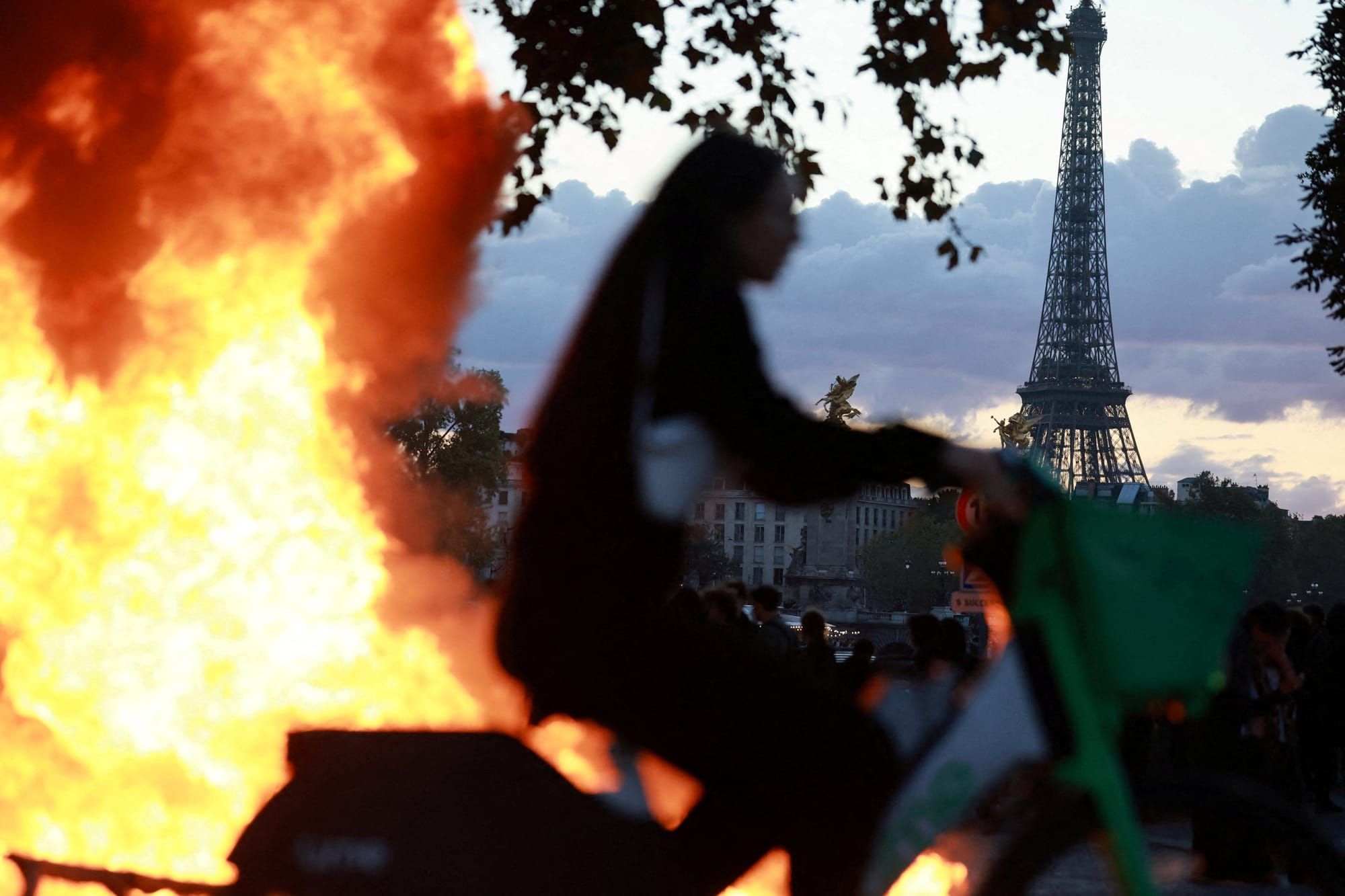
The protests in France. For the past month, protests and riots have broken out across France, with violence and disorder significantly escalating over the weekend. In mid-September, high school students began demonstrating against a perceived lack of resources in schools; parents, college students, teachers and trade unions later joined the effort, and it has since broadened into nationwide unrest over cost-of-living concerns. French officials say that far-left groups are primarily responsible for the escalation into rioting and looting, while some French politicians and U.S. political leaders suggest the protests underscore deeper issues linked to immigration.
Back up: The protests began in Paris-area schools, where students and parents have highlighted overcrowded classrooms, teacher shortages, aging infrastructure, and a lack of investment in the education system. By early October, several violent incidents led to hundreds of arrests and dozens of injuries, as well as significant property damage. French officials claim that “ultra-left” groups, such as La France Insoumise, have catalyzed the violence and want to encourage chaos ahead of France’s 2027 elections. Right-wing politicians have argued that heightened levels of immigration and government tolerance of disorder have fueled the riots.
On Saturday, an estimated 550,000–800,000 protesters participated in 110 marches across France, and many demonstrations resulted in clashes between participants and police. Officials say approximately 1,000 law enforcement officers and firefighters were injured, 2,400 people were arrested, and 3,000 businesses were damaged. French Prime Minister Sébastien Lecornu said police “had lost control” and suggested he would impose a national state of emergency if necessary. In a national address, French President Emmanuel Macron said, “Those who looted will have to pay back for the damage, and those who sought to bring down the Republic will be held accountable.” Paris police issued a partial curfew Monday night.
Some protesters have criticized the police response as overly aggressive, highlighting an incident where a 15-year-old student lost his hand from a police stun grenade. Many politicians, pundits and citizens have condemned the vandalism and rioting, though some protesters have defended it. “The state is violent and property damage is the people’s response to that violence,” one college student protester said. “The violence in the streets is against property, not people.”
On Monday, President Donald Trump linked the riots to immigration, writing on Truth Social, “The migrants have taken over France. They must CLOSE THE BORDERS, FAST!” On X, Vice President JD Vance said, “Western liberals imported the third world into France and other countries in the name of diversity and compassion. They ignored fundamental questions of assimilation and compatibility. They were told it would lead to this and they didn’t listen.”
Today, we’ll have views from the left, right and French writers on the protests and riots, followed by Managing Editor Ari Weitzman’s take.
|
What the left is saying.
|
In The Philadelphia Inquirer, Will Bunch asked “do French protests have a message for America?”
“In recent years, billions of dollars in badly needed maintenance have been postponed, resulting in classrooms with toxic hazards like asbestos and ancient lead paint, stale, polluted air, inadequate heat in winter, and a lack of air-conditioning in summer,” Bunch wrote. “These, of course, are the K-12 conditions in the Philadelphia School District, and school squalor like this is something you see in a lot of large American cities, unfortunately.”
“But while there’s the occasional one-off rally… we’ve seen nothing when it comes to protesting like what’s happening this month in France,” Bunch said. “Unless you follow the big international news sites, the youth protests in France and India haven’t received extensive media coverage here in the U.S. You could argue that’s because we have plenty of our own problems on American soil… Which brings back the question: Why isn’t America’s Gen Z manning the barricades?”
The Economist argued “no one is addressing the core problems the country faces.”
“The context for the riots is the underlying tension linked to next year’s election… The country wants change, but is deeply divided about what should come next,” the writer said. “It looks probable that the polarisation of public debate and the politicisation of the street will intensify over the next six months — and probably beyond… [If Le Pen wins in 2027,] it could prompt a new round of protests on the left.”
“The government’s budget deficit is expected to be 5.4% of GDP this year, one of the highest in the euro zone,” the writer said. “Wariness in the markets and anger on the streets make for a toxic mix. Worse, as attention turns to law and order, France is even less likely to have the political conversation it badly needs: about what sort of welfare system it can afford and how to generate the wealth needed to sustain it.”
|
What the right is saying.
|
In The Daily Signal, Steve Cortes said “Europe is burning — is America next?”
“A violent weekend of Marxist-Islamist protests rocked Europe, from Portugal to Italy. The worst carnage erupted across France, where rioters torched the revered, architecturally stunning town hall of Limoges. The 143-year-old landmark is a protected national monument. Its roof caved in, and its iconic bell tower collapsed into the flames,” Cortes wrote. “Is this kind of mayhem headed to America next?
“Sadly, current trends suggest that the growing ‘red-green’ alliance of hardcore leftists and radical Islamists in the United States could produce exactly this kind of disorder and destruction here, if we are not vigilant — and if the looming elections go poorly for nationalist candidates,” Cortes said. “Admittedly, [Marxist and Islamist] political factions make a strange political marriage, and they clearly disagree on many topics, especially social issues. So, what binds this dangerous new merger? A common enemy. They both hate Western civilization.”
The Wall Street Journal editorial board described “why France is burning.”
“The news this time is the pre-election play by far-left candidate Jean-Luc Mélenchon,” the board wrote. “The riots are ostensibly about declining public services, but the presidential election next April figures into the protest calculations… If the riots move more center-right voters away from the centrist candidates and toward Ms. Le Pen, Mr. Mélenchon may figure he has a fighting chance to become the next President in the May runoff.”
“The parties of the right and left see a rare opportunity to use the moment to gain the Élysée Palace,” the board said. “As a lame duck, [Macron] is left to rely on police to protect the French streets. They couldn’t do it on Saturday, as protesters ransacked shops in Marseille and elsewhere, and even torched the historic town hall in Limoges that survived the Nazis. France is in a violent democratic funk, and it will probably get worse. Don’t think it can’t happen in the U.S. given the current state of American politics.”
|
What writers in France are saying.
|
The Le Monde editorial board said the protests “force Macron to confront the failures of his presidency.”
“Saturday’s protests should not be reduced to these acts of looting and destruction. French President Emmanuel Macron emphasized this in an address on Sunday evening,” the board wrote. “Yet, for the past 10 years, Macron has consistently turned a deaf ear to the social movements that have marked his two terms. Refusing compromise, his successive governments have systematically bypassed unions since 2017, contributing to their weakening.
“By doing so, the authorities have deprived themselves of the essential intermediaries needed to channel public anger. Meanwhile, Macron has distanced himself from the youth by pushing unpopular reforms and ignoring their growing discontent,” the board said. “Listening to and respecting dialogue partners is essential. But above all, the government must give concrete political responses to their demands, which it can no longer afford to reject out of hand. Social peace can only be restored under these conditions.”
In The Free Press, Simone Rodan-Benzaquen called protesters’ actions “an assault on democracy.”
“The government needs to protect officials and teachers, prosecute their attackers, and get schools open. It needs to investigate police abuses seriously, without accepting that those abuses justify an assault on anyone in uniform,” Rodan-Benzaquen wrote. “I believe in the French Republic. I resent the suggestion that caring about its survival makes someone naive, or secretly authoritarian. We have the right to protest because we live in a democracy.
“We also have the right to go to school, to disagree with a crowd, and to elect a mayor who can do the job without fearing for his family,” Rodan-Benzaquen said. “Marseille’s city hall is not the Bastille. The people who broke into it were not staging a just revolution against authoritarianism; they were attacking the means by which their fellow citizens govern themselves… I want a government that understands how serious this is — and acts before another public servant, or another family, pays the price.”
|
||||
|
||||
|
Reminder: This is where we share a personal opinion. If you have feedback, criticism or compliments, leave a comment or reply to this email.
|

It’s tempting to tell a simple, three-part story about these protests and stop there.
Part one of the simple story starts in the French suburb of Créteil, where students began protesting a lack of school resources. Protests are a fixture of French culture; as recently as 2018–2020, “Yellow Vest protesters” flooded the streets to demand the government address rising gas prices and weakening economic opportunities for workers.
A more recent fixture has been a forceful police response. In 2017, France passed a law allowing police to use weapons for reasons other than self-defense. Since then, French law enforcement has increased its use of non-lethal weapons against protesters, particularly guns that fire rubber pellets (called “lanceur de balles de défense,” or LBDs). Authorities said they needed to take stronger measures to respond to violent elements who commingle with protesters.
Whatever the cause, the effect has been dramatic. Eye injuries caused by LBDs increased from two in 2016 and one in 2017 to 25 in 2018 and 15 in part of 2019. The sudden increase led to a rebuke from Europe’s human rights commissioner, who said France’s policing tactics against the Yellow Vest protesters were making it a violent outlier from the rest of Europe.
That context is crucial to understanding part two, the tipping point that intensified the past month’s protests. In late September, the student-led protests spread from the Parisian suburbs to cities across France. On September 30, a 16-year-old was blinded in his right eye by injuries that prosecutors described as consistent with an LBD. Then, on October 5, a 15-year-old’s hand was blown off by a police grenade.
This incident ushered in part three, as at least 160,000 teachers and parents joined the marches. Protests spread across Europe. The Yellow Vests joined the movement. Then, rioting and looting broke out in French cities over the weekend — rioters burned a tourist office in Lyon, set fire to the 143-year-old town hall in Limoges, and looted Marseille’s city center. By Monday morning, at least 3,000 storefronts had been vandalized, and looters in Marseille were brazenly gathering their spoils in broad daylight.
In the simple story, a protest about something specific began attracting dissatisfied factions, particularly from the left, who were more bent on destruction and crime than delivering a political message (and who actually undermined the original message the students were raising). But that narrative doesn’t tell the whole story. Instead, the whole story asks you to confront an uncomfortable element that is easy to discern the moment you start watching videos, listening to eyewitnesses, or reading local accounts.
Right-wing commenter Thaïs d’Escufon presented this element as strongly as possible in two contrasting videos. In the first, a white woman is pleading with the mob not to loot a nearby store, saying “this isn’t for the cause” as she is gently held back by a member of the crowd. In the second, a Muslim business owner trying to protect her storefront is aided by members of the crowd, who tell looters “don’t smash it up, she’s a sister” and “it’s okay, my brothers, please go.”
As French writer Charles Consigny bluntly stated on a daily French talk show, “the looters are children of immigrants.” Frankly, I’m having a hard time processing that claim — because I’m finding more reason to support it than to reject it. On the same show, a caller who identified herself as a Muslim business owner whose shop had been looted in Marseille said, “It’s unfortunate, but 80% — it’s my community.” Additionally, a police union representative said most of the looters were from “disadvantaged neighborhoods,” outlying communities like Créteil that are often home to immigrant families.
Conversely, the response that Green Party MP Sandrine Rousseau gave to Consigny was a passionate plea not to blame immigrants for the damage, saying immigrants are part of the fabric of French culture and many are firefighters and police responding to the destruction. Rousseau is right, almost obviously so: Most immigrant families are law-abiding citizens who contribute to the societies of their adopted home countries. However, Rousseau notably didn’t deny Consigny’s central claim, which is somewhat telling. I’m not willing to go as far as to say that the rioting in Marseille is proof of “migrant chaos” causing “Europe’s decline,” but as of this moment, I have more reason to believe Consigny than I do to dismiss him. So, if it’s true that many of the looters were children of immigrants, why is that the case?
I think that question has a scary answer that I’m hesitant to agree with and an easy answer that doesn’t tell us much. The hard answer is what Steve Cortes wrote in The Daily Signal (under “What the right is saying”), that these looters are representative of a tide of migrants who hate Western civilization but are increasingly seeking refuge in Western civilization. The easy answer is simply that the rioters and looters come from poor families, who tend to disproportionately be immigrant families, and their rioting and looting is largely an economic impulse.
Grappling with these answers is very uncomfortable and difficult for me. I generally tend towards accepting the easy answer, but I’m aware of how, well, easy it is. I also don’t think the civilizational concern should just be dismissed out of hand, especially as French social media is awash with videos reposting a 1979 speech by Ayatollah Khomeini over images of rioting and destruction in France from this past weekend. The ‘red–green’ alliance between communist protesters and Islamist extremists that Cortes described feels meaningful to me, as does the paucity of the responses to this criticism from the left.
Frankly, I don’t know how anyone can deny that the communist/Islamist rhetoric coming from these protesters is oppositional towards Western civilization. However, I have a much harder time accepting that young students calling themselves communists or online posters calling for an anti-Western jihad are the same people smashing up a Hermès store to sell handbags online. I’ve spent plenty of time on college campuses — the people espousing the most extreme rhetoric are often not at all willing to back it up with correspondingly extreme actions, instead opting for more milquetoast public disruptions. I ultimately believe that the worst of the weekend’s riots came from low-brow opportunists, the same kind of people who look for excuses to steal, smash and burn that we’ve seen time and time again, in the U.S. and abroad.
France is now tasked with drawing a line between protecting its long-practiced ability to demonstrate publicly and punishing crimes committed during those demonstrations. As of today, it’s pushing back against the resale of stolen goods and instigating curfews, while politicians from the left are themselves pushing back against the crackdown as collective punishment. If France goes too far in its enforcement, it risks its own culture of protests and citizen trust in the government. But if it doesn’t go far enough, it will not only send a permissive signal to opportunists who came out under the cover of protests, but to the red–green alliance itself. It’s a delicate moment, and if the French government gets this wrong, the circumstances could be dire and long-lasting.
|
||||
|
Take the survey: What’s driving the protests and riots? Let us know.
Disagree? That’s okay. Our opinion is just one of many. Write in and let us know why, and we’ll consider publishing your feedback.
Under the radar.
On Monday, the Supreme Court announced that it will hear a challenge to an 1868 federal law that bans the production of spirits like bourbon and whiskey at personal residences. The U.S. Court of Appeals for the 5th Circuit previously found the ban unconstitutional, but the federal government appealed to the Supreme Court, arguing that at-home production allows individual producers to avoid inspections and taxes. The Hobby Distillers Association, the main group challenging the law, says that the ban exceeds Congress’s taxation power. Oral arguments are expected in early 2027. SCOTUSblog has the story.
Mainstream financial news is more concerned with the “attention economy” than the global economy. They churn out sensationalized headlines for views, only to feed you uninspired content with zero value.
You’re not just a pair of eyes on a webpage. You have a brain. The Daily Upside was created by Wall Street experts for readers like you who crave real insights on finance and investing.
Join 1M+ readers and subscribe for free today.
The extras.
- One year ago today we covered President Trump commuting former Rep. George Santos’s (R-NY) sentence.
- The most clicked link in our last regular newsletter was our partnership with Ground News offering Tangle readers 40% off a Ground News subscription.
- Nothing to do with politics: See if you can guess where a person is from with limited clues.
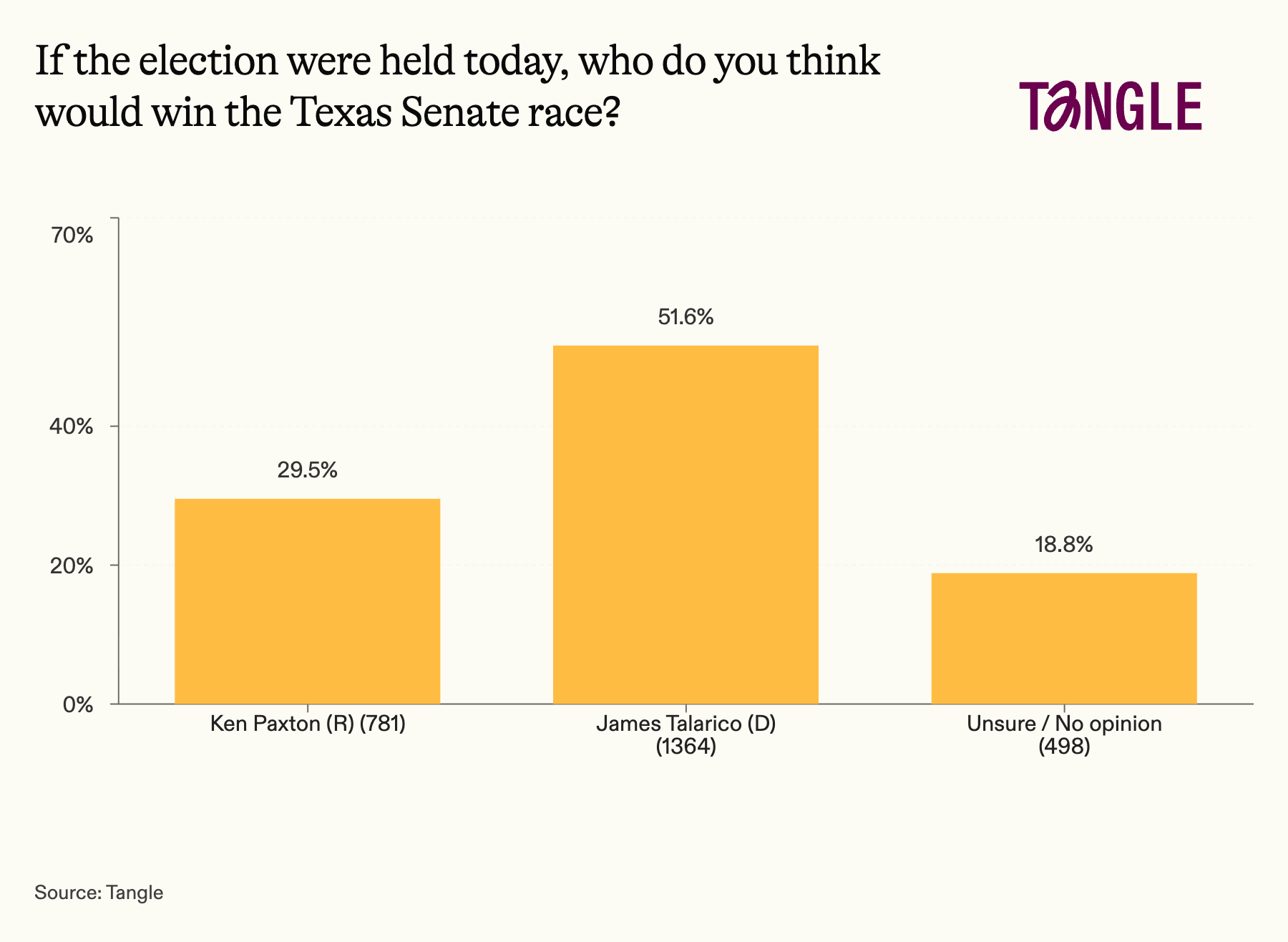
- Our last survey: 2,643 readers responded to our survey on the Texas Senate race, with 52% saying they think James Talarico (D) would win if the election were held today. “Talarico is a better candidate, has more crossover appeal, and Democrats are highly motivated to vote,” one respondent said. “I’ll be shocked if Texas goes blue,” said another.
Have a nice day.
Brooklyn Green, 21, was leaving an AMC theater in Maryville, Tennessee, with her grandparents when she noticed an elderly employee pushing a cleaning cart. The image didn’t sit right with Green; when she got home, she posted a video of the worker to TikTok with a GoFundMe to help her retire. The effort garnered a lot of participation, and two days later, Green returned to the theater to present the woman, named Mary, with nearly $145,000. Mary said she would use part of it to help others, including people on the street she already helps with cash or food from her car. “I’m overwhelmed and certainly blessed by the Lord and you wonderful people,” Mary said. KYMA has the story.

Member comments