
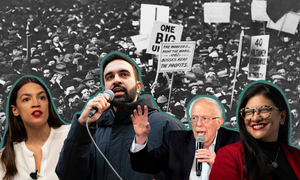





Happy Wednesday and welcome to election season (I think). I stayed up late last night watching Michigan results roll in, then got up before the sun this morning to start processing their implications. It feels like November, despite being August, because we are in the midst of some very, very consequential primaries. Today, we’re covering the results in Michigan and what they mean for Democrats in November.
Plus, a reader question about our daily topic selection and a newsy quick hits section with updates on the Iran war and other election results from across the country. It’s a 14-minute read.
Coming soon: our West Virginia event.
In June, Tangle hosted a live discussion about the future of artificial intelligence, featuring Executive Editor Isaac Saul, Editor-at-Large Kmele Foster, Longview’s Andy Mills, and The Free Press’s Kat Rosenfield. We’re excited to share the full recording of the event next week; in the meantime, here’s a teaser trailer:
Quick hits.
- President Donald Trump said the U.S. is close to an agreement with Iran to reopen the Strait of Hormuz to commercial traffic, with a formal announcement expected Wednesday or Thursday. (The update)
- Rep. Wesley Bell defeated former Rep. Cori Bush in the Democratic primary for Missouri’s First Congressional District. (The result)
- The Senate Judiciary Committee voted 12–10 to advance Todd Blanche’s nomination for attorney general to a full Senate vote. Sen. Susan Collins (R-ME) announced that she will vote against Blanche’s nomination. (The latest)
- Rep. Chuck Edwards (R-NC) announced he will not seek reelection after the House Ethics Committee recommended his censure for violating “the spirit” of House rules on sexual harassment. (The announcement) Separately, Rep. Max Miller (R-OH) asked the House Ethics Committee to investigate domestic abuse allegations against him, saying that he has “absolutely nothing to hide.” (The request)
- Law enforcement arrested an armed man who they said was documenting security operations at Trump National Golf Club Los Angeles ahead of President Trump’s visit to the course. (The arrest)
While You Wait, Earn 9.5% Fixed.
Markets move. Opportunities come and go. Your cash doesn’t have to sit on the sidelines.
The Groundfloor Bond Note offers accredited investors a 9.5% fixed annualized return over six months, providing a predictable return while preserving the flexibility to redeploy capital later this year.
Capped at $10M with a perfect repayment track record, this won’t stay open long.
Today’s topic.
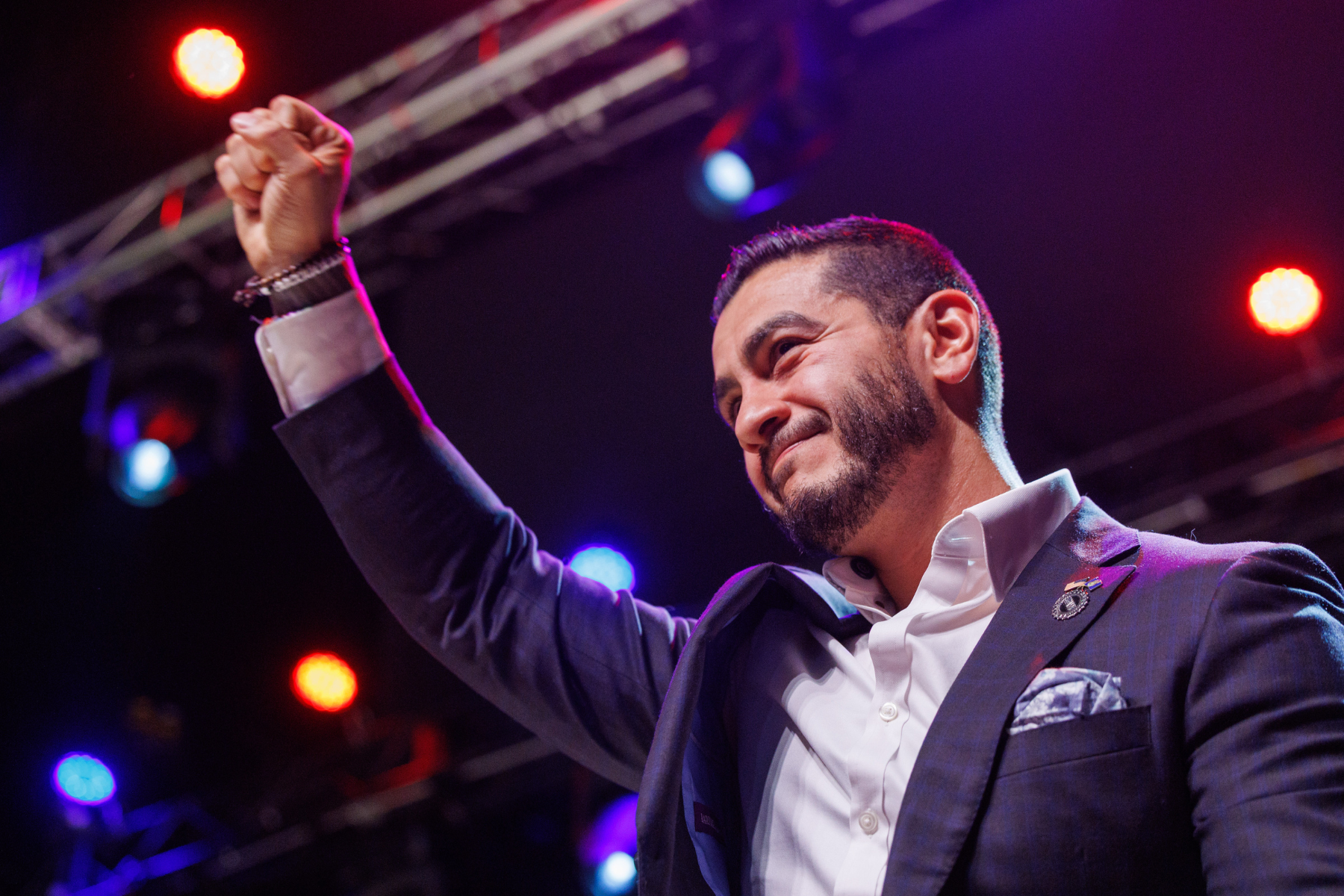
The Michigan primaries. On Tuesday, the Democratic and Republican parties held primary elections for several key seats in Michigan. The contests were headlined by the Democratic Senate primary, in which Rep. Haley Stevens (MI) faced off against former public health official Abdul El-Sayed to replace retiring Sen. Gary Peters. At 8:35 AM ET on Wednesday, Decision Desk HQ declared El-Sayed the winner, and Stevens conceded the race shortly after. El-Sayed will face former Rep. Mike Rogers (R) in the general election.
Voters also decided on their party’s nominees to replace term-limited Gov. Gretchen Whitmer (D). In the Democratic primary, Michigan Secretary of State Jocelyn Benson defeated Genesee County Sheriff Chris Swanson 83.2%–16.8%, while Rep. John James beat businessman Perry Johnson for the Republican nomination 50.1%–35.2%.
Back up: The contest between El-Sayed and Stevens garnered significant media attention as a test for the progressive movement, which has been successful in primaries in liberal metropolitan areas this summer. Stevens was endorsed by the outgoing Sen. Peters and Gov. Whitmer, as well as Senate Minority Leader Chuck Schumer (NY). El-Sayed ran as an outsider with support from Sen. Bernie Sanders (I-VT) and Rep. Alexandria Ocasio-Cortez (D-NY). The former public health official differentiated himself from Stevens by supporting Medicare for All and criticizing her support from pro-Israel groups like the American Israel Public Affairs Committee (AIPAC).
El-Sayed built a significant polling lead over Stevens in the race’s final weeks, but the primary proved much closer than expected, with Stevens winning in Detroit’s Wayne County and overperforming in some smaller counties.
In remarks on Tuesday night, El-Sayed said his campaign was inspired by the idea of “government of the people, by the people and for the people, instead of government of the corporations, by the special interests and for the billionaires,” adding, “Tomorrow we begin to mend fences. Whatever happens tonight, we have a responsibility to assure that we unite to make sure that Mike Rogers never sees the inside of the U.S. Senate.”
In a statement, Rogers said, “Abdul doesn’t represent a vision for the future. He’s leading a movement grounded in ideological fanaticism. His agenda would make our communities less safe and our state less affordable.”
We’ll get into what the right, left and Michigan writers are saying about the primaries below, before Executive Editor Isaac Saul gives his take.
|
What the right is saying.
|
In Fox News, Liz Peek said “Michigan can stop the socialist fever rage — or watch it swallow the Senate.”
“[The race is] a choice between normal and crazy. El-Sayed, who wants to abolish ICE, eliminate oil and gas, ban school choice, deny arms shipments to U.S. ally Israel, sharply raise taxes, provide tuition-free four-year college degrees and establish a wealth tax, will likely win the primary. Stevens, in contrast, is a normal liberal Democrat,” Peek wrote. “Why should you care? Because the critical Michigan contest could well determine whether Democrats take over the Senate in November and effectively shut down the Trump agenda.”
“The Michigan race will also indicate whether the progressive left — the ideological home of the Democratic Socialists of America — has the support of mainstream voters in a Midwestern purple state,” Peek said. “If El-Sayed wins the primary but is defeated in the November election, the progressive left will lose steam and have less say in choosing the Democratic presidential nominee in 2028. That would be good for Democrats and good for the United States.”
In USA Today, Ingrid Jacques wrote “El-Sayed’s Michigan win could cost Democrats the midterms.”
“Winning the primary was the easy part. El-Sayed, like every far-left Democrat who's won a primary this election cycle, now has to sell his progressive message to voters statewide,” Jacques said. “Michigan is a swing state that’s gone for Trump twice, so the prevailing logic is that El-Sayed faces a tougher general election audience, and that this could help [Republican candidate Mike Rogers]… [El-Sayed is] walking a fine line, appealing to progressives while distancing himself from the Democratic Socialists of America, of which he’s not a member. He’s even said he believes in capitalism.
“Who your friends are says a lot about you, and El-Sayed’s friends are about as radical as they come. He has the enthusiastic backing of avowed democratic socialists Sen. Bernie Sanders (I-VT) and Rep. Alexandria Ocasio-Cortez (D-NY). Self-described Marxist Hasan Piker… campaigned with El-Sayed several times,” Jacques said. “El-Sayed has also previously advocated for defunding the police and currently supports abolishing U.S. Immigration and Customs Enforcement… He can win a Democratic primary with Sanders, AOC and Piker at his side. Whether he can win Michigan with them is the question he and Democrats have three months to answer.”
|
What the left is saying.
|
In MS NOW, Max Burns argued “El-Sayed’s campaign in Michigan has forced a Democratic reckoning.”
“Democrats’ mess in Michigan, and El-Sayed’s ability to weather what should have been a debilitating coordinated effort by Democratic leaders to dislodge him from front-runner status, should be a wake-up call to the party’s Washington elite,” Burns wrote. “The fight between El-Sayed and a rotating cast of Democratic challengers first drew the party’s national leaders into a damaging public brawl that blanketed voters’ screens with almost $100 million in attack ads. Nearly all that money came from outside groups opposing El-Sayed or supporting Stevens, yet a tidal wave of negativity did not appear to dim voter enthusiasm for El-Sayed.”
“Like [Graham] Platner, El-Sayed’s unapologetically leftist candidacy was incendiary from the start. His strong criticism of the Israeli government and the war in Gaza led centrist Democratic groups like Third Way to accuse El-Sayed of antisemitism, an attack Stevens adopted five days before Election Day,” Burns said. “If Democratic leaders want to mend the ideological rifts tearing apart Michigan, Maine and other key races nationwide, they’ll need to stop treating the party’s progressive wing as an unwelcome infection that must be eradicated at any cost.”
In The American Prospect, David Dayen suggested “the Michigan revolution is about old-fashioned politics.”
“Despite over $60 million in advertising — half of that from AIPAC’s super PAC United Democracy Project — outside groups can’t seem to make enough Michigan Democrats love El-Sayed’s opponent,” Dayen wrote. “The fearmongering over what may happen in these critical races three months from now has dwarfed any kind of introspection over what has already happened leading up to today. El-Sayed [and other progressive candidates]… have put themselves in this position through outworking their opponents, finding issues that resonate broadly, and energizing the party base of volunteers and donors.”
“Both El-Sayed and [Congressional candidate Will] Lawrence have amassed significant grassroots organizational support in their campaigns, well beyond the ground games of their opponents. And they are rather generously running almost as a slate, not only with each other but with other candidates and organizations in the region,” Dayen said. “How this plays out in November will fuel weeks’ worth of factional arguments. But it’s at least a little surprising how the Democrats saying they are the most serious about winning in November aren’t willing to put in the time or learn any lessons about how to get to November.”
|
What Michigan writers are saying.
|
In The Detroit News, Nolan Finley asked “is Abdul El-Sayed’s win a moment or a movement?”
“Tuesday’s nomination of the apparent socialist Abdul El-Sayed as the Democratic nominee for the U.S. Senate, and gains by far-left candidates in other races, are political lunacy on a scale to match anything Republicans have done over the past two decades,” Finley wrote. “It will do to Democrats what the GOP’s fascination with the fringes did to that party — make it unpalatable to a wide segment of the electorate. Just like with the Republicans, the blame for the corruption of the Democratic Party rests with its failure to deliver for its loyal base.”
“But whether this becomes a movement, as MAGA did, or is simply a moment, depends on whether El-Sayed and other hard progressives on the ballot, including Garlin Gilchrist for secretary of state, Eli Savit for attorney general, and Will Lawrence the socialist who won the Democratic nomination in the 7th Congressional District, can broaden their appeal to the independents who decide most elections,” Finley said. “Just like Trump, El-Sayed defeated an opponent who outspent him by a margin of 13.5 to one. Rep. Haley Stevens ran on cash and competence; El-Sayed ran on charisma, proving again that passion can be a more valuable as political capital than money.”
In The Detroit Free Press, Nancy Kaffer wrote about “what’s going to happen” in the Senate race.
“Progressive or Democratic Socialists of America candidates’ wins have, largely, happened in deep blue states or districts. This primary is a test case for whether, by this logic, El-Sayed is too radical to win in Michigan. That’s where things get fuzzy,” Kaffer said. “Michigan voters believe the country is on the wrong track, and are more interested in unconventional policy ideas than past electorates. But the policy question is, in its way, a red herring. A lot of Michiganders debating policy in public are asking another question in private: Will Michiganders vote for an Arab American Muslim?
“El-Sayed’s supporters argue that, actually, he’s the only electable candidate; with more than $50 million in outside spending, they note, Stevens is, at best, just neck-and-neck with El-Sayed, while El-Sayed has enthusiastic grassroots support and an energizing policy agenda,” Kaffer wrote. “Today’s outcome, of course, won’t settle this question. Electability among a small, dedicated group of primary voters is one thing, but the top vote-getter has to rally not just the party’s base, but the independents whose loyalty fluctuates from cycle to cycle.”
|
||||
|
||||
|
Reminder: This is where we share a personal opinion. If you have feedback, criticism or compliments, leave a comment or reply to this email.
|
Since 2016, the left wing of the Democratic Party has been demanding an opportunity to carry the party torch.
10 years later, it appears they are about to get their chance.
Despite the dramatics in the final hours, Abdul El-Sayed hung on to win the Michigan Democratic primary Wednesday morning, making the Wolverine State the latest domino to fall to the leftist wing of the Democratic Party. Progressive and Democratic Socialists of America (DSA) candidates have been winning local, state and federal elections in blue strongholds across the country, and El-Sayed’s nomination gives November’s general election greater progressive ideology on the ballot than any in recent memory (of note: El-Sayed is not a DSA member and was not formally endorsed by them).
Already, some of the left’s biggest stars are self-proclaimed democratic socialists: Sen. Bernie Sanders (I-VT) is among the most recognizable political figures in the country. Zohran Mamdani, New York City’s mayor, is now one of the most well known politicians in the country, scoring White House visits and constant media attention (and now, he’s one of the country’s more popular mayors). Rep. Alexandria Ocasio-Cortez (D-NY) looks like a legitimate presidential contender in 2028. And next week, another swing state is poised to tap another candidate for major office from the progressive, DSA left: Francesca Hong in Wisconsin.
The rising DSA tide is truly starting to feel like a Democratic Party insurgency — and one that isn’t yielding to deep political funding and fear-mongering.
If you want to know why El-Sayed prevailed, watching his debate with Stevens from eight days ago is a good place to start. He’s a polished, clever politician with a good personal story: an Oxford-educated doctor who grew up in Michigan with immigrant parents, captained all his high school sports teams, and played club lacrosse in college. He’s young, at just 41 years old, and he’s an epidemiologist who worked as the director of Health, Human & Veterans Services in Wayne County, Michigan. When he speaks, El-Sayed naturally falls into eloquent storytelling about fighting for clean air and solving childhood ailments.
He is, in short, a successful, smart, young politician with a demonstrated track record of leadership and a positive public persona.
During his debate with Stevens, he insisted the focus should be on the people watching and not Democrats’ intraparty squabbles. He’s gifted at delivering the anti-establishment, populist lines. When asked how he’d address affordability issues, he told the viewing audience that it starts with this: “I don’t take money from the corporations jacking up your prices in the first place.”
“When you’re bought off by DTE and Blue Cross and Big Pharma and Big Tech and AIPAC,” he continued, referencing the big money backing Stevens, “don’t be surprised that there’s a ‘pro quo’ that comes with that ‘quid.’ That money doesn’t just fall off trees. $60 million from outside organizations in this race… those exact organizations expect something on the other side. And that’s that they expect to own your next U.S. senator.” After explaining that he was outspent 12 to 1 in the race, he said to the audience, “You are going to see an ad, probably two of them, on behalf of AIPAC during the next commercial break, lying about me and my record.”
Freedom from these donors, El-Sayed insists, will allow him to enforce antitrust policy, tax billionaires, and vote to keep money in Michigan — rather than sending that money “somewhere else to drop bombs on kids.”
If you think this messaging has narrow appeal to just far-left progressives in Michigan, I think you need to spend more time talking to Americans. Putting aside the merits of any of these arguments, this is undeniably very good messaging. It’s why El-Sayed won.
He’s also adept at defending himself. He’s distanced himself from 2020 rhetoric on defunding the police and staked out a much more center-left stance on social-justice issues. He’s also deftly defended himself from charges of anti-Israel sentiment veering into anti-semitism. He’s reframed the question of whether Israel has a right to exist as a call for both Israeli Jews and Palestinians to have a homeland and self-determination, and argued that the problem is not one to be solved with American tax dollars (he’s said he’d support any peaceful resolution). He’s defended calls to halt funding for Israeli weapons by arguing that he wants to spend that money here, adding that although his family is from Egypt, he would never suggest U.S. tax dollars should be spent solving Egypt’s problems.
“I’m just saying that you can both say that ‘Israel exists,’ but it doesn’t have a right to my tax dollars,” he said on Pod Save America.
These are, again, resonant answers from a clever politician. And they are why he’s been so successful.
They’re also, of course, a little slippery.
We’ve given $4–5 billion to Israel annually over the last 15 years, and we spend about $180 billion on U.S. education in a year and around $2 trillion on health care. Arming Israel is not stopping us from having better education or health care systems. In a similar vein, politicians who are forthright about their views’ evolution don’t typically scrub their social media accounts of said views. El-Sayed has said unequivocally that he has never supported defunding the police, but in the height of 2020 mania he was tweeting with the #defund hashtag and explaining what the movement was “about.”
These weren’t the musings of some college undergrad figuring out his worldview and attaching himself to a movement, either. He ran for governor in 2018, winning a considerable 30% of the Democratic primary vote and establishing the foundation of his political career. He hasn’t really explained his evolution, except to say that “defund the police” was a slogan that lacked nuance (personally, I think El-Sayed’s view that we should give less money to police and more to public schools and health departments is totally defensible, and he’d be better off just owning it — but alas).
His smooth, friendly demeanor on the debate stage also may belie a different personality behind closed doors. In a leaked Zoom meeting obtained by POLITICO, El-Sayed suggested he could use his first years in office to help primary people like Sen. John Fetterman (D-PA). “Ideally you put one ogre on a pike, and then everyone else gets the message,” he said.
Now, El-Sayed will have to navigate all this in a general election in a swing state. The writer Ken Klippenstein recently argued that Democratic establishment fear-mongering against candidates like El-Sayed and Francesca Hong is detached from reality; that is, the establishment is exaggerating a classic “electability” issue with DSA candidates that just doesn’t exist. And he’s got a solid argument: Consultants for Hong’s Republican opponent in Wisconsin have privately conceded that she is a massive electoral threat, with a platform that is “broadly popular and difficult to counter” and an agenda “built around kitchen-table issues that poll strongly with independents, working families, and even some rural voters.”
But it’s not all vibes. In Michigan, El-Sayed polls much more poorly against the Republican candidate, former Rep. Mike Rogers, than Stevens did. Rogers even said outright that he’d prefer to run against El-Sayed. Plenty of Democrats say they don’t want to share the party with candidates from the DSA, and I think whether they’ll spoil a ballot for El-Sayed come November is still an open question. As of publication, Stevens only trails El-Sayed by 1%. El-Sayed himself was part of the “Uncommitted Movement” in Michigan, which mobilized voters not to cast ballots for Democrats in the 2024 presidential race unless they ceded to their policy demands. He ultimately backed the national ticket, but we all know how 2024 turned out. Is he going to be able to rally those same Democrats — and the 700,000 voters who punched a ballot for Stevens — to his side now?
Zooming out, unapologetically progressive candidates won primary races this summer against other Democrats in places like New York City, Los Angeles, Washington, D.C. and Denver, but they have yet to prove that they can win state-level general elections in more purple places like Michigan and Wisconsin. This upcoming November election is their best opportunity in a generation — and they may not get a better opportunity for another generation after this.
Consider the environment candidates like El-Sayed and Hong are running in: a wave of populism, amplified by anti-establishment sentiment, anti-corporate sentiment, anti-war sentiment, and anti-Israel sentiment. President Trump is a historically unpopular president who has overseen a destabilizing 18 months in office, all while the Democratic Party is experiencing its own historic unpopularity. We are tangled in an unpopular war, experiencing state-backed violence in the streets, and economic sentiment is, in a word, bleak. It is also a midterm blowback year, in which turnout and enthusiasm are almost always higher for the minority party and lower for the sitting president’s party. Add the fact that most Americans left of center (and many independents) view Trump and Republicans as an existential threat to the country, and it’s pretty hard to imagine a better environment for anti-Trump, anti-Democratic establishment candidates to be running in general elections.
In other words: If candidates like El-Sayed can’t win in this environment, they probably can’t win in any environment. The dog has caught the proverbial car, and now we’re waiting to see what he does with it.
Take the survey: Who do you think will win Michigan’s Senate race? Let us know.
Disagree? That’s okay. Our opinions are just two of many. Write in and let us know why, and we’ll consider publishing your feedback.
Your questions, answered.
Q: You regularly ask your readership to vote on a topic for you to cover. How do you use this vote? Do you always cover what the majority asks for? Do you sometimes consider the vote but then cover something else? Is this just a ploy to make your readers feel they have a voice in the topical coverage of Tangle? You owe your readers full transparency if you want our trust.
— Jerry from Columbus, OH
Tangle: Yes, we poll the readership (through our text-messaging service) at the beginning of the week about which topics you think we should cover. It isn’t an empty ploy for engagement, but we aren’t completely beholden to the results, either. Instead, the results of those surveys are a valuable signal about what topics are more interesting to our most engaged readers.
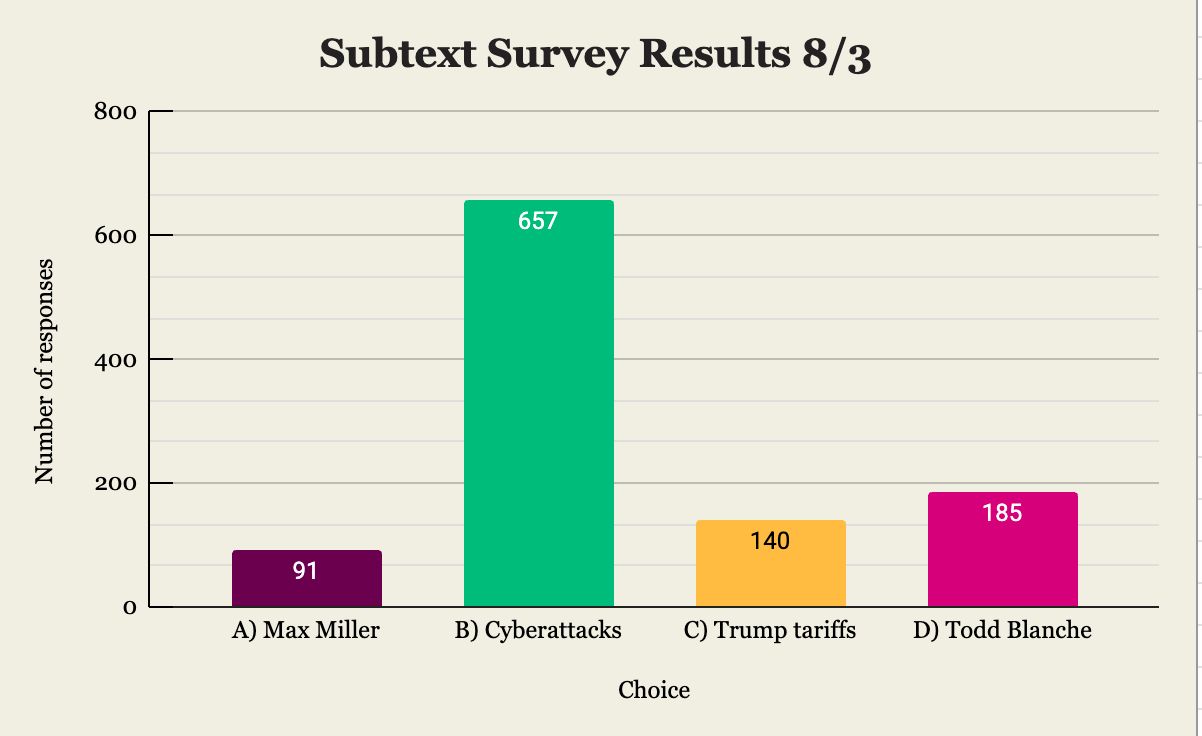
If we’re choosing from several good options without a clear frontrunner, reader responses to that informal survey can be decisive. That was the case just this week, when our readers gave us the very clear sign that they wanted to hear more about the cyberattacks on water systems. And since you asked for transparency, here’s a screenshot of those initial results:
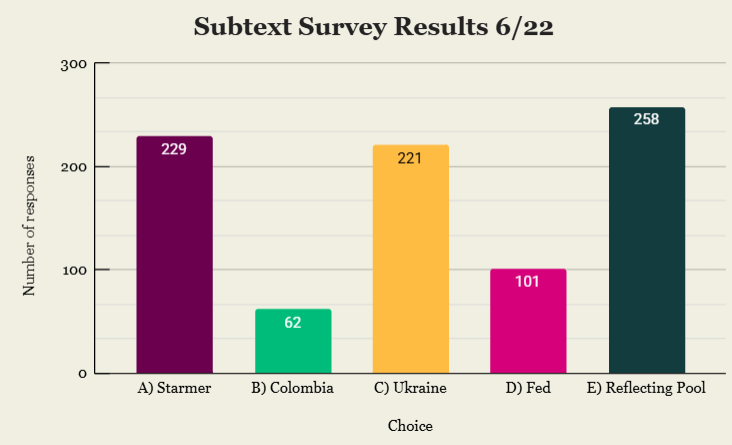
On the flip side, we have at times decided against covering the story that received the most votes in our survey. On June 22, readers wanted us to cover former UK Prime Minister Keir Starmer’s resignation or the Reflecting Pool. However, neither selection gained a majority, and we were not internally convinced of the relevance of those topics for the broader Tangle audience and eventually opted to cover events that we hadn’t been considering at the time we sent out the survey (we wrote about that decision here).
Every week is a different story — sometimes readers reinforce our priors, sometimes we opt against the favorites, and other times the results are so decisive they end up setting our agenda. But we always consider these reader surveys when making our decisions.
Want to have a question answered in the newsletter? You can reply to this email (it goes straight to our inbox) or fill out this form.
Numbers.
- $98.2 million. The approximate total spending on advertisements in the 2026 Michigan Senate primaries, according to AdImpact.
- $80.8 million and $17.3 million. The ad spending in Michigan’s Democratic and Republican Senate primaries, respectively.
- $63.9 million and $7.5 million. The ad spending in support of Rep. Haley Stevens and Abdul El-Sayed, respectively.
- 88%. The percentage of ad spending in Michigan’s Democratic primary from non-campaign groups (or outside groups).
Money.com compared 2026’s top-rated pet insurers.
One surprise vet bill can run into the thousands. A single surgery can hit $7,000, and cancer treatment can top $10,000. The right plan reimburses up to 90% of that; the wrong one leaves you guessing.
Money ranked this year’s top pet insurance providers side by side, so you can see who covers what, which plans are actually affordable (some start at $10 a month), and which fits your dog or cat.
The extras.
- One year ago today we covered redistricting efforts in Texas and California.
- The most clicked link in our last regular newsletter was our ad for The Penny Hoarder.
- Nothing to do with politics: A 1950 short story by Ray Bradbury that you have to read today (read to the end to find out why).
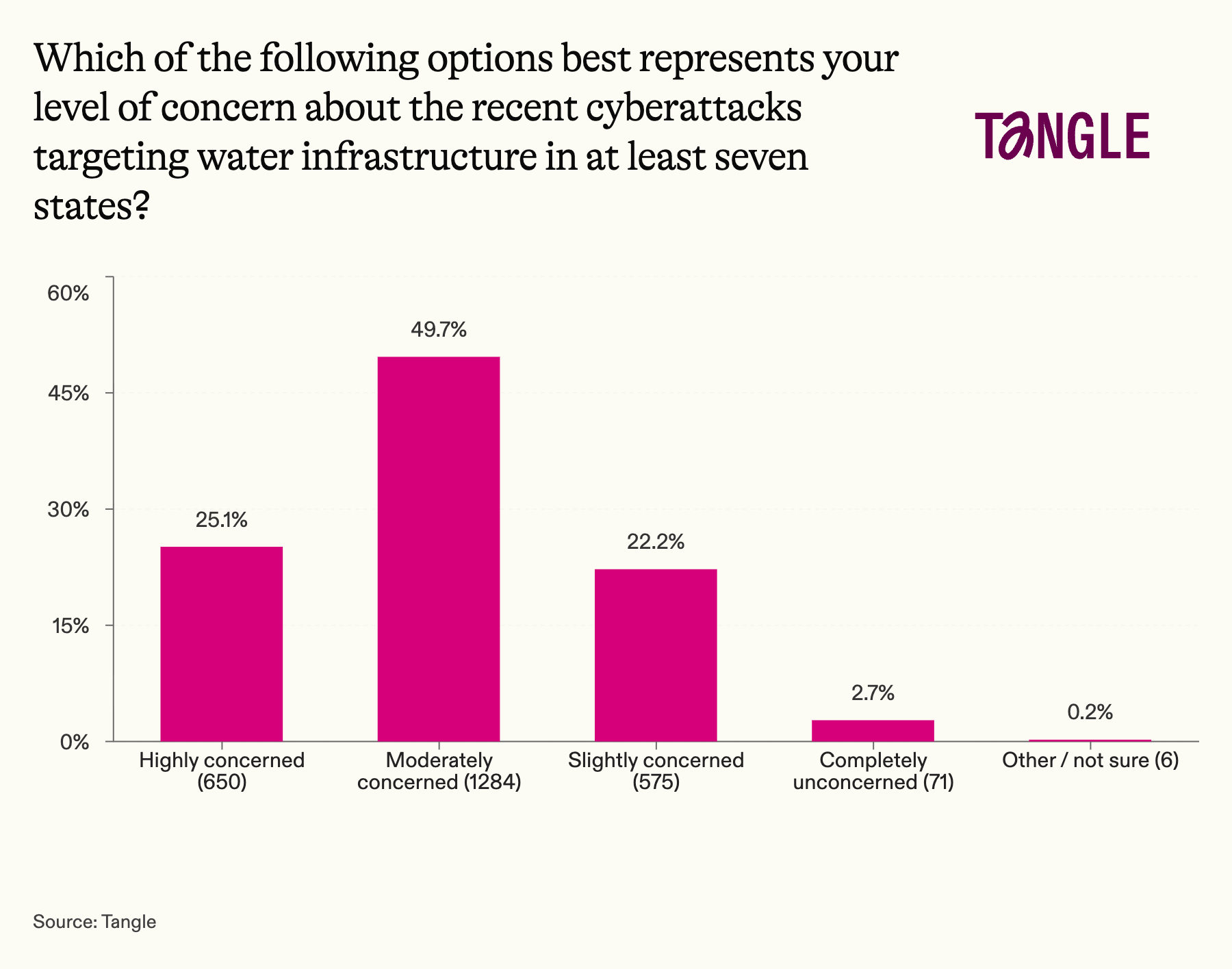
- Our last survey: 2,586 readers responded to our survey on the water infrastructure attacks in seven states, with 50% saying they are moderately concerned by the attacks. “Just because this attack did minimal damage doesn't mean these vulnerabilities can't be exploited at scale,” one respondent said. “I’m not at all worried if we take this opportunity to fix things and worried if we don’t,” said another.
Have a nice day.
In the last decade, the National Hockey League (NHL) recognized a need to prepare young athletes for their professional responsibilities. Their solution was surprising: improv class. They reached out to Second City Works, a business-to-business operation that uses the principles of improv to teach soft skills to corporate executives, sales teams, and (now) professional hockey players. On paper, the classes accomplish the goals of media training and teamwork. In practice, young athletes face the awkwardness of learning new skills through unexpected, comedic circumstances. “What we discovered when we first started working with the NHL is that these guys had to be introduced to the concept of applauding,” said Sandy Jobin-Bevans, a Second City comedian. “These are future superstars, so it’s not something they ever had to really do before.” The New York Times has the story.

Member comments