



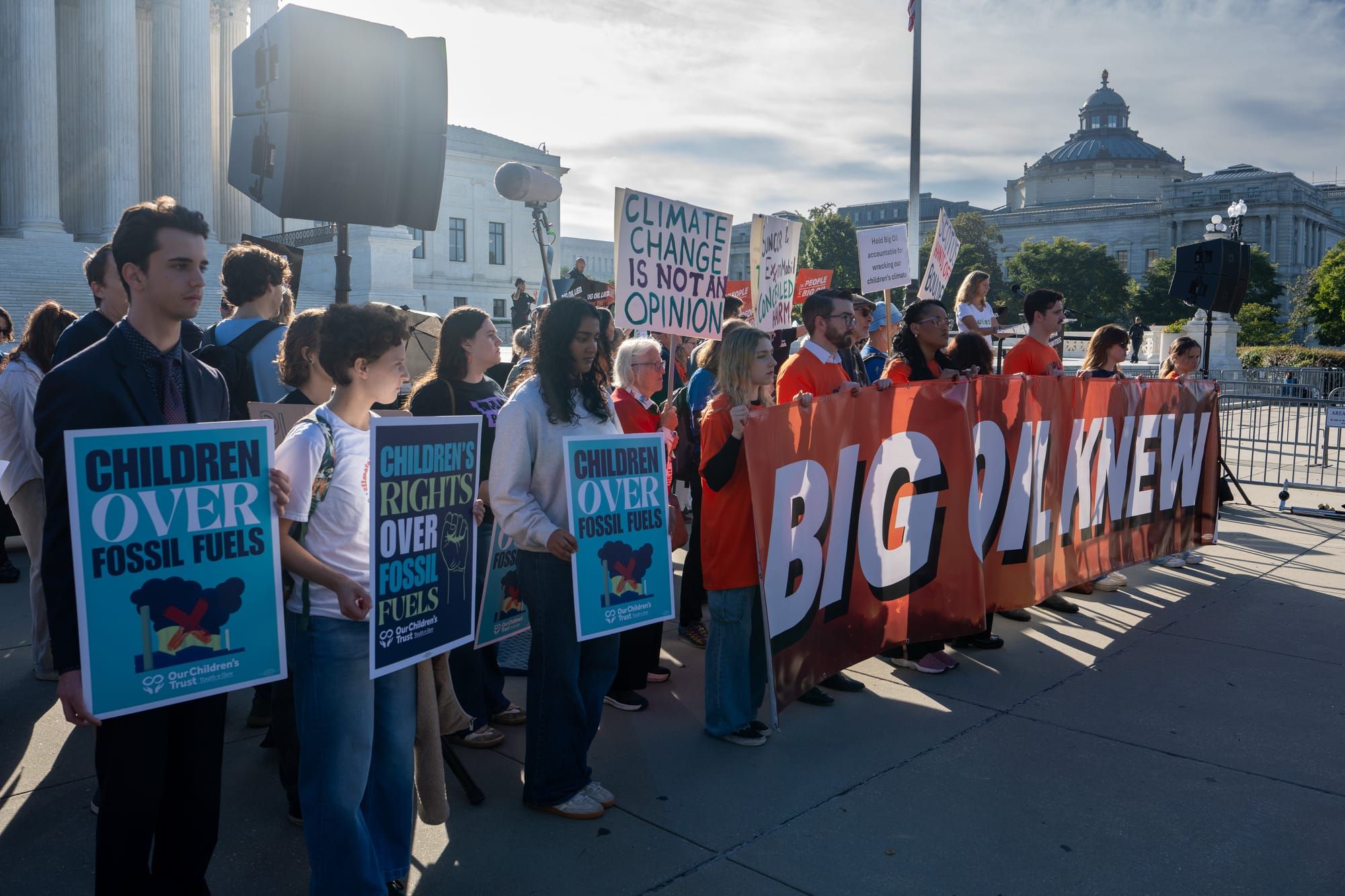


Welcome to Tangle. This is Senior Editor Will Kaback, and today, we’re rounding out our week of regular editions with the opening case of the Supreme Court’s new term. I spent yesterday afternoon reading through the transcript of oral arguments and was struck — as I usually am — by how issues that seem dry and technical on the surface come alive when they’re interrogated by the high court’s nine (well, in this case, eight) justices. This one is a bit of a doozy, touching on climate change, the energy industry and federalism, but we’ll dive right into the core questions at the heart of the case.
Then, we’ll answer a reader question on the national debt and share a heartening story of a resilient tree.
It’s a 13-minute read.
Isaac Saul, Ari Weitzman, Audrey Moorehead, Carina Pacheco, Russell Nystrom, Isaac Wood, and Bailey Saul edited or contributed to today’s newsletter.
The latest Suspension of the Rules.
This week's Suspension of the Rules spans several topics. First, as the midterms draw near, Isaac, Ari, and Kmele get ready with their election hot takes. Then, which former Tangle guests are getting themselves in hot water? And does the left have an anti-semitism problem? All this and more on today’s episode! Listen here or watch below:
Quick hits.
- The Pentagon has directed the U.S. military to prepare for new strikes on Iran as President Donald Trump reportedly weighs resuming combat operations. (The directive)
- Federal Bureau of Investigation agents arrested an 18-year-old man for allegedly plotting a terrorist attack at the Mall of America in Minnesota. (The arrest)
- Russia’s health regulator said “no emergency situations” occurred at a disease research lab where a researcher died after contracting pneumonia of an unknown origin. (The update)
- The Democratic National Committee sued the Trump administration for using federal funds to pay for allegedly partisan national television advertisements. (The suit)
- Hurricane Isaias is forecast to make landfall along the U.S. Gulf Coast this weekend. Florida Gov. Ron DeSantis (R) and Alabama Gov. Kay Ivey (R) declared states of emergency. (The forecast)
You’ll spend roughly 80,000 hours of your life working. That makes your choice of career one of your most important decisions.
80,000 Hours is a nonprofit that’s spent over a decade researching one question: how can you find a fulfilling career that does good? They’ve published a career guide that covers why “follow your passion” gets things backwards, which skills will increase in value in the age of AI, and why the highest-impact work is in areas most people have never considered.
Everything they provide is free, forever — their only aim is to help people find more fulfilling careers that do good.
Get your free copy of their in-depth career guide at 80000hours.org/tangle.
Today’s topic.
Suncor v. Boulder. On Monday, the new Supreme Court term began with oral arguments in a case over whether cities can sue energy companies for contributing to climate change. The arguments center on two major issues: whether federal law should block local governments from suing energy companies under state law, and whether the U.S. Supreme Court has jurisdiction to rule on the matter. Justice Samuel Alito, who is not involved with the companies named in the case but owns stocks in the energy industry, recused himself from the case.
Back up: In 2018, Boulder County and the city of Boulder, Colorado, filed a state lawsuit against the energy companies Suncor and Exxon on the grounds that the two companies had concealed and misrepresented the effects of climate change, exacerbating its effects and damaging Boulder’s property and residents. The companies sought to have the case dismissed on the grounds that they could not be held subject to state laws on climate change; the Colorado Supreme Court ruled that Boulder could sue under state law. The U.S. Supreme Court agreed to hear the companies’ challenge to the Colorado court’s ruling in February.
During oral arguments, the energy companies argued that state law cannot be used to “regulate global conduct”; longstanding court precedent leaves issues of climate change to federal law, and allowing local jurisdictions to sue for damages would unfairly burden global companies like Suncor and Exxon. Boulder County argued that states have long had the power to remedy local harms, even when the conduct that led to injury occurred elsewhere.
The justices’ positions during oral arguments were mixed. Justices Clarence Thomas, Sonia Sotomayor, and Ketanji Brown Jackson asked several questions about the Court’s jurisdiction over the case. Chief Justice John Roberts and Justice Elena Kagan each questioned whether past precedent allowing state laws to apply to larger companies should guide the Court’s decision. Justices Brett Kavanaugh and Amy Coney Barrett questioned whether allowing Boulder’s lawsuit would create too wide an avenue for future litigation. If the final decision is split 4–4, the Colorado Supreme Court’s ruling will stand.
Below, you’ll hear views from the right and left on the case. Then, Senior Editor Will Kaback gives his take.
|
What the right is saying.
|
In the Washington Post, Michael Toth argued “this Supreme Court case is much bigger than oil and gas.”
“The underlying question should be straightforward: Can a state or local government regulate emissions that occur somewhere else? Under the city’s theory, any company that sells products in a state or municipality could be sued there for its worldwide emissions, even if only a tiny fraction occurred in the jurisdiction bringing the suit,” Toth wrote. “Letting a state court apportion responsibility for global energy demand isn’t adjudication — it’s a usurpation of the federal government’s exclusive authority over foreign affairs.
“Boulder invokes a Clean Air Act provision preserving states’ authority to set stricter emissions standards than Washington. But the Constitution does not allow a state to impose its standards on emissions occurring beyond its borders,” Toth said. “Suncor is bigger than oil and gas. It is about whether any company meeting global demand for its products can be regulated from any courthouse in America, at any time, for conduct occurring somewhere else.”
In the Daily Caller, David Blackmon called the original lawsuit “climate lawfare.”
“This Boulder case is not even the latest in this blatant lawfare campaign which is designed less to win judgments than to extract pounds of flesh from the industry defendants via tens of millions of dollars wasted on litigation costs,” Blackmon wrote. “It is lawfare, not environmental stewardship. Every dollar wasted by the industry throughout this lawfare campaign means a dollar less being spent on drilling, refining, or keeping power and fuel prices affordable.
“The courts, regulatory agencies, and Justice Department have repeatedly ruled during administrations of both parties that climate policy of national scale has to be handled by the federal government,” Blackmon said. “The justices should tell Boulder and its lawfare attorneys no, but Justice Samuel Alito’s recent recusal leaves open the possibility that a 4–4 split might leave the mess made in the lower courts in place. That is a very bad place for America and its future energy security to be.”
In Bloomberg Law, Donald Kochan said the Court has the “chance to end legally flawed climate claims.”
“The case could have major implications for federal-state balance, separation of powers, and the availability of creative and market-disruptive lawsuits across dozens of cases nationwide,” Kochan wrote. “In [AEP vs. Connecticut], Justice Ruth Bader Ginsburg delivered a unanimous opinion, holding that public nuisance and related claims based on alleged harms from the transboundary effects of emissions would, by default, be governed by federal common law if any were to exist.”
“Any attempts to inject requirements beyond what Congress set in the Clean Air Act would upset the delicate balancing that Congress is allowed when setting national and international policy in such areas, according to Ginsburg’s opinion,” Kochan said. “Since the AEP decision, plaintiffs’ attorneys have developed creative litigation strategies… The Supreme Court in Suncor can put an end to at least one area of this entrepreneurial lawyering that has gone on far too long.”
|
What the left is saying.
|
In The Nation, Elie Mystal wrote “this lawsuit could make Big Oil pay for the harm it’s caused.”
“If [this lawsuit isn’t dismissed], it could allow local governments and maybe even individual citizens to sue energy companies for the effects of climate change,” Mystal said. “People might be able to sue for everything from adverse health outcomes to lost property. It could fundamentally change the way oil and gas companies operate across the country and, most likely, across the entire world. But the lawsuit is not going to be successful.
“Unlike the tobacco industry… this is Big Oil we’re talking about, an industry with a market valuation upwards of $4 trillion,” Mystal wrote. “I think a win here for Boulder could wreck the fossil fuel industry… Which is why the Supreme Court won’t let that happen. It’d be chaos — glorious, righteous chaos… What’s sad is that the court will care more about the practical effect of climate change lawsuits than the practical effects of climate change.”
In Vox, Ian Millhiser suggested the Court is “looking for a way to kill climate lawsuits.”
“The outcome in Suncor is uncertain. The oil companies led with a weak legal argument, and only Kavanaugh seemed to fully embrace that argument. Many of the justices appear bothered that these lawsuits exist, but the most skeptical justices couldn’t agree on a legal theory they could use to shut them down,” Millhiser wrote. “Under our Constitution, the proper solution if the oil companies want federal law to preempt state court suits like Suncor is that they can lobby Congress, and Congress could then draft a statute.”
“Congress has the power, for example, to combine all of these state lawsuits into one grand federal lawsuit, where a single proceeding could determine how to portion out the costs of climate change to various energy companies, and how to divide whatever these companies are ordered to pay among the various plaintiffs,” Millhiser said. “But that solution would undoubtedly require compromises that companies like Exxon will not like. So, instead, they’ve asked the Supreme Court to give them the legal regime that they want.”
In Balls and Strikes, Madiba K. Dennie argued “oil companies are begging the [Court] to let them off the hook.”
“Boulder has already spent over $100 million repairing damage related to climate change, and expects to spend over $100 million more in order to adapt its infrastructure over the next 25 years,” Dennie wrote. “Climate change has a hefty price tag, which is why dozens of state and local governments like Boulder’s have filed lawsuits to force the culprits to help pay the costs. It’s also why polluters like Suncor Energy and Exxon are desperate to get the lawsuits thrown out of court.”
“Although the court routinely takes the side of corporate power over people and the planet, Justice Sam Alito’s last-minute recusal from the case means Boulder only needs one Republican justice to defect,” Dennie said. “As the federal government’s response to the climate crisis ranges from disinterest to disdainful, state and local governments have had to ask: Can’t anyone do anything about this harm? Again and again, the court’s answer has been no. Now the prospect of accountability turns on getting a single Republican justice to say yes.”
|
||||
|
||||
|
Reminder: This is where we share a personal opinion. If you have feedback, criticism or compliments, leave a comment or reply to this email.
|

In the long run, this could end up being one of the most consequential Supreme Court decisions of this term. Boulder’s suit against Suncor and Exxon charges that energy companies are financially liable for environmental harms caused by fossil fuel-driven climate change. If it succeeds, it could both create a path for other cities and states to bring similar suits and compel energy companies to shift their business models away from fossil fuels.
In the short run, however, the Court won’t be ruling on the merits of the suit. Instead, it’s weighing whether Boulder can sue at all. That question is a bit technical, but the Court’s ruling will determine the long-term trajectory of this case and others like it.
I found Monday’s oral arguments compelling on both sides. Kannon Shanmugam, the attorney representing Suncor and Exxon, centered the Court’s past rulings on the Clean Air Act (CAA) and the Clean Water Act (CWA), arguing that only the Environmental Protection Agency (EPA) can regulate issues involving interstate pollution. Even before the CAA, the Supreme Court held that disputes over interstate pollutants were a federal matter. In Illinois v. Milwaukee (1972), Illinois sued Milwaukee — a city in Wisconsin — for allegedly creating a public nuisance by dumping sewage into Lake Michigan. The Court ruled unanimously that federal common law governs these types of interstate claims, dictating that the case be heard in federal district court. After the CWA was enacted, the Court ruled that the law now superseded its prior decision, solidifying the precedent that the EPA was responsible for regulating these matters. That meant Illinois would need to appeal to the EPA to stop Milwaukee’s dumps.
This precedent helps Suncor’s case. In Shanmugam’s words: “Because of the ambient nature of air and water and the conflicting rights of states, this Court has held for over a century that federal law governs interstate pollution claims. That principle applies with even greater force to claims involving global climate change.”
On the other side, Kevin Russell, the lawyer for Boulder, argued that the lawsuit isn’t about regulating interstate pollution but holding energy companies financially accountable for harms that result from that pollution (also known as tort claims, or demands for compensation to address another actor’s harmful actions). “When somebody in New York defames a citizen of Boulder on national television or somebody in California releases a computer virus on the Internet or a biological virus into the world and it causes mass damage in Colorado, it has never been thought that only federal law can provide a remedy simply because the tortious conduct and the injury occurred in different states,” he said.
Russell also noted that Congress has not passed any law — in the CAA, CWA, or otherwise — that says energy companies can’t be sued for damages from fossil fuel emissions. A brief submitted to the Court highlights that Congress has acted to insulate some entities (like gun manufacturers) from tort claims for alleged harms associated with their products, and it could do the same for energy companies if it wanted to. But until it does, nothing prevents Boulder from bringing this suit.
Of course, the absence of an explicit provision that says “states cannot bring civil suits for fossil fuel-related damages” doesn’t mean federal law inherently allows it. For instance, the Supreme Court ruled in International Paper Co. v. Ouellette (1987) that Vermont residents could not sue a New York paper mill for polluting Lake Champlain in violation of a Vermont state law, despite the lack of an explicit federal provision against such a suit. The Court’s decision was direct: “It is not necessary for a federal statute to provide explicitly that particular state laws are pre-empted.”
I was interested to see how the justices probed these competing arguments, and I thought Chief Justice Roberts got at the heart of the dispute. He asked Principal Deputy Solicitor General Sarah Harris, who argued in support of the energy companies, why the state should be barred from pursuing damages when these kinds of civil suits are permitted for a range of other companies and industries (drug makers, car manufacturers, etc.). Harris responded that Colorado’s suit was different, an attempt to control energy companies’ behavior, but Roberts seemed unconvinced.
On the other side, the chief justice pressed Russell on the practical implications of the suit and whether it is a thinly veiled attempt to circumvent the EPA and CAA. “If you prevail, the next day, a municipality in every single state will file a lawsuit, they’ll probably copy your pleadings, and then… at least 50… different cities in one state could do it,” he said, later suggesting, “[the lawsuit is] an effort to reduce emissions.”
After reading these exchanges and the related arguments, I found Boulder’s case more persuasive, particularly the point that the CAA does not prevent it from seeking damages for energy companies’ actions. Yes, federal law and Court precedent clearly prevent states from establishing laws that regulate interstate pollution or energy company behavior, but Boulder is cleverly side-stepping that issue. It’s not suing to force Suncor and Exxon to conform with its laws directly, but to collect damages for alleged harms. That’s a different issue than the one raised in Ouellette or Illinois v. Milwaukee, which dealt with state laws that sought to regulate polluter behavior; as Roberts noted, Boulder’s case is in line with standard tort claims. I don’t think there’s clear precedent or law to stop this suit from proceeding.
Would that be a good thing? Even as someone who cares about the negative impacts of fossil-fuel-driven climate change, I worry about the implications. Roberts suggested that a ruling in favor of Boulder would immediately prompt 50 different cities in one state to do the same; I think it’d be more like hundreds of cities in tens of states (dozens of similar cases are already pending across the country). To me, it underscores the prudence of having an agency like the EPA to establish and enforce uniform rules. Without it, the potential for chaos reigns.
You don’t need to sympathize with these energy companies or downplay the role of fossil fuels in climate change to scrutinize the ramifications of ruling in Boulder’s favor. Drowning Exxon in a deluge of litigation surely sounds nice to some, but I don’t think battling energy producers by proxy lawsuit is a smart strategy, as there’s no guarantee that these suits will actually win on the merits. Companies may not alter their behavior, either, instead opting to jack up prices.
It’s also clear to me that Boulder’s suit is a de facto attempt to regulate energy companies, one that violates the spirit of the CAA and Court precedent. If it succeeds, the city could demand payment for a vast array of environmental issues; its suit lists heat waves, wildfires, droughts, floods, and more as hazards exacerbated by climate change that fossil fuel producers could be partially liable for. The breadth of that claim is inherently coercive — in response, energy companies would have to move entirely away from fossil fuel production or be sued out of existence. Again, I think you can view these companies as harmful polluters and still see how that new status quo would conflict with the EPA’s well established power to regulate emissions and emitters.
I don’t have a strong sense of how the Court will rule; other justices (not just Roberts) seemed uncertain of both sides’ arguments. A plausible outcome is a 4–4 split with Roberts joining the three Democratic-appointed justices, which would leave the Colorado Supreme Court’s decision in place and allow the suit to proceed. Alternatively, the Supreme Court could decide that it is too early for it to weigh in on the case and allow the suit to proceed on that basis.
I’m left in an uneasy position of supporting Boulder’s legal arguments for letting the case proceed while worrying about the consequences of it succeeding. Ultimately, a resolution may only come once lower courts have had the opportunity to decide on the merits, at which point the case may end up back before the Supreme Court.
|
||||
|

Take the survey: Should states be able to sue energy companies for damages related to climate change? Let us know.
Disagree? That’s okay. Our opinion is just one of many. Write in and let us know why, and we’ll consider publishing your feedback.
Your questions, answered.
At what point will our ever increasing national debt become a real problem that needs to be addressed?
— Cindy from Ojai, California
Associate Editor Carina Pacheco: The national debt is a prominent political issue that is usually at the forefront of national policy debates. Politicians on both sides of the aisle have expressed concern at the towering scale of the national debt, which hit the $40 trillion mark in August. There’s no one specific benchmark that would signify a real drastic financial threat, but many economists and policymakers theorize that $40 trillion is a major economic concern because of how much of the federal budget goes to interest on the national debt.
The United States collected about $5.23 trillion in tax dollars last year, but spends over $7 trillion each year. The money the government borrows is in the form of bonds, which are sold to pension funds, foreign countries, businesses, and even private citizens.
The federal government dedicates nearly two thirds of its budget to mandatory and safety-net-related spending like Social Security, Medicare, and Medicaid. Defense spending accounts for roughly 13% of the overall budget, and interest payments on the national debt account for about 15% — that’s roughly one trillion dollars a year.
Simply having national debt isn’t inherently a bad thing, because it allows the government to build or provide expensive infrastructure or services quickly. But as for any borrower, taking on debt gets bad when the interest starts to add up. When the debt and concurrent interest are too high, instead of spending over a trillion dollars on schools, parks, highways or other public benefits, that sum is going straight to paying down interest on the national debt.
So, while there is no fixed dollar amount that will set off alarm bells, experts are concerned that the interest is growing faster than the U.S.’s overall economy — as of this year, interest costs are projected to double by 2036. And since spending isn’t likely to slow down anytime soon, the conversation about the national debt is likely to remain front and center.
Want to have a question answered in the newsletter? You can reply to this email (it goes straight to our inbox) or fill out this form.
You’ll spend roughly 80,000 hours of your life working. That makes your choice of career one of your most important decisions.
80,000 Hours is a nonprofit that’s spent over a decade researching the question: How can you find a fulfilling career that does good? Everything they provide is free, forever.
Get your free copy of their in-depth career guide at 80000hours.org/tangle.
The extras.
- One year ago today we covered U.S. strikes on alleged drug boats near Venezuela.
- The most clicked link in our last regular newsletter was our new video on the National Guard deployment to Washington, D.C.
- Nothing to do with politics: See what the world would look like at different sea levels.
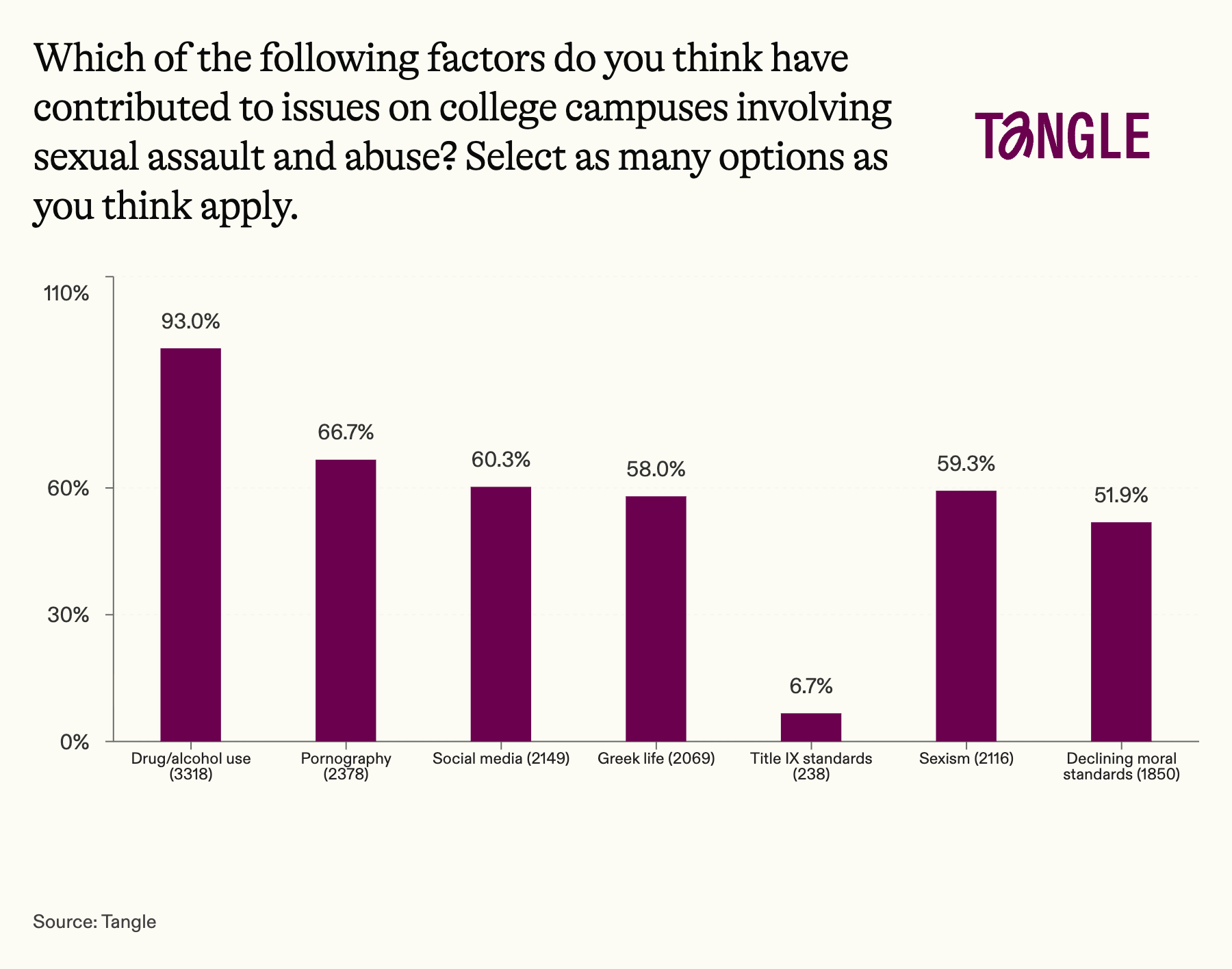
- Our last survey: 3,566 readers responded to our survey on the rape allegations at Cornell University, with 93% saying drug and alcohol use contribute to issues on college campuses involving sexual assault and abuse. “It is not just a problem at Cornell. It is a problem at all universities. The antiquated Greek system and alcohol contribute to it,” one respondent said. “Until we can collectively see others as more than objects of sex, scorn, hatred, pleasure or utility, and as embodied human beings, things will only continue to decline,” said another.
Have a nice day.
Three years ago, two men illegally cut down England’s Sycamore Gap tree for unknown reasons. The tree had been a local landmark and something of a pop culture icon, and its felling devastated people in the local community and beyond. However, on September 28, the conservation charity National Trust shared that leafy shoots have sprouted around the Sycamore Gap’s base, calling it “a sure sign that the tree is in recovery.” These signs offer hope that the resilient tree will one day grace the English countryside again. Smithsonian Magazine has the story.

Member comments