







Hello, happy Hump Day, and welcome to Tangle. This is Senior Editor Will Kaback. President Trump’s White House ballroom project is back in the headlines this week, and the Supreme Court may have just written the final chapter in the construction saga (emphasis on “may have”). There’s a bit more than meets the eye here, so stick around as we parse the Court’s Monday decision. As a bonus: I finally get to connect Robert Moses to a contemporary news item, which I’ve been pining to do after spending the bulk of last year reading Robert A. Caro’s The Power Broker.
We’ve also got some interesting numbers about the scale of the planned ballroom construction, plus a story about an incredible rescue in an underwater cave.
It’s a 13-minute read.
Get texts from us.
The news cycle is heating up as we head into the midterms, and you can follow along with us every step of the way. On our SMS messaging service, we give readers exclusive opportunities to weigh in on our daily topics, access to behind-the-scenes peeks at our editorial process, and staff analysis of breaking news that doesn’t go to the newsletter.
Opt in to only the texts that you want, and cancel anytime.
To join the conversation, sign up here!
Quick hits.
- U.S. Central Command said the military carried out a new wave of airstrikes against Iranian targets in response to Iranian missile and drone attacks on U.S. bases in the Middle East. (The latest)
- Sen. Ed Markey defeated Rep. Seth Moulton in Massachusetts’s Democratic Senate primary. Markey will face Republican attorney and veteran John Deaton in the general election. (The result)
- Germany said it believes Russia was behind an attempt to send explosive drones to a German airport in August. Germany’s interior minister said, “We do not consider ourselves at war but we are the daily target of hybrid warfare,” and pledged to seek new sanctions against Russia. (The accusation)
- The House voted 370–48 to pass a three-month spending bill in advance of a September 30 funding deadline. The Senate passed the bill in August, and it now goes to President Trump to sign. (The bill)
- House Minority Leader Hakeem Jeffries (D-NY) rebuked Reps. Jared Golden (D-ME) and Marie Gluesenkamp Perez (D-WA) after they cast deciding votes to pass a Republican-led procedural measure advancing parameters for how a set of bills will be debated on the House floor. (The criticism)
Nosier Than Your Neighbors
Every website you visit leaves a trail. And between internet providers, public WiFi and various online snoops, more people can potentially see that trail than you might like.
Proton VPN helps shut the curtains. It encrypts your connection and hides your IP address so your browsing stays more private.
You can use it on up to 10 devices, take it traveling to keep streaming your usual shows, and run it without feeling like you’ve returned to dial-up speeds.
Tangle readers can get 70% off Proton VPN for a limited time, with a 30-day money-back guarantee.
Today’s topic.
The White House ballroom ruling. On Monday, the Supreme Court decided 5–4 to allow President Trump to continue above-ground construction on his White House ballroom project. The unsigned order pauses a federal judge’s halt on above-ground construction, stating the plaintiff likely lacks legal standing. However, the majority did not decide whether Trump has the legal authority to build the ballroom without congressional approval, and litigation will continue in lower courts.
Back up: In July 2025, the Trump administration released plans to construct a 90,000-square-foot addition to the White House, and in October construction crews began demolishing the White House’s East Wing. The project, originally estimated to cost $200 million, would feature a large ballroom and underground military compound. The National Trust for Historic Preservation in the United States (NTHP) sued the National Park Service and Donald Trump, among other defendants, alleging that presidents cannot demolish parts of the White House without congressional authorization.
In March, U.S. District Judge Richard Leon ordered above-ground construction on the project to pause, saying the president is the steward of the property and not the owner. The Trump administration asked the Supreme Court to issue an immediate administrative stay on Leon’s order on August 13; Chief Justice John Roberts granted the request on August 21.
Roberts’s order temporarily allowed above-ground construction to continue while the Supreme Court considered the case. Ten days later, the Court ruled in favor of the administration. The five-justice majority cited national security concerns and rejected the plaintiff’s asserted basis for legal challenge based on grounds of “aesthetic, cultural, and historical interests.” The unsigned opinion said, “Mere offense, disagreement, or distaste does not qualify as a concrete and particularized injury under Article III [of the U.S. Constitution].”
Chief Justice John Roberts, joined by the Court’s three Democrat-appointed justices in dissent, argued that federal law requires congressional approval for any construction in federal parks in the District of Columbia. Roberts also cited Court precedent that environmentalists can have standing based on being “aesthetically injured” by the destruction of ecosystems, drawing the parallel that preservationists can have similar standing based on the destruction of historic buildings.
The NTHP president and CEO, Brent Leggs, criticized the ruling. “We are deeply disappointed in the Supreme Court’s ruling today and respectfully disagree with the majority’s opinion on standing,” he said. “It is noteworthy that the majority did not weigh in on whether the ballroom project was in fact legal.”
Donald Trump called the NTHP lawsuit “baseless” and celebrated the Court’s decision. “I am pleased to report that the United States Supreme Court has just ruled in favor of the Ballroom/Military Complex being built without any further contingency, doubt, or threat,” he said, predicting that construction will finish in summer of 2028.
Today, you’ll hear views from the right and left on the ruling. Then, a take from Senior Editor Will Kaback.
|
What the right is saying.
|
In National Review, Dan McLaughlin suggested the ruling “looks like the right decision.”
“[Alison Hoagland, who serves on the NTHP board of trustees,] hasn’t been personally harmed in any way; she just doesn’t like the way the place looks. That would be a flimsy basis for a property owner to complain of a neighboring building, short of meeting the common-law standard for a nuisance — let alone a person who just walks by a building now and then,” McLaughlin wrote. “As it happens, ‘aesthetic standing’ really is a thing in the law, however — if a dubious one. The doctrine, like so many silly things, comes out of a 1970s opinion, Sierra Club v. Morton (1972).”
“It is, however, largely a creature of environmental law, in which courts tend to stretch the law of standing on the theory that the legal protection of nature is intended in good part to benefit people who use parks… This case, however, is quite different: If Trump is breaking the law in renovating the East Wing of the White House, the real victim is Congress,” McLaughlin said. “[Chief Justice Roberts argued,] ‘The White House is not just any building, and — when it comes to historic preservation — Hoagland is not just any person.’ But in a republic where all of us are created equal, maybe she is.”
The Washington Post editorial board wrote about “what Trump’s ballroom win really says about the Supreme Court.”
“Those who want to portray the court as a puppet for President Donald Trump will point to Monday’s ruling on the White House ballroom as supposed proof… But look at the case’s details,” the board said. “The majority based its decision on standing. In general, a person needs to face a ‘concrete and particularized’ injury to bring a valid lawsuit… Millions of Americans are offended by Trump’s unilateral effort to change the White House, but that doesn’t give courts standing to enter a judgment on their behalf.
“Saying so reflected venerable conservative priorities. In general, while liberals have been open to relaxing rules around standing, conservatives have resisted,” the board wrote. “This was a conservative decision, not a pro-Trump one… It’s a shame that the separation of powers didn’t work as intended, with Trump and Congress agreeing on what reasonable construction would look like. But the Supreme Court wouldn’t have strengthened the constitutional order by overstepping its own legal role.”
In PJ Media, Matt Margolis said “being offended isn’t a legal injury.”
“Presidents from both parties have wanted a White House ballroom for years. State dinners have been hosted in a tent on the South Lawn, forcing foreign dignitaries to trudge outside to portable toilets. This was never about the ballroom itself; it was about the fact that Trump is finally the one building it, and the left can’t stand it,” Margolis wrote. “In his dissent, Roberts wrote that the construction was ‘likely unlawful’ and argued the majority was letting it proceed ‘not because that construction is legal,’ but because the Trust likely lacks standing to sue.
“There’s no reason to justify the claim that the project was unlawful. In fact, presidents have been renovating and expanding the White House for more than a century, and nobody sued over it then,” Margolis said. “Franklin D. Roosevelt installed an indoor pool and expanded both wings. Harry Truman gutted and rebuilt the entire interior in 1948. Richard Nixon added the press briefing room and a bowling alley. Barack Obama spent two years and $375 million turning the tennis court into a basketball court, and nobody on the left blinked. And you didn’t see that project get tied up in lawsuits either.”
|
What the left is saying.
|
In Vox, Ian Millhiser said the Court “just gave Trump his illegal ballroom.”
“Notably, no member of the Court argued that Trump’s ballroom, an enormous structure that the president plans to build on the former site of the White House’s East Wing, is legal,” Millhiser wrote. “Because the majority opinion is so poorly explained, it is hard to tell what its implications will be. If the Court had explicitly overruled its past decisions holding that a plaintiff may often sue to challenge the destruction of something beautiful, that would be an existential threat to countless environmental, conservationist, and historical preservation laws that all exist to preserve natural or historic beauty.”
“But the Court’s failure to explain why [Lujan v. Defenders of Wildlife] does not require them to rule against Trump leaves lawyers and judges to guess at what the Court just did to the rules governing standing,” Millhiser said. “Perhaps this is a one-off decision intended solely to do a favor for Trump. Or maybe it’s the harbinger of a future decision setting much of America’s environmental protection regime on fire. The five justices in the majority barely explain themselves, so we cannot yet know what National Park Service means. But one thing that is clear is that the decision makes no sense.”
In Balls and Strikes, Jay Willis suggested the ruling is “everything Trump could have asked for.”
“The upshot of National Park Service v. National Trust for Historic Preservation is that whether or not Trump’s already-in-progress ballroom is ‘legal’ — something that, in my view, the Supreme Court of the United States really ought to weigh, but whatever — no one has the power to stop its construction, even temporarily,” Willis wrote. “As a result, if a federal court eventually rules on the merits that, no, Trump can’t build the ballroom, that conclusion will be academic. The ballroom will already be complete.”
“National Trust for Historic Preservation is yet another entry in the canon of cases in which the conservative justices… cobble together some half-assed gibberish to assert that The Law compels their preferred result. An abstract concept like standing doctrine is especially useful in this context, since its contours are flexible,” Willis said. “The fight over the ballroom lays bare the absurdity of the Court’s strategy of ‘resolving’ Trump-adjacent cases by pretending to do something (anything) else. For Trump and the Trust and everyone else watching this case, the only thing that matters here is whether the conservative supermajority’s favorite president gets to build what he wants.”
In Mother Jones, Pema Levy argued “the president’s lawlessness is the chief justice’s fault.”
“While Roberts clearly doesn’t want to be blamed for the ballroom, he wrote many of the precedents that undergird the majority’s decision to let it go forward… In case after case, the majority presumed that the harm to Trump is greater than the harm to the targets of his actions — even when those are far more irreparable and concrete,” Levy wrote. “There is an irony in Roberts’ unwillingness to go along with this view of executive prerogative in the ballroom case, because he is largely responsible for it.
“In decision after decision, Roberts has imbued the presidency with the powers of the so-called unitary executive, a king-like ruler with total control over the executive branch,” Levy wrote. “The country, he promised, would be better off with a decisive leader, rather than one who must ‘“answer for his conduct” in court.’ Just one year later, Trump decisively but illegally razed the East Wing and started building a giant ballroom… On Monday, the court once again told Trump to go ahead with an illegal scheme. The lesson is clear.”
|
||||
|
||||
|
Reminder: This is where we share a personal opinion. If you have feedback, criticism or compliments, leave a comment or reply to this email.
|

A brash New Yorker sets his sights on a legacy-defining construction project. He knows he’ll face staunch opposition, and the funds needed to complete the project are not guaranteed. But he has an ace up his sleeve (or, really, a willingness to exploit flaws in the system): just start building.
That New Yorker was urban planner Robert Moses, and the project was his incalculably large transformation of the city from 1924 to 1968, often at the expense of lower-class residents and, in his later years, with little regard for the law. Here in the 21st century, that description also applies to President Donald Trump and his White House ballroom.
Moses’s challenge was securing public financing for his enormous public works projects. He realized that if he could obtain an initial sum to get his projects started, lawmakers and public officials would be more likely to relent and approve the rest of the funding later on. Once he’d put down stakes and spent the initial capital, city and state officials didn’t want to let construction sites sit half-complete, wasting both money already expended and the work already done. More often than not, Moses got the funds he needed.
Trump’s challenge with the ballroom is a bit more complex: He has ostensibly raised necessary funding from private donors to start the project, but tearing down an entire wing of the White House and putting something new in its place isn’t the same as constructing a new highway. In theory, such an endeavor requires congressional authorization and multiple executive agency reviews. Trump has essentially sidestepped these hurdles by employing the Moses strategy — tearing down the East Wing without following normal procedures, and daring the courts or Congress (or anybody, really) to stop him after taking irreversible steps.
To understand how we got to this point, we can contrast what should have happened to what has happened.
In the normal process, the Trump administration would have begun by consulting Congress about its plans. Yes, Section 107 of the National Historic Preservation Act exempts the White House and its grounds from requirements that constrict other prospective building projects on federal properties. That exemption, however, does not give the president boundless authority to alter the executive mansion. As the Court of Appeals for the D.C. Circuit noted in its August decision, Congress has broad authority over federal property, which includes the White House.
Next, assuming authorization and funding for the project were secured, the National Capital Planning Commission (NCPC) and the Commission of Fine Arts (CFA) would each review the planned construction. After clearing final designs and ensuring permits were in place, demolition and construction would begin.
Here’s what actually happened. Trump announced the project in July 2025, and within two months, site work began without congressional consultation or commission review. Between October 20 and 24, the entire East Wing was demolished. Despite this progress, the CFA was still set to review the administration’s ballroom plans, and it could have still raised concerns. However, in late October, President Trump fired all six of the commission’s members before they could issue their report. In January of 2026, the president appointed new CFA members widely viewed as administration allies; they joined the loyalists already on the NCPC, who had been appointed in July 2025.
The newly constituted CFA began its review in January, and it approved the plan in February. NCPC approval followed in April. Of course, these assessments were largely pointless by then, as the East Wing was already gone. All that was left to do was rubber-stamp the ballroom construction that was (surprise, surprise) well underway.
In sum: The Trump administration ignored proper procedure at key steps, disregarding Congress and taking irreversible action before the courts could catch up. Whatever you think of the merits of the ballroom itself, that underlying narrative is hard to dispute.
Given the president’s disregard for proper procedure in tearing down the East Wing, you might assume that the courts would prevent any further action while challenges to the project proceeded. How, then, did the Supreme Court arrive at this week’s decision? The answer is technical and leaves me feeling unsatisfied.
As a brief refresher, the National Trust for Historic Preservation (NTHP) sued last December to pause ballroom construction, claiming that group member Alison K. Hoagland would suffer irreparable harm to her “aesthetic, cultural, and historical interests” if the ballroom were built. It also said in a later filing that the government’s national security interests wouldn’t be harmed in this instance, since a lower-court ruling allowed underground construction of a secure bunker to continue.
But the majority disagreed, deferring to the government’s broad claim that “constructing something approximating the height and mass of the intended above-ground ballroom is ‘crucial’ to the security of the below-ground military installation.” Furthermore, it rejected the NTHP’s argument that Hoagland had standing to sue, writing, “Mere offense, disagreement, or distaste does not qualify as a concrete and particularized injury.”
In his dissent, Chief Justice Roberts noted that the Court has held that aesthetic injury can qualify for standing in environmental cases, comparing Hoagland’s preservationist interest in a public historic site to a conservationist’s desire to observe an endangered species in the wild.
On the narrow question of standing, I can understand both perspectives, but I’m more convinced by the majority. I also think the principle of standing is far from trivial — it prevents frivolous lawsuits and focuses the legal system on cases where courts can offer redress for alleged harms. Those on the left outraged by this ruling should remember all the times the Supreme Court ruled in their favor on issues of standing: California v. Texas (2021), which preserved the Affordable Care Act; United States v. Texas (2023), which upheld the Biden administration’s immigration policies; Food and Drug Administration v. Alliance for Hippocratic Medicine (2024), which upheld access to abortion medication; and many more.
However, what frustrates me about this outcome is what it means for challenges to Trump’s “Moses strategy” in the future. If “aesthetic, cultural, and historical interests” don’t meet the threshold for standing in this case, who besides Congress itself could bring a valid suit? In effect, the Trump administration appears to have broken the law without leaving anyone with a sufficiently direct injury to challenge it, thus allowing it to proceed. That feels unacceptable — but I’m not sure what can be done.
I fully acknowledge that, as Isaac wrote when we covered the demolition last October, this ballroom project is far down the list of pressing national issues; but at the same time, it’s really about more than the ballroom. Trump is currently threatening to tear down the Kennedy Center if he can’t renovate it to his liking. I’m not confident that the demolition could be stopped if he decided to proceed.
Beyond construction projects, consider the Iran war. The Constitution gives Congress, not the president, the power to declare war — though presidents have long sidestepped this by initiating “military actions” without congressional authorization. After six months of such actions, very few would dispute that we’re at war with Iran (Trump himself calls the conflict a war), but no congressional authorization has been given. It’s hard to imagine the Supreme Court (or many lower courts, really) accepting that an individual citizen or U.S. business has standing to challenge the president’s war powers, and with Congress declining to assert its own power, we’re left to accept a war that Congress never authorized continuing in perpetuity.
If there’s one lesson to take from the second Trump administration so far, it’s that the president prefers to act fast and handle opposition later. In cases where standing is more easily established — tariffs, birthright citizenship, mistaken deportations, DOGE layoffs — he’s often lost in court. But the ballroom saga shows that sometimes this strategy works; the Iran war shows that sometimes it works in much more consequential situations. However you feel about the merits of either action, I don’t think we should be comfortable with this administration, or any subsequent one, having that kind of power.
|
||||
|

Take the survey: What do you think about the legal and practical implications of this case? Let us know.
Disagree? That’s okay. Our opinion is just one of many. Write in and let us know why, and we’ll consider publishing your feedback.
Numbers.
- 90,000. The square footage of the proposed building replacing the White House’s East Wing.
- 22,000. The projected square footage of the White House ballroom itself.
- 55,000. The square footage of the White House’s main building.
- $200 million. The initial projected cost of the new ballroom as of July 2025, according to the White House.
- $600 million. The projected cost of the new ballroom as of March 2026, according to invoices obtained by The Washington Post.
Keep the Internet Out of Your Business
You don’t need to be doing anything particularly interesting online to want a little privacy. Wordle scores, vacation research, an embarrassing number of Wikipedia rabbit holes — your business is your business.
Proton VPN encrypts your connection and hides your IP address, helping protect your browsing and public WiFi networks from prying eyes — all on 10 devices. Plus, it’s easy to get started!
Tangle readers get 70% off Proton VPN for a limited time, with a 30-day money-back guarantee.
The extras.
- One year ago today we covered an appeals court striking down most of President Trump’s tariffs.
- The most clicked link in our last regular newsletter was from yesterday’s sponsor: 8 things we’re probably spending too much money on.
- Nothing to do with politics: Watch NASA launch its newest orbiting observatory into space.
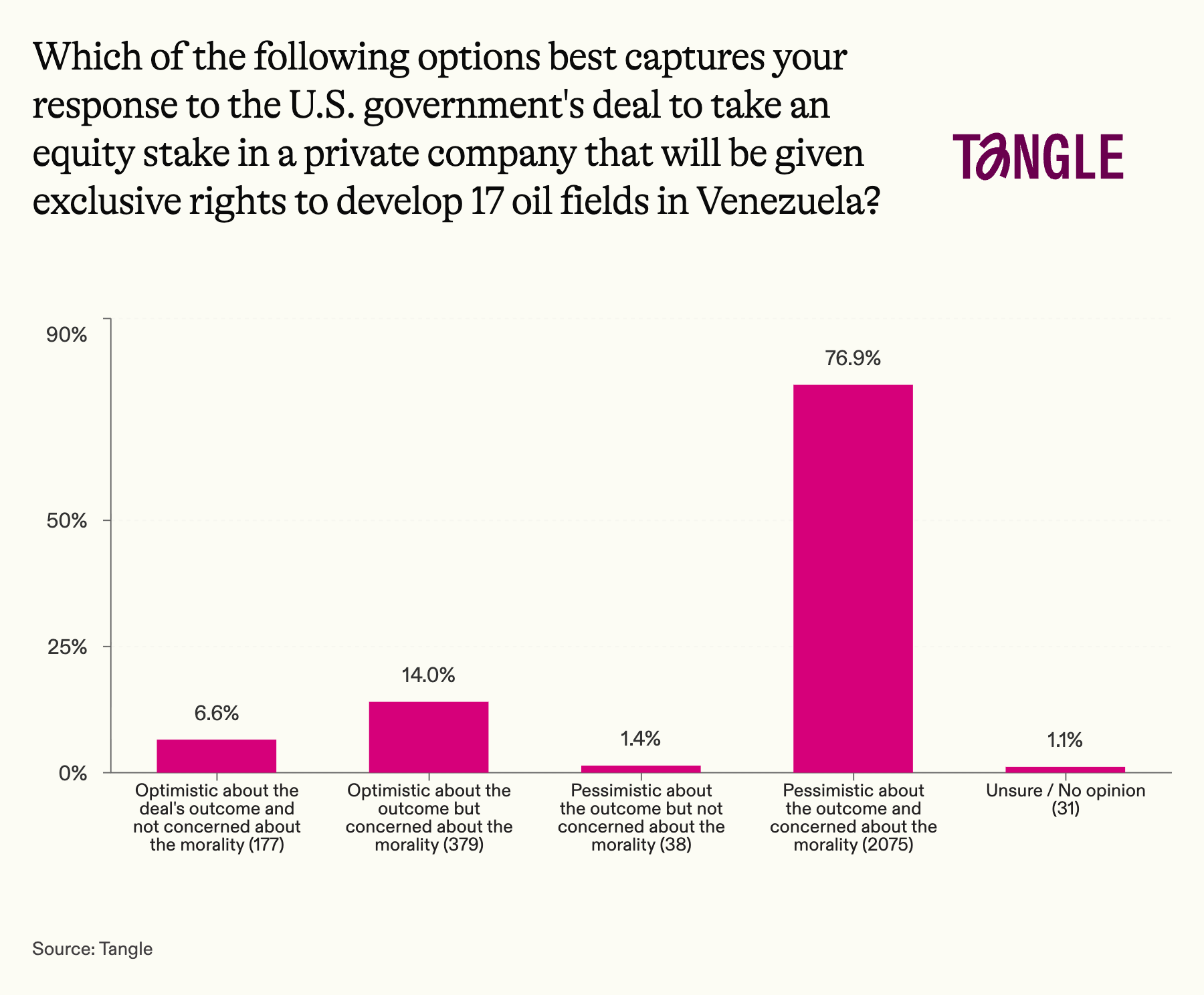
- Our last survey: 2,700 readers responded to our survey on the Trump administration’s oil deal with Venezuela, with 77% saying they are pessimistic about the agreement’s outcome and concerned about its morality. “There is gross hypocrisy here in the U.S.’s taking an equity interest; gross corruption in the cronyism of the deal; and gross disregard for ‘the opinions of mankind’ in the blatant neocolonialism,” one respondent said. “Bolstering Venezuela’s economy could provide hope and options to its citizens,” said another.
Have a nice day.
On July 23, Erasto Crisanto Valdez disappeared while fishing in Mexico, prompting an urgent search. After two weeks, hope appeared to be lost; but on day 15 of the search, authorities found Valdez alive, trapped in an underwater cave. Valdez told rescuers that he ventured into the cave after going underwater in the area, adding that it was pitch-black inside. While trapped, he was able to breathe thanks to an air chamber in the cave, and he drank water from a spring running through the cave to survive. He remains under medical care but has been reunited with his family. People has the story.

Member comments