



By Zaid Jilani
In the fall of 2008, I was a student in my last year of undergrad at the University of Georgia.
The day after the presidential election, I happened to see a friend who had spent the past few months as a student organizer for the Obama campaign. He was grinning from ear to ear, for good reason. He was the son of Liberian immigrants.
Obama’s win had opened a new door for him, as it had African Americans across the nation.
I approached him and exclaimed, “Now you can be president!”
Without missing a beat, he replied, “Now you can be president!”
I don’t remember what I said in response, but I’m sure I was thinking that he was getting a little carried away. Obama’s victory lifted the spirits of millions of black Americans who had spent their lives believing, with good reason, that America was not ready to elect a black president.
By the time Obama entered the White House, the country had been through decades of painstaking civil rights work that had finally earned African Americans a real seat at the political table. Black people had earned representation in both houses of Congress, as the mayors of major cities, and as governors of entire states. They had a real foothold in Hollywood and the music industry; while negative stereotyping of black people continued to exist, many aspects of black culture and the black historical experience were at the forefront of American society.
I could not say the same about Muslim Americans. Although Muslims have existed in the United States since the colonial period, we’ve always been a small minority. And after the 9/11 attacks, many Americans conflated us with violent extremists in their minds. Recall that when the first Muslim American — Minnesota’s Keith Ellison — was elected to the U.S. Congress in 2006, then-CNN host Glenn Beck confronted him, asking Ellison to “prove” that he was “not working with our enemies.”
This kind of vortex of suspicion soon became the norm for any Muslim who ran for a post anywhere in the country. Politicians and pundits alike warned that Sharia law — imposing Muslim beliefs through the force of the state — was coming to a community near you. Muslims faced some of the most open opposition from voters when asked who they would vote for as a president.
Although I had long been skeptical of the idea that Muslims would develop political power, Muslim Americans have generally been optimistic about the country itself. Indeed, America is in many ways a promised land for American Muslims.
Growing up as the son of two Pakistani immigrants in the American South, I always stood out a bit. I had a funny name and I prayed somewhat differently than everyone else. I was also very confused by the concept of Santa Claus.
But by and large, I did not feel unwelcome because of my faith. In fact, after the 9/11 attacks, a friend of my father’s —a white and probably quite conservative man — approached my father and told him that if anyone bothered our family, we could come to him for help.
Thanks to my parents’ migration to the United States, I could get a world-class education and obtain gainful employment. I found success as a journalist and communicator. My story demonstrates that America is still a land where someone can start with little and end up with a lot. And that is something that most American Muslims truly believe.
Yet in a political climate that often treats Muslims as invaders, mere steps away from conquering the country and subjecting everyone to extreme religious whims, you can hardly blame us for being skeptical that Americans would want to entrust any Muslim with the awesome power of something like a seat in the world’s most powerful legislative body. Indeed, that vortex of suspicion around Muslim American political candidates is still alive and well in 2026.
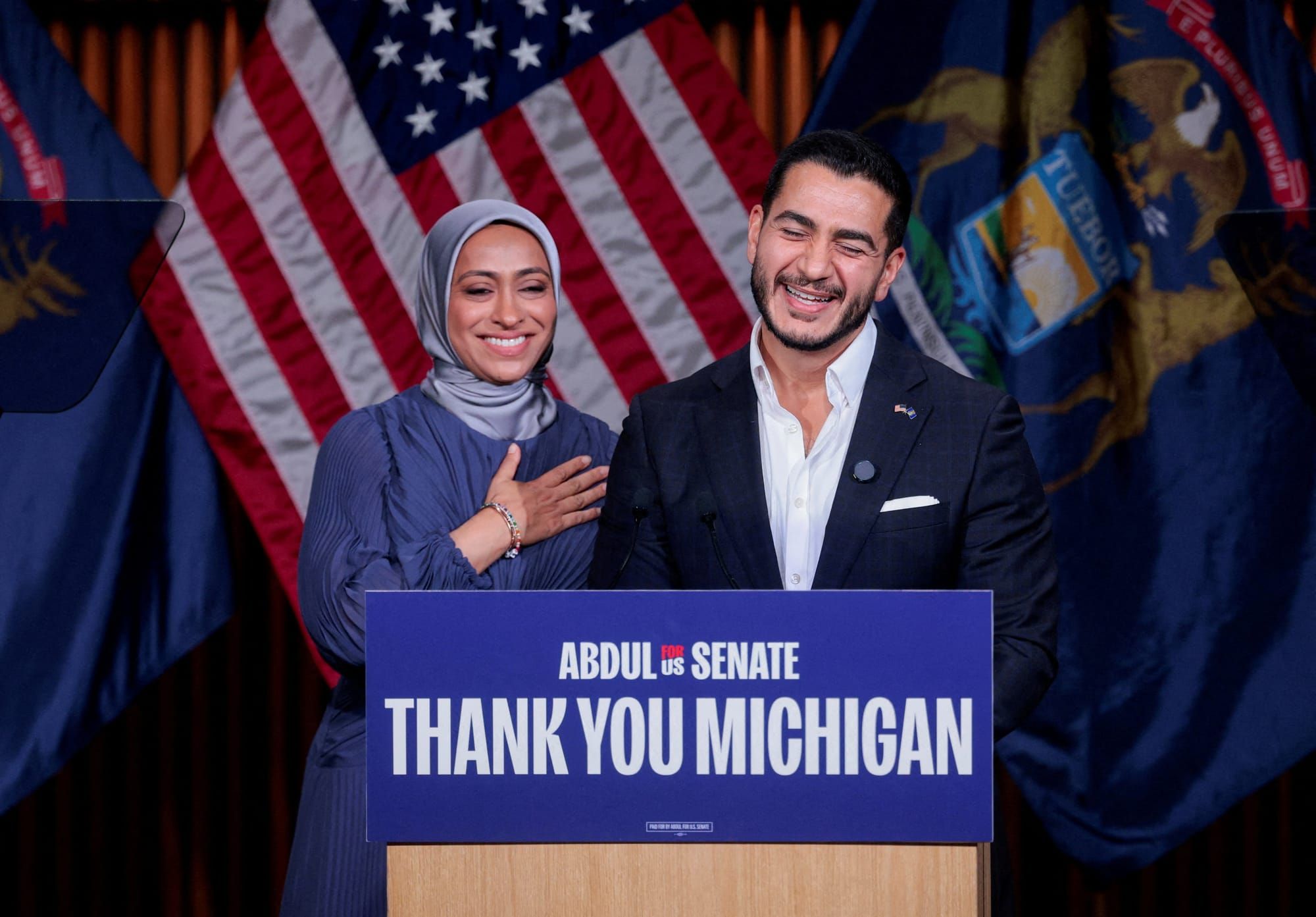
In the leadup to Democrat Abdul El-Sayed’s election to Michigan’s Senate seat, every Muslim American I knew was on pins and needles. Doubts clouded our minds — would the same country where politicians have spent decades demonizing Muslims really elect one to the U.S. Senate?
All of this has left me amused by the punditry’s arguments about how El-Sayed’s seven-point margin of victory was an underperformance compared to other Democrats in the state. I’ll leave it to political scientists to study the exact explanations for the margins of victory around the country during the 2026 election — dozens of variables are at play, and anyone telling you they can precisely dissect the meaning of victory margins in Texas versus Michigan versus Georgia without doing the careful, slow work of political science is out of their depth. This is an election that will be studied for years to come, and we should be humble about our political conclusions.
But as a Muslim American, I can say that margins are meaningless; many in our community would’ve cried tears of joy if El-Sayed had won by just a single vote.
After all, he endured some of the most bigoted campaign attacks in modern U.S. history. Voters received mailers associating him with scary-looking, masked brown men carrying rifles. President Trump said he should have to go through a metal detector to enter the Senate. Republican senators referred to him as a “jihadist” and a “terrorist.” Rather than debate taxes or health care or climate change with El-Sayed, his opponent tried to turn the contest into a referendum on his religious faith.
This negative campaign was unfortunately savvy; one poll found that 45 percent of Michigan voters said they would not vote for a Muslim for president, almost exactly matching the percentage of votes that El Sayed’s opponent, Mike Rogers, ultimately secured.
Yet, in the face of this barrier of prejudice, El-Sayed broke through. And ultimately, it wasn’t even close.
His was not the only historic win on election day. Where I live, in Georgia, former Atlanta Mayor Keisha Lance Bottoms became the first black woman ever elected governor in the United States and the first black governor in a state that still has residents who lived through Jim Crow.
I was at Democratic Senator Jon Ossoff’s victory party on election night. Ossoff, a six-year incumbent who is broadly liked across the state, was widely considered to be in a noncompetitive race.
But Lance Bottoms was a different story.
She was mayor of Atlanta during a rocky time, when the city was feeling the effects of the pandemic and a huge nationwide spike in violent crime. Unlike most mayors in city history, she did not run for re-election and instead chose to work in the Biden administration.
Atlanta has often been referred to as the “Black Mecca,” a place where African Americans found political and economic success in a region that spent hundreds of years keeping them out of positions of power. While Atlanta is an economic engine for Georgia, many outside the city continue to be wary of the black political power there. White racism against African Americans still very much exists; it’s one of the reasons why we’ve never had a proper public transit system that extends out into the suburbs. We always hear about how this would bring crime and transients into the surrounding communities, and you don’t have to be a dog to hear that whistle.
So when the newscast blared told us that the race had been called for Lance Bottoms, the cheers were deafening. Unlike Ossoff, none of us considered Lance Bottoms to be a lock for victory; we had all watched her opponent, a Republican billionaire, spend tens of millions of dollars on ads that warned that she would bring Atlanta-style chaos and crime to every corner of the state.
While she ran behind Ossoff’s monster margin, she still easily won her race. In both El-Sayed and Lance Bottoms’s historic victories, voters from Muslim and black communities scored historic wins, with El-Sayed being the first Muslim senator and Lance Bottoms becoming the first black woman to ever win a governor’s mansion (although in the modern United States, Muslim lawmakers are far more rare than black ones).
Few of us are sitting around crunching the numbers to see if they could’ve won by a larger margin; we’re simply shocked that they won at all — in a good way. Our dream of an America that accepts all people for who they are, regardless of how they look or pray, is now a couple steps closer.
But it wouldn’t sit right with me to celebrate the victories of these two candidates just because they happened to come from underrepresented minority groups. Ultimately, politics is about governance. Nobody who can’t afford groceries or gas will suddenly be able to feed and transport their family simply because the race or religion of their public official changed.
I have never voted for someone simply because I shared a superficial characteristic with them, whether it be gender, race, or religion. I want the best people to serve in office, no matter what they look like or who they descend from. But that’s also because I believe these identity markers are superficial.
The challenge going forward is for El-Sayed and Lance Bottoms to demonstrate to everyone who doubted them, everyone who bought into the negative stereotypes about Arab Muslims and African Americans, that they can govern effectively because their faith and skin color don’t define them.
The only way to prove to so many Americans who remain skeptical of minorities that we’re just as capable as anyone else is to be just as capable as anyone else.
Only time will tell if El-Sayed is an effective senator and Lance Bottoms is an effective governor. But I’ve already come to one conclusion — my friend who suggested years ago that even a Muslim could one day be president was correct. This is a country with a promise of boundless imagination and opportunities for everyone. It just takes a little time to fulfill that promise.
Zaid Jilani is a freelance journalist based outside Atlanta, Georgia. He maintains a Substack newsletter called The American Saga.

Member comments