


On taking danger seriously without losing the life in front of you
I put away my phone and took a deep breath, trying to ease the familiar tightness in my throat.
Leaves fell from the turning trees above. Sunlight peeked through the clouds, gleaming on the green grass. Children played, ducks waddled, tourists photographed. It was a beautiful London day, but my mind was somewhere else.
Over the past six months, my social media feed had filled with warnings about the risks of powerful AI. Some concerns seemed more justified than others, but there were enough strong arguments to hold my attention. Scrolling left me anxious and afraid, but if that was the price of staying informed, I’d pay it. After all, it could be a matter of life and death. Not just for me, but for humanity.
The thinking was familiar.
My mind spun back to childhood mornings in our one-bedroom apartment in Hawai’i. Waking in my bunk bed, I’d see Dad on the couch across the living room: bowl of granola by his side, brow furrowed, scanning his laptop for clues about when it would happen.
Dad said that They had a plan to wipe out most of humanity by whatever means necessary. It had become his fatherly duty to keep us safe, because to ignore The Plan like everyone else meant certain death.
We first moved when I was six weeks old. Y2K was coming, and he didn’t want to be in the Bay Area when the computers failed. Thirteen years, twenty-four moves, and two divorce attempts later, we’d landed back in rural Hawai’i. Dad searched for somewhere safe while Mom homeschooled my brother and me.
My friends’ dads went to work; mine had retired early, and even after our savings were gone, he wouldn’t get a new job. He had more important things to do. When he wasn’t researching, we went on bike rides, built forts, and played catch. He gave me foot rubs while we watched Seinfeld and told me he loved me every night. I said it back, and I meant it.
Most of the time, he didn’t tell me what he was reading. But at night I’d hear the fear slip into his voice through the walls as he urged Mom to move again. I’d see it in his eyes when he told my brother and me not to speak to her until she agreed. And I’d feel it myself when he told me that every time he heard a plane fly overhead, he wondered if bombs would fall from it.
I didn’t understand why he was so afraid. We had food on the table, a roof over our heads. Nobody else seemed to be running. But Dad knew things I didn’t. His laptop held truths I couldn’t see.
Still, sometimes I wished he would just close it.
Eventually he decided Hawai’i wasn’t safe, either. Once the world fell apart, the ships carrying food would stop, and there’d be no way off the island. We needed a boat. When he found an old one in Florida, Mom refused to go, and they finally split. He left to fix it up for the voyage to the South Pacific.
After a year of repairs, my brother and I joined him for the first leg, sailing for Panama by way of Cuba, gold coins stashed in the hulls. He said it was the last time we’d see America. Out at sea, I’d never felt so free, or so afraid. Three weeks in, one of the hulls began pulling away from the rest of the boat, the gap widening with every wave. Dad drilled bolts into the fiberglass, but it wasn’t enough. We flew home to Mom from Mexico. He patched it up and sailed on for a few more months, then sold it and flew to Australia.
Between high school math assignments, I read the articles he forwarded:
THIS IS JUST ONE REASON AUSTRALIA MAKES A LOT OF SENSE
LEAVING THE EYE OF THE HURRICANE
PLEASE LISTEN
World War III, economic collapse, and civil war were imminent. Hawai’i wasn’t safe. If I wanted to live, I needed to join him ASAP.
The articles made sense, even if I couldn’t understand them — after all, Dad had been studying this stuff longer than I’d been alive. Still, I didn’t want to leave my life in Hawai’i. So I bought an Australian visa and gold coins, and tried to work out how much warning I’d get.
At the same time, Mom had been working to give me a chance for a different future. As I neared the end of high school, she convinced me to give college a chance. Before deciding whether to enroll near Boston, I used nuclear bomb simulators to determine how safe it’d be from an attack on D.C. Then, a few hours before the deadline, I accepted.
For a couple of years, life was mostly normal. I took classes in economics and the environment and worked on building a business I could run from my laptop. Dad’s emails continued, but I started pushing back. Economies could crash and hurricanes could form, I argued, without anyone planning them.
Then he warned of a virus in China. It was February, 2020. Within weeks, everyone was doing what Dad had done for decades, and I wondered if he’d been right all along. When my college shut down, I said I’d join him in Arizona, where he was living out of a Eurovan stocked with rice and beans. But when Mom heard my plan, she convinced me to come home to Hawai’i instead. Dad called it a betrayal and threatened to disown me.
A few months later, he followed me there anyway. We watched Seinfeld and went on bike rides like the good old days. But this time, our conversations inevitably returned to “the plandemic” and his warnings about the vaccines. The emails increased:
FOR THE TRULY OPEN-MINDED
CRITICAL INFO
DOCTORS OBTAIN IDENTICAL RESULTS WITH NO “VIRUS”
I read them alongside my own research, which kept leading me somewhere else: COVID was real; viruses were real; the vaccines weren’t a plan to kill us. We fought more and more.
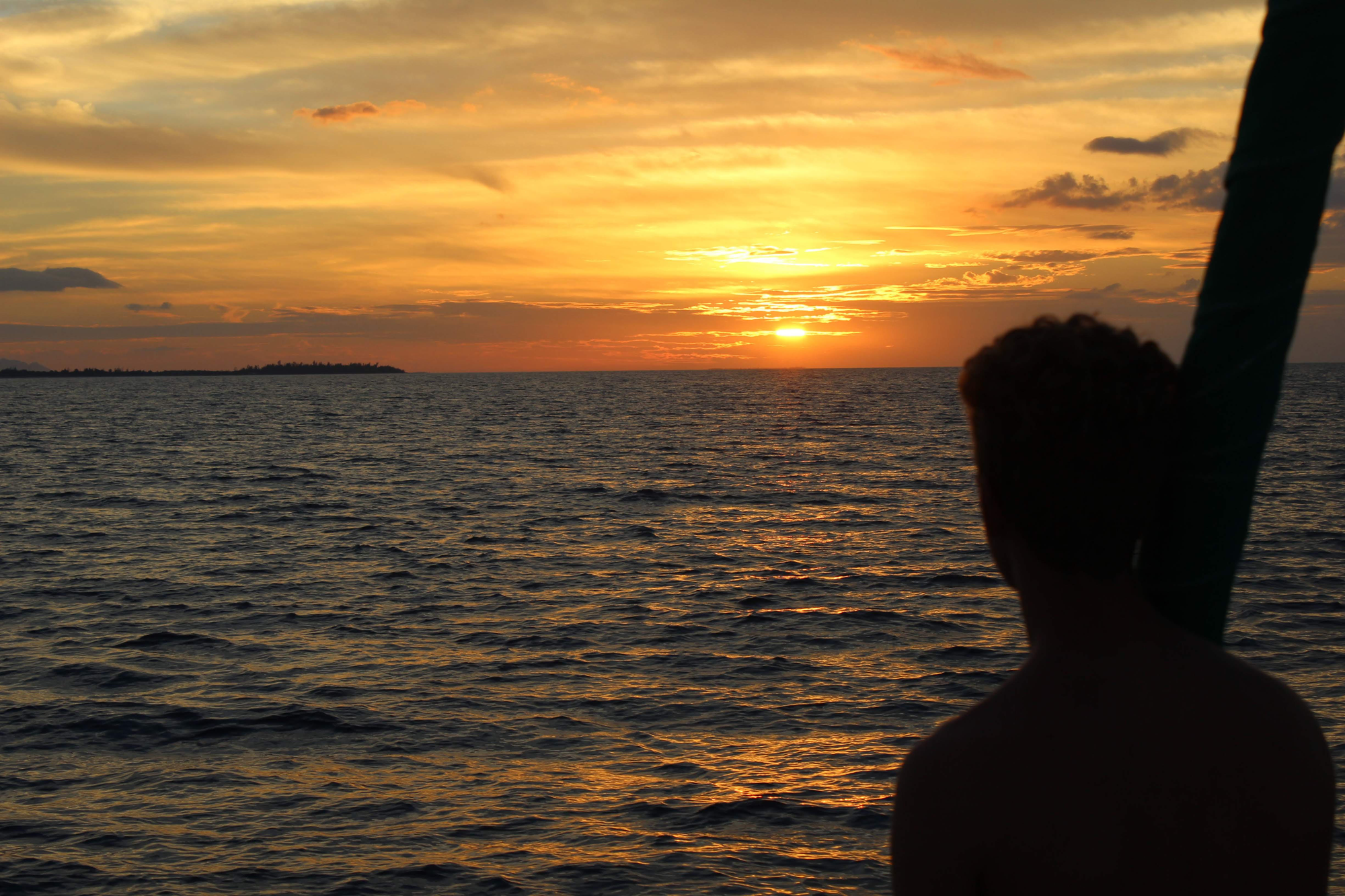
A year later, with my business finally up and running, I told him I was leaving to travel. As the sun set over the ocean behind us, he pleaded with me to listen and prepare for what was coming. I got on the plane.
I didn’t know it’d be the last time I saw him.
After traveling, I went back to school, hopping on a plane every chance I got. Life was full of friends and freedom. Then I fell in love with a girl who’d grown up on the same island I had. With her, I could picture a future that didn’t need an escape plan. She also took me to church.
Eventually I asked her to marry me, her father’s blessing in hand. Before the wedding, I was baptized into her church, still carrying questions and fears, but full of hope. We married on that island, celebrating with our closest friends and family as the sun set over the same ocean. I wished Dad could have been there.
After our wedding, we moved to Manhattan together. Part of me thinks the warnings will always be in the bomb shelter in the cellar of my brain. But for the first time in my life, my life truly was no longer governed by fear. And I cherished it.
Back in the park, in present-day London, the sun lit up the grass again. And here I was, thinking about doomsday once more. I told myself it was different. Dad’s fears came from paranoid conspiracy theories; risk from building powerful AI that we couldn’t fully control felt like common sense. People said we could reduce it, and I wanted to help. But I’d seen what a life spent anticipating catastrophe could become.
Dad had pushed away nearly everyone who loved him. The last time I spoke with him, a couple of years after I got on that plane, he told me his favorite time of the day was going to sleep, because at least the madness stopped for a little while. The words haunted my memory.
A child ran across the grass, laughing as she played with her dog. I couldn’t help smiling, and felt my shoulders drop. Lately, I’d caught myself watching kids like her, imagining the ones my wife and I would have someday. I already knew I’dlove them more than anything. The closer that future came, the more I understood Dad, and the more I feared becoming him.
How could I take real dangers seriously without losing the life in front of me? Act with conviction without anxiety?
I told myself I’d figure it out later. Today would be my day off.
I canceled my plans to study the Industrial Revolution and deleted social media from my phone. Instead, I’d walk in the park, wander the city, maybe have a beer by the river. Whatever I did, I wanted to actually be there.
Before I knew it, a day became a week. I took a boat down the Thames and wandered the Oxford countryside with my wife. I sat in church and closed my eyes and breathed in the candles and ancient stone. I bought a book and read lazily in the sun. Sometimes I did nothing at all.
When I finally reopened my feed, the same warnings were waiting. But they stirred something different in me. Before, they’d spiked an anxious need to act before it was too late. Now, I felt an odd calm. I still thought the risks were real, and worth working on. But I could weigh the arguments without the tightness in my throat.
I read some arguments and counterarguments, updated my resume, and applied to a few AI safety programs.
Then my wife came home, and I closed the laptop.
What Do We Do With a Dangerous World?
My father was wrong about a lot. I don’t believe there’s a global conspiracy or that the world is as simple, or as evil, as his sources claim.
But there’s one thing I think he saw more clearly than most: the world is dangerous, sometimes catastrophically. History is full of tragedies that sounded crazy right up until they happened, and paying attention was sometimes the difference between who got out and who didn’t.
I find something respectable, in an odd and uncomfortable way, about his willingness to uproot his family to survive, even if his concerns were misguided.
His fear began with love. “What would you do,” he asked us many times, “if you’d just had two beautiful sons, then discovered that 9/11 was an inside job?” Inside his reality, he was doing what any good father would.
But his love became so warped by fear, grandiosity, and the need for control that he forgot what it was all for. He became so intent on saving his sons that he drove us away. And even that made sense to him. “So what if they don’t like me? I’m saving their lives. They’ll see one day.”
Still, the question he kept asking is one most of us face once we start paying attention: What do we do with a dangerous world? One answer is to “prepare”: find somewhere off-grid, stock up on guns and food, and ride out the collapse. But this response forgets the power we have to reduce the risks, especially the ones we create ourselves.
That’s what I’m trying to do about AI: taking courses, going to conferences, and looking for ways to help. But it isn’t always easy to be in the room with the people most afraid. These “AI doomers” trade dark jokes about the end of humanity, treat dread as proof of seriousness, and suspect anyone who isn’t afraid of being naive. All of it sets off alarm bells in my mind. I witnessed firsthand the traps of predicting catastrophe: false precision, feeling chosen, getting lost in abstraction. And the one I know best: fear that slowly crowds out everything else.
AI is the bogeyman du jour, but with a different monster from another closet the story’s just the same. Swap in the election, the economy, or the next pandemic, and the same pull can be felt.
I’m still figuring out how to think about starting a family without becoming like my dad. I know that as soon as I see that first ultrasound, I’ll stop at nothing to keep them safe. Just like him. The question is how to do it without becoming him: so intent on saving the people I love that I lose them, or so busy trying to save the world that I forget to live in it.
So far, what’s helped is simple, even boring. I kept the social media apps off my phone. I read about AI in narrow windows and remind myself that the scariest argument isn’t always the best one. The rest of my attention goes to the life in front of me. I try to be present when my wife is talking, and I let her pull me back when I get too far into my head. I call friends, see my mom, and get outside, somewhere with trees and no signal. And I tend my spiritual life, which reminds me the world is held by something greater than me.
Most of all, it means not mistaking fear for care, or anxiety for action.
That goes for anyone trying to take danger seriously. We can work to make the world safer, and if catastrophe still comes, let it find us doing sensible and human things, not cowered in fear. Let it find us walking in the park, sitting in church, or sharing a meal with the people we love.
I still read the warnings. I still think they matter. But they don’t get the last word.
Ryan Combes is a writer and entrepreneur based in New York City. You can read early chapters of his childhood memoir and related essays at ryancombes.com.

Member comments