





It’s Wednesday, and this is Senior Editor Will Kaback, welcoming you to Tangle. It’s been a while since we dove into an interesting policy debate — foreign wars and elections and nationwide ground stops and tech industry scandals will do that. But today, I hope a small change of pace from what has been an especially unnerving week will cleanse the palate a bit and remind you that important, constructive work is still happening in our government. All that and more as we get into the major permitting reform bill moving through Congress.
Then, a question we’ve fielded repeatedly since the midterms: Could Justice Samuel Alito retire in the lame-duck session? Lastly, be sure to check out our mini-documentary (linked below) on what’s happened to Utah’s Great Salt Lake since scientists projected its imminent ecological collapse nearly four years ago. We put a ton of work into the video and hope you enjoy the result.
All in all, today’s newsletter is a 13-minute read.
Isaac Saul, Audrey Moorehead, Carina Pacheco, Russell Nystrom, Isaac Wood, and Bailey Saul edited or contributed to today’s newsletter.
The Great Salt Lake debate.
In early 2023, a group of scientists reported that the Great Salt Lake would suffer ecological collapse within five years if its water level continued its rate of decline. It would be a catastrophe of epic proportions, devastating the local environment and economy while potentially exposing millions of people to “toxic dust” from the lakebed. Now, as we approach the four-year mark since the report was published, what’s happening with the lake? In our newest mini-documentary, we head to Utah to find some answers:
Our new video
Quick hits.
- The National Security Agency said that a classified network it uses for internal communications experienced a temporary outage. The agency said it had not found evidence the outage was caused by a cyberattack. (The outage)
- Several news outlets projected that Mary Peltola (D) will defeat Sen. Dan Sullivan (R) in Alaska’s Senate race, giving Democrats a 56–44 majority in the chamber. (The call)
- House Democrats voted 251–11 to nominate Hakeem Jeffries (D-NY) to be speaker of the House in the new Congress. (The vote)
- President Donald Trump arrived in China as part of his ongoing Asia trip. He is scheduled to meet with Chinese President Xi Jinping and Russian President Vladimir Putin. (The arrival)
- The White House withdrew Heidi Overton’s nomination to lead the Food and Drug Administration before a key Senate Health Committee vote. (The withdrawal)

Americans over 55 are ditching hearing aids for this new device.
Meet the nearly invisible innovation packed with two AI chips that separate speech from noise in real time. The result? Warm, natural sound anywhere life gets loud. No choosing between hearing the room and hearing the person.
Nearly invisible, rechargeable, smartphone-compatible, it’s the device over 670K+ people switched to for unmatched clarity.
People who try Horizon IX by hear.com tend to say the same thing afterward: “I waited too long.”
Experience the tech for yourself with a 45-day no-risk trial.
Today’s topic.
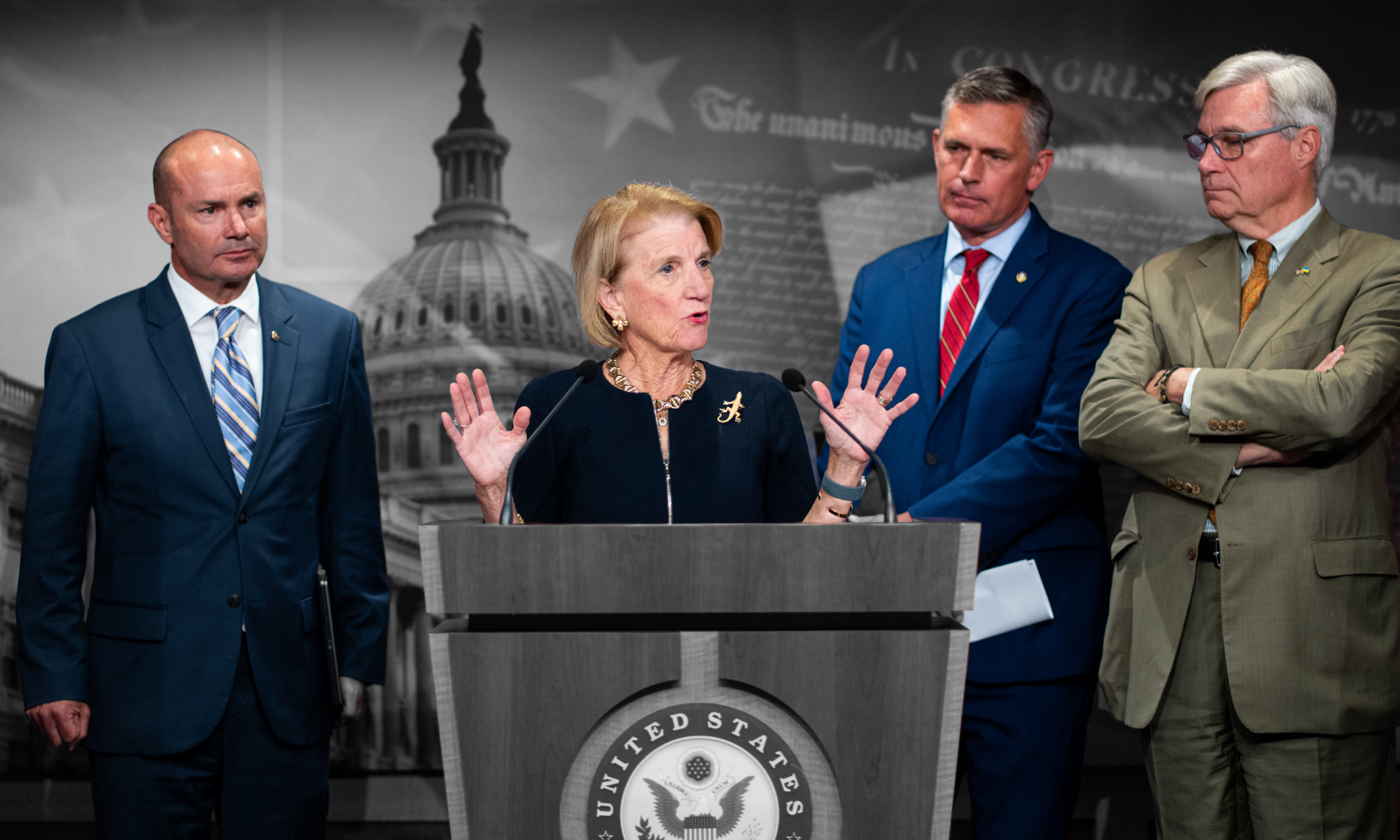
The Senate permitting bill. On Monday, November 16, the Senate voted 70–27 to end debate on the Bipartisan American Affordability and Jobs Act (BAAJA), a major permitting reform bill. The decision sets up a final Senate vote on the legislation, and if passed, it would then go to the House. The 494-page bill would constitute the most comprehensive permitting reform in decades, significantly overhauling existing processes for building projects that require federal approval.
Back up: Federal permitting for building projects is primarily regulated by environmental protection statutes enacted throughout the 1960s and 70s. As time has passed, delays to major building projects — including clean-energy developments — have become more common, prompting calls for reforming the process. BAAJA comes after months of bipartisan negotiation in the Senate and was introduced by Democratic and Republican senators on the Environment and Public Works and Energy and Natural Resources committees.
BAAJA would significantly reform four existing statutes: the National Environmental Policy Act (NEPA), the National Historic Preservation Act (NHPA), the Clean Water Act (CWA), and the Endangered Species Act (ESA). In each case, the bill would limit the existing law’s scope when it comes to reviewing and denying permits for new building projects; BAAJA’s changes attempt to preserve core environmental protections while removing more restrictive provisions. It additionally includes provisions that would hinder the executive branch’s ability to block permits; streamline the process for approving transmission lines; digitize the federal permitting process; and reform processes for hydropower, offshore energy, hardrock mining mill sites, and geothermal and nuclear energy projects.
On November 7, the bill’s sponsors released a manager’s amendment to the bill, giving Native American tribes greater determinative power in many of the suggested reformed processes; the amendment also clarified language in the bill’s permitting certainty section.
President Trump, energy developers and labor unions have expressed support for the bill; however, climate groups largely oppose it. Democrats are split, with some arguing lawmakers should delay action until Democrats assume large majorities in both chambers of Congress next year.
Below, you’ll hear views on the bill from the right and the left. Then, Senior Editor Will Kaback’s take.
|
What the right is saying.
|
The National Review editors called the bill “a golden opportunity for permitting reform.”
“Republican lawmakers have long sought to ease permitting for fossil-fuel production, while Democrats have wished to do the same only for clean energy. They joined for the rare congressional deal that improves matters in both directions,” the editors wrote. “If Republicans had drafted the legislation alone, they likely would have included more provisions from their 2023 legislation aimed at expanding oil and gas production.
“Yet compromise is a political necessity for any lasting reform effort, and to the extent the Senate has moved the ball forward on permitting, it has done so overwhelmingly toward deregulation and growth,” the editors said. “For once, Congress has taken initiative and done serious work to improve the nation’s laws… When they return from the midterm elections, lawmakers will have an elusive opportunity to clear roadblocks for infrastructure and energy projects of all sorts. They should seize it.”
In Cato at Liberty, Travis Fisher and Michael Abi-Nader said “America’s private sector is ready to build.”
“BAAJA builds on previous reform efforts, such as Manchin-Barrasso’s EPRA in 2024 and this term’s SPEED and PERMIT Acts,” Fisher and Abi-Nader wrote. “This moment is different for myriad reasons — electricity demand growth is reaching levels not seen this century, costly Biden-era energy subsidies have mostly been cut or curtailed, and Democrats now understand how much damage a president can inflict when he despises certain forms of energy.”
“And the stakes are high. Consulting firm McKinsey estimated in 2025 that up to $1.5 trillion in infrastructure investment was awaiting federal permits,” Fisher and Abi-Nader said. “BAAJA is an excellent set of bipartisan reforms. Not perfect by any means, but a substantial movement in the right direction. Our question to policymakers is this: Will you embrace reform, or will the federal government continue to deny permission for much-needed energy projects?”
In the Daily Caller, David Blackmon suggested the bill “would put [advocacy] groups out of the problem-creating business.”
“The Natural Resources Defense Council, the Sierra Club and a swarm of allied activist groups are trying to kill the most serious permitting reform bill Congress has taken up in years,” Blackmon wrote. “They oppose it because it would shrink the bureaucratic rot and litigation veto that keep them in business. It is no surprise these conflict groups oppose a bill which would help resolve conflicts. These groups exist to preserve and extend conflicts, not to solve them.”
“The conflict groups could not stop the first vote. They are now trying to peel Democrats off before final passage... and to park the bill until January. The country cannot afford that delay. American energy demand is rising in every part of the economy,” Blackmon said. “[The bill] would put real deadlines on reviews… limit the lawsuit treadmill used to stop projects, and require data centers to pay their own way. That is why the bill needs to become law.”
|
What the left is saying.
|
In CounterPunch, Katie Bilodeau said BAAJA will “[remove] much of the remaining protective measures.”
“BAAJA is described as ‘permit reform,’ which simply means it amends environmental laws,” Bilodeau wrote. “This isn’t just about energy projects. The bill would amend environmental laws themselves, including any project proposed for public land or that uses a significant amount of taxpayer money. Think of logging projects, fish-poisoning projects, or roadbuilding projects as well as mining projects.”
“BAAJA presumes that all government decisions are good, so they should be hard to challenge and the decision should remain in force, even if laws were broken to get there,” Bilodeau said. “Bills are inherently value-driven. Proclaiming that S. 5653 ‘cuts red tape’ clarifies that the real driving value is to eliminate current environmental protections, which would allow our government to authorize environmental damage with little accountability.”
In The New York Times, Ezra Klein argued “leaving the system unchanged is a guarantee of calamity.”
“I don’t want this column to read as more confident about this bill than I really am… Legislation at this scale rarely plays out exactly as its architects expect,” Klein wrote. “But at its core, the Bipartisan American Affordability and Jobs Act would do the same thing over and over again: It would make it faster and simpler to build energy infrastructure by rolling back the opportunities for delays, lawsuits and vetoes that have proliferated in recent decades.”
“The problem, right now, is that we cannot meet enough new demand… with renewables. What the act might make possible is the construction of an energy grid where there is enough renewable power to meet new demand. In the absence of that energy system, new demand would be met by fossil fuels,” Klein said. “I don’t dismiss the concerns any [Democrats] have about this bill. But it’s a risk worth taking to make the future they’ve promised possible.”
In Common Dreams, Dean Baker suggested returning to permit reform “after Trump is gone and democracy is restored.”
“I have long been familiar with the argument for permitting reform and am largely in agreement,” Baker wrote. “But I still can’t buy Ezra Klein’s enthusiastic endorsement of the bill [in] the New York Times over the weekend. The point is that the bill will substantially reduce opportunities to block energy- and infrastructure-related projects. That is a great idea, but not with Donald Trump in the White House and picking the projects.”
“[Trump] has already said that he will deny permits to wind turbines, apparently due to a hatred resulting from their placement near one of his golf courses in Scotland. It’s a safe bet that Trump will do everything in his power, and then some, to block the development of clean energy in his last two years in office,” Baker said. “The framing of this as a short-term ‘affordability’ story, as Klein does, is Washington-silly.”
|
||||
|
||||
|
Reminder: This is where we share a personal opinion. If you have feedback, criticism or compliments, leave a comment or reply to this email.
|

Since I began writing for Tangle, I’ve spent many a take bemoaning legislative inaction as the executive and judicial branches assert more and more power. So today, I’m glad (excited, even) to be writing about a bill that’s not only ambitious and bipartisan, but has a strong chance of becoming law, too. Congress is doing something! Best of all, I think it’s doing something good.
Let’s start with the central premise of the Bipartisan American Affordability and Jobs Act of 2026 (BAAJA): Infrastructure permitting processes in the U.S. are too slow, expensive and fragmented, making it harder to meet energy needs and driving up prices for consumers. Consider a few examples of how difficult it has become to build energy projects in the United States. According to an Energy Department report, “The number of miles of newly built high-voltage transmission has declined… from an average of 2,500 miles each year from 2013–2015 to just 56 miles in 2023.” And 2021–2024 was the slowest four years of high-voltage transmission line construction since at least 2010. Berkeley Lab’s Queued Up report found that at the end of 2025, roughly 8,200 projects were actively seeking grid interconnection in the U.S.
Meanwhile, the median time to complete the environmental impact statements mandated by the National Environmental Policy Act (NEPA) was 2.8 years from January 2019 to December 2024 (somewhat humorously, that’s an improvement of five months compared to 2010–2018). And while NEPA was designed (in part) to compel federal agencies to consider the environmental impacts of their decisions, some experts have found that these requirements actually bog down renewable energy projects that environmental advocates champion.
The horror stories caused by the current system are everywhere — a “fast-tracked” power project that was finally approved after 17 years, a wind farm project that was abandoned after 16 years, a natural gas pipeline that didn’t start operating for six years after construction began. It’s a mess, and as writers on the right and left agreed upon above, unwinding the tangle of environmental reviews, disparate agency requirements, and complex approval processes is imperative for the U.S. to meet rising energy demand (and keep costs in check).
Hearteningly, both sides also agree on a key piece of that reform. The bill would empower the Federal Energy Regulatory Commission to approve new interstate transmission lines when proposals hit snags at the state level, along with a slew of other provisions to expedite new builds and upgrade existing ones. As National Review’s editors noted (under “What the right is saying”), the reforms would also remove barriers to emerging energy sources like geothermal and hydropower, bolstering an all-of-the-above energy policy.
I could spend the rest of this take writing about other provisions I like in BAAJA, like accelerating nuclear power adoption and protecting consumers from higher energy bills linked to new data center construction. But its limitations are just as important to discuss.
Legal scholar Steve Vladeck made the strongest argument I’ve read against passing the bill in its current form. He highlights how BAAJA would remove or weaken key legal remedies for potential violations of environmental laws while making it harder for courts to review or undo federal agencies’ permitting decisions. It would restrict the president’s ability to block already-approved permits, but also empower them to prioritize their preferred projects. That puts enormous power in the president’s hands.
Currently, that’s President Trump, who has two more years in office and is eager to sign BAAJA into law. His critics are sounding the alarm that the bill would allow him to spend his remaining time blocking clean energy projects (and greenlighting new fossil fuel development). The president has a tendency to rush certain projects on dubious legal grounds, and this law could further embolden him. Conversely, a hypothetical Democratic president in 2029 could spend the next four years sidelining new (and necessary) fossil fuel projects and boosting “green energy” in ways that enrage the right. You can see the dilemma for both sides. Are we really fixing the permitting system if we just open it up to presidential whiplash every four or eight years, creating new uncertainty for developers and eliminating legal pathways to constrain executive overreach?
Environmental concerns loom large over this debate. A bill that seeks to introduce efficiency and order to permitting processes sounds great on paper, but what if some of the “inefficiencies” existed for good reason? For instance, if a proposed project could create environmental hazards for a community or pollute a waterway or disrupt a local economy, maybe we shouldn’t be speeding through its approval process. A more methodical approach, while frustrating at times, offers a buffer against decisions that could harm people and the environment.
Ultimately, these concerns don’t convince me to oppose the bill. Many of its critics suggest that it would destroy all meaningful environmental review and enable unchecked pollution — that isn’t the case. The bill changes NEPA, but it doesn’t eliminate it. Environmental impact statements are still required, agencies will still have to consider the environmental risks of proposals, and regulations are still in place to curb air and water pollution. The timelines for those processes will be accelerated and certain considerations removed, but projects will still face considerable scrutiny before winning approval.
Even still, some of the concerns I flagged could be addressed by holding the bill through the lame-duck session and taking it back up with the Democratic Congress in the new year. But getting to this point took months of hard negotiations, and I think it’s far from guaranteed that Republicans would maintain their support if the bill stalled out now. Furthermore, the ultimate travesty would be allowing fear of what President Trump (or any future president) might do to scuttle reforms with so much potential.
BAAJA’s trade-offs are worth it. Realizing a future of more robust, sustainable, and affordable energy projects involves taking risks, and this bill has plenty. But we have no shot at getting there with the status quo.
Plus, don’t discount what passing BAAJA could do for our national psyche. As I wrote earlier, Congress’s inaction or indifference on so many issues has been maddening for all of my adult life. Obviously, they’ve passed some major bills in recent years, and one permitting reform bill isn’t exactly a sea change. But the legislative branch has become historically unproductive, and passing a bill like this would show that even a polarized Congress can still do things. It’d be a demonstration of competence and responsiveness at a time when it’s sorely needed. I hope lawmakers recognize this opportunity.
Take the survey: What do you think of BAAJA? Let us know.
Disagree? That’s okay. Our opinion is just one of many. Write in and let us know why, and we’ll consider publishing your feedback.
Your questions, answered.
Do you think [Justice Samuel] Alito will retire from the Supreme Court so the Republicans can push someone through before January?
— Molly from Springfield, IL
Editor Audrey Moorehead: Justice Alito has already confirmed to Fox News that he will not retire any time soon. I don’t expect that he, or any Supreme Court justice, would ever retire in a lame-duck term for a few reasons: personal motivation, precedent, and pragmatism.
First, personal motivation: Supreme Court justices are not politicians, so predicting their actions based on what will be most helpful for their perceived political allies will often lead you down the wrong path. The Supreme Court is the most academic branch of the government. Most justices on the Court are more concerned with the interpretation of the law and the Court’s legacy than anything else. As such, politically timed retirements are very rare, given the understanding that such retirements would tarnish the justice’s reputation and the Court’s institutional credibility. Furthermore, retiring mid-term would make things difficult for their colleagues and clerks on the Court itself — retiring suddenly without good reason would be an extremely uncollegial move.
Second, precedent: Retirements in the middle of a Supreme Court term are extremely rare. The last Supreme Court justice to retire mid-term was Justice Sandra Day O’Connor in January 2006, but her retirement wasn’t sudden: She’d announced her plans in July the year before and conditioned her resignation on the confirmation of her successor (who turned out to be Justice Alito), so the Court never had an empty seat during the session. Before Justice O’Connor, most 20th-century justices who retired mid-term without a successor in place only did so after a major health issue, like Justice William O. Douglas’s stroke. I sincerely doubt Justice Alito or any other modern justice wants to become the first to break this pattern.
Third, pragmatism: Republicans aren’t likely to force through a Supreme Court confirmation within the next two months. Several outgoing Republican senators who’ve provided deciding votes in the past — Collins, Cornyn, Tillis — now have adversarial relationships with the president and would be harder to sell on confirming any nominee in a short time frame. Simultaneously, President Trump’s dissatisfaction with his first-term appointees — who are generally moderate and widely respected — means there’s no guarantee he would nominate similarly moderate figures now, which would make the confirmation process far more combative.
Want to have a question answered in the newsletter? You can reply to this email (it goes straight to our inbox) or fill out this form.
Tired of struggling to hear conversations over background noise?
Horizon IX by hear.com uses two AI chips to help separate speech from noise, delivering clearer, more natural sound.
It’s nearly invisible, rechargeable, and smartphone-compatible.
Try it for yourself with a 45-day risk-free trial.
The extras.
- One year ago today we covered cost-of-living concerns.
- The most clicked link in our last regular newsletter was the discount offer for Tangle readers to get 40% off AquaVault’s wireless charge card (with code TANGLE40).
- Nothing to do with politics: Meet the new voice of Boston’s Logan Airport.
- Our last survey: As of 10:00 AM ET, 1,828 readers responded to our survey on Jensen Huang’s resignation from Nvidia, with 61% saying they support him resigning and don’t think it will affect U.S. AI development. “Consequences should follow anybody’s indiscretions. I guarantee we’ll survive whatever perceived loss as the chips fall,” one respondent said. “He was THE spokesperson for AI. He will be missed in that role, and it will adversely affect the acceptance of AI by the general public,” said another.
Have a nice day.
In 2022, Betsy was shocked by a casual comment from her aunt: “By the way, there’s a Georgia O’Keeffe in the hall closet.” Sure enough, Betsy discovered a 1930 painting — believed to have never been seen by the public — still in its original box under a pile of fur coats. Betsy’s aunt had received it from her mother, who had bought it from O’Keeffe’s Manhattan dealer in 1963. The painting was put up for auction and sold yesterday for $4.9 million to an undisclosed buyer. The New York Post has the story.
Member comments