





Hello, and welcome to Tangle. I’m Senior Editor Will Kaback. I was midway through editing yesterday’s edition on the measles outbreaks when my computer began to light up with notifications. First it was texts, the little red unread-message bubble jumping from 1 to 5 to 10 to 100 within minutes. Then, it was Tangle’s Slack. “WTF,” read one message. “STOP,” read another. Then, it was my Twitter feed, a rapidly refreshing repository of shocked reactions.
Jensen Huang was back.
Today, we tackle the Nvidia CEO’s return, President Trump’s role in the reinstatement, and what it all means for our country and society.
Afterward, exclusive results from a post-midterm poll conducted on behalf of Tangle (and with direct input from the Tangle community). We’ll close with a feel-good food story to send us into Thanksgiving break.
It’s a 13-minute read.
Isaac Saul, Audrey Moorehead, Carina Pacheco, Russell Nystrom, Isaac Wood, and Bailey Saul edited or contributed to today’s newsletter.
Get 40% off of your first year of ad-free, all-access when you upgrade today. |
|||
New perspectives. Better conversation. Calmer dinner tables. |
|||
 |
|||
|
|||
Quick hits.
- Rep. Jimmy Gomez (D-CA) said he will resign after the House Ethics Committee found “substantial evidence” he engaged in sexual misconduct. (The resignation)
- The U.S. Army will detonate degraded lead azide at an ammunition plant in Iowa after a federal appeals court approved the plan. (The approval)
- The Democratic National Committee announced it is planning to hold 12 debates for the party’s 2028 presidential primary, with the first in June 2027. It will also require debate participants to sign a pledge denouncing outside spending on their behalf from “dark money groups.” (The announcement)
- Senate Republicans are reportedly negotiating a deal with Democrats to fund the Pentagon in return for restrictions on the Trump administration’s ability to conduct future military operations in Iran. (The report)
- Virginia and Oregon sued SpaceX over AI features that allegedly allow users to create sexually explicit deepfake images. (The suits)

The stocking stuffer they’ll actually use! 🎁
Ever hit 1% on your phone because you left that bulky, brick-sized charger at home? We’ve all felt that panic. Once your phone dies, there goes your Uber, your GPS, your camera, and that important call.
So we thought, what good is a charger if you leave it at home? Which is why we developed the Ultra-thin Wireless ChargeCard. At just 0.3 inches thick, it fits in the bill compartment of many wallets. When your battery runs low, just attach it to your phone. No cables needed.
It works with iPhone 12–18 and Android phones that support wireless charging. Its 5,000 mAh battery delivers up to a full 100% charge.
How often do you find a gift this useful for everyone?
Tangle readers get 40% off with code TANGLE40.
Shop AquaVault and give the gift of staying charged!
Today’s topic.
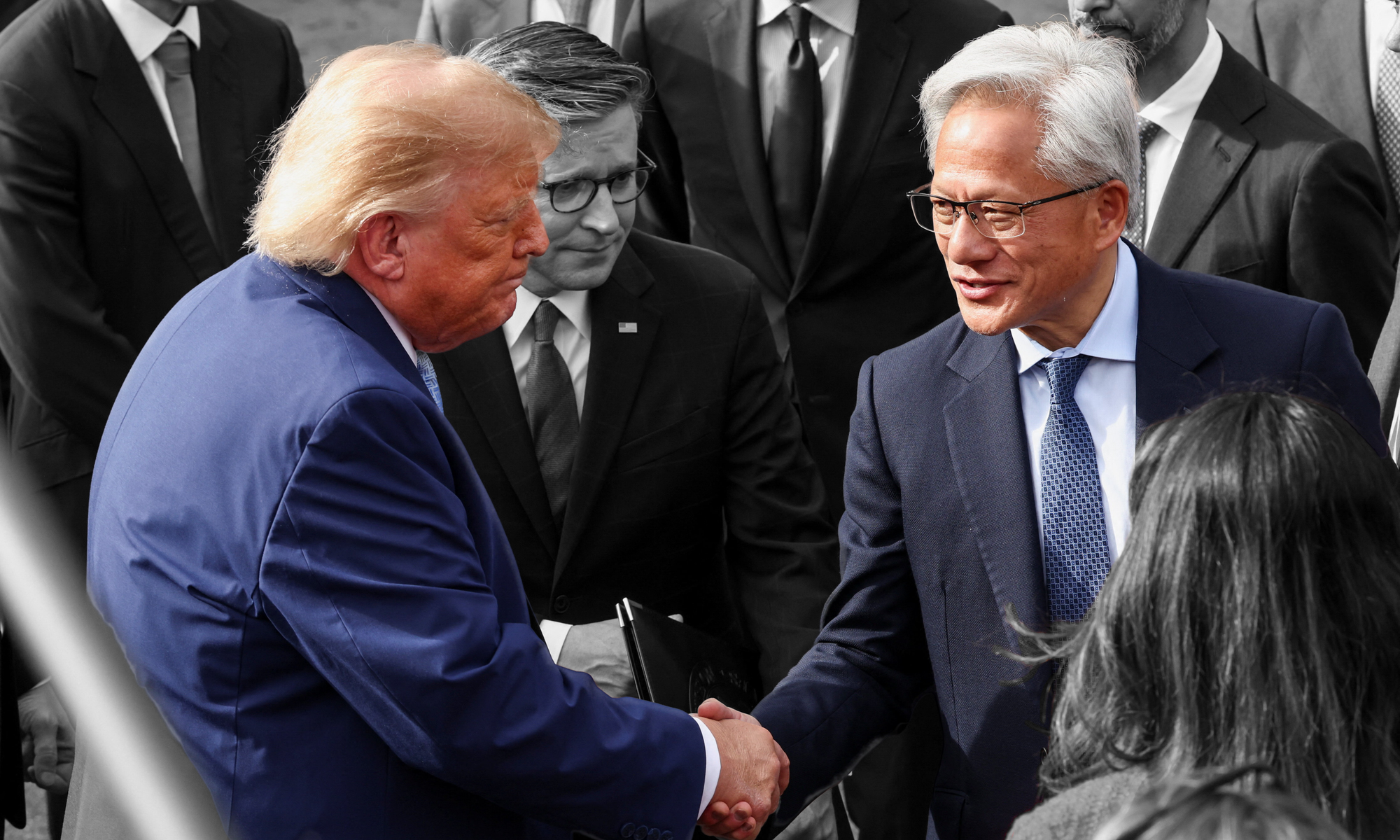
Jensen Huang’s reinstatement. On Monday, Nvidia announced that it had reinstated Jensen Huang as president and CEO, effective immediately. The company’s board of directors said it had voted unanimously to bring Huang back following a series of meetings over the weekend. The board also said it had received input from “senior levels of the U.S. government,” and President Donald Trump told CNBC that he had spoken directly to the board ahead of its decision.
Back up: Huang resigned in mid-November amid reports that he had multiple extramarital relationships, including with Alice Huang (no relation), a former executive of the Singaporean cloud computing company Megaspeed suspected of ties to the Chinese government. Megaspeed has been under investigation since 2024 for potential violations of U.S. export controls on semiconductor chip sales, and on Monday, the Trump administration added Megaspeed to its trade blacklist.
Senior figures in the Trump administration — including the president — expressed support for Huang and suggested he could return to Nvidia; on Monday, Trump told CNBC he “convinced them” to change course. The board’s statement on the decision said it had been assured that reinstating Huang would not pose a national security risk.
Following the announcement, Nvidia’s stock rose 31%, recovering most of a decline that began after Huang’s confirmation of the extramarital affair on November 8. President Trump praised the decision on Truth Social, writing, “The Country needs Jensen’s leadership at NVIDIA in order to ensure the Success and Prosperity of not only the Company, but the American Economy.”
Republican and Democratic lawmakers alike questioned the board’s decision and expressed concerns about the Trump administration’s involvement, with some suggesting that Congress would investigate the matter further. Sen. Rick Scott (R-FL) said, “This looks terrible on its face, and it drives home the need for Congress to be informed on the full impact of Jensen Huang’s actions on our national security and economy.” Sen. Ruben Gallego (D-AZ) wrote, “We need to investigate what stock positions took place before the announcement. This White House is the most corrupt in history.”
Below, you’ll hear views from the left and the right on Huang’s reinstatement. Then, Senior Editor Will Kaback gives his take.
|
What the left is saying.
|
In Bloomberg, Beth Kowitt argued “the Nvidia board just confirmed its own irrelevance.”
“Bringing back Huang is a short-term fix that only calcifies the kinds of long-term problems the board has shown it doesn’t have the will or the competence to handle. And the flip-flopping only further undermines its own power and relevance. The most pressing problem is how the company plans to explain to employees why the rules apply to everyone but the CEO,” Kowitt wrote. “The board’s big solution now is starting a search for a chief compliance officer.
“Somehow I highly doubt adding this new position is what finally reins in Huang. The board also said that its investigation into the foreign intelligence effort targeting Huang will be completed. I can only see that ending one way now, and that’s quietly clearing Huang; the board can hardly afford to oust him again,” Kowitt said. “None of this leads me to believe the board has shown it can temper Huang the second time around.”
In The New York Times, Michelle Goldberg wrote about “billionaire impunity.”
“We don’t yet know the impact of Jensen Huang’s Chinese entanglement on American national security, but he may have caused lasting damage. His removal from Nvidia, however, harmed something Donald Trump values even more: the stock market,” Goldberg said. “So Trump, never a fan of rich men facing consequences, launched a rescue mission. According to The Times, he dispatched JD Vance to help broker Huang’s restoration, including by offering Nvidia’s board assurances that Huang doesn’t pose a national security risk.”
“Trump has now yoked the rest of his presidency, as well as Vance’s political future, to Jensen Huang,” Goldberg wrote. “However this scandal develops, Trump has demonstrated that his administration’s culture of impunity, as well as his alliance with tech oligarchs, remains intact despite the repudiation of the midterms.”
In The Boston Globe, Gary Marcus suggested “the questions are just beginning.”
“The first big question is whether the market gains are sustainable, and where this whole Huang affair… leaves the generative AI boom/bubble,” Marcus said. “Fans of generative AI will point to the fact that Nvidia rose 31% today; cynics might note that the stock is still 32.2% below its peak of $243.37 earlier this year, and even with Huang’s return is overall down 21.8% over the past month. The boom was already starting to cool before Huang’s scandals broke.”
“Let’s be honest: Most stocks in that industry have already taken a giant haircut since the heady days of June,” Marcus wrote. “The Huang that has returned is not the Huang we once knew, and the Nvidia we have now is not the Nvidia we once had. The old Huang was universally treated as a hero, viewed largely without suspicion, and given very little serious media scrutiny; the new Huang is a man who was pushed out for a lack of candor and who is now under a public microscope.”
|
What the right is saying.
|
The Washington Post editorial board asked “why is Trump picking [Nvidia’s] CEO?”
“President Donald Trump personally pressed Nvidia’s board to bring Huang back, calling into its meeting Sunday night,” the board wrote. “Maybe Nvidia’s board made the right call, but this is not how free markets are supposed to work… A president worried about falling stock prices shouldn’t respond by rearranging the management team of one of America’s most valuable companies.”
“Huang’s extraordinary resurrection will inevitably teach Silicon Valley something about power. The wrong lesson would be that executives need more intertwined relationships with Washington,” the board said. “Healthy capitalism depends on companies succeeding because they satisfy customers and investors, not because their executives curry the president’s favor. Huang might be indispensable, but that’s for Nvidia to decide.”
In The Wall Street Journal, Vinay Nair suggested “fast-moving companies should lock in guardrails.”
“The board may have been right; no board can wave away a national-security inquiry into its chief executive. But the timeline followed the headlines, not the findings,” Nair wrote. “Boards today are increasingly quick to oust founders when scandals arise, mostly out of self-preservation… In a crisis, a director’s safest move can become whatever decision ends the exposure fastest, not whatever creates the most shareholder value.”
“Nvidia’s next chapter will be shaped by the controls adopted in this crisis. Mr. Huang may not like all the rules he finds as he returns. But he should ask for something in exchange: a durable agreement with the board about the process by which he can be removed,” Nair said. “The lesson of Nvidia’s past two weeks isn’t that founders should be untouchable, or that boards should defer to them indefinitely. It is that a founder who wants the freedom to make handshakes worth billions should also want the protection to keep making them.”
In Fox News, Rebecca Grant said Huang’s reinstatement “sends China a clear message.”
“Huang’s return is a loud and clear message to China. The fight is on for the U.S. AI tech stack to prevail, not only in quality, but by winning dominant global market share,” Grant wrote. “Huang famously wanted to fight to keep selling mid-level Nvidia chips in China as well as globally. That is why, in part, the Commerce Department’s Bureau of Industry and Security opened up [a] review of export licenses [for Nvidia chips]... That’s over.”
“It’s what comes next that makes Huang’s return important,” Grant said. “Talk to any of the Magnificent 7, and the strategy is basically the same for all the top tech companies. Their global business denies sales to China and generates cash for more investment in the AI ecosystem… Be it chips or data centers or other elements of the tech stack, we can’t just build in America and leave the rest of the globe to China. Huang understands that.”
|
||||
|
||||
|
Reminder: This is where we share a personal opinion. If you have feedback, criticism or compliments, leave a comment or reply to this email.
|

I say this without judgment: Whether you support or oppose Jensen Huang’s reinstatement is a question of what kind of society you want to live in. That might sound dramatic, but as we stare down a future of AI-driven uncertainty, how we answer that question in moments like this will prove crucial to where we end up.
The good-faith case for reinstatement is a kind of utilitarian, we-don’t-like-it-but-we-have-to-do-it bargain that asserts Huang’s value to the United States outweighs his very human shortcomings. In this view, stabilizing one of America’s most important companies (and, by proxy, the economy) takes priority. Huang led Nvidia to Olympus-like heights, which confers a demigod-like status. Yes, it’s an ugly and uncomfortable situation, but imagine how much uglier and more uncomfortable it could get if Nvidia tumbles from the mountain with the U.S. economy strapped to its back.
It’s tempting to fixate on wealthy tech leaders’ gloating in response to yesterday’s news, but remember that for millions of others, Huang’s return comes as an enormous relief. Nvidia stock fell sharply as it became clear Huang would either resign or be forced out, wiping out trillions in its market capitalization. It was a financial shock that threatened to devolve further this week and beyond, and Huang’s return instantly reversed most of the sell-off.
Who am I to say the Nvidia board should have prioritized the moral high ground when so much is at stake for so many people? I don’t own any Nvidia stock and never have, nor do I have any dependents. If Nvidia fell apart and the U.S. entered a recession tomorrow, it’d cause me personal strain, but I wouldn’t have to worry about putting food on the table for my kids or making a mortgage payment or covering healthcare costs for an ailing parent. Those real-world considerations change the calculus. We don’t know that Huang’s permanent departure would have led to disaster, but considering the warning signs across the economy that predated his short-lived resignation, it’s plausible. Bringing him back now mitigates this risk.
That’s one path for society: Do what’s best for the country’s economic (and technological) prospects, and accept that stability and prosperity sometimes require messy decisions and imperfect actors.
The second path adheres to a variation of Alexis de Tocqueville’s self-interest rightly understood. It does not welcome an economic downturn, but it holds that excusing serious misbehavior for short-term gain will only weaken society in the long run. If reports of Huang’s multiple affairs, including one with a direct report, prove true, he violated the most basic standards of corporate conduct. Worse, his affair with Alice Huang, the former Megaspeed executive reportedly suspected of spying for Beijing, may have created a major national security risk. When asked about that relationship, Jensen Huang reportedly misled Nvidia's general counsel — the same executive who had intervened in a Commerce Department investigation into whether Megaspeed evaded U.S. export controls. That could be a coincidence, but it raises important questions about what Huang may have known or said at the time. Bringing him back in a desperate attempt to right the ship does not calm the tumultuous waters he steered them into.
Worse still is the message sent to the world: Amass enough power and influential allies, and the rules cease applying to you. As Editor-at-Large Kmele Foster wrote last week, “Returning [Huang] to the job without severe sanctions would tell every employee at Nvidia, and every executive watching from elsewhere, that candor with your board is optional if you’re valuable enough.” The effect of this message isn’t as instantaneous as a stock market dip, but it’s far more damaging over time — further erosion of trust in institutions, laws, and norms. Whatever pain Huang’s exile might cause right now, it’s a necessary price to avoid that much darker future.
Both camps profess their interest in the long-term flourishing of the United States, but believe in very different paths to get there. I personally want to live in the second society, but I don’t judge those who land on the other side. I don’t see a way in which a society that willingly excuses the actions of a man like Jensen Huang, pins its prospects on one man and one company, and fails to consider any alternate course is one that can thrive. Still, I know it is much easier to take a principled stance before it requires any sacrifice.
Nvidia’s decision to bring back Huang makes me even more uncomfortable when I consider the Trump administration’s role.
By all accounts, President Trump — with the urging of major tech CEOs — campaigned to reinstate Huang. The president said as much in interviews after the announcement while he repeatedly extolled Huang’s singular value to the country. The possibility that Huang’s affair with Alice Huang imperiled U.S. national security doesn’t bother the president. “The United States Government has no reason to believe that Jensen’s return to NVIDIA poses any risk to National Security,” he wrote on Truth Social. In fact, Trump suggested that the reinstatement actually enhanced national security, since Huang might have gone to work for a Chinese company out of spite.
In effect, the president took it upon himself to intervene in a public company’s affairs and override its board’s judgment. His action injects the executive branch into corporate governance in a way I’m not sure we can reverse, particularly as Trump leaves the door open to future interventions. We now have at least one company that the government has unilaterally determined is too important to leave to its board of directors or shareholders; I think the sugar high of this extraordinary move will soon give way to nausea as we grapple with a further redefined relationship between government and industry.
While I don’t know whether the Trump administration will face consequences for this decision, the tenor of the response — particularly from the right — is different from past controversies. Some, like The Dispatch’s Nick Catoggio, are confident that this is “the one,” the scandal that takes down the president after so many false starts in years past. Catoggio is a long-time Trump critic, but Charles Gasparino isn’t, and he’s singing a very similar tune. “There are scandals and there are scandals,” he wrote on X. “This [Nvidia] drama is something where the stuff connects. It would be a huge mistake for the GOP to follow Trump down this rabbit hole.”
Catoggio and Gasparino have good reason to think so. Since Huang’s initial ouster, journalists at The New York Times and Wall Street Journal have uncovered damning details about Nvidia’s suspect business practices and Huang’s personal role in helping China access Nvidia chips’ compute power. I’m confident that more stories like this are coming, and each one will add new layers of scrutiny to everyone involved in bringing back Huang.
Another sign the ground is shifting beneath our (and Trump’s) feet: Republican lawmakers’ response. Sens. Tom Cotton (AR), John Curtis (UT), Rick Scott (FL), and Kevin Cramer (ND) are just some of the prominent GOP elected officials who have publicly spoken out against the administration’s pressure campaign to reinstate Huang. Democrats just won overwhelming majorities in Congress in a direct rebuke of Trump’s second term, and Republicans are positioning themselves for a post-Trump future. The Nvidia saga may be a breaking point. We’re entering a period unlike any we’ve seen since Trump first won the presidency, and Democrats will use their power to publicly investigate every facet of Nvidia’s business and Trump’s role in reinstating Huang.
Will politically vulnerable Republican lawmakers stand by the president as the vise tightens? Will Scott Bessent? Will Marco Rubio?
More importantly, what should the coming hearings and investigations focus on? Personally, I’m interested in a few key questions. How did the Trump administration so quickly reach its determination that Huang posed no national security risk? What information has the U.S. intelligence community collected on Alice Huang and her ties to the Chinese government? What did Jensen Huang know about illicit sales of Nvidia chips, particularly those facilitated by Megaspeed and Alice Huang? Why did Nvidia’s board reverse its decision so quickly and before a third-party investigation was complete? Did anyone in the Trump administration’s orbit — including the president, his family, and his business partners — stand to benefit from Jensen Huang’s reinstatement? I think answers to these questions are within reach with a Democratic-controlled Congress and an increasingly Trump-wary Republican minority.
For now, we wait. But the coming months will determine the bounds of executive power and, perhaps, the kind of society we want to live in.
Take the survey: What role should a president play in private-sector decision making? Let us know.
Disagree? That’s okay. Our opinion is just one of many. Write in and let us know why, and we’ll consider publishing your feedback.
The stocking stuffer they’ll actually use! 🎁
Give everyone on your list a gift they’ll actually use! The AquaVault ChargeCard makes staying charged and connected on the go easier than ever. Small enough to fit in a stocking, practical enough for everyday use.
Tangle readers get 40% off with code TANGLE40.
Shop AquaVault and give the gift of staying charged!
Post-midterms perception gaps.
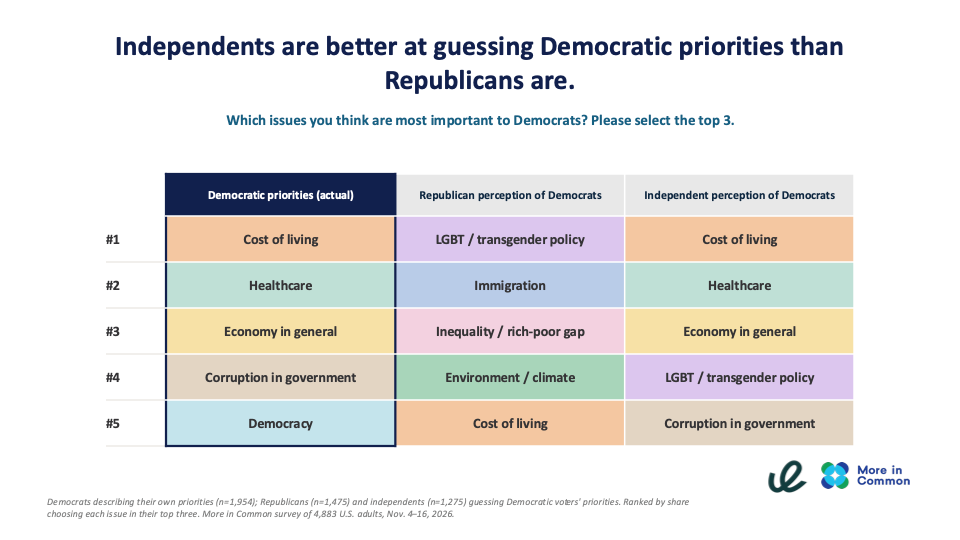
In August’s edition of Press Pass, Isaac shared details about Tangle’s first-ever polling partnership. Since the start of last summer, we’ve worked with More in Common, a non-profit, non-partisan organization, to inform public polling on topics like polarization, partisanship, and societal divides. After publishing the initial results, we put out a call for Tangle readers to submit their own questions and selected several of them for a new round of polling this fall. Today, we’re excited to share the latest survey, which offers insights on the dividing lines in American politics after the midterms.
One question explores how people view the political priorities of those with different views. The results were striking:
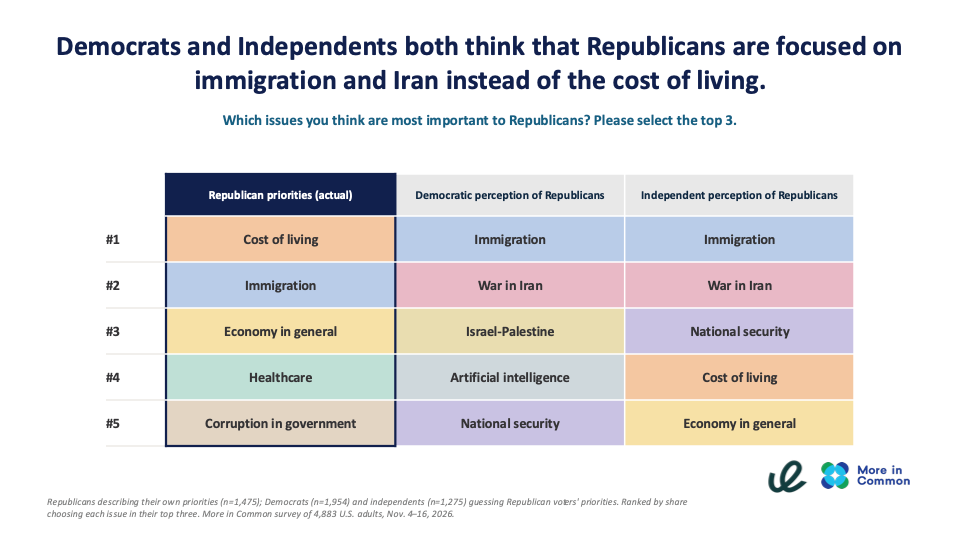
To see the full report, head over to our website.
Then, submit a question for an upcoming poll!
The extras.
- One year ago today we covered the Trump–Mamdani White House meeting.
- The most clicked link in our last regular newsletter was the animated film in Excel.
- Nothing to do with politics: What happened to the telephone book?
- Our last survey: As of 10:00 AM ET, 2,159 readers responded to our survey on the U.S. losing measles elimination status, with 40% saying they think the U.S. will regain the status within 10 years. “I think it is ironic that [Secretary] Kennedy is in the position that has to take responsibility for the official recognition of our failure after all the years he spent contributing to it,” one respondent said. “The ‘lies’ of the COVID era contributed greatly to this current situation and is where much of the blame lies,” said another.
Have a nice day.
Chef Maddy Goldberg started a private dining business in 2021, leaving every Tuesday free. Now, Goldberg cooks lunch for 100 people every Tuesday using whatever donations turn up at Toronto’s Fort York Food Bank. The ingredients are unpredictable, so she improvises; when a recent week offered little beyond onions, carrots, potatoes, eggs and milk, she turned a bag of raw red lentils into falafel-style fritters and served them with toasted pita. “I was struggling a lot when I was working in fine dining, and it stressed me out,” Goldberg said. “I wanted to do something where the goal wasn’t to make money off of it. It was just to feed people.” Good Good Good has the story.
Member comments