





Hello and welcome to Tangle. I’m Isaac Saul, officially in the 10-day countdown to my favorite holiday of the year: Thanksgiving. Fingers crossed for a week without whatever happened to our aviation system on Friday. That nationwide ground stop is the subject of today’s newsletter, and I’ll be making my case for some major FAA reforms. Plus, a reader question about the impact of super PAC money on elections and a major geological discovery.
It’s a 13-minute read.

Will Kaback, Audrey Moorehead, Carina Pacheco, Russell Nystrom, Isaac Wood, and Bailey Saul edited or contributed to today’s newsletter.
Seeing what we want to see.
Stark electoral outcomes often inspire takes that one issue or another was responsible for the results. After the 2026 midterms, the Iran war, immigration policy, tariffs, and more have all been offered as the driving force behind Republican losses. In last Friday’s edition, Isaac writes on the pitfalls of this siloed thinking. You can read it here.
Quick hits.
- Iran launched a drone attack on a U.S. airbase in Bahrain. Iran said the strikes were retaliation for “hostile US actions.” (The attack)
- Treasury Secretary Scott Bessent said AI chipmaker Nvidia should hire outside the company as it searches for a new CEO, calling for a “dramatic shakeup” after former CEO Jensen Huang’s resignation. (The comments)
- A tanker collided with a riverboat docked on the Mississippi River near the Port of New Orleans on Friday, injuring over 30 people on the riverboat. The cause of the collision is under investigation. (The collision)
- The Supreme Court agreed to hear a case on President Trump’s order to suspend the asylum system at the U.S.–Mexico border. (The case)
- The Pan American Health Organization revoked the United States’s measles elimination status following outbreaks across the country over the past two years. (The decision)
Not every breaking news link is what it seems.
You read the news closely. You click through to primary sources, dig into threads, and follow links to get the full picture. That’s a great habit, and one worth protecting.
As more of our news consumption happens online, it’s also important to be mindful of misleading links, spoofed websites, and phishing attempts that can be difficult to spot. A little extra protection can help you browse with more confidence.
That’s where Surfshark VPN comes in. Its built-in scam and phishing protection automatically blocks known malicious links and fake websites before they load, adding another layer of security as you browse.
Get it now: $2.49/mo on the 2-year plan — 88% off + 3 extra months.
Read critically. Browse confidently.
Today’s topic.
The nationwide ground stop. On Friday, the Federal Aviation Administration (FAA) grounded most flights in the United States due to disruptions to air traffic control communications systems. The stop lasted for approximately five hours, causing mass flight cancellations and delays that continued through the weekend. Government officials suggested the issue originated from a router installation by a government contractor, and Transportation Secretary Sean Duffy called on Congress to pass additional funding to modernize FAA systems.
Back up: Before Friday, the FAA had ordered a nationwide ground stop twice in U.S. history, first after the September 11, 2001, terrorist attacks and second in 2023 when a critical computer system malfunctioned.
Secretary Duffy said the decision to call the ground stop was made after communication and radar systems experienced “inconsistency,” creating gaps in contact between air-traffic controllers and pilots. All of the roughly 3,500 flights in the air during the disruption landed safely. By 8:15 PM ET, the systems were stable and flights began departing again.
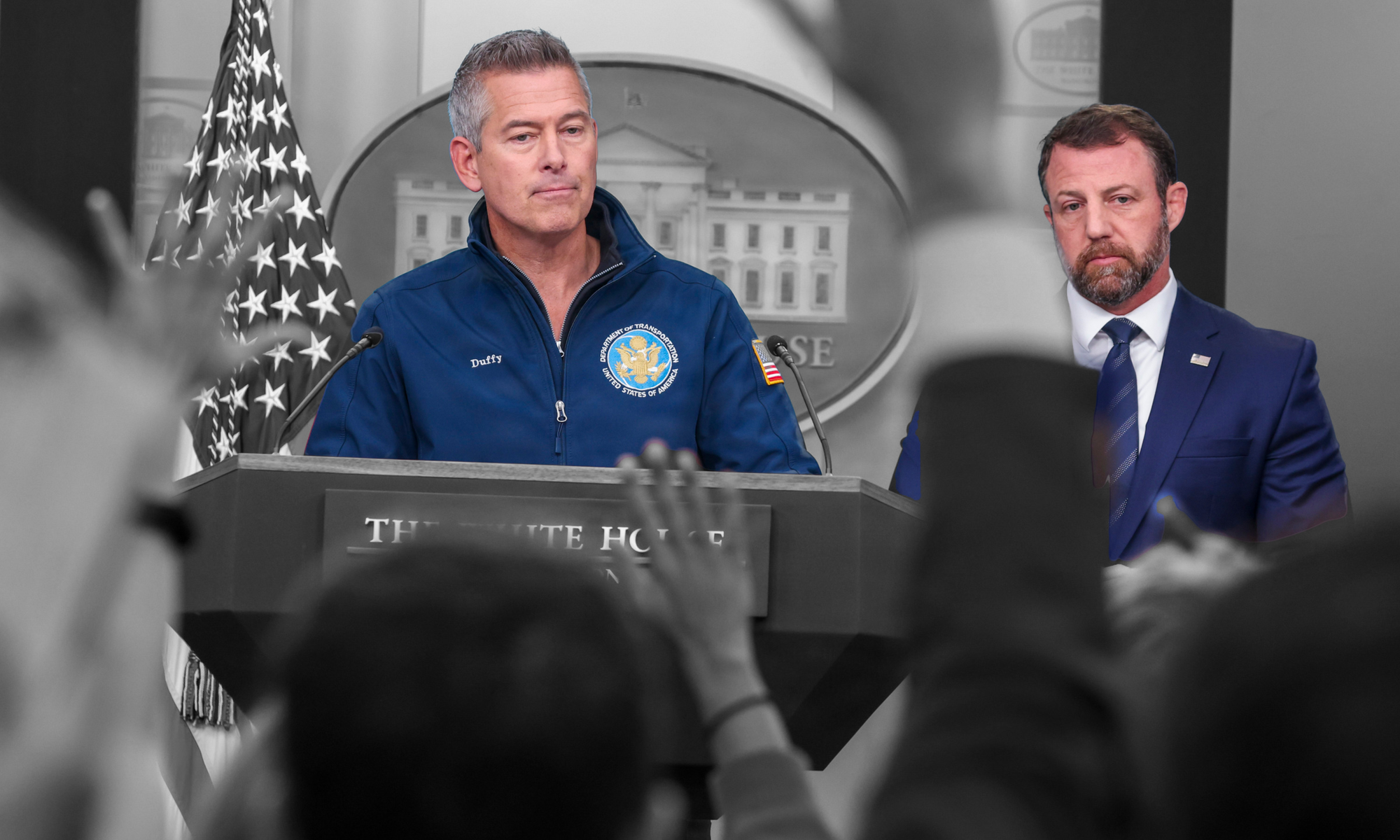
In a press conference on Friday night, Duffy repeatedly described the issue as a result of outdated FAA systems and said the agency needs more funding to upgrade aging infrastructure. “This is a continual problem that we have and it should be fixed,” he said. “New hardware, new software, new telecommunication.”
Separately, Homeland Security Secretary Markwayne Mullin said he had seen “zero evidence” that a cyberattack caused the disruptions but that his department was still investigating. Mullin later suggested that Duffy’s ongoing efforts to upgrade the FAA’s systems “was overwhelming the older system.” However, the FAA said on Sunday that the new equipment was not responsible, reporting that its initial investigation found two potential sources for the disruption: a facility in Arkansas where government contractor L3Harris was conducting maintenance on telecommunication lines, and a radar site in Texas.
Below are views from the right and left on the ground stop. Then, Executive Editor Isaac Saul’s take.
|
What the right is saying.
|
In The Wall Street Journal, Marc Scribner suggested “tech isn’t the FAA’s biggest problem.”
“[America’s air-traffic control system] is antiquated and in dire need of an update, but money won’t solve the fundamental problem: the Federal Aviation Administration’s obsolete institutional model, which is responsible for its crumbling infrastructure,” Scribner wrote. “The agency has a dual mandate to provide air-traffic control and regulate its safety. It depends on congressional appropriations to sustain itself.
“As a result, air-traffic control competes with other federal spending priorities, and it faces operational trade-offs between efficiency and safety. This web of conflicting interests explains why the near-constant concern about the outdated U.S. air-traffic control system has persisted for decades without resolution,” Scribner said. “Those reforms start with the recognition that air-traffic service provision and safety regulation shouldn’t be performed by the same entity.”
In PJ Media, Matt Margolis wrote “Democrats hope you forget this about the last nationwide FAA ground stop.”
“[Duffy said] he expects flights to be ‘back up and operational as we come into the heat of travel during Thanksgiving.’ Former Transportation Secretary Pete Buttigieg slammed the ground stop anyway,” Margolis said. “[Buttigieg] pretended that the Biden administration was proactive about modernizing the system… [He] had four years, a mountain of infrastructure money, and his own nationwide ground stop to learn from. If he ‘got to work,’ where are the results?”
“An August 2023 New York Times investigation found that under Biden and Buttigieg, there was a sharp rise in near-collisions at U.S. airports nationwide, with internal FAA records showing that commercial airline close calls were happening multiple times a week,” Margolis wrote. “Democrats left behind a crumbling air traffic system, and now they want to prosecute the people trying to fix it.”
In The New York Post, Michael Goodwin argued “money alone won’t fix the FAA.”
“The most troubling consistency of both the press conferences on Friday and Saturday was the officials’ eagerness to blame Congress for not budgeting enough money to speed the modernization of the FAA’s communication network,” Goodwin said. “Duffy said the work should have been done years earlier, and renewed his appeal for Congress to appropriate a staggering $50 billion in new funding for emergency overhauls.
“Coming in the midst of the mysterious shutdown, the not-enough-money argument struck me as being predictable and off key. Washington is now $40 trillion in debt, or about $121,000 for each US resident. How much is enough?” Goodwin asked. “Even if Congress wrote the check tomorrow, the work would take years. So the cavalry is not coming soon. Such pleas always sound like everything would be fine if only America spent more.”
|
What the left is saying.
|
In The Atlantic, Josh Tyrangiel wrote “the next major grounding will be worse.”
“Even if today has a boring explanation, the experts I’ve been talking with are pretty sure that plenty of days like this are coming, for two main reasons,” Tyrangiel said. “First, anyone can be a bad guy now… Deterrence works on parties who have something to lose and an address where you can send a reply. The trouble with AI (um, one of the troubles) is that it may hand state-grade capability to people who have neither.”
“Second, our best defense against this kind of chaos is amputation… when cyber defenders find a hole they can’t patch fast enough, the rational move is to amputate: Switch the system off and wait,” Tyrangiel wrote. “Whatever caused today’s ground stop, halting every departure in the country ‘for reasons of safety’ until someone works out what’s going on isn’t a sign that the system is failing. More and more, it is the system.”
In MS NOW, Steve Benen said the administration “tried to play a blame game.”
“Those looking to federal officials for answers were left wanting,” Benen wrote. “Homeland Security Secretary Markwayne Mullin hosted a rather clumsy, nine-minute press briefing just outside the White House, where he said very little… That led to a longer Q&A in the White House press briefing room, led by Mullin and Transportation Secretary Sean Duffy, in which they spent roughly a half-hour explaining how uncertain they were about precisely what happened.”
“If the goal was to reassure the public, it was an embarrassing failure,” Benen said. “It wasn’t until Sunday morning when the president managed to publish a couple of brief online statements about the developments from two days earlier, and to the surprise of no one, he blamed his Democratic predecessor. For those concerned with the Republican administration’s rampant incompetence, the developments did not inspire confidence, but just as notably, Team Trump was playing a blame game it couldn’t hope to win.”
In Bloomberg, Thomas Black suggested the “disruptions need more than money to fix.”
“If you listened to Transportation Secretary Sean Duffy explain why flights were grounded for about four hours on Friday, you would come away thinking that a lack of funding from Congress was the culprit. That’s not the case,” Black wrote. “Duffy should have instead taken the opportunity to be frank with the American people about the challenges of upgrading the fragile infrastructure that undergirds US aviation.”
“Voters expect critical infrastructure to function at all times, but they detest when city streets are torn up to fix a water pipe or when traffic is snarled by a highway expansion,” Black said. “Once the FAA has a better understanding of what happened on Friday and how to avoid repeating the mistake, it shouldn’t retreat into safe mode. Pushing upgrades into the future is why these antiquated systems pose such risks to air travel today. The future is now.”
|
||||
|
||||
|
Reminder: This is where we share a personal opinion. If you have feedback, criticism or compliments, leave a comment or reply to this email.
|

Consider for a moment the magnificent, outlandish miracle of modern-day air travel in America.
Nearly 45,000 flights take off and land each day, almost always without incident. At peak, some 5,500 planes are in the air at once, criss-crossing the skies at various altitudes, speeds, and directions. These flights communicate through what is essentially a giant walkie-talkie network — linked by cable lines, aided by their on-aircraft systems, and managed by air traffic controllers. Pilots can see, obviously, but a key part of flying a commercial jet is listening; they’re not just reacting to what they see out the window, but also trying to match their altitudes, speeds, and angles to the precise instructions they receive over the radio.
On Friday, some pilots and air traffic controllers noticed that those walkie-talkies were acting kind of funny. They started asking each other things like, “Can you hear that static?” or “Did you hear me calling you?” which is not exactly the sort of question you want your pilots and air traffic controllers asking while operating commercial planes full of people. The FAA, which operates under Transportation Secretary Sean Duffy, began investigating the source of the communication issues — in the 45 minutes it spent trying to resolve the problem, the agency came up empty-handed while the disruptions seemed to intensify. That’s when it made the call to ground most flights.
Duffy, predictably, is now asking Congress for more money. As we speak, the FAA is trying to replace thousands of miles of copper wire with fiber optic cable to modernize its systems. Duffy said this work likely triggered Friday’s mess — a contractor completed a changeover which caused routers in the system to be flooded with more than 1,000 connection attempts every four to five seconds, disrupting feeds across air traffic control (ATC). In simple terms, the situation was akin to a four-year-old screaming “hello?!” over and over into a walkie-talkie that is communicating with all other walkie-talkies. You can see how that would make communication between pilots and ATC difficult.
(Worth noting: Some new reporting has called Duffy’s explanation into question, and air traffic controllers have been warning about vulnerabilities in these systems for a while, but I haven’t seen a coherent alternative explanation offered, either. For now, I’m going to assume the FAA’s theory is correct.)
Here, it might be easy to dunk on Duffy as the reality TV star Transportation secretary who’s in way over his head. But the truth is Duffy is far from unusual: Of the 20 Senate-confirmed transportation secretaries since the post was created in 1967, about half had no regional or national transportation sector experience. A few were former mayors (like Duffy’s predecessor Pete Buttigieg) whose relevant experience was linked to passing legislation dealing with airports or local transit. Others had virtually no background on transportation issues at any scale. In reality, Duffy — an experienced lawyer and former congressman — has just as much government experience as many of his predecessors, even if he has much less direct transportation experience than some of them, too.
He also made the right call, which very few people seem to be saying. If my loved one was on one of the thousands of flights scheduled or in progress on Friday afternoon, I’d much prefer them getting to their destination a day late than not at all. Our risk tolerance for pilots can’t hear air traffic controllers should be quite low, and Duffy and FAA officials acted quickly and responsibly in calling for the ground stop. Friday was quite dramatic, and like everyone else, when the news broke I speculated to friends and colleagues about an Iranian attack or “AI bot gone rogue.” But similar cascading issues have surfaced repeatedly over the years, most notably in 2023 and 2009.
The question then is: Now what?
A better solution than “keep funding the system producing poor track records” might be finally beginning the corporatization (or “utility model”) of air traffic control. This proposal would separate the FAA from ATC to make the latter a standalone public utility funded by user fees. In theory, this model would separate ATC from political volatility in appropriations and allow it to finance large-scale technology upgrades through long-term revenue bonds.
Libertarians and some conservatives have long called for the U.S. to move toward this model, and every single year their case gets more compelling (I used to be against it; now I’m not). Our system has a self-evident weakness: Fees and taxes on airlines and passengers (as well as general taxes) raise money for infrastructure improvements, and congressional appropriators then decide what to do with it rather than sending it straight to the operators. Congress gives the money to the FAA, which ends up as both referee and player — it receives the money to build out and modernize, then oversees its own use of that money. All of this happens on Congress’s timeline (through appropriations).
Over the years, Congress and the transportation sector have had spurts of momentum to reform this system. As Reason Foundation Transportation Policy Director Robert Poole noted, from 2013–2018, reform bills to move our system to a public utility model garnered support from “all the major passenger and cargo airlines, [the labor union representing air traffic controllers], unions representing pilots and flight attendants, six former U.S. Department of Transportation secretaries, all three former chief operating officers of the Air Traffic Organization, 13 former senior Clinton administration officials, transportation experts from a long list of noted think tanks, taxpayer and consumer groups, and the editorial boards of many leading newspapers, including the Chicago Tribune, Miami Herald, Orlando Sentinel, The Wall Street Journal, Washington Post, and USA Today.”
And it’s no wonder.
Countries with strong safety regulators like Germany, the United Kingdom and New Zealand have all set up a kind of separate, fee-funded company for air traffic control. Our northern neighbor Canada has perhaps the most unique system of all — a nonprofit with a 15-person board that finances itself through aviation user fees.
This model has improved safety and substantially lowered costs. Airlines and flyers, not the general taxpayer, fund Canadian air traffic control, and that has made efficiency a top priority. That copper wire replacement we’ve been working on for 25 years? Canada completed most of its own in 18 months under the Nav Canada system.
Success wouldn’t be guaranteed or linear, of course. Nav Canada’s entire air traffic control covers about 9,000 flights per day, a fraction of U.S. volume. As former Rep. Steve Russell (R-OK) once said, comparing the two systems is like “comparing an apple to a horseshoe.” We’re also already handing some ATC duties off to corporate America with mixed results. In fact, the defense contractor L3Harris was the group behind the repairs on Friday that allegedly triggered Friday’s nationwide grounding.
Still, it’s not like Canada operates a completely different system with completely different vehicles. Recreating its success is a simple matter of scale, and I sincerely doubt we are incapable of following through if we really want to. But the current Transportation secretary or president is clearly far less relevant than the system itself. The FAA’s job should be to regulate — not operate — and a push to keep the agency in its lane while building out a private air traffic control system would generate more money to support the system, more efficiency in using funds, and faster modernization across the board. It’s time to stop doubling down on the FAA’s convoluted structure and start laying the groundwork for an altogether reimagined and better system.
Take the survey: What do you think of the “utility model” proposal for air traffic control? Let us know.
Disagree? That’s okay. Our opinion is just one of many. Write in and let us know why, and we’ll consider publishing your feedback.
Your questions, answered.
What implications does this midterm election have for big/dark money in politics? In both primaries and the general election, we saw candidates whose strategies relied on sincere outreach and grassroots efforts trump candidates supported by super PACs and megadonors like Elon Musk.
— Sophie from Lafayette, LA
Senior Editor Will Kaback: It’s difficult to say confidently that grassroots fundraising will win out over super PACs and megadonors (or vice versa) in every case. So many variables go into individual races, and one fundraising approach might help a candidate in a certain race and hurt them in another. That said, a 2025 study in Research & Politics found that voters (both Republicans and Democrats) were more likely to say they would vote for candidates who rejected PAC contributions. Overall, I think candidates with small-dollar support can claim an enthusiasm edge, but PACs will continue to be an important source of funding for many successful campaigns.
A separate but related question is whether deep-pocketed campaigns have a clear advantage in the first place. Some academic studies have established that political spending can shift voter preferences and influence election outcomes, but that impact is not 1:1 — that is, spending can reach a point of diminishing returns, regardless of where the funding comes from.
In this year’s midterms, we saw that idea play out. According to OpenSecrets, Democrats and Republicans spent $5.5 billion and $5.1 billion, respectively, on the 2026 midterms. Of course, those funds were allocated differently; Republicans spent more than Democrats on advertising in the Texas, Ohio, Michigan and Maine Senate races, while Democrats spent more on ads in the Iowa, North Carolina, and Georgia Senate races. But the common denominator? Democrats won all seven races.
At minimum, these results show that dumping huge sums into elections doesn’t guarantee an outcome. Elon Musk spent at least $225 million supporting Republicans in Texas this year, and they got wiped out. Similarly, Kamala Harris’s campaign spent a whopping $1 billion in the 2024 presidential election (compared to Trump’s $472 million) and lost decisively.
Does that mean campaign spending doesn’t move the needle anymore? Not really. You also have to factor in the quality of the ads themselves, where and when campaigns make ad spends, and other variables. But after an election in which the party with the far larger war chest lost nearly every key race, I wouldn’t be surprised if campaigns start to rethink how they spend their money.
Want to have a question answered in the newsletter? You can reply to this email (it goes straight to our inbox) or fill out this form.
Staying informed shouldn’t put your online security at risk.
Fake breaking news links, phishing emails and spoofed websites are designed to trick even savvy readers into exposing their passwords, accounts, and personal information.
Surfshark VPN’s built-in scam and phishing protection automatically blocks malicious links and fake sites before they load.
Get it for $2.49/month on a 2-year plan, 88% off + 3 extra months.
Read critically. Browse confidently.
The extras.
- One year ago today we had just published a reader mailbag.
- The most clicked link in our last regular newsletter was our Instagram post of a sentinel chastising a group with Defense Secretary Pete Hegseth at the Tomb of the Unknown Soldier.
- Nothing to do with politics: Watch SpaceX catch its Starship rocket on return from orbit for the first time.
- Our last survey: As of 10:00 AM ET, 4,712 readers responded to our survey on the effort to impeach Defense Secretary Pete Hegseth, with 53% saying they think Hegseth will be impeached in the first half of 2027. “His actions have hurt the effectiveness of forces, and I believe he has taken illegal measures in taking out the boats he says are transporting drugs,” one respondent said. “I wish the Democrats would spend their time and energy on other more important issues, such as the cost of living, instead of trying to impeach different people,” said another.
Have a nice day.
After collecting rocks from several sites in northwestern Iran, Ali Mohammadi’s team at Istanbul Technical University discovered something that had been mostly erased from the geologic record: a chain of volcanoes that was active between 101 million and 97 million years ago. During that period, an ancient ocean called the Neo-Tethys was closing, which helped shape the modern Middle East. The discovery changes the way geologists understand the history of the region. “The magmatic history of northwestern Iran is more complex than previously recognized,” Mohammadi said. ScienceDaily has the story.

Member comments