





Good Tuesday morning. I’m Isaac Saul, writing from North Jersey. One week ago today, we were predicting how badly the polls were underestimating Republican support and whether Democrats would really retake the Senate. A lot can happen in a week. Amid the midterm madness, one story we didn’t get to was President Trump’s surprise Election Day announcement that he would be ending U.S. aid to Israel in 2027. Today, we give that story its proper attention.
Later, a historical dive on Veterans Day (and a reminder we’re off tomorrow in observance of the federal holiday).
It’s a 12-minute read.

Will Kaback, Audrey Moorehead, Carina Pacheco, Russell Nystrom, Isaac Wood, and Bailey Saul edited or contributed to today’s newsletter.
Is election fraud dead?
In the latest edition of A Grain of Saul, Isaac discusses how post-election claims of widespread fraud have differed this year compared to past cycles. He writes:
Election denialism is pretty much dead. Could it be resurrected? Perhaps. But for now, there isn’t a single losing candidate in any race denying the results of their election, nor is the president shouting from the rooftops that this sweeping rebuke of his presidency was somehow rigged.
Read on to get Isaac’s full take on why this year is different.
We’re off tomorrow.
We are not publishing a newsletter or podcast tomorrow in observance of Veterans Day. We’ll be back in your inbox on Thursday!
Quick hits.
- Rep. Thomas Massie (R-KY) introduced articles of impeachment against Defense Secretary Pete Hegseth. (The articles)
- The Bureau of Labor Statistics reported that the consumer price index for October increased 0.4% on a monthly basis, with energy prices rising 0.7% after increasing 5.2% in September. (The report)
- The Supreme Court issued an unsigned order that will allow the Trump administration to proceed with border wall construction in the Big Bend region of Texas. Justice Ketanji Brown Jackson indicated that she would have denied the administration’s request. (The order)
- News outlets projected that a California ballot measure that would have levied a one-time 5% tax on residents with a net worth of $1 billion or more has failed. (The projection)
- French Minister of Foreign Affairs Jean-Noël Barrot accused Iran of carrying out cyberattacks on refrigerators at hundreds of food distribution sites in October. (The accusation)
Hey guys, Isaac here –
If you missed our election coverage livestream, you may have missed out on an incredible offer from our sponsor, Incogni.
I’ve talked before about how strange it is that you can Google your name, address, phone number, and other personal information. A lot of that comes from data brokers collecting and selling personal information, which is probably part of the reason your phone becomes completely unusable around election season.
Incogni goes after those companies for you, sends removal requests, and keeps following up, erasing your data so you don’t have to.
So if you’d prefer that strangers on the internet know less about you, click the button below and use code TANGLE for 58% off an annual plan.
Keep your private info – private.
Today’s topic.
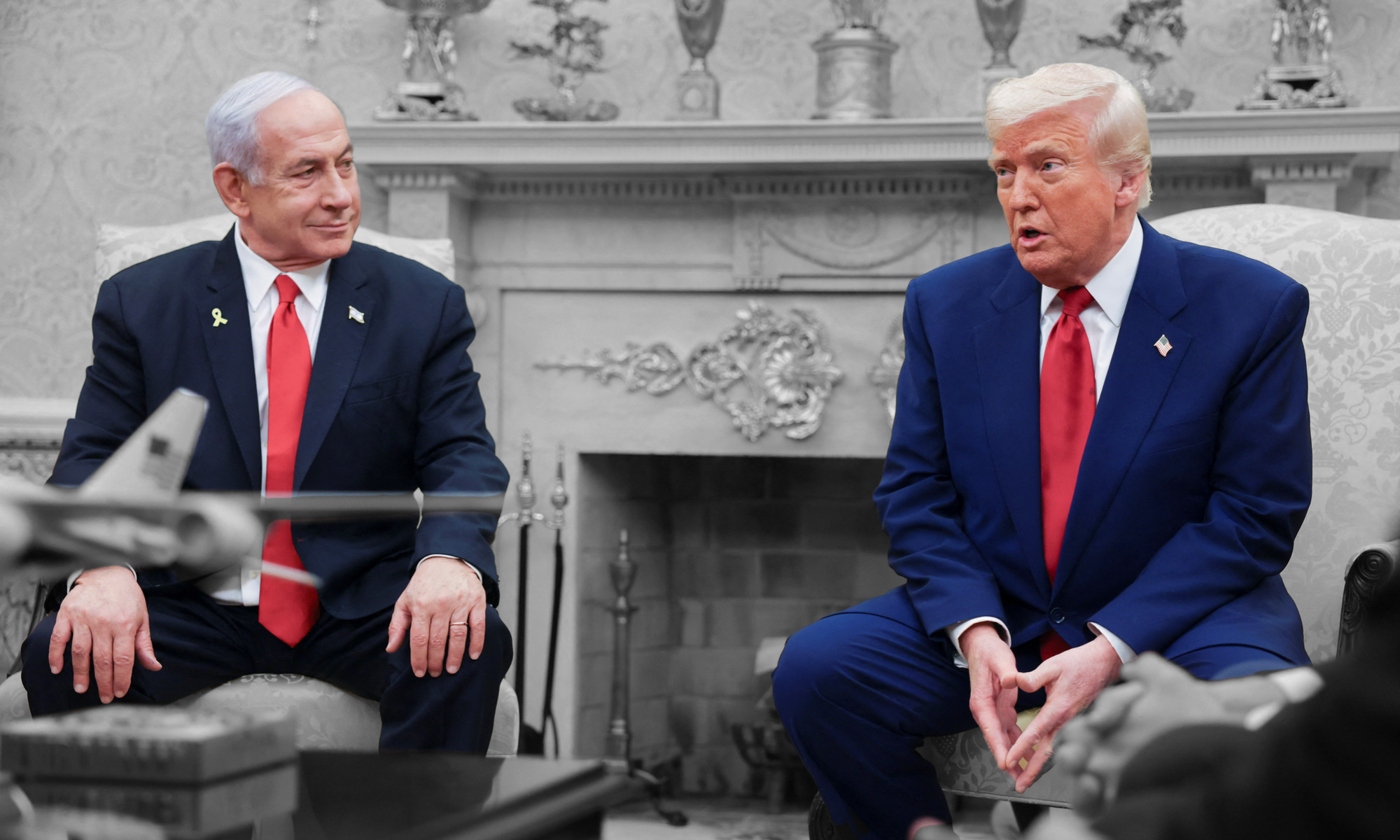
U.S. aid to Israel. On Tuesday, November 3, President Donald Trump announced that U.S. aid to Israel will end at the start of 2027, saying that the country “no longer need[s] it.” The president said that Israeli Prime Minister Benjamin Netanyahu brought the idea to him years ago, and the two agreed that now is the time to end the assistance. While Trump indicated that the roughly $3.8 billion in annual aid would be reduced to zero, recent reporting from Israeli outlets suggests the package will only be halved as a result of shortening its time frame.
Back up: The United States has provided Israel with approximately $300 billion in combined economic and military aid since Israel’s founding. As part of that assistance, the Obama administration signed a memorandum of understanding in 2016, agreeing to send $3.8 billion annually through 2028. The majority of the aid goes to purchases of U.S. military equipment and services; weapons sales are subject to Congressional review, but Congress has never blocked a transfer.
In his comments on Tuesday, President Trump suggested that the annual aid payments were an effective political target for the left. “The left uses the $4 billion payment that everybody knows about, when it’s no secret, as a signal of unfairness, and we can’t allow that to happen,” he said. “Why should we suffer the slings from lunatics like [Democratic Senate candidate Abdul] El-Sayed when they don’t need it?”
In January, Prime Minister Netanyahu said he wanted to “taper off” U.S. aid to Israel in the next decade. On Friday, he said Trump’s decision to end the annual assistance “shows the strength” of the relationship, adding, “Israel has a strong and stable economy.”
While President Trump suggested that the aid would end in its entirety in 2027, Israeli news outlets Ynet and Yedioth Ahronoth reported this week that a new memorandum of understanding would continue the aid for five years through 2033, after which it would be phased out completely. The White House has not shared further details on the plan.
The developments come as political leaders in both parties have scrutinized the U.S.–Israel relationship amid protracted conflicts in the Middle East, including Gaza and Iran. Today, we’ll share views from the right, left, and Israeli writers on the potential aid cutoff. Then, Executive Editor Isaac Saul’s take.
|
What the right is saying.
|
The Wall Street Journal editorial board said the leaders “discussed phasing it out over years, not months.”
“President Trump’s Election Day surprise that he will end aid to Israel is less and more than meets the eye. Less because he is acting on a proposal of Israeli Prime Minister Benjamin Netanyahu and joint plans that have been in the works for at least a year. More because of what the move says about the worsening politics of the U.S.–Israel relationship,” the board wrote. “Mr. Trump came around to the Netanyahu idea; if Israel no longer wanted aid, why force it?
“Discussions advanced to phase out the aid over several years, starting at the end of 2026. That’s why the President’s statement on Tuesday that it would all end in two months caught Israelis unaware. Did Mr. Trump misstate the point? Or did he deliberately put it in the way he felt would be most politically advantageous?” the board asked. “This augurs poorly for the Jewish state, even if it would rather tear off the Band-Aid with Mr. Trump… than have a hostile Democratic President end aid as punishment after 2028.”
In National Review, Noah Rothman suggested “cutting off Israel won’t appease the ‘anti-Zionist’ left.”
“The president’s approach to this issue has a domestic political component. ‘Why should we suffer the slings from lunatics like [Abdul] El-Sayed when they don’t need it?’ Trump asked. ‘It’s a bad talking point,’” Rothman wrote. “If this becomes U.S. policy at the beginning of next year, as Trump forecast, it will have about as much effect on the anti-Israel left’s advocacy as did the end of high-tempo combat operations inside Gaza 13 months ago. Which is to say, it won’t have any effect at all.”
“Those who continue to rail against the ongoing ‘genocide’ inside Gaza are operating independently of the facts on the ground. Why should an amendment to a line item that consumes 0.05% of America’s annual outlays represent a moderating force?” Rothman asked. “There are many compelling reasons to transition away from the current posture toward Israel on which both sides of the equation can agree. But mollifying Israel’s monomaniacal critics isn’t one of them. They cannot be appeased.”
|
What the left is saying.
|
In Vox, Eric Levitz wrote about “the Israeli case against U.S. aid to Israel.”
“Trump’s remarks Tuesday morning seem to have been ad-libbed. The Israeli Treasury Department reportedly had no knowledge of a supposed joint agreement to end U.S. aid. And existing U.S. law provides Israel with $3.8 billion in annual funding through 2028. All this said, Trump didn’t pluck his Election Day rant out of thin air,” Levitz wrote. “Rather, his remarks actually reflect a prominent strain of thinking among Israeli leaders and security experts.
“In their view, America’s cash may no longer be worth the political blowback that it invites,” Levitz said. “A voter doesn’t need to have any strong opinion about the Israel–Palestine conflict to oppose sending billions of dollars to a wealthy foreign country… On the U.S. left, right, and center, political winds are blowing against aid to Israel. With some of that country’s own leaders and admirers bowing to such gusts, the draw down of American aid to Israel might now be a matter of when, not if.”
In MS NOW, Zeeshan Aleem said “the foreign policy script is flipping.”
“Trump remains under fire for joining forces with Israel in an unpopular war with Iran, and his Tuesday statement sounded like a Hail Mary attempt to help the GOP win over swing voters who oppose aid to the U.S. ally,” Aleem wrote. “If that particular aid package is ended, it’s likely to be replaced by a more covert policy of arming Israel with U.S. weapons. But Trump clearly recognized that it could be politically advantageous to appear to be severing aid to Israel.
“A slow-moving but seismic shift is taking place across American politics: Progressives are gaining real power in the debate over Israel,” Aleem said. “For decades, the conventional wisdom has held that criticizing Israel too forcefully is politically lethal. But Trump saw an Arab American progressive like El-Sayed as a threat to the GOP’s voter base because he criticized Israel. We seem to be in the early stages of an inversion of the bipartisan consensus on support for the longtime ally.”
|
What Israeli writers are saying.
|
In JNS, Duvi Honig suggested “aid to Israel was also Israel’s aid to America.”
“U.S. President Donald Trump’s announcement about ending approximately $4 billion in annual U.S. military aid to Israel has people worried, as though Israel just suffered a terrible financial loss,” Honig wrote. “My reaction is exactly the opposite: Thank You, Hashem! It’s all for the best. For decades, Israel has been giving America extraordinary strategic, technological, intelligence and economic value while being portrayed as the country standing with its hand out.”
“How much has American research and development benefited from Israeli expertise? How many American lives and military resources have been protected through Israeli intelligence and defense technology?” Honig asked. “Perhaps what looks like a financial loss will become the beginning of greater economic independence, more opportunities for Israeli industries and a partnership that better recognizes Israel’s true contributions.”
In The Jerusalem Post, Yoram Dori called the aid “a central pillar of Israel’s national security and military planning.”
“Let us consider the facts. American military assistance is not some generous Christmas present that Israel can politely decline,” Dori wrote. “Ending that assistance prematurely would represent a serious blow to Israel’s defense capabilities and impose an enormous additional burden on Israeli taxpayers… The American assistance agreement is not merely a financial arrangement. It reflects a long-standing bipartisan commitment to Israel’s security.
“For decades, Israeli leaders understood that maintaining bipartisan American support was a strategic national interest, not a partisan luxury,” Dori said. “Let the transitional prime minister publish the terms of the deal. Let him explain why Israel should surrender nearly $4 billion annually, what strategic advantages Israel will receive, and how the resulting gap in our defense budget will be filled. And, above all, let him explain why this extraordinary announcement had to be made on the very day Americans went to the polls.”
|
||||
|
||||
|
Reminder: This is where we share a personal opinion. If you have feedback, criticism or compliments, leave a comment or reply to this email.
|

For a long time, I’ve sensed a fundamental contradiction in the way Americans discuss our aid to Israel.
Casual political observers, anti-Israel activists, and — frankly — antisemites all tend to portray Israel as entirely dependent on the United States for its survival, yet somehow powerful enough to dictate American foreign policy. In this framing, Israel is both a beggar that needs the U.S. to survive in the Middle East and an all-powerful puppet master that pulls the strings of U.S. policy. It’s rather absurd if you think about it for a moment.
In reality, and in a stroke of irony, the most zealous Zionists in Israel have long wanted the same thing progressive, pro-Palestine voters in America want: to wean Israel from U.S. aid. For the Israeli right, no longer taking money from America would mean no longer having to explain their actions to a Western government and populace that don’t understand how a fundamentally non-Western country must operate to live in safety in the Middle East. The United States is not the only place Israel can buy weapons from, and the chance to shed the often constrictive rules of American foreign aid is highly desirable to many Israelis.
A lot of Americans (and, apparently, some American journalists who write about Israel) don’t seem to grasp that Israel is not a Western country. It is not a little America. It is not Europe. It is Middle Eastern, through and through. Our relationship with Israel is less akin to an allyship with France or Canada than it is to Egypt or India. Israel is just different from America.
It’s worth being specific about what aid to Israel actually comprises. Some frame it as “giving” Israel $3.8 billion a year, while others suggest Israel is just buying $3.8 billion of U.S. weapons. The reality sits somewhere in between: It’s a grant of U.S. taxpayer money that goes to Israel, which must be mostly spent on American weapons and military technology. In other words, this is not a loan — the U.S. government doesn’t get the money back — but Israel spends the bulk of the funds on deals with American defense contractors like Lockheed Martin or Boeing.
The Israel aid does have some unique elements: For one, it’s a lot of money. While defenders of U.S. aid often note that $38 billion over ten years is just 0.05% of the federal budget, $3.8 billion a year is far more military aid than any other country gets from the U.S. in a normal year. The next closest is Ukraine ($1.0 billion a year) and then Jordan ($429 million a year).
Second, Israel aid has two special conditions that make it unique: It can use the funding to purchase arms from its own domestic industry (in FY2024, it was allowed to use roughly $770 million on buying Israeli arms). Also, the U.S. sends the funds to an account with the U.S. Federal Reserve, so the Israeli government benefits from the interest on those funds (many other countries receiving U.S. foreign aid draw funds as they are needed).
This kind of “special” arrangement has long been a bedrock of American–Israeli relations. And in a lot of ways it makes sense: The Middle East is a hostile region for the United States, so allies there are at a premium (this is, incidentally, why Egypt and Jordan are also top recipients of U.S. funding — though that gets far less attention). Intelligence sharing, technological exchange, and some values alignment (like a free press, democracy, and independent courts) make Israel incredibly valuable to us for a relatively small cost. Israel also regularly limits the growing power of our mutual adversaries (like Iran).
There’s also the more organic crossover: Most population estimates find that only Canada, the United Kingdom, Mexico, and France have more Americans living in their countries than Israel. And as a proportion of the population, nobody is close: Even low-end estimates of 200,000 Americans in Israel would mean roughly 2% of the 10 million-person population is American (compared to roughly 0.64% to 1.1% of people living in Canada). The simple reality is that many Americans living in Israel create all manner of incentives to grow military, political, financial, and even spiritual bonds.
These entanglements are, again, a core part of the relationship that is often overlooked by the people who view Israel as a kind of leech on American power and cash. It’s reasonable to argue that Israel provides just as much as it takes from the United States. And far from being the orchestrator of American politics, the Israel lobby — the all-powerful Jewish overlords — actually fails to get what it wants from America on a regular basis. In a debate with the anti-Israel comic Dave Smith, writer and podcaster Coleman Hughes recently listed examples of requests that Israel failed to get from past United States presidents, including decades of not recognizing Israeli sovereignty over the Golan Heights and decades of not moving the U.S. embassy to Jerusalem, among others. Interestingly, it’s been President Trump — the man now proposing aid cuts — who has seemed to be most amenable to the Israel lobby: He eventually did recognize Israeli sovereignty over the Golan Heights (in 2019) and moved the U.S. embassy to Jerusalem (in 2018). He also tore up the Obama administration’s nuclear deal with Iran and followed Netanyahu into the Iran war.
Yet even Trump doesn’t always give what the lobby wants: He lifted sanctions on Syria against the Israeli government’s wishes, orchestrated a truce with Houthi rebels in Yemen without forcing them to stop firing on Israel, and even struck a hostage deal with Hamas without involving Israeli negotiators. That’s to say nothing of all the money the Israel lobby regularly wastes failing to defeat candidates it views as hostile toward Israel (this recent election being a notable example).
Given all this, I’m not sure the people calling for an end to U.S. aid to Israel have a genuine grasp of the more far-reaching consequences. Our relationship with Israel is a constant push and pull — one that undergoes changes every decade. Not giving Israel money to buy American weapons is not the same as not supporting Israel in its wars in Gaza, Lebanon, or Iran. In fact, the money we do grant Israel is one key leverage point deployable to sway its behavior. So if you want Israel to more closely align itself with American values, or to be more responsive to sentiment from American voters, cutting off its aid is not very tactical.
In some ways, I’m almost hopeful that Trump follows through on his promise so Americans can see clearly that shaping a foreign nation’s actions is not as simple as cutting off grants for it to buy our weapons. America has long functioned as a restraint on leaders like Benjamin Netanyahu, and it’s a good thing those restraints have existed. So for the people who feel like their wishes are finally coming true, I might remember the old maxim to be careful what you wish for.
Take the survey: What do you think of the U.S. potentially ending aid to Israel? Let us know.
Disagree? That’s okay. Our opinion is just one of many. Write in and let us know why, and we’ll consider publishing your feedback.
Veterans Day.

At the eleventh hour of the eleventh day of the eleventh month — at 11:00 AM on November 11, 1918 — an armistice agreement between Germany and the Allied Forces went into effect, ending the hostilities of World War I; the war would officially end with the signing of the Treaty of Versailles in June 1919. At the time, the war was one of the deadliest in modern history, as roughly 9.7 million soldiers died due to combat, wounds, or disease, while more than 6.8 million civilians died. The United States, which entered the war in 1917, had a total of 323,018 casualties (including non-fatal injuries), accounting for roughly 8% of its mobilized forces.
In the aftermath of the war, President Woodrow Wilson declared November 11, 1919, “Armistice Day,” commemorating the end of the war and the valiant service of the Americans who fought and died. Congress passed legislation recognizing the holiday in 1926, and made Armistice Day an official annual holiday in 1938.
Though Armistice Day was initially reserved to honor World War I combatants, the sheer scale of World War II — and subsequent American involvement in Korea — created new cohorts of American soldiers to honor. Thus, in 1954, Congress officially renamed Armistice Day to Veterans Day, meant to honor all Americans who served in the military. Aside from a brief stint from 1971 to 1978 (in which the federal government attempted to move the holiday to a Monday), it has been celebrated annually on November 11.
Tired of spam callers and random flyers showing up at your house? Or worse, people having access to your private information like your Social Security number?
There are data brokers out there selling your private info — and bad guys hacking their systems.
Incogni goes after those companies for you, sends removal requests, and keeps following up, erasing your data — so you don’t have to.
Use code Tangle for 58% off Incogni’s annual plan. Let them get to work for you, keeping your private info private.
The extras.
- One year ago today we covered the Senate voting to end the government shutdown.
- The most clicked link in our last regular newsletter was the report on the in-demand Harvard course.
- Nothing to do with politics: See the winning panoramic photos from this year’s Pano Awards.
- Our last survey: As of 10:00 AM ET, 4,101 readers responded to our survey on President Trump naming Stephen Miller as his new chief of staff, with 93% saying they oppose the move. “Miller represents the ugliest part of MAGA — smart, educated, and genuinely disgusted by people who are different,” one respondent said. “Congress can blame Trump [and Miller] all they want to, but they are the ones who refuse to fix immigration policies,” said another. Reminder: We’re debuting a new survey tool this week. After you submit your response, you can see the live results.
Have a nice day.
For over three years, Rudy Cazares has carved out time every week to help veterans and their families in the New York City area. Cazares is a Marine veteran who runs a delivery company; every Wednesday, he loads up his vans with free meals from The Campaign Against Hunger and assigns drivers to distribute them to military families across New York’s five boroughs. He says they’ve delivered more than 80,000 meals to date, and he wants to scale up the effort. “I’m just one individual with only so many vans and so many drivers. But if we get the same level of commitment from others, [it can make a difference],” Cazares said. People has the story.

Member comments