






I’m Isaac Saul and this is Tangle. We had a political earthquake last night, and I’m grateful the Tangle team was here with me in person to process it. As we continue to get our bearings, I’m sharing 19 thoughts on what we just witnessed — and what it means for the future.
It’s a 13-minute read. Off we go.

Ari Weitzman, Will Kaback, Audrey Moorehead, Carina Pacheco, Russell Nystrom, Isaac Wood, and Bailey Saul edited or contributed to today’s newsletter.
Midterms mailbag.
This Friday, we’ll be answering your questions about the 2026 midterms in a reader mailbag edition. You can submit a question for consideration here!
Quick hits.
- House Speaker Mike Johnson (R-LA) said he will not run for House minority leader in the new Congress. Reps. Jim Jordan (R-OH) and Steve Scalise (R-LA) indicated that they will run for the position. (The latest)
- President Donald Trump said the U.S. will no longer provide $4 billion in annual aid to Israel beginning in 2027. (The announcement)
- The Dow Jones Industrial Average rose 2.7%, and the S&P 500 gained 1.6% on Wednesday morning. (The rise)
- The Supreme Court heard oral arguments in a challenge to Colorado excluding Catholic preschools from its state-funded universal preschool program. (The arguments)
- U.S. job openings increased to 7.5 million in September, the largest number of openings since May. (The numbers)
Hey guys, Isaac here.
Today’s edition is brought to you by Snopes, the internet’s most trusted fact-checking website.
Like Tangle, Snopes lets the facts speak for themselves when both sides push partisan agendas. We’re glad to partner with a team that shares our mission.
In the days after the midterms, social media could be flooded with misinformation about election fraud and misleading soundbites from politicians.
Tracking down the truth shouldn’t take hours of scrolling. That’s why Snopes does the heavy lifting for you. They investigate each rumor with a fine-toothed comb, delivering verified facts regardless of how they affect either side.
Better yet, Snopes is independently owned and operated. That means they answer to their readers, not big corporations or billionaires.
Don’t get duped by clickbait headlines, misinformation, and flat-out lies online. Check out their free newsletter and see for yourself.
Today’s topic.
The midterm results. On Tuesday, Democrats flipped the House and Senate, winning majorities in both chambers by significant margins. As of 10:30 AM ET, Decision Desk HQ has called 54 Senate seats for Democrats to Republicans’ 44, with Alaska and Mississippi still too close to call. In the House, Democrats will hold at least 241 seats to Republicans’ 149, having flipped 32 seats so far.
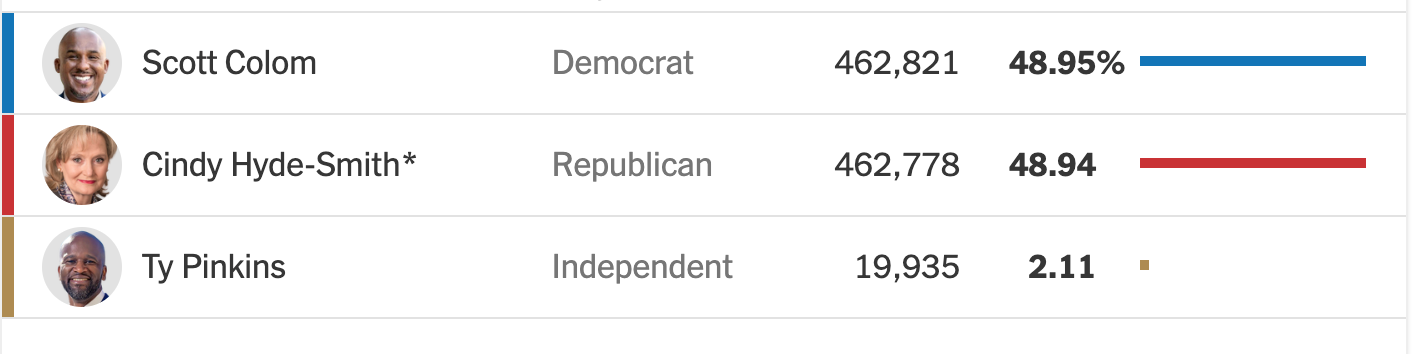
Of the seats that have been called, Democrats have won every Senate battleground race, in addition to some seats Republicans were favored to win. In South Carolina, Annie Andrews (D) defeated Sen. Darline Graham (R), and in Mississippi, Scott Colom (D) leads Sen. Cindy Hyde-Smith (R) by fewer than 50 votes with over 95% of the expected votes in.
In Texas, James Talarico defeated Ken Paxton, becoming the first Democrat to win a Texas Senate seat since 1988. In Kansas, Adam Hamilton became the first Democrat to win a Senate race since 1932. Democrats also flipped Senate seats in North Carolina, Ohio, Iowa, and Maine; they retained seats in Georgia, New Hampshire, Michigan, and Minnesota. Alaska’s race between Mary Peltola (D) and Sen. Dan S. Sullivan (R) is too close to call, with 74% of votes counted.
In the House, Democrats will have their largest majority since 2011. Of the races that have been called, Democratic candidates won all seats considered toss-ups and five rated as “lean Republican.” So far, they have flipped 32 seats, while Republicans have flipped two.
Democrats also had a successful night in gubernatorial elections across the country, netting five governorships with wins in Texas, Georgia, Ohio, Iowa, and Nevada. The gains extended to the state level throughout the nation; 366 state legislature seats flipped from Republican to Democrat compared to 10 Democrat-to-Republican flips.
House Minority Leader Hakeem Jeffries (D-NY), the leading candidate to become Speaker of the House in the new Congress, said on Tuesday night, “This is a change election. And we understand as House Democrats we need to deliver dramatic change.” Senate Minority Leader Chuck Schumer (D-NY) said, “There is now a generational remake of the Senate map that is going to change America now and on into the future.”
House Speaker Mike Johnson (R-LA) conceded the House majority, saying, “We knew that to keep the House and sustain our majority, we would have to defy more than a century of midterm history… It’s very, very difficult to overcome. And it looks like history will be kept tonight.” Senate Majority Leader John Thune (R-SD) posted on X, “As we head into 2027, Senate Republicans will not stand idly by as the far-left, socialist wing of the Democrat Party attempts to unwind everything we’ve done. Thankfully, we still have President Trump in the White House, and we’ll work with him to stop the worst impulses of Democrat extremism.”
President Donald Trump posted on Truth Social, “I wasn’t on the Ballot and if I was, we would have won IN A LANDSLIDE!” In a Fox News interview, he said he would work with Democrats in Congress but also planned to use veto power to curb any legislation passed.
Below are views from the left and right on the results. Then, Executive Editor Isaac Saul’s take.
|
What the left is saying.
|
In The New Republic, Alex Shephard called the results the “beginning of the end for Trump.”
“Two years ago, it looked like Donald Trump had a mandate… He wasn’t just normalized. He was American culture. Or so it seemed at the time,” Shephard said. “There are many explanations for this blue tsunami — Iran, tariffs, horrific GOP candidate selection — but the simplest is also the most persuasive: This is a historic rebuke of Donald Trump and his party… Trump’s downfall has begun. The only question is what happens to the political movement he has led for the last eleven years.”
“For the last decade, [Republicans] have allowed their party to transform into a cult of personality. Trump has had almost total control over the GOP at almost every level, and has remade the party in his own image. Now, voters have delivered a historic rebuke to that party,” Shephard wrote. “But even though Republicans have lost power in Congress, and Trump is historically unpopular, he is still in charge. He is also venal, thin-skinned, and increasingly erratic. The next two years will be turbulent.”
In The Atlantic, Idrees Kahloon wrote about “why Republicans lost so big.”
“A moralizing account might say that Trump is getting just deserts for his precedent-breaking behavior in office — the great personal enrichment, the weaponization of the justice system against his enemies, the dismantling of agencies without congressional consent,” Kahloon said. “But this assumes too much about the propriety of American voters — who, after all, returned the president to office after he had tried to overturn his election loss in 2020.
“The more obvious explanation for Republicans’ poor performance is economic,” Kahloon wrote. “Unlike the president, Democrats learned the lessons of the last election: both that incumbents were vulnerable to attacks over the cost of living and that they had veered too far to the left on immigration and social-justice issues such as trans rights. The party has many sects — urban socialists, rural populists, ‘abundance’-pilled technocrats — that converged on a common message: the issue of ‘affordability,’ on which Republicans were weak.”
In MS NOW, James Downie suggested “here’s what comes next.”
“For the first time in either Trump presidency, then, Democrats hold both chambers of Congress… And they can — they must — begin tearing down the political project that gave rise to President Donald Trump, while laying the foundations of a new project to take its place,” Downie said. “Voters will expect Democrats to address affordability: by reversing the tariffs and the cuts to SNAP and Medicaid, raising the minimum wage and restoring the Biden-era child tax credit.
“Trump has already said he will ‘become Mr. Veto’ should Democrats control the next Congress… But simply passing these bills can help Democratic lawmakers establish trust with voters who may not have been as open to, or enthusiastic about, the party in the past,” Downie wrote. “Above all, Democrats must remember. Remember who came out Tuesday, and who came out every day the last two years: to vote, to protest and to do the hard work of democracy. Remember the millions of everyday Americans who stood up and spoke out while the wealthy and powerful bowed and cowered.”
|
What the right is saying.
|
The National Review editors wrote “there is no sugarcoating this debacle.”
“Tuesday’s result was a combination of difficult fundamentals and political malpractice in individual races. It is typical for presidents to suffer significant defeats after their sixth year in office, which was true of both Bush in 2006 and Barack Obama in 2014,” the editors wrote. “Trump also did himself and his party no favors. Though he closed the border and expanded the signature tax cuts from his first term, he mitigated these wins with unforced errors.
“Despite being given a second term in large part because of consumer frustration with the cost of living, he decided to pursue an erratic and unconstitutional tariff policy, which, by design, made consumer goods more expensive,” the editors said. “Democrats won a sizable-enough majority to block Trump’s judicial nominees for the next two years, and, if they are able to build on this in 2028 by establishing unified control of Washington, they will seek to blow up the filibuster and get free rein to implement a radical agenda.”
In the Washington Examiner, Tom Rogan argued Trump is “likely to become more erratic.”
“We should expect more impulsiveness from the president going forward,” Rogan said. “The most obvious area for Trump to roll the dice is on foreign policy… In the short term, the [Iran] war’s unpopularity with voters is no longer a concern for Trump as it was prior to the midterm elections. But given that the new Congress will likely cut off funding for the war, if Trump is to act, he will want to do so aggressively and in short order.”
“On domestic policy, also, Trump is sure to test the limits of presidential power. Expect new executive orders and diversions of appropriated funding,” Rogan wrote. “Trump will be stung by what he will regard, though never admit, as a humiliating rebuke. His character and record suggest he will now make every effort to ensure that Americans and the world know he retains a very great and personal power. Even if that power is not used wisely.”
In the New York Post, Isaac Schorr suggested the “blue wave may crash into a dead end.”
“It looks like voters are unhappy with President Trump. The Iran war is unpopular, and sky-high gas prices are, well, fuel for voters’ continued fury over the ongoing affordability crisis. But what will Democrats do with that discontent?” Schorr said. “Even if they end up with control of both chambers of Congress come January, it’s unlikely that Democrats will be doing much governing at all. With President Donald Trump in the White House and his veto pen in hand, they won’t be able to push through any of their major agenda items.”
“Of course, they could pursue a more prudent strategy of horse-trading that could move their ball forward… When it comes time to fund the government, could they not offer Trump something, like, say, permitting reform to increase domestic energy production and lower costs in exchange for more funding for their beloved welfare state?” Schorr asked. “And why not try to pair another criminal-justice bill like the First Step Act with a crackdown on fraud of the sort that’s run rampant in Minnesota? Because it’d kill them to, is why not.”
|
||||
|
||||
|
Reminder: This is where we share a personal opinion. If you have feedback, criticism or compliments, leave a comment or reply to this email.
|

- Political coalitions have now been totally re-aligned three times since 2008. Maybe we should learn some lessons from that: Candidates matter. Policy matters. There is not enough money in the world to convince Americans they’re eating filet mignon when it’s really fast food. Nearly half of Americans self-identify as independents, and it turns out they are persuadable. As are white voters (shifted left by 13 points), women (shifted left by 13 points), Hispanics (shifted left by 28 points), and men (shifted left by 17 points). All the tropes about Americans being too dumb or too partisan to change how they vote should be tossed out the window. For good.
- Obviously, this is a political earthquake. Even the most optimistic of the Democratic optimists did not think last night would be this lopsided. I thought Sean Trende of RealClearPolitics said it best: “If you are watching this and just have a passing familiarity with elections, just understand you’re seeing something special, a 100-year flood. Easily the worst election for a party since 1974.” It’s the largest victory in the national popular vote in any congressional election since at least 1976. Democrats flipped five Senate seats in states where Trump won by double-digit margins just two years ago.
- To that end, let’s get this out of the way now: My final Senate prediction was pretty bad. I was confident enough in the polls to predict a slim, 51-seat Senate majority for Democrats, and wise enough to concede that all signs pointed to a Talarico win in Texas even if I didn’t want to take the risk of picking the state to flip. I also knew that if I was wrong, it would be because of a blue tsunami. But South Carolina? Kansas? Mississippi in play? You never could have gotten those predictions from me. Some of the Tangle staff was overwhelmingly more bullish on Democrats’ odds, and I’m eating my humble pie.
- On that note, the polls were wrong — just not in the direction any of us thought. Right now, the generic ballot appears to favor Democrats by +13. The polling average (which we all had a hard time accepting) was only +9, underestimating Democrats in 14 of the 15 key Senate races, and the average polling error across those states was 4.4 points. Political polling is still not 100% reliable, but in the end it is still a useful tool for the directional feelings of Americans. I feel silly for over-indexing on vibes rather than the information we had before us.
- The results came in so fast and races were called so early that we were genuinely caught flat-footed on our livestream. We had a couple hours of programming planned ahead of when we thought we’d know where the night was headed, and instead we ended up processing a ton of results with our guests in the early slots. Audio issues had to be solved on the fly because we couldn’t pause. I was prepared to be on camera until 2:00 AM ET, and instead the balance of both chambers of Congress wrapped up so fast we basically knew where it was headed by 9:30 PM ET. I feel like I’m still getting my bearings.
- On our stream, Sen. Andy Kim (D-NJ) said something that I just can’t shake: Democrats feel celebratory because they put so much work into winning, but he hopes the party can take a step back and recognize that they had such a strong night because the American people are hurting. They are in pain. “And if we miss that, if we don’t connect those dots, then we’re just going to squander this mandate from the people,” he said. Wise words.
- Speaking of squander, two years ago, after President Trump won the 2024 presidential race by sweeping all seven swing states, one of my 19 thoughts on the election was this: “Some free advice for Republicans: Political fortunes change quickly in our country, and the biggest changes often come in the wake of unbridled over-confidence.” Democrats, take note.
- President Trump and the Republican Party fumbled an unbelievable political opportunity. Bernard Stanford went viral last night for a brilliant summation of the failures, some of which I’ll note here: They had a governing trifecta, had won the national popular vote, swept all seven swing states, and six of nine Supreme Court justices were appointed by Republicans. And yet, two years later, they have very few durable victories. They oversaw one of the least productive Congresses in American history, essentially extended President Biden’s federal budget, passed an unpopular tax bill, and couldn’t even sniff long-term immigration reform. Trump, his family, and his cabinet have openly enriched themselves while Americans struggle. A fresh foreign war, high tariffs, and high deficits now plague the balance sheet. DOGE was a complete and utter failure. Trump’s strongest issue, immigration, became a vulnerability after DHS agents terrorized American towns and killed American citizens on video. Democrats just accumulated more power in a single night than they have in any other election since President Barack Obama’s 2008 victory. It’s hard for me not to feel vindicated, as we’ve criticized the administration for all of these things in Tangle over the past two years and have endured claims that we’re biased or that I have Trump Derangement Syndrome. It turns out that a lot of former Trump voters (and even the vice president!) agree. Now, Republicans will have to endure two years of investigations and gridlock.
- Worse yet, the president seems to have lost all of his best political instincts. He obsesses over ballrooms and the male figure, he refuses to listen to his base on the war, and he deflects cost issues still plaguing the country. He uses his bullhorn to post AI slop, throwing every ally imaginable under the bus, and calls to rename everything “America.” He actually told a rallygoing audience ten days before an election that Americans should accept high gas prices because Big Oil was making money hand over fist. It turns out none of this stuff works on the electorate when you aren’t addressing their needs. Not surprising.
- Given all this, I think it’s fair to say that voters did something Republicans in Congress refused to do: They stood up to Trump. The president broke a core promise with the Iran war. He’s forced tariffs on Americans without congressional authority. He’s permitted — and very likely participated in — rampant, historic corruption. He has not focused on affordability like he said he would. Congress had the power to address each of these issues if only a quorum of Republicans were willing to exercise their authority, but they didn’t have the courage to do it. So voters did it for them.
- Speaking of messaging, the economy is still king. In Senate races in Texas, Ohio and Michigan, Republicans leaned into a closing message of “sorry we screwed up the last two years but trans people and Islamic extremists are worse.” One lesson might be that fearmongering about sharia law and the “threat” of children getting gender reassignment surgery without their parents’ knowledge is not going to eclipse affordability concerns. It got so bad that Republicans started to complain about how many political ads include candidates talking about transgender people, essentially saying the right is now unhelpfully amplifying the issue.
- It deserves no celebration, but it is noteworthy that the president did not challenge the results. He actually called into The New York Times relatively early in the night to insist he was ready to work with Democrats. On Fox News, he was subdued and calm. I’ve seen no prominent figures (outside of Kari Lake) advance election-fraud allegations. All the major Republican candidates gracefully accepted defeat, and some conceded their races before they were even called. It was oddly… normal.
- In 2024, there was a lot of talk about the “they/them” ad that Republicans ran so effectively against Vice President Kamala Harris. I think this cycle’s best ad may have been from Democrat Scott Colom, the Mississippi Senate candidate who hammered his opponent for suggesting voters “pick another protein” due to high beef prices. Colom is the same candidate who stood in line at Trump rallies, met the president’s voters, asked them about their concerns, and talked to them like human beings rather than try to prove them wrong or mock their positions. His race is yet to be called, but he may actually flip the seat blue. This is good politics.
- And yes, you should vote.
- Republicans’ gerrymandering efforts have blown up in spectacular fashion. They spent $50 million trying to win three Florida seats they redrew to favor them — and lost all three. In South Texas, they drew maps relying on their support from Latino men and ended up losing every single district on the border. “Dummymanders” are everywhere we look. Perhaps, again, our politicians should try running on the issues rather than segmenting voters.
- I gave a good bit of attention to independent and third-party candidates in this election, but it does not look like running independents in deep-red states was a very effective strategy. In Idaho and South Dakota, the races were not close at all. In Nebraska, the independent ran behind Democrats in neighboring Iowa and Kansas. Even in Montana, where independent Seth Bodnar may have been able to win had the Democratic nominee dropped out, the better strategy could just have been to run through the Democratic primary. From a purely political and electoral perspective, Democrats may have actually shrunk their map by backing independents against Republicans.
- Not enough people are talking about the larger ramifications of what just happened at the state level. For example: Democrats now have enough state governments to ratify the National Popular Vote Interstate Compact and effectively end the Electoral College. They will be able to redraw congressional maps across the country and hold the line on election-reform bills. State constitutions could be overhauled. The long-term results of this shift could be much, much bigger than people are considering.
- People forget that President Donald Trump was pretty open to working with Democrats after they flipped the House in the 2018 midterms during his first term. While he seems in denial that last night is a referendum on his record, he does seem conciliatory and once again open to working with Democrats out of the gate. Given the way Trump has treated people like Zohran Mamdani, I think Democrats would be wise to approach the president like an open, persuadable leader they may actually be able to work with.
- I proposed a radical theory a few months ago: Decency is about to make a comeback. I’d chalk last night up as a win on that front. Voters in Ohio rejected Vivek Ramaswamy’s indecent ad campaign. Ken Paxton got blown out. Even candidates who ran respectful above-the-belt campaigns, like Colom (who hasn’t won yet) and Ashley Hinson (who lost), outperformed pugilistic candidates like Abdul El-Sayed and Marsha Blackburn. Americans are tired of the mud-slinging, dial-it-up-to-11, nonstop hatred and indecency. I think what we saw last night is a good reminder that you can run on decency and still win.
Take the survey: What issues were most salient in the midterms? Let us know.
Disagree? That’s okay. Our opinion is just one of many. Write in and let us know why, and we’ll consider publishing your feedback.
Tired of searching for the truth? Let Snopes do the heavy lifting for you.
Over 1 million readers rely on their free newsletter to cut through political spin and one-sided reporting. Get the straight facts delivered to your inbox six days a week.
The extras.
- One year ago today we published a special edition on the 2025 elections.
- The most clicked link in our last regular newsletter was the report on the plane crash in Florida.
- Nothing to do with politics: Rolling Stone ranks the 200 best rock songs of the century, so far.
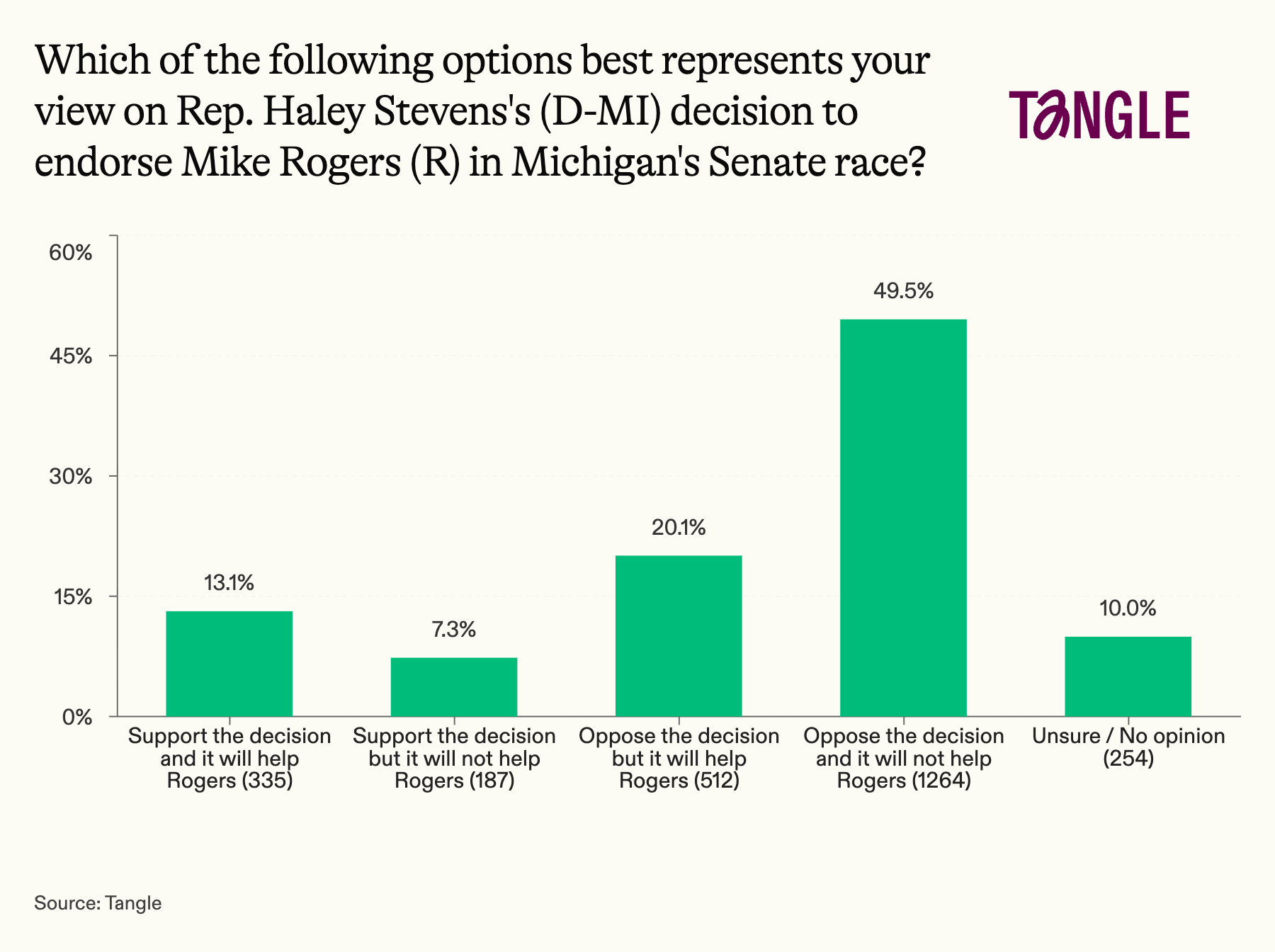
- Our last survey: 2,552 readers responded to our survey on Rep. Haley Stevens’s (D-MI) decision to endorse Mike Rogers (R) in Michigan’s Senate race, with 50% saying they oppose the decision, and it will not help Rogers. “Steven’s actions look petty. They don’t look like someone standing up for their values,” one respondent said. “Steven’s throwing her support behind Rogers was just an effort to try and put the people of Michigan above the Democratic Party,” said another.
Have a nice day.
Virgil Wiebe was waiting at O’Hare Airport in Chicago after missing a connecting flight when he stepped outside to take a smoke break. While standing in a park outside Terminal 1, Wiebe said he saw a small orange kitten run up to him. Wiebe didn’t find the kitten’s mother in the bushes, so he took it inside the airport — then decided it would fly home with him. He paid for a cat ticket on his next flight, and now looks forward to his new life with the cat, dubbed Macanudo O’Hare (or “Harry” for short), by his side. NBC Chicago has the story.

Member comments