




I'm Isaac Saul, and this is Tangle: an independent, nonpartisan, subscriber-supported politics newsletter that summarizes the best arguments from across the political spectrum on the news of the day — then “my take.”
Are you new here? Get free emails to your inbox daily. Would you rather listen? You can find our podcast here.
Today’s read: 13 minutes.
A new Suspension of the Rules.
Aliens, antisemitism, GOP infighting, and some scorn for nature: This week, Isaac, Ari, and Kmele chopped it up about the latest primary results, the UAP disclosures (proof of aliens), a scary Democrat in Texas, and Trump’s new anti-weaponization fund — plus, wild deer, noisy birds, and aggressive turkeys. This one’s got something for everyone to love (or hate). Check it out here!
Peaceful News is Possible
Reading the news these days can feel like eating one big plate of anxiety, with a side dish of information.
Here's the thing: you already know what to do when something consistently makes you feel bad. You stop eating the food that bloats you. You cut back on the drink that keeps you up at night. Yet many of us keep going back to the headlines even when it costs us our peace. But why?
The Pour Over is a free Christian news newsletter built on the idea that staying informed doesn't have to come with that helping of anxiety. Three times a week, they cover the biggest headlines — clearly, neutrally, briefly — and pair them with biblical reminders that keep your eyes on what matters most.
Join 1,500,000 Christians who decided a healthier news diet was worth trying.
P.S. They're also funnyish. Get their welcome email — if you don't at least smirk, they'll issue a full refund. (It's always free, so that's $0. But still.)
Quick hits.
- The Department of Justice unsealed a grand jury indictment against Raúl Castro, the former president of Cuba. Castro was indicted on murder charges related to a 1996 aircraft shootdown that killed four people, including three Americans. (The indictment) Separately, the aircraft carrier USS Nimitz arrived in the Caribbean this week. (The arrival)
- James Murdoch’s Lupa Systems announced it will acquire New York Magazine, the Vox Media podcast network, and Vox.com in a deal valued at over $300 million. (The acquisition)
- President Donald Trump said on Wednesday that the U.S. and Iran were in the “final stages” of negotiations and that he would wait a few days for an Iranian response to the latest U.S. proposal. (The update)
- On Wednesday, SpaceX filed papers to move forward with an initial public offering; it is expected to become the first U.S. company to go public with an estimated market value of $1 trillion. (The move)
- The Department of Justice charged a former federal prosecutor with stealing sealed documents related to special counsel Jack Smith’s investigation into President Donald Trump’s classified documents case. (The charges)
Today’s topic.
The latest on the Russia–Ukraine war. On May 8, President Donald Trump announced Russia and Ukraine agreed to a three-day ceasefire. Both sides accused the other of violating the truce, and heightened strikes resumed when it ended on May 11. Over the weekend, Ukraine conducted an overnight drone attack on Russia, including strikes in Moscow, killing at least four and injuring 12, according to local officials. The Ukrainian military launched over 1,300 drones in the attack, which Russian state media called the worst in a year. The offensive followed last week’s large-scale Russian bombardment that killed at least 24 Ukrainians and injured dozens more.
In recent weeks, Ukraine has ramped up its long-range drone attacks against Russia, striking deeper into the country and specifically targeting its energy infrastructure. Additionally, Ukraine’s military has invested heavily in “middle strikes” (targeting sites 30–180km behind front lines) and is outfitted with advanced technological weaponry, including a homemade precision glide bomb. These tools have enabled Ukraine to strike oil, gas, and electricity targets across Russia. Roughly 20 Russian oil export terminals and refineries have been damaged by Ukrainian strikes between April and mid-May. As a result, Russia’s crude-processing rate fell to its lowest since December 2009.
These developments have raised questions about Russia’s dominance in the war it escalated over four years ago. Russian forces suffered a net loss of 45 square miles in April, the country’s first net loss since August 2024, according to the Institute for the Study of War (ISW). On May 9, the Russian Victory Day holiday commemorating the surrender of Nazi Germany, Russian President Vladimir Putin held a significantly scaled-back parade in Moscow. Reports indicated the Kremlin was concerned about security amid heavy Ukrainian strikes.
However, some analysts push back on the narrative that the tides of the war have turned against Russia. Russian forces maintain control over key parts of Ukraine, and the ISW estimates Russia has gained nearly 30,000 square miles, or 12%, of Ukrainian territory, since Russia’s full-scale invasion in February 2022. Additionally, Western military officials estimated in February that roughly two-thirds of Ukraine’s energy production capacity has been destroyed, damaged, or occupied by Russia since late 2025.
Since fighting began, Ukrainian and Russian troops have suffered over one million combined casualties, while thousands of civilians have reportedly been killed — and the outlook of the war remains uncertain. President Putin, who traveled to China this week for discussions with Chinese President Xi Jinping, said shortly after the victory parade that he thinks the war in Ukraine “is coming to an end.” In an evening address on Tuesday, Ukrainian President Volodymyr Zelensky said, “This month has brought a shift in the dynamics in our favor — in Ukraine’s favor,” adding the country is “holding more positions and inflicting more damage.”
Below, we’ll share some perspectives from the right, left, and writers abroad on the state of the war and the most recent strikes. Then, Managing Editor Ari Weitzman offers his take.
What the right is saying.
- Many on the right praise Ukraine’s use of drone warfare.
- Others say Ukraine’s war efforts offer grim lessons for its allies.
In The Wall Street Journal, Tom Tugendhat described “the economics of victory in Ukraine.”
“The war in Iran teaches an old lesson about military spending,” Tugendhat said. “More than 1,000 interceptor drones roll off Ukrainian production lines every day, at $1,000 to $3,000 apiece. The bodies of Kyiv-built attack drones are redesigned within months, not years, their engines even more quickly, and their guidance software within a matter of days. By keeping costs down and rapidly iterating simple technology, at scale, Ukraine is delivering a devastating effect.”
“Ukraine produced four million drones last year and plans to produce seven million this year, 10 times its output three years ago,” Tugendhat wrote. “For Ukraine, that’s the economics of victory: billions of dollars of weapons destroyed by drones that cost around $2,000 each… The goal is no longer the perfect weapon. You build the best you can. Then build it again, 90% as good, at 80% of the cost, in 50% of the time. Then do it again and again, a thousand times more. That not only fills the armory; it creates a system to keep it full.”
In The American Prospect, Gil Barndollar said “drone dominance isn’t the vital lesson of Ukraine.”
“Finding enough men to man the 1,200-kilometer front line is a ceaseless struggle for Ukraine. The country has more than ten million military-aged men but is struggling to keep an army of one million in the field,” Barndollar wrote. “Many soldiers are exhausted after years of war without rest… Policy decisions also contribute to the manpower crisis. Fearing postwar demographic collapse, Ukraine still refuses to draft men under 25. Many others have exemptions for critical civilian work, family circumstances, or health issues.”
“The reality is that manpower is still the critical ingredient in war… Absent true machine autonomy, drone tactics don’t remove the need for troops; they simply move manpower around,” Barndollar said. “All the attention now being paid to drones and munitions production suggests that war can be undertaken without sacrifice. Ukraine’s messy partial mobilization bears witness to the cost of failing to prepare the public for war: a broad loss of trust in the army, widespread draft evasion, an army forced into a war of attrition by its lack of manpower for assault and maneuver. NATO nations, most still wedded to a brittle all-volunteer force model, need to honestly grapple with what a protracted war would demand of their armies and societies.”
What the left is saying.
- Some on the left say Ukraine has all but eliminated its reliance on the United States and other countries.
- Others contend that Europe must now step up to help ensure Ukraine’s long-term security.
The Newsweek editors argued “Ukraine is increasingly able to go it alone.”
“Ukraine’s need for Western capability has given Washington an effective veto over many of the most politically sensitive strike options. And it’s not just Washington. Germany has also shown reluctance to give Ukraine its long-range Taurus missiles for similar reasons,” the editors said. “Kyiv, however, is gaining strike options that can be launched without a fresh American transfer of materiel. Ukraine’s liberating push for self-sufficiency in long-range drones and missiles is beginning to pay off.”
“The military damage from drone strikes near Moscow will vary by target and interception rate, but the political effect is harder for the Kremlin to quarantine because the war is becoming increasingly immediate for Russian civilians,” the editors wrote. “The political question is no longer whether Ukraine may someday acquire a U.S.-approved weapon capable of reaching symbolic Russian targets. Kyiv is already demonstrating that Moscow’s defenses can be stressed by Ukrainian-made systems.”
In Bloomberg, Marc Champion argued “Ukraine is doing better, now it’s Europe’s turn.”
“After a brutal winter, Ukraine has managed to stabilize the front over the last few months, on occasion even making net territorial gains. Overall, the nature of the battlefield has changed in ways that blunt Russia’s overwhelming advantages in manpower, artillery and armor,” Champion said. “Now the bloc must agree to a new non-US framework for peace talks, and give Ukrainians hope by creating a bespoke path to their integration into the European Union and Western security arrangements.”
“The good news is that most of Europe’s leaders by now recognize that integrating Ukraine’s large military and drone industry offers their own best security guarantee against a revisionist Kremlin, absent a reliable US partner,” Champion wrote. “Less encouraging is that this war has become a contest of narratives and confidence, as much as a fight over land, so Ukraine’s allies must regroup and respond accordingly. They cannot fall for Putin’s nuclear threats, which are more a sign of desperation than of strength. For their own sakes, they need to find a new mediator to replace the US and ensure that Kyiv survives what feels very much like Moscow’s last throw of the military dice this summer.”
What writers abroad are saying.
- Many writers abroad say recent Ukrainian attacks have threatened Russian control.
- Others argue that European countries should prepare to rebuild Ukraine on several fronts once the war ends.
In the Washington Examiner, Igor Bondar said Ukraine has “broken the myth of an untouchable Moscow.”
“Long-range Ukrainian drone strikes against Moscow and the Moscow region have exposed something the Kremlin desperately tried to hide for years: Russia can no longer fully defend its own capital,” Bondar wrote. “The Ukrainian drone campaign is also exposing a deeper strategic problem for Russia. Modern drone warfare favors cheaper, mass-produced systems over traditional, expensive air defense missiles. Russia is now forced to spend millions of rubles attempting to intercept relatively inexpensive drones. In a long war of attrition, that imbalance matters.”
“The broader point is that Ukraine is steadily scaling up a new model of warfare. The next phase will likely involve coordinated swarms, autonomous medium-range drones and artificial intelligence systems designed to overwhelm Russian air defenses. Russian authorities already appear deeply concerned about this shift. Panic inside Russia’s drone industry has led to investigations, raids and corruption cases connected to failed procurement programs,” Bondar said. “[Ukraine] is dismantling the central myth sustaining Russian President Vladimir Putin’s system — the belief that the Russian state remains strong, untouchable, and capable of protecting its own people while waging war against its neighbors.”
In National Review, Oleksandr Kraiev and Andreas Umland argued that a coalition “must prepare for numerous new challenges once the war ends.”
“War, not peace, remains the most likely scenario. Yet history rarely ends as expected,” Kraiev and Umland said. “Europe cannot afford to be unprepared for the consequences of a sudden cease-fire. Should the fighting cease, Ukraine would not face a simple recovery period, but rather the beginning of a new, multidimensional struggle — one that would simultaneously test its security, economy, institutions, demographics, and political cohesion. Winning peace, especially under an imperfect cease-fire agreement, will be just as demanding as surviving the war.”
“Once security is established, economic recovery will be the decisive test,” Kraiev and Umland wrote. “Ukraine’s decline during or after the war… would grant Russia a belated victory and spur authoritarian revisionism far beyond Eastern Europe. The end of fighting — whenever it comes — will be celebrated by Ukrainians, yet will neither reduce Russian imperialism nor resolve many of Ukraine’s accumulated domestic problems. It will merely mean the transition to a new phase of intense political developments whose outcome will continue to significantly impact the future of Europe.”
My take.
Reminder: “My take” is a section where we give ourselves space to share a personal opinion. If you have feedback, criticism or compliments, don't unsubscribe. Write in by replying to this email, or leave a comment.
- The war in Ukraine has been deadlier than most people can comprehend, and it won’t end any time soon.
- Ukraine has been forced to adapt its tactics in order to survive.
- Their adaptation towards small and AI-assisted drone warfare is simply stunning, and I shudder to think of its effect on future conflicts.
Managing Editor Ari Weitzman: The war in Ukraine is horrifying.
Start with the numbers alone. Accurately reporting on these figures is difficult, since both sides inflate the other’s losses, but here’s a good estimate: Since Vladimir Putin decided to launch an all-out assault to conquer Ukraine by force in 2022, the war has claimed 250,000–300,000 Ukrainian military casualties and roughly 1,000,000 Russian military casualties (killed and wounded). Ukraine has killed 8,000 Russian civilians, according to Russia, while Russia has killed 15,000 Ukrainian civilians, according to the UN.
Just for comparison, Israel’s war in Gaza has killed over 72,000 people. That’s not to say one war is more horrific or more important than the other, or to minimize what’s happening in Gaza — that conflict is massively asymmetric, and the majority of those killed in that war have been civilians. It’s just to try to give some perspective on the number of lives still being lost in this conflict as it enters its fifth year.
The war’s territorial changes are also rather astonishing. Russia occupies over 45,000 square miles of Ukraine, roughly 20% of the country. Recently, the tide of this war has turned, yes; but it’s not a dramatic reversal of fortune. Instead, it is more like a high tide no longer advancing but starting to slowly recede from shore. With the help of foreign aid and some foreign volunteers, Ukraine has offered fierce resistance mostly with its own forces against the slow, inexorable, steady Russian advance through Eastern Ukraine, losing small amounts of territory every month since November 2023. In March, Ukraine pushed the lines back for the first time in years, then they did so again in April. Not far back, but enough that you could see the past six weeks as marking the beginning of Ukraine’s own inexorable march to pushing Russian forces out of its country.
No peace is coming. Yes, the two sides mutually agreed to a U.S.-brokered three-day ceasefire and a prisoner exchange during the Russian Victory Day celebration, but that peace was tenuous at best. Each side accused the other of breaking the ceasefire’s terms throughout, and the key disagreement remains: Russia won’t accept any peace that doesn’t include Ukraine ceding control over parts of the Donbas region it’s currently still defending.
Instead of hoping for productive negotiations with Russia — which Ukrainian President Volodymyr Zelensky famously told President Trump, Vice President Vance, and the entire world would be a fool’s errand — Ukraine has adopted a different strategy: Remove Russian soldiers from the battlefield faster than they can be replaced by new recruits. Doing so requires the Ukrainian military to inflict 30,000 enemy casualties a month. And they’re succeeding.
I consider myself a realistic person. I understand that Russia is relentless, that they’ve been barraging Ukrainian cities and vital infrastructure for years, unleashing combined missile and drone attacks to deadly effect, and all the while flooding the zone with propaganda. I get that the support the U.S. and NATO countries have given Ukraine has been self-interested and wanting, providing just enough to keep Russia engaged without being decisive enough to drive Russian troops out of the country. And I know that, given the situation — the existential threat, the relentlessness of the enemy, and the solitary nature of its fight — Ukraine has been forced to adapt or die.
That adaptation is simply frightening to behold.
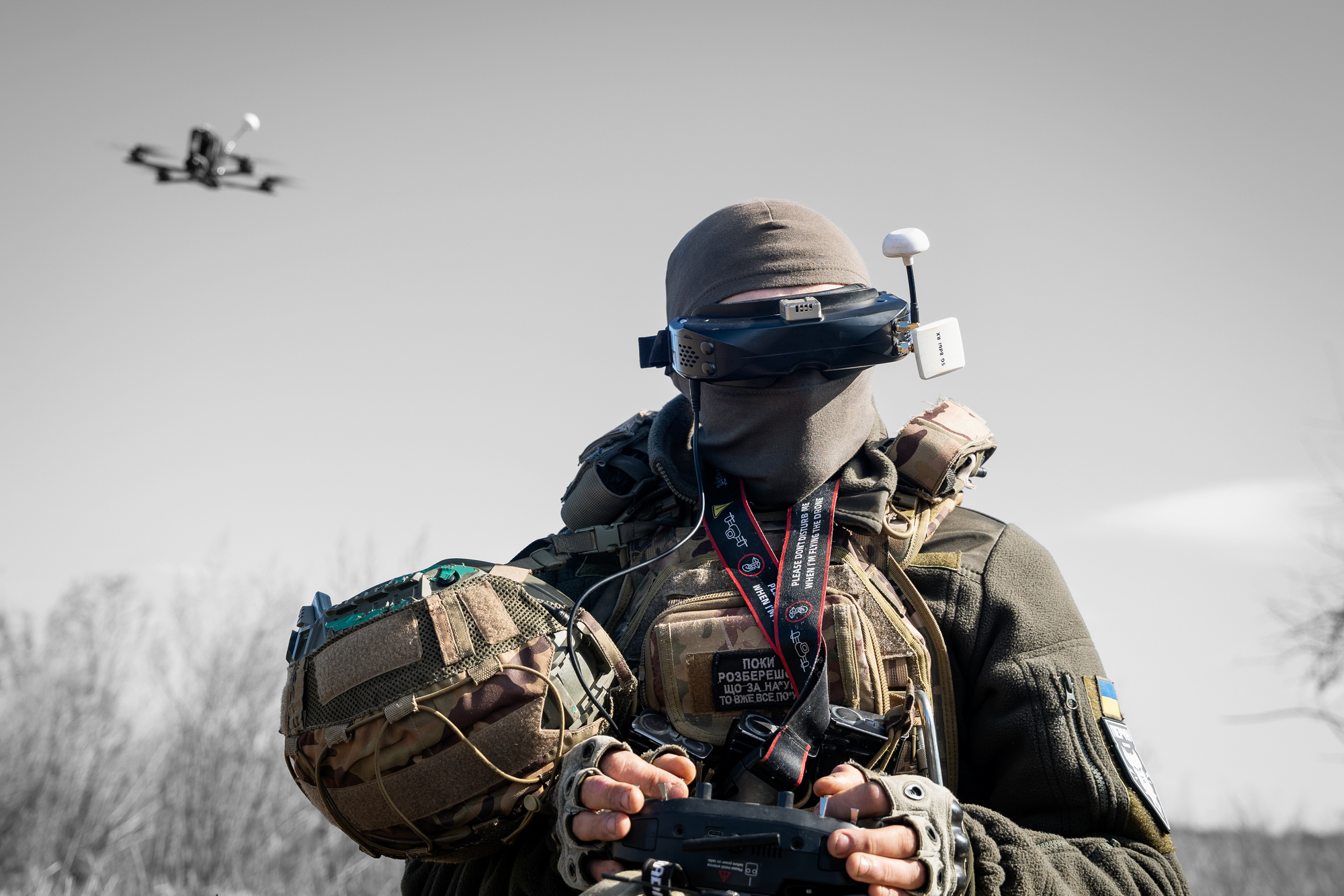
Ukraine has created a “kill zone” along the front with a few innovations to existing drone technology. To understand it, you need to know three acronyms. First, FPV. Ukrainian first-person view (FPV) drones are small, cheap aircraft that relay real-time video back to their remote operators. These are different from the long-range drones that Ukraine has been using to attack sites in Russia and terrorize its vast countryside — the ones Russia is now diverting into Baltic countries. These FPV drones are small, fast, and cheap. Ukraine is sending thousands to the front every day, at about $1,000 per drone.
Second, EFP. FPV drones can be armed with explosively formed projectiles (EFP), which are superheated concave metal plates that, when detonated, transform into solid, fast-moving slugs that can pierce armor. EFPs can easily penetrate netting or wire that troops on the front lines use to protect themselves from other FPV drones, and they can even punch through tanks.
Third, AI. Ukraine uses artificial intelligence systems to help pilot small quadcopter drones, turning cheap and easy-to-make machines into tools sometimes referred to as “slaughterbots.” These machines allow FPV operators to identify a target, then cede control to an AI-piloting system, breaking the requirement of remote human control. On-board AI makes drones impervious to jamming and allows them to complete the last leg of their killing journeys without human control.
Videos from FPV drones killing soldiers are easy to find, and frankly, they may be the most disturbing videos I’ve ever seen. Watching a human being die is always disturbing, and many other videos of human death are far more gruesome or nauseating. But every video death evokes a feeling of uncanny distance through the screen. It’s a facsimile, an experience less like what it is and more like watching a video game, creating a terribly alienating feeling of removal. That feeling is grotesquely acute in these videos (warning: graphic content): an unsuspecting soldier. The drone approaches. He notices it and begins to panic. It accelerates towards him. He helplessly tries to evade, turns to face it at the last second. Freeze frame, AI-enhanced image, a face. 45 years old. Deep lines of hard years engrained into a startled face, not comprehending its encroaching death. Another face, 35 years old. 21 years old.
Zoom out, a small explosion.
Next video.
Let me be as clear as I can: I am not blaming Ukraine for finding the path it needs to take to win a war it did not choose. We should never forget that Vladimir Putin started this war, he did it because he believes the free nation of Ukraine belongs to Russia, and he can stop the war at any time by leaving the territories he invaded. Ukraine is doing what countless nations and armies and tribes have done throughout history, which is innovate the cold and bloody machinery of war. Here’s how one Ukrainian FPV brigade commander put it to The New York Times: “Any large-scale war, it delivers demons… It unleashes something powerful and it accelerates developments which otherwise would have taken decades.”
Or, if you prefer: “If the international community is concerned about this, then they should have stopped the war early on.”
The United States, Europe, and NATO should all be gladdened to see Ukraine assert control — again, it would be good for Ukraine to prevail here. But if indeed the tide of this war is turning, then it’s a red tide coming in. It’s very unsettling to be cheering Ukraine’s advances in this moment. I unequivocally hope that they can push Russia out, that they can rack up steady gains on the front lines, and then leverage their success into a strong negotiating position to bring an end to the war. But I also fear the future of war that the end of this one would bring.
“Slaughterbots” would have seemed like science fiction a year ago. Today, they’re actually Ukraine’s battlefield strategy. And while Ukraine is making concerted efforts to ensure oversight of their AI-powered FPV drones, would every army do the same? A future where Iranian forces remotely crack open a container in the port of Los Angeles to unleash flying autonomous killing machines is no longer a scenario that seems far-fetched. Ukraine is giving us a glimpse of that potential future. And I don’t think we’re prepared for it.
Take the survey: When do you think the Ukraine–Russia war will end? Let us know.
Disagree? That's okay. Our opinion is just one of many. Write in and let us know why, and we'll consider publishing your feedback.
The news can leave you informed — and completely drained. The Pour Over is a free Christian newsletter delivering the biggest stories briefly, neutrally, and with biblical perspective that keeps the focus on what matters most. Join 1.5 million readers choosing a healthier way to stay informed. It's free!
Your questions, answered.
Q: What was the East Wing of the White House used for before it was demolished? What are we losing from not having it there?
— Diane from Kansas
Tangle: The White House can be broken down into three distinct parts: the East Wing, the West Wing, and the residence. The residence is, obviously, where the presidential family lives; it takes up a large part of the central portion of the building (the section that is most easily identifiable from the exterior). Also known as “the Main House,” this portion is home to reception rooms that are frequently opened to public tours — the green, blue, and red rooms; the diplomatic reception room; and the state dining room. The West Wing is home to the administrative offices of the president, as referenced by the famous television drama of the same name.
The East Wing of the White House is the section of the building least used by the president for daily tasks. It’s also the newest section, with the current structure added by President Franklin Delano Roosevelt in 1942. Before President Trump demolished it late last year, the East Wing housed some of the building’s ceremonial spaces, its guest entrance, and the offices for the first lady’s staff. It also contained a movie theater and sat above a bunker.
Although those original spaces have been lost, the functional losses won’t be permanent. A renovated bunker is part of President Trump’s planned ballroom construction, as is a new visitor’s entrance, new offices for the first lady, and even a new movie theater. The ballroom’s architect also said he is considering additions to the building’s West Wing in order to retain the White House’s symmetry.
Want to have a question answered in the newsletter? You can reply to this email (it goes straight to our inbox) or fill out this form.
The road not taken.
Our editorial team had a long discussion over what topic to cover today. We knew we would be covering the Trump–Xi summit on Monday and the primary results on Wednesday. Initially, we anticipated covering the White House ballroom on Tuesday, but pivoted after the anti-weaponization fund was announced. Today’s choice gave us the most to consider.
Ballroom funding was the obvious early frontrunner since we bumped it on Tuesday, but we decided that waiting to see how legislation advanced would be prudent. So, what else was timely and relevant? Musk v. Altman? The Senate housing bill? The Ebola outbreak? None seemed to be generating enough commentary to make them obvious choices. Minnesota banning prediction markets felt too niche, and the Raúl Castro indictment felt premature. Ultimately, we agreed that it was time for the long overdue Ukraine update.
Numbers.
- 29,083. The area, in square miles, of Ukrainian territory that Russia has gained since its full-scale invasion in February 2022, according to the Belfer Center.
- 1,585. The area, in square miles, of Ukrainian territory that Russia has gained between May 2025 and May 2026.
- 9.6 million. The approximate number of Ukrainian citizens displaced by the war as of February 2026, according to United Nations estimates.
- 3.7 million. The approximate number of internally displaced Ukrainians.
- 5.9 million. The approximate number of Ukrainian refugees.
The extras.
- One year ago today we published our first piece on Trump’s big, beautiful bill.
- The most clicked link in our last regular newsletter was the announcement of our upcoming live event in West Virginia.
- Nothing to do with politics: Nine things the pros would never have in their outdoor spaces.
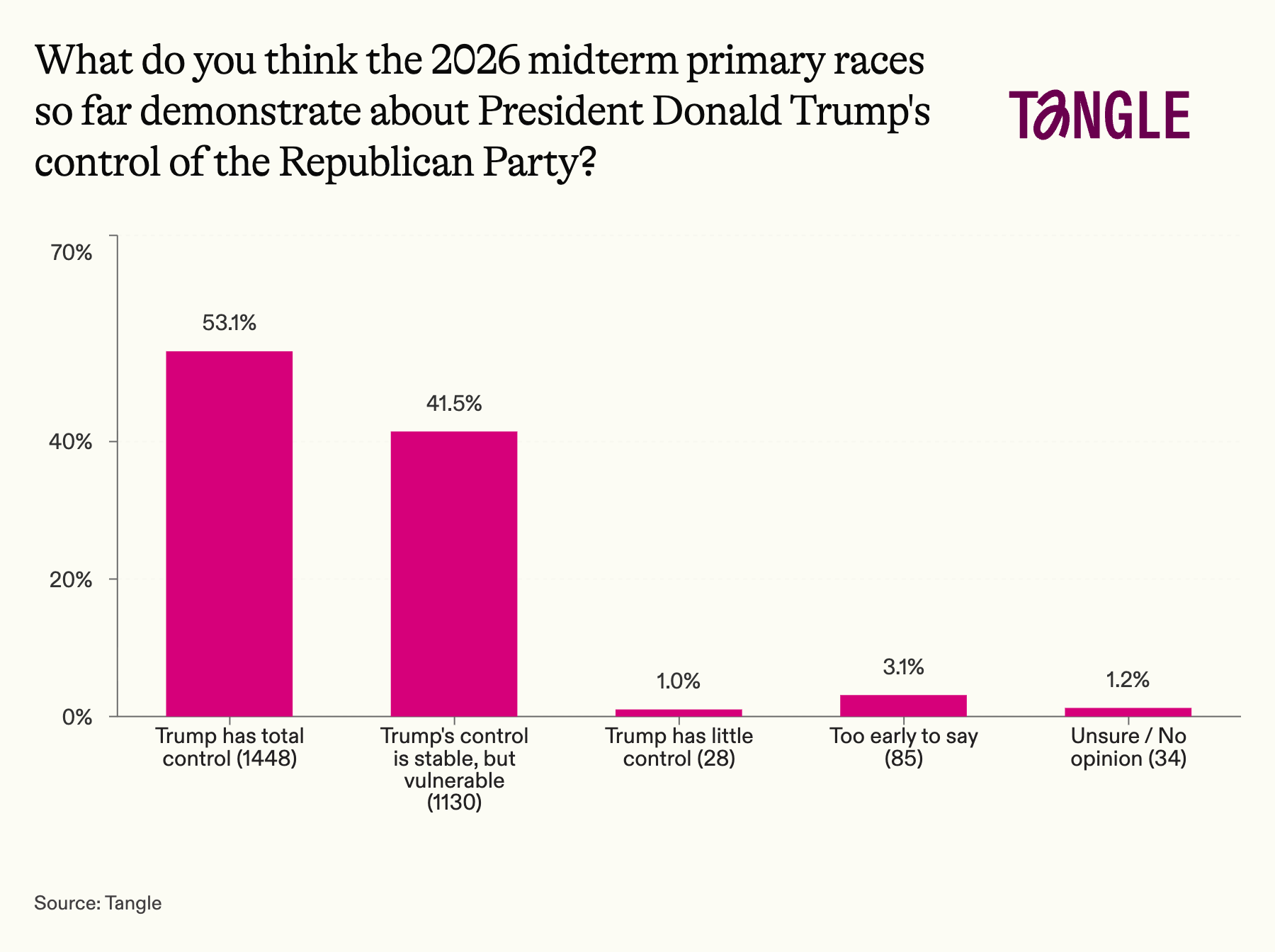
- Our last survey: 2,725 readers responded to our survey on the midterm primary races with 53% saying they show President Donald Trump has total control of the Republican Party. “I can’t believe it. They have all caved, to the detriment of all of us and to our country,” one respondent said. “I think primaries are different from general elections and there are a lot of unhappy people out there,” said another.
Have a nice day.
For a male kea parrot, being born without an upper beak is a disability that typically amounts to a death sentence for birds. For Bruce, it was only a challenge on his way to becoming the alpha male of his flock. Researchers studying Bruce at Willowbank Wildlife Reserve in New Zealand found he had developed a novel jousting technique, thrusting his lower beak at opponents across 36 recorded combative interactions, winning every one. He also had the lowest stress hormone levels in the group and was the only male groomed by other males. “Behavioral innovation can help bypass physical disability,” lead researcher Alexander Grabham said. Good Good Good has the story.

Member comments