This is the Tangle Sunday Edition, a brief roundup of our independent politics coverage plus some extra features for your Sunday morning reading.
What the left is doodling.
Mike Luckovich | Creators Syndicate
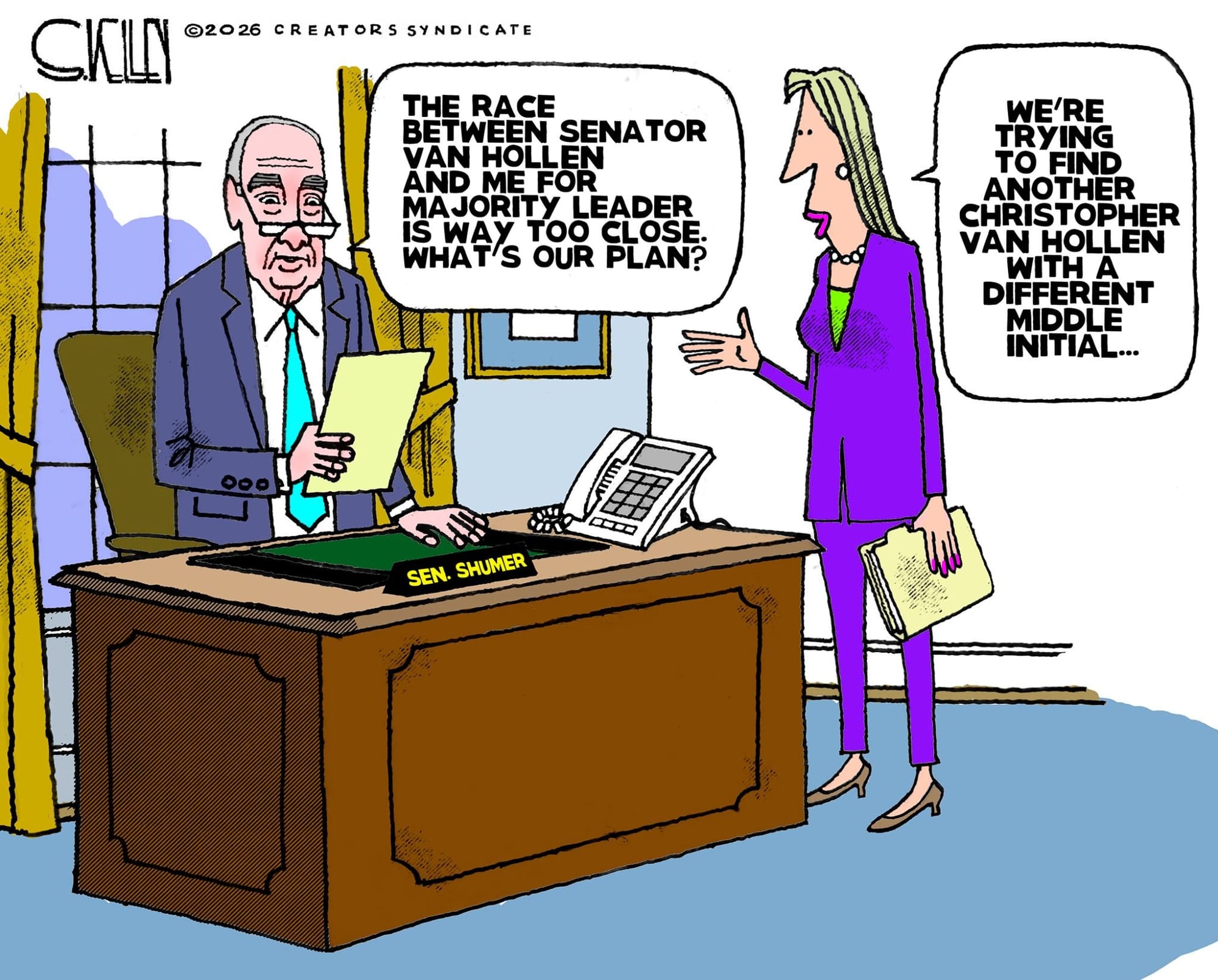
What the right is doodling.
Steve Kelley | Creators Syndicate
Today's Partner
Hey guys, Isaac here –
Today’s newsletter is brought to you by Snopes, the internet’s most trusted fact-checking website.
When both sides push partisan narratives, it’s hard to know what’s true. Snopes uncovers the real story and fills in any missing pieces. We’re glad to partner with a team that shares our mission.
Did Project 2025 really call for “dismantling” the FAA? Did Texas actually have more registered voters than citizens during the midterms? These are just a few examples of rumors Snopes investigated to give you the full story, complete with context and verified sources.
Because Snopes is independently owned and nonpartisan (like Tangle), they follow the evidence wherever it leads, without fear or favor. Join over 1 million people getting the straight facts delivered to their inbox six days a week.
A “software Beirut”? Apps and emails and agencies going down? Advisories to stockpile supplies? On this week’s Suspension of the Rules, Isaac, Kmele, and guest host Audrey Moorehead break down AI-related fears and how they’re thinking about the past week’s news. You can watch here:
The latest Suspension of the Rules
A note on our new survey tool.
As we shared last week, we are launching a new reader survey tool in the weekday editions. The new service offers live, real-time results, which allows you to see the vote totals immediately after voting — then come back to them and see how they’ve changed. We hope this will make the survey experience more engaging.
For the Sunday edition, there’s added value. Sunday readers will now have the opportunity to take the poll themselves and see up-to-the-minute results after they do. As always, we’re interested in your feedback on this new offering!
Monday, November 16.
The nationwide ground stop. On Friday, November 13, the Federal Aviation Administration (FAA) grounded most flights in the United States due to disruptions to air traffic control communications systems. The stop lasted for approximately five hours, causing mass flight cancellations and delays that continued through the weekend. Government officials suggested the issue originated from a router installation by a government contractor, and Transportation Secretary Sean Duffy called on Congress to pass additional funding to modernize FAA systems.
Executive Editor Isaac Saul’s take: “The ground stop was the right call and a reminder of how fragile aviation systems can be. Duffy says that more money would fix the problem, but we should rethink the FAA’s structure altogether. A competitive privatization model for air traffic control would be more efficient and durable.”
Reader Survey: What do you think of the “utility model” proposal for air traffic control?Let us know.
Tuesday, November 17.
Jensen Huang and Nvidia. On Thursday, November 12, technology company Nvidia announced CEO Jensen Huang’s resignation following reports that he had multiple extramarital relationships, including with a woman suspected of being a Chinese spy. Nvidia has hired an outside firm to investigate the claims and has faced increasing scrutiny from public officials over its business practices. Separately, on November 16, the Justice Department and Commerce Department announced that investigations into the company associated with the alleged spy have been underway since 2024.
Editor-at-Large Kmele Foster’s take: “While I maintain sympathy for Jensen Huang, his actions deserve serious scrutiny. Key details of this story are still evolving, but based on what we know, Huang’s affair will have cascading consequences. The biggest consequence could be losing a leading advocate for technological progress.”
Senior Editor Will Kaback’s concurrence: “I think the Trump administration’s role in this story deserves comparable scrutiny to Jensen Huang’s and Nvidia’s. The public deserves answers on Commerce Secretary Howard Lutnick’s reluctance to crack down on Megaspeed. I agree with Kmele that President Trump’s inaction when briefed on Alice Huang and Megaspeed over one year ago represents a ‘staggering dereliction of duty’ if confirmed.”
Reader Survey: How do you think Jensen Huang’s resignation will affect U.S. AI development? Let us know.
Wednesday, November 18.
The Senate permitting bill. This week, the Senate considered the Bipartisan American Affordability and Jobs Act (BAAJA), a major permitting reform bill. The 494-page bill would constitute the most comprehensive permitting reform in decades, significantly overhauling existing processes for building projects that require federal approval. The Senate passed the bill in a 62–33 vote on Thursday; it now heads to the House of Representatives.
Senior Editor Will Kaback’s take: “I’ve grown accustomed to legislative inaction, so a major bipartisan bill like this gives me some hope. Critics of BAAJA have valid concerns, but the bill’s trade-offs are worth it. Passing the bill may build sorely needed policymaking momentum in Congress.”
Reader Survey: What do you think of BAAJA? Let us know.
Thursday, November 19.
The technology outages. Over the past week, a slew of outages across industries, service providers, and government agencies have heightened concerns about vulnerabilities in U.S. technology systems and the threat of artificial intelligence-driven cyberattacks. Affected companies and the federal government have maintained that most of the issues were not cyberattacks or connected to one another. However, some experts have said to expect more outages in the near future as companies seek to patch vulnerabilities in their technology in response to AI-related threats.
Executive Editor Isaac Saul’s take: “A few months ago, I was skeptical of AI warnings, but now I think they’re coming true. Companies are rapidly trying to patch vulnerabilities in their systems and breaking things along the way. I’m highly concerned about what that means for the durability of these systems going forward.”
Senior Editor Will Kaback’s dissent: “Assuming that most of the recent disruptions are a byproduct of companies and government agencies trying to patch vulnerabilities identified by new AI models, I have a different reaction than Isaac. I would be far more alarmed if this work wasn’t being done — that is, it’s relatively reassuring that new vulnerabilities are being found and urgent work is being done to address them. If the disruptions and outages become more significant, I’ll start to see the trade-offs differently.”
Reader Survey: Do you think outages will grow more disruptive to daily life? Let us know.
Friday, November 20.
Most days, technology feels miraculous — but the events of the past week have shaken things up and left many of us, including Contributing Editor Isaac Wood, questioning tech leaders. In this week’s Friday edition, Isaac ponders three questions about the AI industry and how we might treat the fast-developing technology. You can read his piece here.
News is cheap, nuance is not.
Support independent journalism and save some cash with 40% off an all access membership.
Here’s a rundown of the major stories that have broken since our newsletter on Thursday.
On Thursday, the U.S. Army announced it will delay a plan to detonate roughly five tons of lead azide explosive material at a munition plant in Iowa. The plan, originally scheduled for Friday, raised concerns about spreading toxic particles across parts of Iowa and Illinois. (The delay)
On Thursday, the International Court of Justice ruled 9–6 that Myanmar committed genocide against the Rohingya minority in 2017, the court’s first-ever determination that a state has committed genocide. (The ruling)
On Thursday, the White House named Kirsten A. Davies its new national cyber director. Davies previously served as the Pentagon's chief information officer. (The announcement)
On Thursday, the Justice Department moved to dismiss its lawsuit to block Alaska's Senate election results from being certified if voter confusion was suspected of impacting the results. (The dismissal)
On Thursday, the Senate voted 62–33 to pass the Bipartisan American Affordability and Jobs Act of 2026, a major permitting reform bill. The bill now goes to the House. (The vote)
On Friday, a federal judge indefinitely extended a temporary block on construction of the Trump administration’s planned triumphal arch in Washington, D.C. (The block)
Today's Partner
Tired of guessing what’s true? Check Snopes instead.
When your feed is overloaded with political spin and clickbait, their journalists save you the hassle of scrolling for hours to find the facts. Better yet, they answer only to their readers, not corporate owners or partisan backers. See why 1M+ readers rely on their free newsletter.
This week, artificial intelligence’s capacity to change the world has been at the forefront of Tangle’s pages, as we’ve considered the ways it’s changing the professional environment and national security. But in this week’s reader essay, Tangle reader Reeve Johnson considers AI’s power to transform the music he loves — and what makes human-made art so special.
Continue reading this story for just $1.13/week
Get instant access to this story and every premium article — while supporting independent journalism.