






A standoff in the Strait.
I'm Isaac Saul, and this is Tangle: an independent, nonpartisan, subscriber-supported politics newsletter that summarizes the best arguments from across the political spectrum on the news of the day — then “my take.”
Are you new here? Get free emails to your inbox daily. Would you rather listen? You can find our podcast here.
Today’s read: 14 minutes.
Data center development: Yes or no?
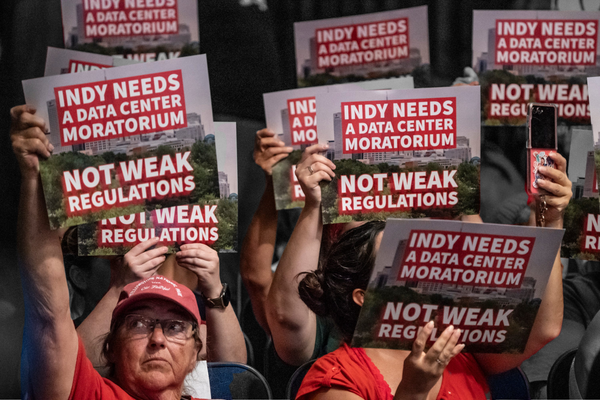
Data center construction is quickly becoming a hot-button issue in the United States. Tech companies seek sufficient computing power for their artificial intelligence products, but local communities push back on the projects’ footprints. On Friday, Managing Editor Ari Weitzman and Associate Editor Lindsey Knuth took part in the first-ever Tangle debate edition, arguing for and against building more data centers.
We polled the Tangle audience on their opinion before and after reading the arguments. Before:

After:

You can read the arguments that changed people’s minds here.
Quick hits.
- Louisiana authorities said a man killed eight children, including seven of his own, and wounded two other people in a shooting spree spanning at least three locations in Shreveport. The shooter died while attempting to evade police by car. (The shooting)
- Congress approved an extension of Section 702 of the Foreign Intelligence Surveillance Act until April 30. The act allows some federal agencies to collect and analyze communications outside of the United States without a warrant. (The extension)
- Customs and Border Protection’s tariff refund system, called Consolidated Administration and Processing of Entries, launched on Monday, allowing companies to submit refund claims for duties deemed unconstitutional by the Supreme Court. (The launch)
- President Donald Trump signed an executive order to expedite research into certain psychedelic drugs as potential treatments for mental health disorders. The president also directed the Food and Drug Administration to accelerate its review of new treatments. (The order)
- A gunman killed seven people and wounded at least 14 others in a mass shooting in Kyiv, Ukraine’s capital. Ukrainian security forces killed the suspect, who was reportedly born in Russia and had lived in the Donbas region for an extended period. (The shooting)
Peaceful News is Possible
In case you missed it, the news has been extra heavy recently. If headlines have been weighing you down more than usual, you’re not alone… but it doesn’t have to feel that way.
Meet The Pour Over: a Christian news company that believes staying informed doesn’t have to mean sacrificing your peace.
They deliver unbiased news that hits just what you need to be caught up on current events, plus brief Biblical reminders that keep you focused on what matters most: the Good News.
Join 1.6M Christians reclaiming their peace with The Pour Over.
P.S. The Pour Over’s not just hopeful, it’s also funny… sometimes. Get their welcome email, and if you don’t smile, they’ll send you a full refund (which is $0, because TPO’s always free).
Today’s topic.
The latest from Iran. On Sunday, President Donald Trump said that the U.S. fired on and seized an Iranian-flagged cargo ship attempting to pass through the Strait of Hormuz from the Gulf of Oman. The vessel is the first ship seized by the U.S. Navy since it began blockading the gulf on April 13. Iran said on Friday it would remove all restrictions on commercial ships passing through the strait, then closed the waterway again on Saturday in response to the ongoing U.S. military blockade. That day, gunboats linked to Iran reportedly opened fire on two ships attempting to transit the strait.
Back up: The sides agreed to a ceasefire on April 7, but the status of the Strait of Hormuz has remained unclear. On April 12, President Trump announced a naval blockade of Iran’s ports to prevent countries friendly with Iran from circumventing restrictions imposed on other ships. Although leaders from both nations communicated that the strait would be open for transit on April 17, several ships reportedly turned back over confusion about the requirements for safe passage.
In one incident on Saturday, a crew member on an Indian-flagged tanker radioed Iran’s military saying the ship was under attack and asking for permission to turn the vessel around. In a second incident, an Indian-flagged container ship was hit by “an unknown projectile,” damaging some containers. Both incidents are under investigation, and India’s External Affairs Ministry called on Iran to “resume at the earliest the process of facilitating India-bound ships across the Strait.”
The U.S. had turned back over 20 Iranian vessels attempting to cross the strait prior to Sunday’s incident. In a Truth Social post, Trump said the Iranian-linked ship “refused to listen” to warnings to stop, after which USS Spruance “[blew] a hole in the engineroom.” U.S. Central Command added that the ship was attempting to travel to an Iranian port and failed to comply with repeated warnings over a six-hour period. In a statement, Iran called the incident an “act of armed piracy” and said it would retaliate.
The seizure comes ahead of scheduled peace talks this week. Vice President JD Vance, Special Envoy Steve Witkoff and Jared Kushner, the president’s son-in-law, will travel to Pakistan on Monday in anticipation of a second round of negotiations with Iran. However, Iran’s participation is uncertain, and it threatened not to attend the meeting over “excessive demands, unrealistic expectations, constant shifts in stance, repeated contradictions, and the ongoing naval blockade.”
Today, we’ll cover these developments, with views from the left, right, and Middle East writers. Then, Executive Editor Isaac Saul shares his take.
What the left is saying.
- Many on the left see Trump’s maneuvers in the strait as risky and counterproductive.
- Others say the U.S. continues to act unlawfully in the conflict.
In CNN, Stephen Collinson wrote about “the gamble in Trump’s Iran blockade that could decide the war.”
“[The] growing hopes of US officials, conservative editorial pages and analysts that the blockade could bring Iran to its knees rest on an assumption that has repeatedly led the US astray in the Middle East,” Collinson said. “The hope is that Iran’s leaders offer concessions to alleviate the blockade’s eventual extreme repercussions. The plan also hints at an unspoken hope that deteriorating economic conditions could set off new internal political dissent and test the regime’s grip… But the idea that Iranian leaders will view the stakes in this way may be a leap.”
“The blockade presents Iran with a new strategic puzzle. Its options for escalation are risky since they could trigger a resumption of fighting and a rupture of the ceasefire with the US and Israel. Islamic Revolutionary Guard Corps forces could respond to the blockading of their ports by renewing attacks on US Gulf allies,” Collinson wrote. “Another option would be for Iran-backed Houthi rebels in Yemen to shut down an alternative oil trafficking route through the Red Sea. Such a move would be a hammer blow to the world economy and would surely heap political pressure on Trump as the war would threaten to careen out of control.”
In The Nation, Maryam Jamshidi argued “only one side has clearly broken the law in the Strait of Hormuz.”
“The Trump administration has made half-hearted attempts to justify its joint attack against Iran as defensive. Hardly anyone — including America’s Western allies — has bought into these legal justifications, even though many still support the US/Israeli war politically and militarily,” Jamshidi said. “Blockades are prototypical examples of illegal uses of force and acts of aggression, where not justified by the right of self-defense or a Security Council resolution. In the case of Iran, the US blockade is both unlawful… and effectively ends the ceasefire between the United States and Iran.”
“The US blockade also violates the laws of naval warfare, which prohibit blockades if ‘damage to the civilian population is, or may be expected to be, excessive in relation to the concrete and direct military advantage anticipated from’ the action,” Jamshidi wrote. “The purpose of the US blockade is not to pursue any military advantage against Iran but rather to achieve the political objective of increasing US leverage in ongoing negotiations with the Iranian government… Even if that objective was somehow a valid, military one, the blockade would still be illegal because it is designed to do significant damage to the civilian population by collapsing the Iranian economy.”
What the right is saying.
- Many on the right encourage Trump to keep up pressure in the strait.
- Some contend the U.S. Navy is well equipped to achieve its goals.
In Fox News, Lisa Daftari said “Hormuz whiplash proves Tehran can’t honor any deal it signs.”
“Within days, Tehran went from signaling that the Strait of Hormuz would remain open to threatening to close it. That reversal is a reminder that the regime cannot be trusted to uphold any deal it signs because its strategy depends on constant threats and keeping the world off balance,” Daftari wrote. “For years, U.S. and European officials have negotiated as if Iran’s commitments on paper would translate into predictable behavior. But the regime’s most powerful actors are not invested in keeping those commitments. This regime was not designed to be constrained, reformed or tamed.”
“Washington cannot afford to treat diplomacy as an end in itself. An agreement that is not backed by real enforcement, credible military deterrence and a clear understanding of who holds power in Tehran will not hold. It will be tested, stretched and eventually broken when the regime decides it can get away with it,” Daftari said. “A regime that turns a vital energy choke point into a pressure tool is not a responsible partner. It is the opposite. The back‑and‑forth over Hormuz is a hard reminder that Tehran’s core strategy is leverage through threat, not cooperation.”
In The Washington Examiner, Ali Holcomb and Joel Griffith suggested “our Navy was built for this moment.”
“President Donald Trump must not forget that the U.S. Navy was created with one thing in mind: securing the freedom of navigation for Americans. And that is exactly what it needs to do in the Strait of Hormuz,” Holcomb and Griffith wrote. “Amid the hand-wringing over this conflict, one crucial fact goes unacknowledged: The U.S. still holds overwhelming military superiority. The U.S. made a serious mistake in negotiations by even entertaining the possibility of Iran profiting from the strait. Thankfully, we have since corrected course.”
“‘Innocent Passage’ is the right of vessels of all nations to traverse through territorial seas, even through a different nation’s exclusive economic zone. ‘Strait Passage’ is even more permissive,” Holcomb and Griffith said. “The U.S. is the world’s leading enforcer of these laws and norms of the sea. When Libyan dictator Muammar Gaddafi declared the entire Gulf of Sidra to be Libyan territorial waters, the U.S. responded by deploying a carrier strike group straight into the gulf and shot down Libyan fighter jets attempting to enforce Gaddafi’s claims. We even have a formalized term for such operations, ‘Freedom of Navigation Operations,’ and we back up our declarations with action.”
What Middle East writers are saying.
- Many writers in the Middle East note the wide-ranging consequences stemming from the strait’s closure.
- Others say the war is already reshuffling our understanding of the global order.
In Arab News, Abdulrahman Al-Rashed wrote about threats against “Gulf ports.”
“The fighting has not stopped since negotiations in Islamabad came to a halt. US President Donald Trump’s dangerous decision to impose a blockade on Iran’s maritime trade has disrupted the entire landscape, as Iran is now threatening to target Gulf ports,” Al-Rashed said. “The blockade is the most dangerous weapon that can be used against Iran. Impeding Iran’s maritime trade could bring down the regime if it is sustained long enough and enforced strictly. Of course, choking Iran at sea has consequences and could potentially reignite a broader war.”
“The US has shown a willingness to continue fighting. It could be argued that more strikes that force Iran into surrender would be Trump’s best option, as they would allow him to emerge victorious in the eyes of the world,” Al-Rashed wrote. “Iran’s new leadership may appear fanatical, but this same leadership has expressed a desire to return to negotiations. It has a strong interest in avoiding destruction that risks the very existence of the regime. A blockade and devastation would be less likely if the American and Iranian delegations were to return to the negotiating table.”
In Al Jazeera, Khalid Al-Jaber said “the Iran war has exposed the limits of neutrality.”
“The course of the war demonstrated that the concept of ‘neutrality’ is no longer viable in contemporary regional contexts, particularly in the Middle East,” Al-Jaber wrote. “Neutrality is easier to declare than to maintain. Iranian strikes on energy infrastructure across Gulf states forced several producers to declare force majeure and suspend their operations. In Qatar, Qatar Energy halted LNG production, and the effects were felt almost immediately in Europe through a surge in gas prices of almost 50 percent in the Netherlands and the UK.”
“Calling for a cessation of hostilities without addressing the root causes of the crisis may amount to nothing more than postponing the inevitable explosion, while pursuing radical change without a clear vision for the day after may open the door to even wider chaos,” Al-Jaber said. “Between these two options, the world confronts a fundamental question: How can it deal with a regime widely viewed by many states as part of the problem, without allowing the pursuit of its transformation to create an even greater one? What appears evident is that the coming phase will leave little room for the grey zone within which states have long been accustomed to manoeuvring.”
My take.
Reminder: “My take” is a section where we give ourselves space to share a personal opinion. If you have feedback, criticism or compliments, don't unsubscribe. Write in by replying to this email, or leave a comment.
- Instability within Iran’s government is contributing to instability of peace talks.
- Iran’s new leadership is more extreme and more willing to use its force than the leaders the U.S. killed, and the situation is much more tenuous.
- All told, I don’t see a way this war ends any time soon.
Executive Editor Isaac Saul: I think a good deal of the chaos we’ve seen in the last few weeks can be attributed to a fractured and chaotic Iranian government. To grasp why, let’s start by revisiting the Iranian government’s pre-war makeup:

The theocratic side of the government (on top) held most of the power. The supreme leader commanded all of the military (the Islamic Revolutionary Guard Corps, or IRGC), while the Guardian Council approved all of the “elected” legislators. The ayatollah’s vetted parliament mostly fell in line, but at times it split from him. In one notable recent example, President Masoud Pezeshkian, who ran as a reformer and was almost certainly allowed to win because Supreme Leader Ali Khamenei wanted to relieve some tension, was much more permissive than Khamenei during the January protests. Pezeshkian even went as far as to say the regime must “listen to the people.”
Now, the Supreme Leader is dead — as are a long list of senior officials, including the secretary of the Supreme National Security Council, the intelligence minister, a top nuclear advisor, the commander-in-chief of the IRGC, the defense minister, the chief of staff of Iran’s armed forces, and the IRGC’s navy intelligence chief, just to name a few. The U.S. was hoping that, in the vacuum created by the deaths of these leaders, reformers like Pezeshkian would rise up — and some have, to a degree. Iran’s foreign minister, who serves under Pezeshkian, has been at the center of negotiations to end the war.
Yet, by and large, a reform-minded Iranian government has not emerged; in fact, the opposite has happened. Iran’s new, younger supreme leader is reportedly more “extreme” (read: theocratic and anti-Western) than his predecessor, and the new state and IRGC leadership is also more radical. Iran’s new national security chief is Mohammad Bagher Zolghadr, who is so radical that Qassim Soleimani — the general Trump assassinated in 2020 — once reportedly quit his role in the military in protest over Zolghadr’s views.
Anti-Western hardliners are dominating military decision-making in Iran, and they’ve expressed their ideology and their power by holding the global economy hostage in the Strait of Hormuz (something Ali Khamenei opted not to do when Israel and the U.S. struck Iran’s nuclear facilities last June). The disparity between Iran’s negotiating team and its military leadership played out in real time over the weekend: Iran’s foreign minister announced the Strait of Hormuz was fully open after negotiations with the United States. Less than 24 hours later, the IRGC said the waterway was still closed (and they’re keeping it closed) while the U.S. attacked an Iranian-flagged cargo vessel.
Power vacuums aren’t usually filled in an orderly manner, and right now Iran’s leadership is unstable. That instability is upstream of miscommunications, inconsistencies, and the inability to land a genuine “ceasefire” — a word that has been so misapplied as to be made totally meaningless (we’re technically in a “ceasefire” right now, it just includes multiple exchanges of fire, constant barrages, and very little negotiating). It is also upstream of intensified crackdowns on dissent and the deployment of regime supporters to the streets of Iran. They recognize their leadership is fragile, and they only have one way to keep it: hard power.
We’re now on Day 52 of the war, and it contains all the ingredients for a prolonged conflict. The men across from us at the negotiating table represent a government that is somehow more radical than the one we thought was too radical to negotiate with originally. Iran reportedly still has about 40% of its prewar stock of drones, and it’s using the reduction in fighting to dig out missile launchers it's been hiding underground. Its missile supply could soon return to 70% of what it was prewar. These estimates, like all intelligence, are inexact; but at the very least they imply that Iran is capable of keeping up the fight, and the new regime seems happy to do so.
A week ago, I wrote about the risk of Iran becoming a kind of “ambient war” — a conflict that fades into background noise we in the U.S. all become accustomed to. That scenario looks something like this: The U.S. and Iran work into an uneasy stalemate, with few major breakthroughs and the occasional blip. Perhaps Iran kills a U.S. sailor in a drone attack, or the U.S. seizes a cargo ship and oil prices temporarily spike, or the Iranian regime engages in a particularly horrific crackdown on protesters, or an Israeli rocket hits a civilian center in Beirut, or maybe a Hezbollah missile breaks through and lands in downtown Tel Aviv. This becomes the new normal — relative quiet punctuated by big, newsy events. Meanwhile, Iran remains under the control of a radical regime, the Middle East remains unstable, and our regional allies remain unsafe, all while stalled negotiations start and stop and an energy crisis continues to spread across the Eastern Hemisphere.
Eventually, some New Thing will demand our attention. Maybe China invades Taiwan, or Russia tests the borders of Poland, or the U.S. reconsiders an incursion into Greenland, or we all simply turn to the midterms and other domestic matters instead. In time, we come to accept the war that did not exist two months ago as a fact of life, and the untold money, blood, and even financial sacrifices at home fade into background static. This is my fear.
I’ve made a habit of steelmanning alternative views to check this perspective, but that sunny alternative seems less and less likely to me each day. I could make the case, sure: Though committing to dominating the strait would be costly, our navy is capable of achieving it. By confiscating Iranian cargo ships that account for so much of the regime’s revenues, we could put Iran in a vice grip that requires them to back off their current demands. Maybe the Gulf states turn against the new leadership to create a kind of unified front that totally isolates Iran, fully bringing its theocratic leadership to heel. In a clearly positive development, we have greatly diminished Iran’s nuclear program, taking a live Iranian threat off the table.
Yet expecting those upsides to lead to long-term peace anytime soon (within months, or even years) feels pollyannish to me. Iran is already angling for a cash deal from the U.S., one much larger than the kind they received from previous administrations. If they don’t get it, they will likely use their grip on the Strait of Hormuz to squeeze more money from the West. Remember, Iran’s current regime is more radical than the last, and the window for decisive regime change has likely closed.
How other impacted nations respond now will be crucial to determining the length of the conflict. Gulf states and some European and Asian nations are surely infuriated by and scared of the new Iranian regime, but those same countries also need Iran’s oil — and the energy pinch they find themselves in is not domestically sustainable. The UAE is already asking the United States for a financial lifeline. I could bet on a future where America’s Eastern allies stand strong with the U.S. while Western allies join in its war with Iran, or I could bet on Eastern countries desperately meeting whatever conditions are asked of them to get their oil from Iran while Western allies criticize the U.S from the sidelines. The smart money is to bet on the latter.
Again: We’re 52 days into the conflict. We are cheering the opening of a shipping lane that was open pre-war and still isn’t really open; we’re facing a new, more radical regime; we’re still grasping for a long-term peace plan; and we’re staring down the barrel of a prolonged global energy crisis. I want to be wrong, but every analytical bone in my body believes this is not a better recipe for a peaceful tomorrow than the one we had just a few months ago.
Take the survey: For how long do you believe the war in Iran will last? Let us know.
Disagree? That's okay. Our opinion is just one of many. Write in and let us know why, and we'll consider publishing your feedback.
Your questions, answered.
Q: Both the Americans and Israel are bombing the heck out of Iran. What is stopping them from using an atomic bomb?
— Gerry from Quebec
Tangle: Several important factors make this possibility highly unlikely.
Two small things off the bat: First, atomic bombs use a nuclear fission process — the United States today maintains a thermonuclear arsenal that uses fission to ignite a hydrogen fusion process, creating a much more destructive explosion. Second, Israel is widely believed to have about 90 nuclear warheads (compared to the U.S.’s roughly 5,000), but they have never officially confirmed that they have any.
Physically, nothing is preventing either the U.S. or Israel from using a nuclear weapon against Iran, but several factors work against it — the largest of which is the immediate moral implications. An estimated 204,000 people died when the U.S. dropped atomic bombs on Hiroshima and Nagasaki, and today’s weapons are many times more destructive. No country has been able to justify the indiscriminate killing of that many people with just one weapon since the end of World War II. But even putting those considerations aside for a moment, several other factors make the option extremely undesirable.
For one, dated reports indicate that Russia has a “deadhand” nuclear deployment system, which would detect incoming ballistic nuclear missiles and deploy its own defensively. The potential for such a system being operational and active in Russia deters any country from using intercontinental ballistic missiles (launched from land) or submarine-launched ballistic missiles (from submarines), especially if their trajectory goes towards Russia.
However, the United States and Israel have air superiority in Iran, so they could feasibly drop a nuclear bomb from an airplane. Of course, the fear of reprisal from Russia or China still remains a deterrent, and support and recruitment for Iranian proxies in the region, like Hezbollah and the Houthis, would likely intensify. That could lead to terrorist attacks in Israel, against ships in the Persian Gulf and Red Sea, against our other Middle East allies, and potentially in the United States.
Even more assured are the diplomatic ramifications. One of the stated reasons for the war was to aid the Iranian people, and deploying even a small nuclear weapon would be devastating to Iran’s civilian population, which would severely diminish the U.S.
diplomatic standing globally. Even a targeted strike on Iran’s nuclear facilities would cause incredible damage by detonating an unknown amount of fissile material. Even one thermonuclear bomb could severely damage a region hundreds of miles in diameter, contaminating groundwater and dispersing irradiated fallout that has been linked to increased incidence of thyroid cancer across an unknown area. Such an attack would fracture — if not destroy — standing U.S. alliances, cause global economic turmoil, destroy the credibility of disarmament pacts, and potentially even trigger impeachment proceedings against the president.
Simply put, nuclear weapons damage the target country physically, but the sheer cost of human life, the possibility of reprisal, and the potential political damage against the aggressor remain massive deterrents against their usage.
Want to have a question answered in the newsletter? You can reply to this email (it goes straight to our inbox) or fill out this form.
Will California’s next governor be a Republican?
California’s all-party primary is on June 2, with the top two vote getters — regardless of party — advancing to the general election. Former Rep. Eric Swalwell’s exit from the race has upended the Democratic field, but on the Republican side, Steve Hilton appears likely to advance. Last week, Isaac spoke with the former political adviser and Fox News host about his upset bid in deep blue California.
You can listen here or watch it here.
Under the radar.
On Thursday, the United States signed an agreement with the Philippines to create a U.S. industrial hub on a 4,000-acre site on the island of Luzon. The land is a gift from the Philippines, and it will function as a special economic zone with diplomatic immunity under U.S. common law. Furthermore, the hub will create access to critical minerals — such as nickel, copper, chromite, and cobalt — independent of Chinese supply chains, giving U.S. companies reliable access to key inputs for high-tech manufacturing. Details on the development’s timeline have not been announced, but the Trump administration will reportedly ask U.S. companies to submit bids to take part in the construction, with investment from private-sector companies. The Wall Street Journal has the story.
Headlines Weighing You Down? There's a Better Way
The Pour Over delivers politically neutral news for Christians — just enough to stay informed, with Biblical reminders that keep the Good News in focus. No anxiety spiral, no rage bait. 1.6 million readers trust their approach.
It's free, it's funny (sometimes), and the welcome email might actually make you smile.
The extras.
- One year ago today we had just published a Friday edition on the SAVE Act.
- The most clicked link in our last regular newsletter was the Senate rejecting a war powers resolution.
- Nothing to do with politics: A young wrestler in Ohio gives an unforgettable interview.
- Our last survey: 1,747 readers responded to our survey on Anthropic’s Mythos model with 45% saying it will have a major effect on cybersecurity and the internet. “As a software engineer, I find the hype believable. I also think this is just the beginning,” one respondent said. “This seems like a topic that is being thrust into the headlines to escape the AI bubble that seems to be forming,” said another.

Have a nice day.
When a former student entered Pauls Valley High School in Oklahoma armed with two semi-automatic handguns, Principal Kirk Moore acted instinctively and courageously, charging and tackling the assailant. Moore took a bullet to the leg before he disarmed the shooter, but no students were harmed in the incident. To show their appreciation, the students voted Moore prom king at the school’s dance this weekend. “He would do anything to save those kids,” Madison Knighten, a former Pauls Valley student, said. WBAL News Radio has the story.
500,000+ readers just today.