





Good Monday morning and welcome back to the Tangle newsletter. I’m Executive Editor Isaac Saul, in the perspective-shifting position of returning from a week-long vacation. That means I (and we) have seven days of news to catch up on. And that also means you get to drink in a regular 2026 week’s worth of news in one edition (deep breath). Here’s a rundown of what we missed:
Let’s start in the Middle East. Iran is reportedly threatening to derail an Oman-brokered deal to reopen the Strait of Hormuz; Iran also attacked a third UAE oil tanker in the strait last week. At a rally in Long Island, President Trump declared (or joked?) that he plans to make the Strait of Hormuz U.S. territory — an idea Iran predictably rejected. Oh, also, The Washington Post reported that Trump secretly left Air Force One in an airport catering truck to board a separate jet for his return flight from last month’s NATO summit after a credible Iranian assassination threat.
In domestic news, President Trump signed an executive order recommending the childhood vaccine schedule be shrunk from 18 diseases to 11 and also called for splitting the measles, mumps, and rubella shot into three separate visits. His comments drew strong rebukes from the American Academy of Pediatrics and Louisiana Republican Sen. Bill Cassidy (a physician). Separately, Sens. Rand Paul (R-KY) and Ron Johnson (R-WI) released text messages showing Dr. Anthony Fauci privately discussed a theoretical miscarriage risk from Covid-19 vaccines back in 2021, sparking viral rumors that the vaccine caused an 82% miscarriage rate in the first or second trimester (spoiler: it didn’t).
President Trump also expanded immigration enforcement on multiple fronts: The administration terminated Temporary Protected Status (TPS) for Myanmar and South Sudan nationals, and a federal judge in Boston lifted a stay blocking TPS termination for Somali nationals. DHS also published a notice that it was equipping ICE officers with gloves capable of delivering electric shocks to subdue subjects.
Then, there are the things we aren’t doing: The administration said it won’t enforce reporting requirements under the 2021 Corporate Transparency Act, a law aimed at shell-company money laundering, while the DOJ has refused to challenge a ruling that struck down a pillar of the Prohibition-era National Firearms Act.
Some other notables: Hunter Biden said that former President Joe Biden’s cancer has metastasized to his bones and other parts of his body. Massachusetts Gov. Maura Healey (D) signed legislation removing gestational age limits on abortion, making her state the tenth state to do so. The U.S. Court of Appeals for the D.C. Circuit ruled 2–1 to block most of President Trump’s planned construction of the White House ballroom, finding that the project lacked necessary congressional authorization. Luigi Mangione pleaded guilty to federal stalking charges tied to the 2024 killing of Brian Thompson. And a crypto company partly owned by the Trump family got preliminary approval for a banking charter from the Office of the Comptroller of the Currency.
That all happened since our last regular newsletter, which is why a lot of political journalists quit from burnout, and that’s why we just took our annual summer recess.
Oh, and today, we’re going deep on the results of last Tuesday’s primaries in Wisconsin, the biggest election to happen while we were on summer recess. It’s a 13-minute read (if you don’t count the work you just did).
Quick hits.
- Admiral Brad Cooper, the commander of U.S. Central Command, visited the USS Abraham Lincoln amid concerns about service members’ living conditions and mental health. The approximately 5,000 sailors and Marines on the ship have been deployed in the Middle East for over 260 days. (The visit)
- President Donald Trump directed the Pentagon to reduce the U.S. military’s joint exercises with South Korea, noting his “very good relationship” with North Korean Supreme Leader Kim Jong Un and calling the exercises “totally inappropriate and hostile.” (The order)
- At least seven people have been killed in severe storms and flooding throughout Indiana over the weekend. (The storms)
- A gunman wounded five people in a shooting at Virginia State University. A suspect, identified as a 19-year-old man, was found hiding on campus and arrested. (The shooting)
- A federal judge ruled that planned border wall construction in Arizona can proceed despite objections from the Tohono O’odham Nation, which argued that the wall would trespass on tribal lands. (The ruling)
Americans Born Between 1941 and 1979 Can Receive These 10 Benefits This Month.
You could be missing out on $1,000s, and you might not even realize it.
Sure, you might know about some senior discounts at diners or retail stores. But what you might not know is there are a number of lesser-known programs that can help slash bills, reduce insurance costs, and unlock powerful financial perks — right now.
We pulled together some of the most valuable money moves for 2026. Cut expenses, boost your retirement, and recession-proof your finances.
But act fast — we don’t know how long these programs will last!
Today’s topic.
The Wisconsin primaries. On Tuesday, August 11, Wisconsin held primary elections for the 2026 midterms, headlined by the gubernatorial race to replace outgoing Gov. Tony Evers (D). U.S. Rep. Tom Tiffany won the Republican nomination with 95% of the vote, while on the Democratic side, Milwaukee County Executive David Crowley narrowly defeated state Rep. Francesca Hong 39.8%–39.4%. Crowley’s victory was a significant upset, as pre-election polls showed Hong with a double-digit lead.
Back up: Hong, a member of the Democratic Socialists of America (DSA), worked as a chef and community organizer before entering politics. Her campaign highlighted healthcare reform and increased funding for public schools. Crowley is a longtime Democratic organizer in the state who positioned himself as a moderate, with housing affordability and public safety as key issues.
Hong’s past social media posts became a source of controversy in the primary’s final weeks, including a 2020 post in which she said Thanksgiving should be canceled because it “celebrat[es] colonialism.” She later walked back the comments and distanced herself from some elements of the national DSA platform, such as abolishing police and prisons, saying her focus was on “delivering for people the policies that improve the material conditions of their lives.”
Crowley suspended his campaign in July but re-entered the race later that month with Gov. Evers’s endorsement after Lt. Governor Sara Rodriguez, whom Crowley had supported, dropped out amid a campaign-finance scandal. Prominent democratic socialists Sen. Bernie Sanders (I-VT) and Rep. Alexandria Ocasio-Cortez (D-NY) opted not to endorse Hong after backing other progressive Democratic candidates, such as Senate candidate Abdul El-Sayed in Michigan. Republican groups also boosted Hong in the primary, ostensibly to produce a more favorable matchup in the general election.
Since winning the primary, Crowley has focused his campaign on Rep. Tiffany’s voting record and support of President Donald Trump, noting his votes against certifying the 2020 presidential election results in Arizona and Pennsylvania. Tiffany, meanwhile, has equated Crowley’s and Hong’s platforms, saying, “There’s not a dime’s worth of difference between all the Democratic candidates.” Data centers have also emerged as a key issue in the race, with both candidates calling for limitations on new construction, though not an outright moratorium (which Hong had supported).
Today, we’ll share views on the results from the right, left and Wisconsin writers, followed by Executive Editor Isaac Saul’s take.
|
What the right is saying.
|
In The Spectator, Freddy Gray wrote “Francesca Hong’s defeat won’t stop the DSA.”
“The long-view — and already ubiquitous — reaction to [Hong’s loss] is to mark it down as a major blow for the Democratic Socialists of America and their bid to take over the Democratic establishment,” Gray said. “But the real story should not be how Hong lost. It should be how on earth she came so close to being the Democratic choice for Wisconsin in a very high turnout primary in such an important swing state. Like many DSA members, Hong has said she wants to abolish the police because law enforcement agencies ‘uphold white supremacy.’ She’s also expressed discomfort at the fact her bi-racial son gives her a ‘proximity to whiteness.’”
“[This result] suggests that successful Democratic candidates are now the ones who bridge the gap between the hard and soft left of their party — as [Abdul] El-Sayed just about did in Michigan, and as the Ojibwe Native American activist Peggy Flanagan did in her Minnesota senate primary last night. Flanagan is not a DSA member, but she was the progressive choice,” Gray wrote. “Just a couple of years ago, Republican strategists would have found it easy to cast Flanagan as a far-left lunatic. Their problem in 2026 is that, compared to Hong and the popular DSA fringe, she seems to many to be the reassuringly sensible choice.”
In The Wall Street Journal, Jack Butler suggested “left-wing candidates are hype masters.”
“The polling and exciting vibes behind the campaigns of Abdul El-Sayed for Senate in Michigan and of Francesca Hong for governor in Wisconsin gave wildly misleading pictures of the actual races,” Butler said. “Neither result was expected. Mr. El-Sayed led by 10.2 points in the RealClearPolitics polling average before his 1-point victory. He was already talking about reshaping the party in his image by purging people like Pennsylvania Sen. John Fetterman. No recent poll in the RCP average had Ms. Hong winning by less than 10 points.”
“DSA-type candidates have mastered the art of hype. It can cow moderate rivals and ‘establishment’ forces into submission even when it’s overblown. Yet the combination of circumstances that stopped her from within the Democratic coalition may be rare,” Butler wrote. “Those pushing our politics leftward have a confidence out of whack with their viability. But if history is any indication, without serious resistance they’ll keep trying to fake it till they make it.”
|
What the left is saying.
|
In The Nation, John Nichols called Hong’s campaign “[a] measure of the strength of a new kind of politics.”
“Election analysis is often an exercise in managing expectations, and that is certainly the case in Wisconsin, where pre-primary polls put Hong in the lead. When she didn’t prevail, pundits and political insiders rushed to declare a definitional victory for the Democratic Party’s embattled centrist wing,” Nichols said. “Seriously? A little-known legislator with a scant campaign treasury, whose candidacy was actively opposed by the sitting governor and faced a hair-on-fire national media onslaught, finished in a virtual tie for the Democratic gubernatorial nomination in the ultimate swing state. And we’re supposed to believe that the result has defined the limits of the left?”
“In the heat of an election season, results are measured in raw vote totals. But they should also be measured by the potential they reveal. That is what Hong did on election night,” Nichols wrote. “With an outsider campaign that defied expectations and conventional wisdom, she came within a whisker of winning one of the highest-profile contests of a volatile election year. And, despite a frenzied final debate about her ‘electability,’ public polls and internal Democratic surveys suggested that she could be a viable contender in November against the extremely right-wing Republican nominee, Tom Tiffany.”
In Salon, Jason Kyle Howard argued “Hong’s loss in Wisconsin is a win for progressives.”
“What the race revealed were the weaknesses and limitations of an ineffective candidate who would have almost certainly flamed out in the general election. Democrats across the political spectrum, and especially progressives, should all be breathing a sigh of relief at her defeat,” Howard said. “At nearly every turn, [Hong] allowed herself to be defined: as a well intentioned candidate with some wacky views (‘Abolish the Senate,’ anyone?); as a provocateur who, to quote one Wisconsin voter, was ‘sort of inviting some controversies’; as being, in the words of the Wisconsin Elections Commission’s Democratic chair, ‘willing to sell out the Jews of Wisconsin for a few bucks.’”
“A more adept progressive, such as New York Rep. Alexandria Ocasio-Cortez or Dr. Abdul El-Sayed, Michigan’s Democratic Senate nominee, would have easily batted away the questions,” Howard wrote. “For the left to succeed, Ocasio-Cortez knows they must move beyond functioning as scolds. Dourness rarely plays well in politics, and it’s a particularly unbecoming quality in progressives, who can sometimes come off as humorless. The most electable progressives are instead happy warriors, a quality Ocasio-Cortez and New York City Mayor Zohran Mamdani have in spades.”
|
What Wisconsin writers are saying.
|
In the Milwaukee Journal Sentinel, James N. Fitzhenry wrote “Wisconsin election results stun as humans wreck the machines.”
“Pollsters botched the Wisconsin race, just like had happened in Michigan a week before. This time, however, the progressive/socialist candidate, Francesca Hong, lost and Crowley, the ‘establishment’ Democrat, won an improbable victory after every single poll had him losing by double digits,” Fitzhenry said. “Prediction is power, the high-tech hucksters on Kalshi and Polymarket would have you believe. When their power to predict is tested, they invariably lash, or cash, out. Algorithms and AI seem sure they have mastered quantifying and ultimately controlling human nature. Sometimes humans have to wreck the machines, which they did Aug. 11.”
“I was ecstatic the polls were ‘wrong’ not so much for who won or lost, but for what it told us about Wisconsin. Most of the critique of today’s politics is that people are easily classified into vicious tribes or voter blocks who are trapped in their own information bubbles. In this view, people are not capable of independent thought or doing something — gasp! — crazy like taking their time to decide or changing their mind,” Fitzhenry wrote. “But most seem to have missed in the Wisconsin Democratic primary that undecided was in the lead for most of the campaign.”
The Capital Times editorial board said “the extremist in this race is Tom Tiffany.”
“Tuesday’s primary election saw the nomination of the most extreme candidate ever to be submitted to the voters of Wisconsin by a major political party,” the board wrote. “Yet, with a campaign funded by out-of-state billionaires, Tom Tiffany has prevailed in a primary, and his cynical Republican allies now seek to confuse general election voters with messaging that seeks to suggest a moderation that simply does not exist. Make no mistake: There is nothing moderate, nothing mainstream and nothing acceptable about career politician Tom Tiffany. The Republican nominee for governor’s outlandish record is practically and ideologically extreme.”
“He is running to serve the most anti-democratic president in American history: Donald Trump… Tiffany actively supported Trump’s drive to overturn results in Wisconsin and nationally. This, despite the fact that Tiffany enjoyed his own reelection win in the very election he now contests,” the board said. “The governor who is elected this year will serve when the 2028 presidential election takes place. Wisconsin cannot afford to have a governor who would actively seek to overturn the results of that election — or any other election. Our democracy is too precious to be sacrificed in the service of Tom Tiffany’s political extremism.”
|
||||
|
||||
|
Reminder: This is where we share a personal opinion. If you have feedback, criticism or compliments, leave a comment or reply to this email.
|
Nearly all the commentary I found about the race revolved around Francesca Hong.
Almost unanimously, conservatives celebrated her loss while decrying how close she came to becoming the nominee. Virtually all writers on the right referenced her off-putting comments about hating Thanksgiving and having “proximity to whiteness” through her biracial son (to be fair to Hong, it was a ham-fisted attempt to discuss the difficulty she has identifying as a racial minority, but it was also a bizarre, distanced, and politically extreme way to talk about her own child).
On the left, meanwhile, the commentary was essentially split — pragmatists, moderates and establishment Democrats celebrated her loss because they believe it will help their odds in November (it will), while idealists, progressives, and democratic socialists were disappointed in the loss but resolute that their movement remains ascendant.
These various perspectives just added to the existing commentary on the DSA and progressive left that has been piling up for months. And very little of it struck me as in any way additive.
I was, however, captivated by three things: The polls, the actual Democratic primary winner, and his Republican counterpart.
First, the polls were very bad — again. We barely discussed this point when we covered Abdul El-Sayed’s victory in Michigan’s Democratic Senate primary, but he had a double-digit lead in almost every one of the final polls only to win by a single percentage point. Hong, too, was crushing Crowley in the final days of the campaign. In late July, Marquette University (a leading pollster and also a Wisconsin institution) had her leading Crowley by 31 points. State Navigate had her up by 22 points. The Crowley campaign’s own poll had Hong ahead by 18 points. Just six weeks ago, Crowley was so far behind the two frontrunners in the polls that he suspended his campaign. Candidates have dropped out of races then come back before, but I don’t know of a single example of it ending in victory — particularly in a race of this significance.
How could this happen? And how could the polls be so wrong that Crowley — whom the pollsters had all but left for dead — ended up winning?
For one, polling a race with this much turbulence is difficult. For another, the number of undecided voters created more uncertainty than polls’ toplines let on. From The New York Times:
In a survey taken by Marquette Law School just after Mr. Crowley re-entered the race in mid-July, 38 percent of respondents said they favored Ms. Hong. Mandela Barnes, the former lieutenant governor, was in second place at 16 percent, and Mr. Crowley had just 7 percent of the vote. But almost as large as Ms. Hong’s vote share was the percentage of undecided survey respondents: 34 percent. Most surveys estimated she would win about 40 percent of the vote, and she ended up winning 39 percent.
What changed was Mr. Crowley’s support. In a ballot-counting marathon that stretched into the wee hours of Wednesday morning, he over-performed the Marquette poll’s estimate by more than 30 points.
So the polls actually estimated Hong’s vote share remarkably well, but they had a hard time pegging Crowley’s eventual support. Is this polling problem an issue in the Midwest? In swing states? Across the country? Is it a polling problem at all, or is it simply a problem with how we report on and write about polls? In 2024, we interviewed pollsters about what they get right and wrong. One takeaway I had was that polls are good at predicting how people would vote but not very good at predicting who will vote. It seems we still aren’t adept at weighing our election predictions for who will actually turn up and cast a ballot.
At the same time, Hong’s weaknesses were there all along. The polls showed us that the percentage of undecided voters was about equal to the percentage of Hong supporters, yet all the media coverage and election analysts focused on Hong’s support dwarfing Crowley’s — not how many potential Crowley voters were showing up in the polls.
For the last 10 years, the inability of polls to capture the electorate accurately, or for us to interpret accurate polls with the correct context, has given the news media a lot of problems.
I’ve also been fascinated by the blanket declarations that Crowley is a moderate. We’ve talked a lot about how Trump has moved the Overton window on what constitutes a scandal or how a president should behave. Now candidates like Hong are moving the Overton window on what constitutes “left” or “progressive.”
As many conservative writers have noted, Crowley supports raising the state’s minimum wage to $20 by 2030, wants to enshrine the right to abortion in Wisconsin’s constitution, and has expressed opposition to local law enforcement cooperating with ICE. On his campaign website, he calls for a “true” public healthcare option and to “guarantee every family with a child under five a subsidized childcare slot through a publicly funded network of existing providers.” On the campaign trail, he’s spoken a lot about experiencing evictions as a child and called for providing free legal fees to people facing eviction proceedings.
Crowley has pretty pragmatic language to his governing approach (with a lot of “abundance” left talking points), and I think his policy positions often take on fresh, interesting angles. He’s certainly caught my attention. But calling someone with this platform a “moderate” was unimaginable even eight years ago.
Which leads me, lastly, to Crowley’s opponent in the general election. With so much focus on Hong, her far-left views and her old social media posts, the Republican candidate for governor in Wisconsin has gotten vanishingly little attention.
Rep. Tom Tiffany won with 95% of the vote, which killed any suspense, but he could reasonably be declared just as radical as Hong (as The Capital Times editorial board argued under “What Wisconsin writers are saying”). Tiffany has been rated the most conservative of all six Republican House members from Wisconsin by the American Conservative Union. Most notably, Tiffany is a 2020 election denier — not just a skeptic or someone trying to mince his words to appease President Trump, but a person who believes Joe Biden stole the election. He tried to overturn President Biden’s win in 2020 by signing onto a Texas lawsuit that would have invalidated the results, and he also voted in Congress to reject the results from Pennsylvania — after the January 6th riots. Tiffany’s still fighting the 2020 results, having just announced his support for an FBI investigation into Wisconsin’s results this May and repeatedly saying he would have overturned Wisconsin’s results if given the opportunity.
Are those views less radical than abolishing ICE or hating Thanksgiving? Reasonable people could disagree about that, but it’s inexcusable that Tiffany’s current positions didn’t get similar levels of attention as Hong’s past comments. Where Hong calls for taxing the rich, Tiffany promises to freeze all property taxes. And while Hong’s past social media posts became a source of controversy, Tiffany quietly deleted pages from his website that outlined his extreme positions on abortion, gun rights, immigration, and crime just days before his September 2025 announcement that he was running for governor.
It’s not a big mystery why. In 2022, Tiffany endorsed a federal bill that would have banned abortion after six weeks, with an exception for saving the life of the mother but no exception for rape or incest, a position that would be very unpopular in a state like Wisconsin. Tiffany’s opposition to universal background checks and red-flag laws would similarly have some trouble getting traction among Wisconsin voters, who overwhelmingly support both measures.
How will all this play out in November? With Hong out of the race, I expect the press to zero in on Tiffany’s past radical positions. Indeed, Crowley is already giving them a roadmap, emphasizing Tiffany’s “MAGA extremism” in an effort to pull Wisconsin’s Democratic coalitions together. It’s too early to know if he’ll succeed, but he’ll certainly benefit from the “moderate vs. far-right” framing.
Take the survey: Who do you think will win Wisconsin’s gubernatorial election? Let us know.
Disagree? That’s okay. Our opinion is just one of many. Write in and let us know why, and we’ll consider publishing your feedback.
Under the radar.
On Thursday, Flock Safety, which manufactures cameras that police departments use to capture vehicle data, announced new restrictions on how its products can be used. The changes include reducing the default amount of time the company retains data from one month to one week and implementing a program that locks out law enforcement officers who perform “abnormal” searches on their databases. The move comes amid growing objections about the technology among Americans and civil liberties groups, which have raised privacy concerns and highlighted instances of police officers using the cameras to stalk people. The company said the changes are intended to address those concerns, but the American Civil Liberties Union’s Chad Marlow said that the continued use of the cameras “undermine[s] the privacy and chill[s] the behavior of everyone in America.” NBC News has the story.
Born between 1941 and 1979? You could be leaving thousands of dollars on the table. From overlooked discounts and insurance savings to programs that cut monthly bills and boost retirement funds, these 10 financial perks could make a real difference in 2026.
See what you qualify for before they disappear.
The extras.
- One year ago today we had just published our video on a day in the life of a U.S. representative.
- The most clicked link in our last regular newsletter was the “Have a nice day” story on Karelian Bear Dogs.
- Nothing to do with politics: A map of castles and fortresses around the world.
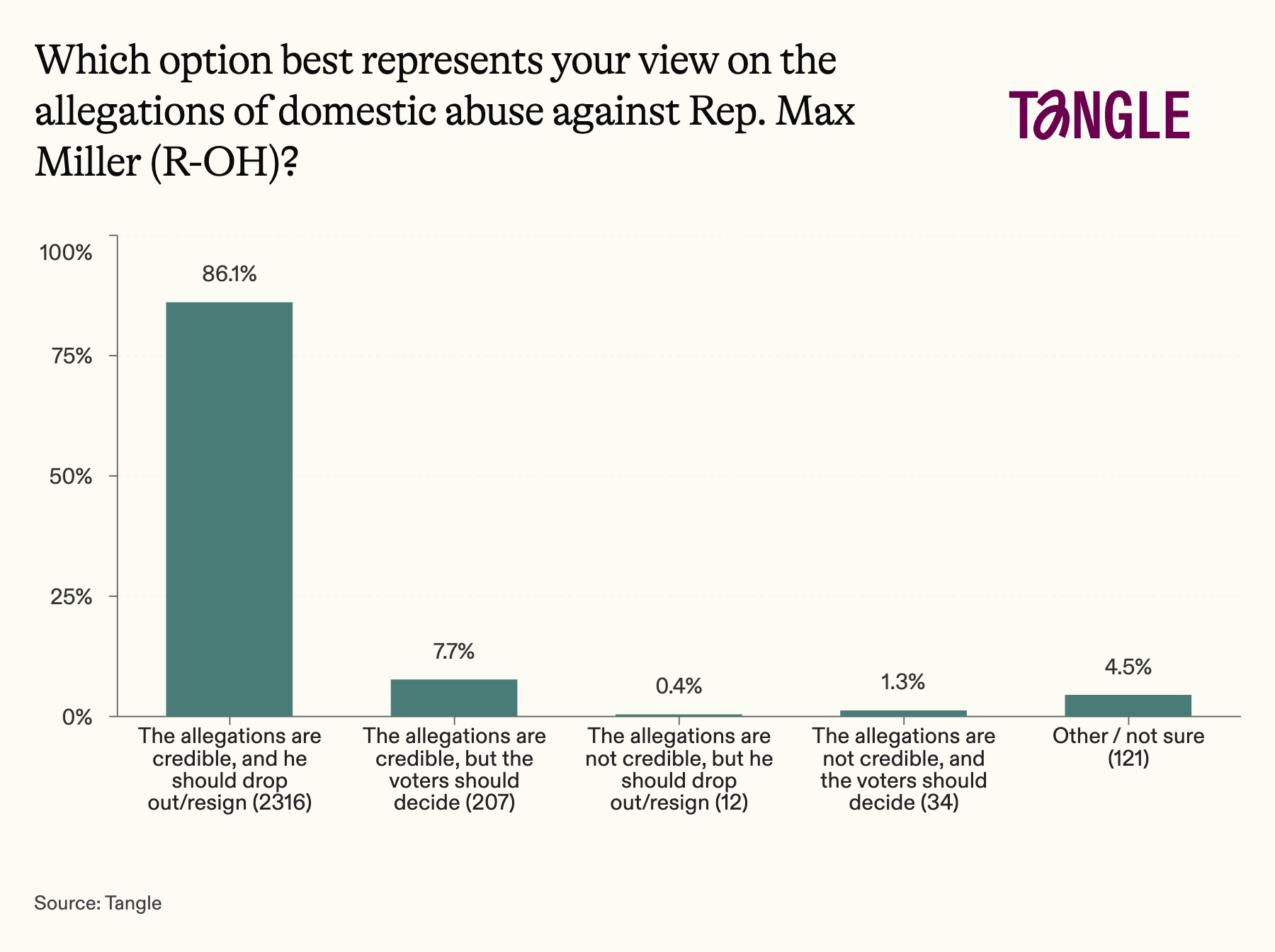
- Our last survey: 2,690 readers responded to our survey on the abuse allegations against Rep. Max Miller (R-OH), with 86% saying they find the allegations credible and Miller should drop out or resign. “This has not been proven in a court of law, but during the investigation and under the circumstances, Miller is not qualified to stand for election,” one respondent said. “The media remains under the delusion that ‘more allegations’ somehow equates to ‘better evidence,’” said another.
Have a nice day.
For Kylie Corbitt, an addiction treatment center helped break a cycle of unhealthy drug use. But when her 30 days at the facility ended, she struggled to maintain her sobriety. She tried attending Alcoholics Anonymous meetings but wasn’t able to connect at the talk-based sessions. Then she discovered The Phoenix, a free gym that is part of a growing model of addiction recovery that emphasizes shared activities like fitness, music, and meditation. Through The Phoenix, Corbitt started rock climbing and eventually got into CrossFit. In July, she reached two years sober and now spends time volunteering at the gym. “We’re not sitting there talking about addiction all day,” Corbitt said. “We’re talking about getting healthy and getting better.” The New York Times has the story.

Member comments