
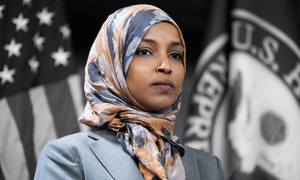

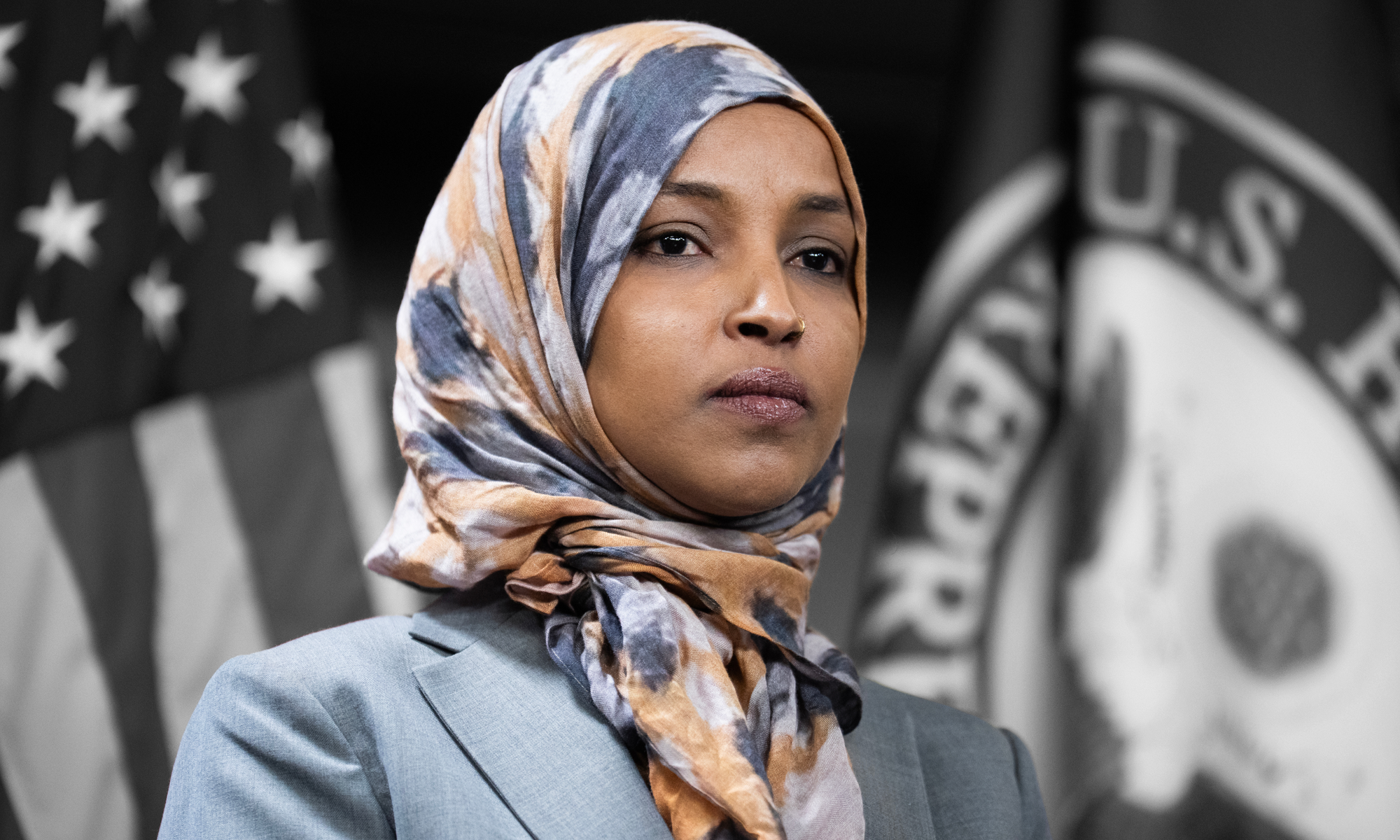


Monday’s raid of Rep. Ilhan Omar’s residence is the latest example of the Trump administration’s investigations into political opponents. And just like the targets of those other probes — like James Comey, Letitia James, and Sen. Adam Schiff (D-CA) — Omar’s feud with President Trump is grounded in both ideological and personal grievances.
I grew up in the suburbs of Minneapolis, in the district Omar represents, MN-05. She was never my representative (I was in college when she won the seat in 2018), but I have a good understanding of the district’s political makeup from working on local campaigns in high school and from family and friends who remain her constituents.
Somali-Americans have an outsized influence in MN-05 and state politics writ large. Growing up, first- or second-generation immigrants from Somalia were my classmates, friends, and teammates. I never really perceived them as a distinct group; they were just classmates, friends, and teammates. If differences existed between us at home, they were rarely present at school or on the field.
But even though it didn’t register with me as a kid, Minnesota’s Somali community is unique — it’s the largest Somali population in the United States, and MN-05 has the largest Somali population within the state. Many, including Rep. Omar and her family, resettled in the Twin Cities after fleeing the Somali Civil War of the 1990s. The community is still a relatively small part of the overall population (even in MN-05, Somalis make up just 3.4% of residents), but they’ve amassed considerable political influence — similar to other immigrant communities throughout U.S. history (and Minnesota history).
And like those other historical immigrant communities, Somali immigrants’ integration hasn’t been seamless — tensions were brewing long before YouTuber Nick Shirley showed up to document claims of fraud. Now, those tensions are ratcheting up: Just this month, alleged members of a Somali gang were charged in connection with a shooting at a homecoming football game, and the FBI arrested a U.S. citizen of Somali descent for allegedly plotting a mass shooting at the Mall of America. After a separate incident linked to Somali gangs in which over 100 rounds were fired in a suburban area, Bloomington Police Chief Booker Hodges said, “I'm not going to sugarcoat it. We're dealing with Somali-American gangs right now.” Meanwhile, many Somali-Americans in Minnesota report feeling increasingly ostracized and scapegoated for the actions of a few.
Somali-American leaders have spoken openly about how issues like fraud can seem endemic to their group. But Somalis themselves are most often the targets of these bad actors in the community. In 2024, Kayseh Magan, a former Medicaid fraud investigator and Somali-American, explained, “The conduit for fraud in publicly funded programs are the recipients, who require services. Somali recipients face language and cultural barriers. In an unfamiliar country, they lean heavily on other Somalis. Somali providers are in a position of trust, and some have taken advantage.”
As the face of the Somali-American community in Minnesota (and, really, the United States), Ilhan Omar has become an avatar for these problems. For the Trump administration, targeting Omar clearly communicates its broader agenda: push people like her out of the United States.
It’s hard to say if the investigation has merit based on the limited information currently available. We know that agents from Homeland Security Investigations (HSI) had a search warrant to carry out Monday’s raid and that their investigation is probing whether Omar’s father falsified her paperwork when applying for legal status. We also know that the Trump administration has been promising to go after the congresswoman for immigration-related offenses — DHS Secretary Markwayne Mullin told conservative podcaster Benny Johnson last month that “something’s going to happen” in relation to Omar, adding, “If we can prove it, that you shouldn't have been here in the first place, we'll deport you.”
Whatever comes of this investigation, the administration faces an uphill battle on any immigration-related criminal charges. As National Review’s Andrew McCarthy noted under “What the right is saying,” even if investigators found evidence that Omar’s father made misrepresentations in his immigration applications, the statute of limitations for prosecuting immigration crimes expired years ago. Not to mention, any theoretical charges would implicate her father, not Omar herself. In sum, the congresswoman almost certainly can’t be criminally charged for immigration offenses, though a civil denaturalization case is possible but unlikely based on what we know now. And the likelihood that she is denaturalized is slimmer still.
With that said, Omar’s backstory is convoluted. After fleeing Somalia, she spent four years in a refugee camp in Kenya before coming to the U.S. at age 12. In 2018, she told The Intercept that she became a U.S. citizen alongside her father through a process called derivative citizenship. However, just this week, The New York Post reported that Omar’s staff had her birth year changed from 1981 to 1982 after she was elected to Congress. That’s a critical change, because derivative citizenship is only available to minors; and if Omar was born in 1981, she would have already been an adult when her father was naturalized.
Questions about Omar’s immigration history extend to other rumors about her family. President Trump and conservative activists have alleged that Omar improperly obtained legal status for her brother in the U.S. by marrying him. As documented by Snopes, the rumor originated from a post on an online Somali community discussion forum and has never been substantiated. Still, the saga is complex — Omar says she married a different man (Ahmed Hirsi) in 2002 but did not complete the application process for a civil marriage. She and Hirsi separated in 2008, and she formally married Ahmed Nur Said Elmi (the man said to be her brother) the next year. Omar and Elmi separated in 2011, but did not legally divorce until 2017. Between those two dates, she reconciled with Hirsi. That marriage also failed, and she is now married to political consultant Tim Mynett. It’s a fairly fraught relationship history (fraught enough to help these rumors persist), but still: No evidence has emerged that Ahmed Nur Said Elmi is Omar’s brother.
Other rumors like this one have also largely been disproven, but I can accept that a narrow immigration investigation into Omar’s citizenship paperwork might have merit (remember, a court had to sign off on HSI’s search). Even accepting that, the Justice Department’s and DHS’s decision to pursue this raid, in spite of the statute of limitations and the proximity to the midterms, screams ill intent — particularly given the DOJ’s traditional (though not explicit or binding) practice of avoiding public actions involving political candidates within 60 days of an election. I don’t think the Trump administration is trying to derail Omar’s chances of reelection — MN-05 is deep blue, and she’s going to win. Rather, this investigation is about sending a message: We’re fighting to push people like Omar out of the U.S.
It’s a playbook we’ve seen Trump run many times, including his 2024 remarks about Haitian migrants in Ohio eating cats and dogs. These days, he’s saying that Somali immigrants are responsible for “Violence, Murder, and Mayhem all over [Minnesota]” and calling on “the people of Minnesota [to] fight back.”
Now, in targeting Omar (someone he’s openly fantasized about sending back to Somalia), Trump is acting on personal grievance but also a collective grievance shared by many in the MAGA movement: People like Omar are taking over this country; we need to push them back. It’s a politically salient message, and its power comes from real frustrations. But I draw the line at casting an entire group of people (most of whom are naturalized or native-born U.S. citizens!) as violent criminals who should be forcibly removed.
I’ve held off on sharing my own views on Omar, but now I’ll show my cards: I’m not a fan. She’s made a slew of objectionable remarks in the past — mostly criticisms of Israel that veered into antisemitism — but I’m more opposed to her political style that emphasizes hollow clapbacks tailored for social media clips, personal digs, and attempted gotchas (even when she’s the one in the wrong). This style isn’t unique to Omar; I’m against it in all cases.
It might feel nice for a moment to imagine someone like this getting a degree of comeuppance, but it’s a fleeting, sickly high. Barring an unforeseen development, Omar is not going to be imprisoned or deported — the big “win” will be a dramatic raid that leads to nothing. We’ve seen this enough in the second Trump administration to call it what it is: wielding the power of the executive branch to target political opponents. Any personal qualms I have with Omar pale in comparison to this abuse of power.
|
Get more of the story...
We broke down the investigation with just the facts, and then we picked out the best arguments from conservative, progressive, and independent writers in today's free newsletter so you can make up your own mind. Read them here. |
Member comments