





By Isaac Saul, Executive Editor, Tangle Founder
Let me start with an obvious point that everyone should grant: News organizations don’t have a First Amendment right to just walk into the White House.
The Trump administration — and its defenders — are correct when they argue that covering the White House as part of the press pool is a privilege, not a right. However frustrating the president’s messaging, these organizations aren’t having their rights infringed solely by being denied presidential access. I’m the leader of a news organization, and I’ve been reporting on national politics for 15 years, yet all my applications for a White House press pass have been denied. I don’t automatically get access to the president just because I’m a member of the media.
So yes, a White House press pass is a privilege; you have to apply, be accepted into the press pool, and follow the rules once you’re inside. There is a reason the room is populated by the biggest news organizations in the world.
However, that doesn’t mean this move is fair or even legal. Revoking a news organization’s access based on the content of their reporting is almost certainly a form of viewpoint discrimination, which is a violation of the First Amendment. The Trump administration may also be violating their due process and property rights under the Fifth Amendment, which is exactly the grounds on which news organizations are now suing the Trump administration. I suspect, too, that those outlets will win their lawsuits on the merits, especially since the Trump-appointed judge assigned to the case has shown a keen deference toward press freedom in the past.
So, yes: The White House gets to choose who’s in the room. But they don’t get to revoke access for people or organizations because they don’t like their coverage. That tug of war between the federal government and the media is well established, and it’s something we should all be grateful for.
What counts as a “hoax”?
Which brings me to the White House’s defense of this move. In response to CNN posting a statement about the ban, the White House Rapid Response team posted a graphic of purported CNN “hoaxes” over the years:
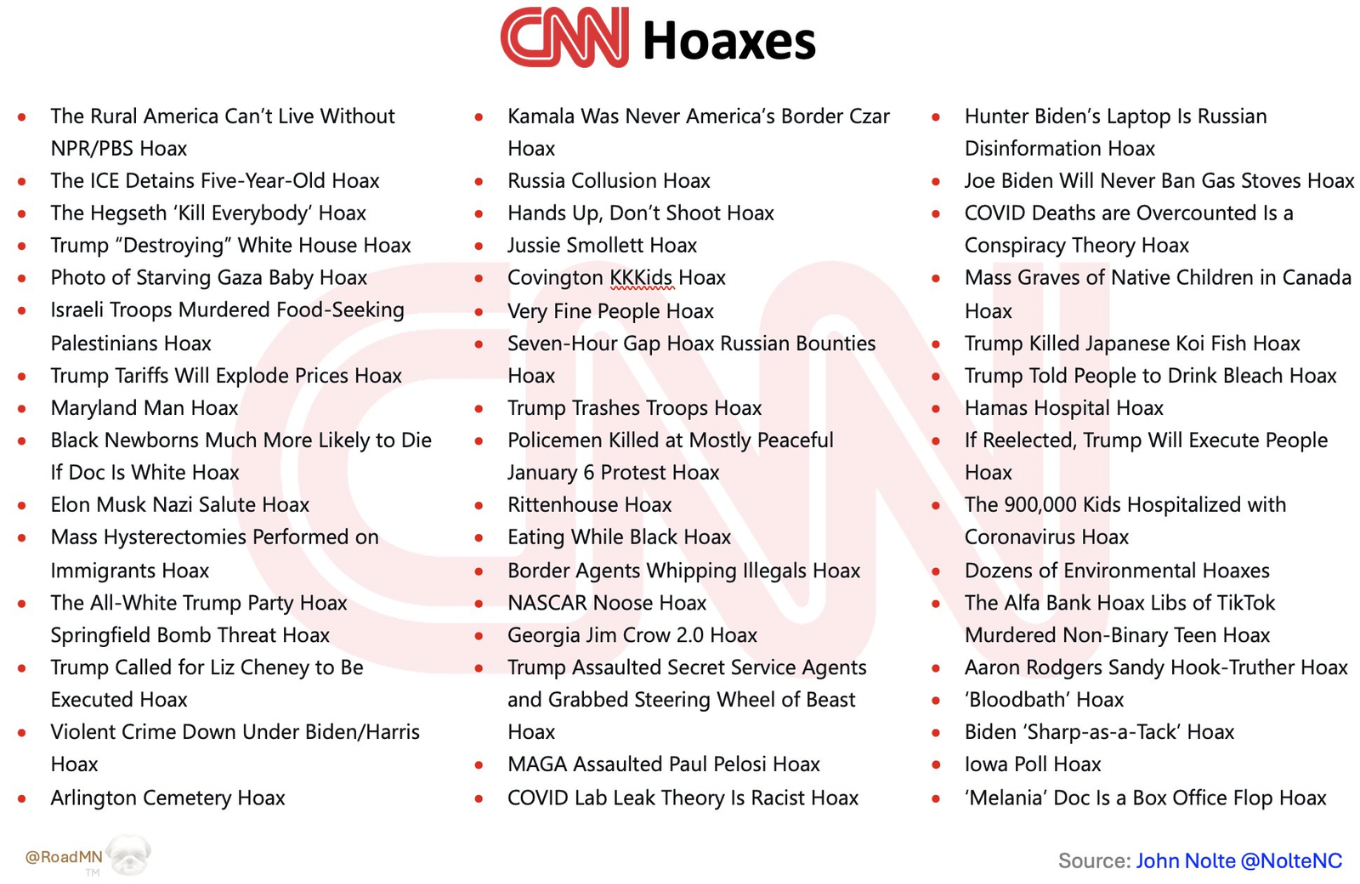
The graphic is actually instructive as a look into how the White House thinks about past reporting and what it deems “fake” and “real” news. Very few of these stories were actually hoaxes — that is, totally fictional accounts — save examples like Jussie Smollett faking his own racially charged attack (which was something CNN reported on with insufficient skepticism, not a myth the outlet itself created from whole cloth). But within Trump’s orbit, the definition of the word hoax has morphed into anything from “story published with inaccuracies” to “exaggerated or misleading story.” And it’s true CNN has had some whoppers over the years.
The “Covington Kids” story was reported with so much bias as to obscure the reality of what happened, and CNN paid the price for it. Claims that Trump promised a “bloodbath” if he lost the election were intentionally quoted out of context to make it seem like he was promising a civil war rather than warning that the auto industry would fail without him. Kyle Rittenhouse was never driven across state lines by his mother, and he did not illegally transport a rifle across state lines, both inaccurate claims CNN reported. Trump never called for Liz Cheney to be executed, but he did insist she stand on the front lines of a war before sending our kids off to fight it for us (this was before Trump launched the Iran war). Other times, CNN leaned into a technically true framing — like the fact that Kamala Harris was never technically border czar — that obscured the truth so much as to be misleading.
I have written or tweeted about most of this inaccurate or misleading reporting in the past, and all of these mistakes always seem to go in one direction. CNN is deserving of criticism for its consistent and demonstrated anti-Trump bias, and the White House is well within its rights to use its bullhorn to call it out.
At the same time, a lot of the purported “hoaxes” in the graphic are real things that happened that CNN and other outlets reported accurately. David DePape, the man who assaulted Paul Pelosi, was a die-hard Trump supporter. And after the assault, many in the MAGA world — including Trump’s own son — mocked Pelosi for being brutally beaten by one of their own supporters. That isn’t a hoax. Trump did run for re-election while promising to pursue death penalties again, and he has since pushed for reinstating firing squads. This, too, is not a hoax. Israeli troops did, actually, shoot and kill food-seeking Palestinians at an aid site. Also not a hoax. And Melania Trump’s documentary was a box office flop, earning just over $16 million after Amazon spent $40 million to buy it. You guessed it — not a hoax.
CNN was right to report that Biden never banned gas stoves and never pushed for such a ban. All that he did was appoint a commissioner on the independent Consumer Product Safety Commission who called gas stoves a “hidden hazard” and said “any option is on the table” in an interview, which conservative columnists then wrote about as Biden planning to ban gas stoves. Biden never planned to do such a thing, and immediately responded to the comments by saying he had no such plans. It was a rather silly story that got blown way out of proportion, and under the Trump administration’s definition, it’s actually an example of a conservative media-led “hoax.”
Trump has offered other justifications for the ban, like claiming Politico was awarded some kind of untoward contract by the federal government as a quid pro quo arrangement for favorable coverage. This claim is also a lie, one that I wrote about at the time in a piece for The Free Press.
Some Strangers Know Way Too Much About You
Your phone number. Your address. Your date of birth. Data brokers collect and sell a surprising amount of personal information. Incogni sends removal requests and follows up when your data pops back up. Basically, they do the annoying part.
Does bias justify a ban?
Some of Trump’s allies have offered their own defense, arguing — for example — that past administrations have limited access to certain members of the press. Many of these examples are deliberately misleading — like the case of an African journalist named Simon Ateba being “barred” by the Biden administration when, actually, he was denied a permanent hard pass but granted a day pass every time he requested one.
Other defenders of the president argue that he has a right to ban these outlets because of their bias. “Reporters covering White House briefings should be conveying facts, not spin,” Ward Clark wrote in RedState. Ironically, if that’s true, then RedState’s own press credentials for the Pentagon and White House should be revoked immediately, given that — as their name implies — they are a news organization whose agenda is explicitly aligned with Trump’s.
Quotes like Clark’s make it exceedingly clear how silly and dangerous this all is. Every administration has its critics and allies in the press; this has been true since the Washington administration, and it should be true going forward. None have ever done what Trump is attempting to do now. Bias is in the eye of the beholder, which is precisely why nobody should support an administration banning news outlets it deems as biased — even if they have a track record of mistakes. All that does is ensure future administrations will further restrict press access they don’t like, which is a loss for anyone who believes in free exchange.
|
Get more of the story...
We broke down the ban with just the facts, and then we picked out the best arguments from conservative, progressive, and independent writers in today's free newsletter so you can make up your own mind. Read them here. |
What is Trump getting out of this?
It’s astonishing to me that the administration thinks this is the play right now. Yes, the media — writ large — is distrusted by the public and obsessed with itself and will inevitably devote plenty of coverage to its own lawsuits and fights with the administration. I’m sure some of them will even build subscription drives off the battle. That’s their right, and maybe Trump is just betting that CNN, MS NOW and Politico will spend more time on “resistance” navel-gazing and less time critically reporting on actual stories about his administration.
But the knock-on effects are already breaking against him. Yesterday, the administration held an event so Trump could unveil his new helipad, but there was no audio on the televised event because there was no press pool after the other four networks, including Fox News, banded with CNN and against the ban. It was actually really encouraging to see Fox News's Washington bureau chief condemn the ban during his time as chair of the broadcasting consortium — a reminder that, despite our perceptions of these organizations as partisan warriors, they still lean on traditions of collegiality and mutual respect.
Hours later, Trump launched “Trump TV,” a 24/7 streaming show on the White House YouTube channel that purports to play the greatest hits of his administration, live updates, and breaking news. When I checked the channel out this morning, there was a grand total of 934 people watching a re-run of a Trump rally — and commenting was prohibited. This is the same administration that promised to “restore free speech.”
Meanwhile, back in the real world
Really consider the context here: Gas and diesel prices are both significantly higher than they were when Biden left office, and rising. We’re still stuck in the Iran War, which is now spreading. The Russia–Ukraine war rages on. Inflation is higher today than it was when Biden left office. The number of uninsured Americans has gone up since Biden left office. The native-born employment rate is stagnant. Real wage gains are down, too. There is no long-promised healthcare bill, no election reform bill, no immigration reform bill. The House was just sent home after doing a grand total of four months of work this year because they didn’t want to take a tough vote on impeaching Trump’s secretary of Defense. Now, they won’t be back until after the midterms.
If any of this concerns you, don’t worry; President Trump is focusing his time on what matters. He just got a new helipad at the White House. He’s hard at work building his ballroom and fighting to get his name on the Kennedy Center (or knock it down), and he’s got plans to turn his grand arch into a drone-deploying military station. And now, thankfully, he’s banned three news organizations from the White House who post stories he doesn’t like, which will inevitably result in taxpayer money being used to fight lawsuits from those organizations that he will very likely lose.
If this is how the president thinks he can stave off a midterm blowout — or rescue his quickly sinking approval ratings — then the bubble he’s living in is farther removed from reality than I even thought. That’s bad news for Trump, worse news for us, and a much bigger deal than any of the shoddy reporting we’ve all had to live through over the last decade.
This piece was written by Isaac Saul, founder and editor-in-chief of Tangle, an independent political newsletter that breaks down the biggest political debates of the day from multiple perspectives. To get more independent takes delivered directly to your inbox, sign up for the newsletter below.

Member comments