







I'm Isaac Saul, and this is Tangle: an independent, nonpartisan, subscriber-supported politics newsletter that summarizes the best arguments from across the political spectrum on the news of the day.
Are you new here? Get free emails to your inbox daily. Would you rather listen? You can find our podcast here.
Today’s read: 13 minutes.
Isaac on Breaking Points.
Executive Editor Isaac Saul’s Friday report on allegations of corruption in the second Trump administration has driven a massive response across the Tangle community — and among those who are newly discovering his work.
This morning, Isaac went on Breaking Points with Krystal Ball and Saagar Enjeti to discuss the piece. You can check out the interview on their YouTube channel at 3:00 PM ET.
Quick hits.
- The United Arab Emirates (UAE) said that multiple missiles were launched toward its territory from Iran; the missiles were intercepted or fell into the sea. The country also blamed Iran for a series of fires at UAE fuel facilities and on ships off its coast. Separately, the United States said it sank several Iranian military boats after Iran fired missiles at commercial vessels in the Strait of Hormuz. The incidents potentially imperil the U.S.–Iran ceasefire. (The latest)
- The Secret Service said its agents exchanged gunfire with a suspect near the White House, causing the building to briefly lock down. The suspect was shot and is currently hospitalized, but further details have not been released. A 15-year-old bystander was also shot and sustained non-life-threatening injuries. (The shooting)
- Florida Gov. Ron DeSantis (R) signed into law a new Congressional map that could net Republicans four additional seats in the U.S. House. The map is expected to face legal challenges. (The map)
- The Supreme Court issued an unsigned order granting a request to immediately finalize its opinion in Louisiana v. Callais, which found that one of Louisiana’s majority-black Congressional districts was unconstitutionally gerrymandered based on race. The decision will allow the state to adopt a new map before the 2026 midterms. Justice Ketanji Brown Jackson dissented. (The order)
- The Justice Department officially ended its investigation into Federal Reserve Chair Jerome Powell over the cost of the central bank’s renovation project in Washington, D.C. U.S. Attorney for D.C. Jeanine Pirro said the inspector general for the Federal Reserve is launching an inquiry into the project. (The update)
Small gift, essential for life on the go (perfect for Mom)
Ever had your phone die right when you needed to make a phone call, take a photo or call an Uber? Unfortunately, it happens all the time.
Meet the ULTRA SLIM Wireless ChargeCard — a portable charger that’s thin enough to slip right into your pocket or wallet (unlike those big, bulky chargers with long messy cables). Since it charges your phone magnetically, there are no cables needed.
Just stick it to the back of your phone and instantly start charging. It’s sleek, powerful, and ridiculously THIN. Innovated by a SHARK TANK company and featured in Forbes and Fox for a reason, the ChargeCard is arguably the most convenient charger around.
Use code 30TANGLE to get 30% OFF your order today.
Today’s topic.
The end of the Homeland Security shutdown. On Thursday, April 30, the House of Representatives passed legislation to fund the Department of Homeland Security (DHS) and end the department’s 76-day shutdown, the longest shutdown in U.S. government history. The House of Representatives and the Senate each had passed separate bills to end the shutdown; on Thursday, the House approved the Senate’s legislation in a voice vote under suspension of the rules, and President Donald Trump signed the bill into law the same day.
Back up: The shutdown began on February 14 amid tensions over the Trump administration’s immigration enforcement efforts, with Democrats refusing to fund the department without significant reform to Immigration and Customs Enforcement (ICE) and Customs and Border Patrol (CBP). DHS oversees ICE and CBP, as well as a host of other agencies, including the Transportation Security Administration (TSA), the Cybersecurity and Infrastructure Security Agency (CISA), the Federal Emergency Management Agency (FEMA), the U.S. Coast Guard, and the Secret Service. While the shutdown paused funding for most DHS departments, the One Big Beautiful Bill Act provided advance funding for ICE and CBP, allowing them to continue full operations.
We previously covered the shutdown here and here.
The end of the shutdown comes after a weekslong standoff between House and Senate Republicans. The House of Representatives would not consider a unanimous Senate bill to fund all of DHS except its immigration enforcement agencies. Then, on April 29, the House voted to adopt a Senate resolution to increase ICE and CBP budgets by about $70 billion. Following the approval of the Senate’s budget proposal, the White House reportedly sent a memo urging the House to approve the DHS funding bill and end the shutdown. On May 4, Republicans in the House and Senate released the text of their plan, with $72 billion in total funding. The bill contains $38.2 billion for ICE; $26 billion for CBP; and smaller amounts for DHS, the Justice Department, and the Secret Service. GOP leaders are aiming to pass the bill by June 1.
Representatives of both parties welcomed the end of the shutdown and blamed the opposition for its length. House Minority Leader Hakeem Jeffries (D-NY) said, “For more than two months, Donald Trump and House Republicans have kept the Department of Homeland Security shut down because of their toxic demand to spend billions of taxpayer dollars on ICE brutality. Today, the extremists backed down.” Rep. Andrew Garbarino (R-NY), chair of the House Committee on Homeland Security, said, “For 76 days, Congressional Democrats forced a shutdown of the Department of Homeland Security… While the majority of the Department has now been funded, I remain committed to ensuring every component of DHS, including those tasked with border security, has the resources and oversight needed to succeed.”
Roughly 1,100 CISA staff reportedly left the agency during the shutdown. TSA staffing had a turnover of 8%, nearly double its usual rate of 4.6%, according to DHS Secretary Markwayne Mullin.
Below, we’ll get into what writers from the left and right are saying about the end of the shutdown. Then, Senior Editor Will Kaback gives his take.
What the right is saying.
- The right expresses urgency around funding DHS — and its defense activities.
- Some say the extended funding lapse has degraded DHS operations beyond border security.
- Others criticize congressional Democrats for long refusing to end the shutdown.
In The Daily Wire, Tod Lindberg wrote “America can’t afford the high cost of a reactive defense.”
“A security camera captured video of the alleged would-be assassin charging through a magnetometer at the White House Correspondents’ Dinner Saturday night… The partial government shutdown affecting the Department of Homeland Security (DHS) didn’t have any direct impact on the effectiveness of the response on Saturday. But with the shutdown now in its 11th week, Congress is playing with fire,” Lindberg said. “Much of the activity of prevention consists of informed speculation about what might happen. The idea is to map out plausible sequences of events leading to a bad outcome, then to derail the sequence.”
“A lot of planning and war-gaming is essential to getting ahead of potential threats. Yet the partial shutdown at DHS has forced much of this activity to close shop as ‘non-essential,’” Lindberg wrote. “The Secret Service and the Transportation Security Administration were both on the scene Saturday to perform essential functions, and they did their jobs. Because Democrats loathe the Trump administration’s immigration policies, it falls to the GOP to find a way to fund DHS. Never has ‘non-essential’ been so essential.”
In Times-Republican, Rep. Randy Feenstra (R-IA) argued “the DHS funding lapse has strained homeland security.”
“Operationally, agencies are struggling to pay vendors, maintain facilities, and support critical travel. These are not just abstract problems; they have direct consequences. At our ports of entry, CBP facilities risk losing essential services, including utilities and communications, if payments lapse,” Feenstra said. “Law enforcement officers incurred travel expenses they may not be reimbursed for, adding further strain on their families. Training programs across multiple agencies have also been canceled, and critical cybersecurity efforts have been scaled back, increasing vulnerabilities to foreign adversaries. The impacts extend far beyond just border enforcement.
“FEMA announced that it is nearing depletion of its Disaster Relief Fund, which has been a lifeline for communities like Rock Valley when responding to emergencies and natural disasters. TSA staffing shortages contributed to longer airport wait times, delayed flights, and even flights being canceled,” Feenstra wrote. “Let’s be clear: this is not about partisanship. It is about ensuring that the men and women who defend our country have the support they need to do their jobs. It is about maintaining the operational integrity of the agencies that safeguard our borders, respond to disasters, and prevent attacks.”
In Townhall, Jenny Beth Martin said “now” is the time to “fund the Department of Homeland Security.”
“Democrats are determined not to fund ICE and CBP, lest they offend the radical base that demands defunding all law enforcement authorities and lose the base’s engagement and turnout in the upcoming midterm elections,” Martin wrote. “When many of us advocated for a shutdown in 2013 rather than provide funding to implement Obamacare, we knew that Republicans would bring the shutdown to an end if the Democrats were unwilling to negotiate, and we knew we would have to make our case to the American people in elections, working to persuade more people to our side.
“By contrast, the Democrats who now refuse to vote to fund DHS, or even to allow the bill to come to the floor of the Senate so that it can be funded by the votes of others, do not care about making their case against DHS funding electorally,” Martin said. “They are not denying the agency funding to draw attention to a political issue, they are denying funding to the agency because they want to eliminate it. They want what they want, and they want it right now, and the consequences be damned.”
What the left is saying.
- Many on the left argue Republicans caved on the DHS shutdown.
- Some suggest the shutdown’s ending was historically unique.
- Others frame the lack of ICE and CBP funding as a win for Democrats.
In New York Magazine, Ed Kilgore said “the shutdown finally ends.”
“The surrender occurred as part of an extremely complicated series of developments in the House Republican Caucus this week that involved deals over FISA (foreign-intelligence gathering) reauthorization, a farm bill, and a budget resolution setting up a budget-reconciliation measure to pre-fund the immigration enforcement functions left out of the DHS bill to secure Democratic votes,” Kilgore wrote. “With this assurance that unencumbered money for ICE and the Border Patrol was on its way, House Republicans apparently decided to stop taking hostage the rest of DHS, including TSA, FEMA, the U.S. Coast Guard, the Secret Service, and various anti-terrorism programs.”
“Members of both parties probably have mixed feelings about the DHS shutdown now that it’s finally over. Democrats got the opportunity to talk for weeks about abuses by ICE and CBP agents and to display to restive elements of the party base their ability to stay unified while ‘fighting Trump,’” Kilgore said. “Republicans got the opportunity to find a way to stuff ICE and CBP full of even more funding than they had before without having to consider or adopt any of the ‘guardrails’ on their conduct that Democrats were demanding. And in the end, nobody in the House in either party had to go on record supporting or opposing the measure that ended the shutdown thanks to the voice-vote device.”
In MS NOW, James Downie argued “House Republicans caved — and changed the politics of government shutdowns.”
“For the first time, the side precipitating a government shutdown neither had to cave in the end nor suffer a backlash for holding out. It seems that, at least for now, the politics of shutdowns have fundamentally changed. It should be acknowledged at this point that unlike last year’s shutdown showdowns, this one was over one department and not the whole government,” Downie wrote. “The shift in shutdown politics may be a function of two circumstances, but neither is changing soon. It certainly helps Democrats that congressional Republicans can barely keep their ship afloat.
“The relationship between Johnson and Senate Majority Leader John Thune is frosty at best, and while Republicans’ narrow House majority would challenge any speaker, Johnson’s tenure has consisted largely of disorganization punctuated by last-minute scrambles to push through must-pass bills,” Downie said. “With midterms looming, Congress could punt the next round of funding bills until after votes are cast, as it did in 2024. But with even some Republicans expecting Democrats to flip the House and perhaps the Senate, a postponement could hurt the GOP’s leverage. Regardless of the date for the next funding fight, though, Democrats should reprise and even deepen the resolve they showed in this one.”
In The New Republic, Hafiz Rashid wrote “Republicans cave[d]” on the shutdown “without funding ICE.”
“The bill, passed by a voice vote in the House, is a win for Democrats, as it still includes no money for ICE or Border Patrol, and is now headed to President Trump’s desk to be signed into law. House Speaker Mike Johnson reportedly decided to finally support the bill after a private meeting with his fellow Republican leaders earlier in the day, where they agreed that the situation couldn’t continue,” Rashid said. “Previously, House Republicans had criticized their counterparts in the Senate for passing the measure with a voice vote, which doesn’t record individual members’ votes, only to adopt the same method on Thursday.
“DHS Secretary Markwayne Mullin complained last week that the department was almost out of money and soon wouldn’t be able to pay its employees. Now, assuming Trump doesn’t veto the bill, employees will still be paid,” Rashid wrote. “But the question of ICE’s future is still unanswered, as Democrats want the agency reformed at a minimum, with some calling for its abolition, and Republicans seem to be fine with the violence it visits on American cities. For now, at least, ICE won’t get any more money.”
My take.
Reminder: “My take” is a section where we give ourselves space to share a personal opinion. If you have feedback, criticism or compliments, don't unsubscribe. Write in by replying to this email, or leave a comment.
- The shutdown may have felt pointless, but the long-term ramifications could be grave.
- The saga weakened both agencies and constitutional norms.
- Republicans may have “won” in the short term, but at what cost?
Senior Editor Will Kaback: So this is the way the shutdown ends — not with a bang but a whimper.
Maybe it’s just me, but I expected a record-shattering shutdown (of a purportedly critical federal department, no less) to feel like it meant something. Instead, very little has changed — except that our government dysfunction has deepened. DHS is responsible for ensuring homeland security, and while 76 days with a partially operational department likely weakened our security apparatus in many invisible ways, the department’s partial shutdown didn’t upend the federal government. Instead, it was more like a rash, flaring up on occasion (airport wait lines) but mostly melting into the background as a low-grade annoyance. Now that the Department of Homeland Security’s external problems are over, however, its internal problems are just beginning.
During the shutdown, critical DHS agencies were forced to scale back important functions: The Federal Emergency Management Agency restricted disaster-related travel, and the Coast Guard withstood energy shortages at duty stations as it racked up millions in unpaid utility bills. Then, the staffing. Roughly 1,100 Cybersecurity and Infrastructure Security Agency (CISA) workers have left since mid-February, a massive reduction for an agency that was already struggling with low headcount. Last week, DHS shared that over 1,000 Transportation Security Administration officers left the agency during the shutdown.
While it’s a relief that TSA workers will again have a reliable paycheck, replacing 1,000 employees lost in 2.5 months (even at a 50,000-person agency) will take time — time the TSA doesn’t have. As DHS stressed before the shutdown ended last week, “Ahead of the FIFA World Cup and summer travel, this [employee] loss has SIGNIFICANTLY decreased TSA’s ability to meet passenger demand and left critical gaps in staffing.”
The issues at CISA are similar. The agency’s operations were already floundering pre-shutdown due to a lack of a Senate-confirmed agency head. Now, with the Iran war causing elevated cybersecurity threats, the agency tasked with cybersecurity and infrastructure protection across all levels of government is operating with a skeleton crew. In April, Acting Director Nick Andersen testified that CISA’s capacity to counter cyber threats was “more limited than I would like,” saying many of its core functions were “simply not possible or legally allowed during the period of a shutdown.” As with the TSA, those challenges won’t be resolved overnight by the shutdown ending.
It’s difficult to assess the full scope of these less tangible costs, but we know from past shutdowns that they can be pervasive. A study of the 2018–19 government shutdown found it correlated with a 17% increase in quit rates among federal workers, with more experienced workers most likely to depart. Another report on the 2013 shutdown found “employees exposed to furloughs were 31% more likely to leave their jobs within one year.”
I know the Trump administration and others might see a long-term headcount reduction as a positive, but I’m not so sure. For one, these agencies all strike me as critical — I don’t think most people, Trump included, are arguing that a hollowed-out TSA would be a good thing. And while the president has railed against CISA for undermining his claim that the 2020 election was fraudulent, the rest of us don’t have to accept that framing. We’re fighting a war against a country known for perpetrating cyber attacks, and tech companies are sounding the alarms about powerful AI models that can be leveraged for cyber warfare. Given all that, I want a cybersecurity agency that’s beefing up its staffing, not hemorrhaging it.
I’m also worried about how this shutdown contributed to an observable erosion of constitutional norms. When we covered the shutdown at the end of March, I wrote that President Trump’s memorandum to reshuffle federal funds to pay TSA workers was “a significant expansion of Trump’s claimed power to use federal funds for purposes that Congress hasn’t approved” — a quiet pilfering of the legislative branch’s power of the purse. Well, Trump’s order was executed without resistance from Republican leaders, TSA agents got paid, and the long airport lines mostly dissipated. What’s to stop the president (or a future one) from deploying the same tactic to resolve the next inconvenient budget fight?
The coming reconciliation battle looms large. Remember: The recently signed funding package doesn’t fund ICE or Border Patrol, but Republicans are moving ahead with a plan to pass $72 billion in new funds for immigration enforcement through reconciliation, which they can pass with a simple majority in the Senate. This was the same tool Congress used to pass the One Big Beautiful Bill Act last year, which allowed immigration agencies to operate unaffected during the DHS shutdown.
Republicans can’t just wave reconciliation like a magic wand to do this; key roadblocks remain. They’ll have to survive the Byrd Rule, which bars provisions that do not primarily affect federal spending or revenue, as well as other rulings from Senate Parliamentarian Elizabeth MacDonough, who previously blocked Democrats from putting immigration-related measures in their 2021 reconciliation bill. And of course, swing-vote Republican senators like Lisa Murkowski (AK) and Susan Collins (ME) are not guaranteed yeses.
But if Republicans can pass CBP and ICE funding through reconciliation, any leverage to reform these agencies will be effectively killed for years to come. While less constitutionally alarming than Trump’s memorandum, this new norm still undermines the traditional appropriations process, which provided an annual check on agency policies.
I’m left not only distressed, but perplexed. Democrats bet that ICE’s sagging popularity gave them leverage to demand sweeping reforms, but now they’ll probably get nothing. Republicans may not have come to the negotiating table in good faith, but at least for a brief period, the White House floated moderate reforms like body cameras for agents and identification requirements. Perhaps Democrats are content to settle for any electoral boost that appearing to “fight” on DHS reform will offer, but now they’re staring down the distinct possibility that they’ll get zero reforms and ICE will be fully funded for years to come. I can’t help but shake my head when I see Democratic leaders framing last week’s funding package as the GOP “caving” — what did Republicans lose here?
Republicans, meanwhile, are teed up to achieve their short-term goal of passing advance funding for immigration enforcement, but at what long-term cost? I’m reminded of the gerrymandering fight playing out across the country — a race to the bottom to accomplish short-term political goals to the detriment of functioning democratic governance. Democrats are guilty of abusing reconciliation, too (the Inflation Reduction Act is just one recent example), and this saga will only embolden both sides. I worry that we’re entering the age of unaccountable, preemptively funded agencies carrying out a president’s agenda without fear of oversight.
So maybe the DHS shutdown isn’t ending with a whimper but a subtle crack, a tap of a hammer to a fragile foundation. We may not feel the effects immediately, or even in the weeks and months ahead; but the foundation is weaker nonetheless, and there’s no telling how many more blows it can sustain.
Take the survey: What do you think will be the impact of the DHS shutdown? Let us know.
Disagree? That's okay. Our opinion is just one of many. Write in and let us know why, and we'll consider publishing your feedback.
Your questions, answered.
Q: In your Sunday edition you wrote: “On Thursday, the Senate voted unanimously to pass a ban on senators trading on prediction markets, such as Kalshi and Polymarket, amid rising concern over insider trading.” What are the penalties if a Senator ignores the ban? Does the ban also cover family members and business associates? Is there a similar ban in the House, the Executive Branch, and the Judicial Branch?
— Ben from Norfolk, VA
Tangle: Last week, the U.S. Senate unanimously passed a rule preventing senators, officers and staff from betting on prediction markets, effective immediately. The ban is not a law, but rather an amendment to Rule 37 of the Standing Rules of the Senate, and it applies only to senators and their staff — not their family, business associates, or members of the House of Representatives. Although the text of the amendment is not yet publicly available, the rule it amends prohibits senators and their staff from profiting off of the office in any way that conflicts with their duties, so adding text to apply to prediction markets is straightforward to imagine.
The Standing Rules of the Senate are enforced by the Senate Select Committee on Ethics, a bipartisan commission that hears and investigates reports of violations of this code. Repercussions for violations can range from reprimand to censure to suspension from office up to expulsion.
Currently, the House’s Code of Ethics does not have any specific regulations preventing its members from placing bets on prediction markets. At the federal level, the judicial branch does not have a similar ban, nor does the executive branch (although the White House has issued a formal warning to its staff against placing trades or bets using private information). At the state level, New York, California, Illinois, and Maryland have included such ethics provisions in their official codes of conduct.
Want to have a question answered in the newsletter? You can reply to this email (it goes straight to our inbox) or fill out this form.
This day in history.

After several decades of instability, the Mexican government announced in 1861 that it would suspend all payments to its European creditors for two years. Spain and the United Kingdom would cut deals with Mexico, but French Emperor Napoleon III had designs on taking Mexico by force. Napoleon III wanted to establish a colony to the south of the United States, then embroiled in civil war, and use that position to trade with the Confederacy for cotton — a resource made scarce in Europe by the Union’s blockade.
In 1862, well trained French troops marched from Veracruz to take the capital of Mexico City. However, they were dealt a startling defeat by a mix of volunteers and conscripts under the command of General Ignacio Zaragoza outside Puebla on May 5. Although France would eventually go on to control much of Mexico from 1863–1867, the surprise victory delayed France’s advance, arguably giving Union forces time to establish control in the American Civil War.
The upset was heralded as a moment of national pride in Mexico, and May 5 — Cinco de Mayo — would eventually become a celebration of Mexican heritage internationally, especially among Mexican Americans. “By 1863, Mexican Americans in California were already commemorating the date, treating it as a political and cultural moment tied to resistance and democracy,” Sehila Mota Casper, the executive director of Latinos in Heritage Conservation, said.
The perfect gift for mom. Dead phone? Worst timing, every time. Bulky chargers? Nobody wants to carry them around. The ultra slim wireless ChargeCard lives in your wallet or pocket, snaps to your phone magnetically and powers it up instantly — no cables needed. Always with you, always ready, it keeps your phone powered all the time.
The extras.
- One year ago today we wrote about President Trump’s 2026 budget proposal.
- The most clicked link in our last regular newsletter was our Friday edition about corruption in the Trump administration.
- Nothing to do with politics: A 17th-century Indian “supercomputer” heads to auction.
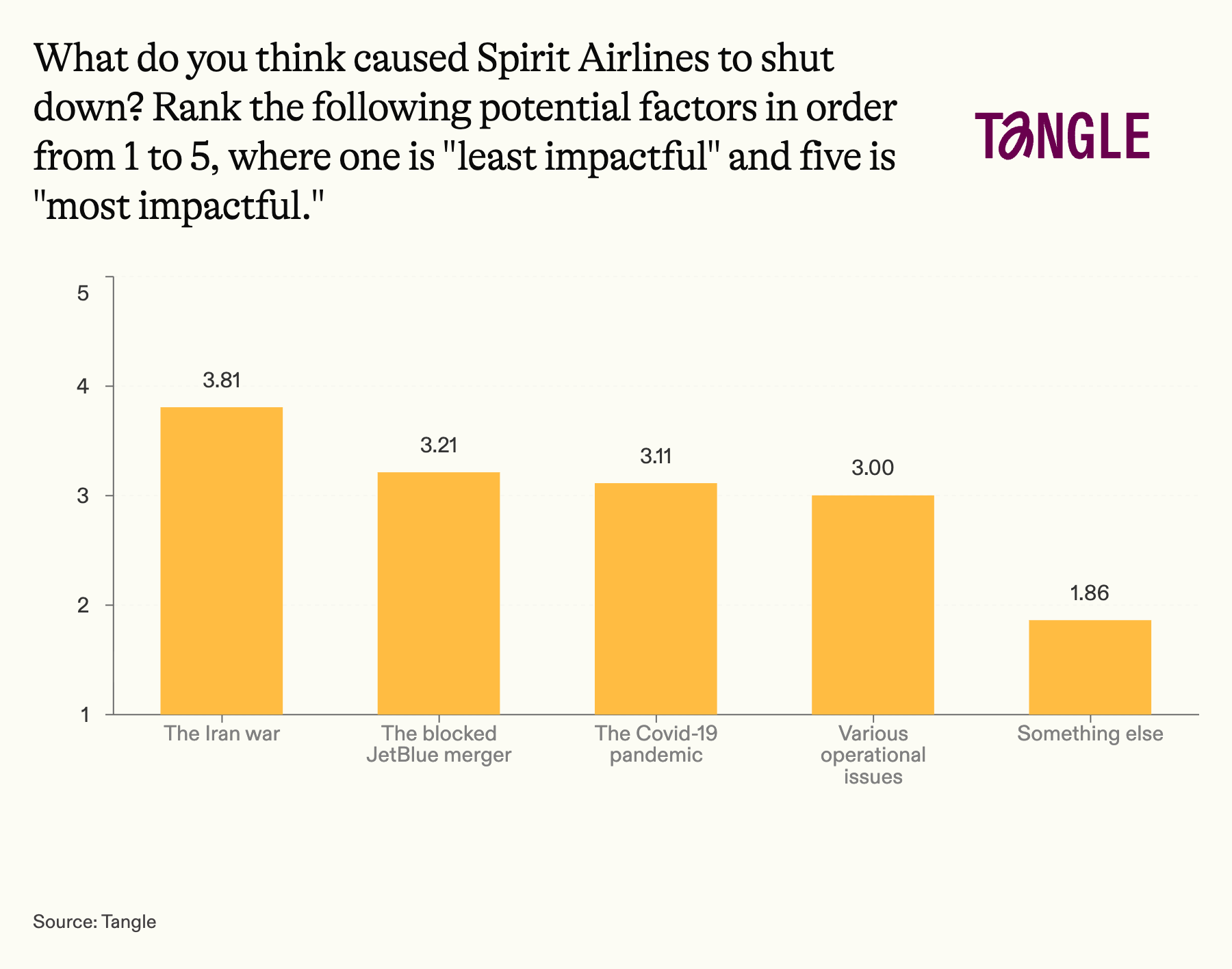
- Our last survey: 1,631 readers responded to our ranked survey on reasons for the Spirit Airlines shutdown with respondents mostly blaming the Iran war. “The final nail in Spirit’s coffin was the price of fuel. JetBlue is having the same issue and a merger would have only delayed the inevitable,” one respondent said. “The most obvious reason is that it was a terrible airline to fly on,” said another.
Have a nice day.
Polish YouTuber Piotr Hancke has built an online following for rapping under the name “Latwogang.” Now, he has a different claim to fame: setting the marathon livestreaming record for fundraising, netting $76 million for children battling cancer. In a nine-day session from his Warsaw apartment, Hancke brought on celebrity guests including Coldplay’s Chris Martin and tennis star Iga Swiatek, drawing 1.5 million viewers to the finale. All told, Hancke netted over 276 million Polish zloty in donations to the Cancer Fighters Foundation, a Polish organization supporting children with cancer. “This simply isn’t about us — it’s about children and everyone who has no choice but to fight this injustice," Hancke said. “Let’s change the way we think about cancer forever. It’s not a death sentence — we will overcome it and fight it.” People has the story.


Member comments