






Happy Tuesday — this is Senior Editor Will Kaback. Yesterday was one of those days that felt like the news cycle was tripping over itself amid a deluge of major stories. Democrat Graham Platner’s Senate campaign in Maine appears to be over after a woman came forward to accuse him of raping her five years ago. Sen. Mitch McConnell’s (R-KY) health is once more under the microscope. President Trump intervened to help overturn a U.S. soccer player’s World Cup suspension, only for the team to lose decisively to Belgium last night.
We’ll have more on these stories — particularly Platner’s campaign and McConnell’s health — later in the week. Today, we’re covering a Supreme Court case that’s not as flashy but just as important: last week’s decision to strike down restrictions on coordinated spending between parties and candidates. We’ll get into the legal arguments and practical implications below, then answer a reader’s question on what it means to define yourself as “left” or “right.” Plus, an uplifting story on how one bookstore is supporting local artists.
It’s a 14-minute read.
Quick hits.
- A woman who dated Maine Senate candidate Graham Platner (D) accused him of raping her in 2021, prompting Democratic lawmakers to pull their endorsements and call on him to drop out of the race. In a video statement, Platner denied the accusation but said he is “taking the time to reflect on the best path forward.” (The latest)
- President Donald Trump traveled to Turkey for a North Atlantic Treaty Organization summit. Leaders are expected to discuss the latest on the wars in Ukraine and Iran, as well as Trump’s calls for member states to increase their defense spending. (The summit)
- U.S. officials claimed that Iran fired missiles at three commercial ships transiting the Strait of Hormuz on Monday night and Tuesday morning, likely violating the memorandum of understanding between the United States and Iran. (The incident)
- Hamas said it will dissolve its government in Gaza and transfer power to the National Committee for the Administration of Gaza in accordance with the U.S.-brokered peace deal. However, the group did not indicate whether it intends to disarm, another key provision of the agreement. (The announcement)
- A five-day preliminary hearing in the case against the man accused of murdering conservative activist Charlie Kirk began in Utah. (The hearing)
Find The Right Business Health Insurance Provider. In Minutes, Not Months.
Benefits season shouldn’t take all year. Top Provider helps businesses skip the endless broker calls, carrier quotes, and weeks of back-and-forth that usually come with comparing health insurance options.
Tell us about your business, your team size, your industry, and what matters most to your employees. Top Provider matches you with benefit providers, including PEOs that can unlock group rates and coverage options many small businesses can’t access on their own.
No broker middlemen. No endless waiting. Just the right options, faster.
Today’s topic.
National Republican Senatorial Committee v. Federal Election Commission. Last Tuesday, the Supreme Court held that a federal law limiting the amount of money political parties could spend in coordination with campaigns violated the First Amendment. The Court’s vote was 6–3 along ideological lines.
Back up: In 1971, Congress passed the Federal Election Campaign Act (FECA) to set limits on spending in federal elections. A 1974 amendment to FECA introduced limits on coordinated expenditures, or political party committees’ spending in direct collaboration with campaigns. In a 5–4 decision, the Supreme Court previously upheld the law’s coordinated-expenditure limits in Federal Election Commission (FEC) v. Colorado Republican Federal Campaign Committee (2001). In 2022, then-Senate candidate JD Vance (R-OH), then-Rep. Steve Chabot (R-OH), the National Republican Senatorial Committee (NRSC) and the National Republican Congressional Committee (NRCC) challenged the law in federal court, arguing that the 2001 decision should be overturned and that FECA inappropriately prevented national committees from coordinating messaging with party candidates. The Supreme Court heard oral arguments in the case in December.
Justice Brett Kavanaugh authored the majority opinion, writing that “modern congressional limits” on coordinated spending violate parties’ free speech rights under the First Amendment because they “impair the party’s traditional forms of communication such as advertisements; preclude parties from amplifying the voice of their adherents; impose additional monetary costs and burdens on political parties; and inflict a ‘stifling effect on the ability of the party to do what it exists to do.’”
Justice Elena Kagan authored a dissenting opinion arguing that coordinated-expenditure limits were meant to supplement candidate-contribution limits introduced by FECA to curb corruption; the majority’s decision “ushers back in the same opportunities for quid pro quo corruption that the contribution limits were meant to check.”
Republicans have broadly expressed support for the ruling as a win for First Amendment rights. Sen. Tim Scott (SC) and Rep. Richard Hudson (NC) wrote, “By striking down these unconstitutional caps on coordinated spending, the Court has restored core political speech and ensured parties can compete on a level playing field.”
Some Democrats criticized the ruling as opening paths for wealthy donors to exert undue influence on politics. In a joint statement, Sen. Kirsten Gillibrand (NY), Rep. Suzan DelBene (WA), and Democratic National Committee Chair Ken Martin said, “Today’s ruling is a win for billionaire donors and special interests who want more influence over the GOP agenda and an invitation for corruption.”
Below, we’ll hear from the left and the right about the ruling. Then, Senior Editor Will Kaback gives his take.
What the left is saying.
- The left is mixed, with some saying the ruling will enable unchecked corruption.
- Some suggest that the ruling won’t change much about money in politics.
- Others argue the decision could have positive downstream effects.
For the Brennan Center, Daniel I. Weiner and Joanna Zdanys said the “Supreme Court continues to dismantle anticorruption laws.”
“On Tuesday, the Supreme Court struck down yet another federal campaign finance law, continuing its nearly two-decade drive to destroy anticorruption guardrails,” Weiner and Zdanys wrote. “Since its infamous 2010 Citizens United decision, the conservative majority has reinforced the unprecedented fusion of private wealth and political power that now shapes our government. But the Court is not the only branch of government at fault.
“For decades, Congress has ceded its authority to presidents and the judiciary and failed to pass long-overdue reforms to repair our warped campaign finance system. Amid growing public outrage at corruption, this ruling must be a wake-up call for lawmakers. Congress must pass a robust anticorruption agenda that would help end the era of massive money in politics that the Court ushered in,” Weiner and Zdanys said. “Congress should take the NRSC ruling as a sign to start reasserting its constitutional role to better deliver for the American people.”
In Slate, Richard L. Hasen called the ruling “not nearly as bad as expected.”
“It’s possible that the [NRSC v. FEC] decision makes our campaign finance system a bit less distorted in bringing candidates and parties closer together,” Hasen wrote. “All of these [super PACs] are unaccountable, spreading negative messages. Parties help preserve democracy in the court majority’s view, and it was only fair to free the parties of limits on them… It’s not clear that the court is wrong. Super PACs in many ways are worse than parties in campaign spending, and maybe funneling money through the parties could strengthen them.”
“But I suspect that NRSC will hardly make a dent in either the weakness of political parties… or the current, deregulated campaign environment,” Hasen said. “The ultrarich will still use super PACs and other means of spending big bucks on campaigns. In the 2016 campaign, there were no individuals spending at least $100 million in a campaign season. In 2024 there were nine individuals or couples doing so, with all supporting Republican candidates. The plutocracy is real.”
In The Atlantic, David A. Graham suggested the decision “might improve politics.”
“The idea that political parties should be stronger may be counterintuitive to most Americans, who hold both the Democratic and Republican Parties in low esteem,” Graham wrote. “But many political scientists have argued that one reason American politics is such a mess is that the party organizations have been weakened for decades… Weak parties are less able to squash candidates whose positions come from the fringes of their coalitions, or massively wealthy candidates.”
“Lifting the ban on coordination won’t eliminate super PACs, which raised $5 billion in the 2024 election, but it will make them less alluring to donors,” Graham said. “Money can be used more efficiently if it’s going directly to a party and candidate, rather than to a super PAC that is legally barred from coordinating with a candidate. One reason Democrats reacted angrily to the ruling is that, in the immediate term, the GOP will likely benefit… In the long run, though, both parties will benefit.”
What the right is saying.
- The right supports the decision, with some arguing it will improve election transparency.
- Others frame the ruling as a clear win for Republicans.
- Some say the outcome upholds free speech principles.
In The Daily Wire, Trey Trainor argued the decision restored “common sense to campaign finance.”
“The Supreme Court got this one right,” Trainor wrote. “For decades, these restrictions rested on a bizarre fiction, that a political party could somehow corrupt the very candidate it nominates. Nobody who has ever worked in politics believes that. Parties exist to elect candidates. The court has now said what practitioners have known all along: the government cannot punish them for doing so.”
“[Coordination limits] did not reduce the amount of money spent on politics. They just pushed spending away from political parties and toward outside groups,” Trainor said. “It is important to remember: parties disclose their donors. Their leadership is public. They file detailed reports with the FEC… If you care about transparency in elections, you should want more money flowing through parties, not less.”
In the Washington Examiner, Alexandra Kingston said the ruling “helps Republicans.”
“Having spent more than a decade raising money for Republican Senate campaigns, I can tell you plainly what this [ruling] means in practice,” Kingston wrote. “The single most frustrating conversation in political fundraising has been explaining to donors why their money could not be used where it was needed most. The ruling fixes it… Campaigns and their party committees can now work together directly, pooling strategy, data, and resources without the legal firewall previously required.
“The practical effect is immediate; every dollar now goes further, and the party best positioned to act on this advantage comes out ahead,” Kingston said. “For Republicans fighting to hold and expand a narrow majority across a map with genuine opportunity, the ruling clears away a hindrance on performance at exactly the right moment. Money will still matter. Candidates will still matter. Turnout will still matter. But the wall between party and candidate spending was costing Republicans real votes in close races, and it no longer will.”
The Washington Post editorial board wrote “political speech wins again at the Supreme Court.”
“One laudable project of the current Supreme Court has been incrementally restoring the First Amendment right of Americans to spend on political campaigns,” the board said. “Political parties are weaker than ever, and one reason is a 1974 campaign finance law that limits how much parties can spend in coordination with candidates… Congress limited coordinated expenditures to reduce ‘what it saw as wasteful and excessive campaign spending,’ Justice Kavanaugh writes.”
“[Such limits] run headlong into the Court’s First Amendment precedents, which have repeatedly held that ‘Congress may not dictate how much political speech is too much or how much spending on speech is too much,’ Justice Kavanaugh writes,” the board wrote. “The root cause of such political distortions is the Court’s blunder in Buckley v. Valeo (1976), which upheld donor contribution limits under a lower level of First Amendment scrutiny than campaign spending limits. A First Amendment distinction between political spending and contributions is dubious… Sooner or later the Court has to wrestle with its Buckley mistake.”
My take.
Reminder: “My take” is a section where we give ourselves space to share a personal opinion. If you have feedback, criticism or compliments, don't unsubscribe. Write in by replying to this email, or leave a comment.
- On the merits, the dissenters make a stronger case that limits on coordinated spending are necessary to head off potential corruption.
- Practically, this decision will likely empower parties and reduce the influence of super PACs.
- Still, I don’t think that outcome will change the kinds of candidates that are winning.
Senior Editor Will Kaback: In 2020, immediately after graduating from college, I started working on a House race in the district where my school was located — New York’s 22nd Congressional District. My candidate, Anthony Brindisi, was a moderate Democrat who flipped the seat in 2018 and was in a rematch against the former congresswoman he had beaten, Claudia Tenney. It ended up being a fairly consequential race decided by the slimmest of margins: We went through months of audits, recounts and legal challenges, and eventually, Tenney was certified as the winner by 109 votes (out of more than 300,000 cast), a key Republican pickup in the closely divided 117th Congress.
As competitive and unpredictable as the race was, one aspect of it stands out in my memory more than anything else: money.
Rep. Brindisi had to carve out huge chunks of time every day for fundraising calls. As a field organizer, I knew that any time he could allocate to speaking with volunteers or participating in phone-banking sessions was precious and limited — every call to a prospective voter was a call that could have been made to a prospective donor. The importance of fundraising was even greater than I had imagined going in.
The campaign finance rules that controlled how money was deployed made an even greater impression on me. Believe it or not, candidates (at least mine) play by the rules when it comes to campaign finance regulations. The national Democratic Party supported us indirectly, but we could do relatively little side by side, and we had to be extremely careful in how we communicated with anyone outside the campaign. We knew which advertisements were “ours” and which the party ran on our behalf, but we had no advance knowledge of their timing or content. We knew that the party was investing in getting out the vote, but it had no strategic coordination with our own GOTV efforts. The dynamic was like an awkward dance in which the party knew the song and steps, but the campaign had to dance with blindfolds on and earplugs in.
After NRSC v. FEC, the blindfolds are off and the earplugs are out.
A lot of the commentary on this case has suggested that the decision will open the floodgates to more money in politics. In reality, it won’t affect the amount of money in politics, just the way it’s directed. And the legal question was narrow: As Justices Brett Kavanaugh and Elena Kagan explain in their majority and dissenting opinions, respectively, the question before the Court centered on whether limits on coordinated campaign spending were necessary to guard against “actual and apparent quid pro quo corruption” despite restricting political speech.
Kavanaugh writes that restricting speech for this purpose can be permissible, but the government “bears the burden of proving the constitutionality of its actions.” He convincingly dismisses three of four potential justifications: First, he notes that the Court has previously held that establishing coordinated spending limits for the “purpose of reducing what [Congress] saw as wasteful and excessive campaign spending” was a clear First Amendment violation. Second, he finds that the government does not have a compelling interest in preventing parties from exerting influence over candidates because the relationship between the two is so “thoroughly intertwined.” Third, he addresses the potential influence of donors, highlighting two recent Court rulings that barred Congress from restricting spending because of “the possibility” that political parties, individuals, or outside groups may spend to impact elected officials’ decision making.
With that said, one “legitimate” basis for capping coordinated expenditures remains: preventing quid pro quo arrangements via political parties. Imagine you’re a wealthy donor who wants to boost a specific candidate in a key Senate race in return for political favors. You’re limited in how much you can give directly to the candidate, but you can give much more to their party. Still, restrictions on party spending in coordination with campaigns makes this an inefficient vehicle for a quid pro quo arrangement. In theory, then, these restrictions prevent donors from using parties to work around the individual contribution limits that hinder money-for-favors schemes.
Kavanaugh asserts that these limits don’t actually prevent corruption, as the party is not obligated to use a donor’s funds for their desired purpose. Donors can “earmark” their money for specific candidates, but the law already regulates and limits these funds. Separately, campaign finance disclosure rules offer transparency into how donations to parties are received and spent, creating a public record that acts as a strong “anti-circumvention tool.” And of course, caps on individual donations to campaigns and parties are still in place, so this decision doesn’t allow for new spending that wasn’t possible before. Thus, the majority holds, coordinated spending limits aren’t necessary to shield against corrupt donor arrangements — at least, not enough to overpower the First Amendment concerns.
This all sounds nice, but I’m not sold. As Justice Kagan lays out in her dissent, the practical effect of this ruling will be to turn parties into candidates’ “checking accounts,” covering all manner of expenses that have nothing to do with political speech. “A candidate, for example, might forward the bill from his pollster; or the rent or electricity bill for campaign headquarters; or the catering bill for a campaign,” she writes. To me, this dynamic creates a clear pathway for “apparent” quid pro quo schemes, which even Justice Kavanaugh acknowledges is a constitutional basis for imposing restrictions of this kind.
The majority suggests that rules on earmarking and campaign finance disclosures are sufficient to prevent corruption, but I think donors, parties, and candidates are too savvy for that. As Kagan notes, candidates can form joint fundraising committees that allow a single donor to give over $550,000 in one fell swoop. Before this decision, most of that money could only be spent on indirect support — such as bolstering get-out-the-vote operations or producing independent advertisements. Now, that money can be spent without restriction.
I don’t know whether this ruling will actually result in quid pro quo agreements that weren’t possible before, but the potential for apparent corruption is immediate and obvious. Donors’ direct impact on candidates was previously measured in thousands of dollars; now, it’ll be hundreds of thousands. I agree with Kavanaugh that the bar should be high for imposing restrictions on speech through political spending, but in this case, Kagan is right that the bar has been met.
So where does this ruling leave us? I’m biased, but I thought the best discussion of the practical effects of this case came in last week’s Suspension of the Rules episode with legal analyst Sarah Isgur. Isgur said the decision will empower parties in positive ways, allowing them to exert greater influence over the kinds of candidates that are elevated while reducing the power of super PACs.
“Parties were the things that bridged election cycles, had policy platforms, and had carrots and sticks to hold candidates to those policies and those platforms,” she said. But today, we have “reality TV politics, where it’s all personality-driven and candidate-driven.”
In that sense, rather than opening the floodgates to corruption, this decision could actually shift us away from insurgent, polarizing campaigns and toward candidates who better represent a party’s voters writ large.
It’s another nice thought, but — again — I’m not convinced. I think Isgur is spot on that super PACs will have less power in the post-NRSC world. Before last week, both parties and super PACs were restricted in how they could work with candidates, but the latter could take in and spend unlimited funds on candidates’ behalf, making them a more strategic funnel for donors. Now, parties’ ability to work directly with campaigns gives them a distinct edge.
But is shifting that money toward parties any better, particularly when the pathways for wealthy individuals to exert disproportionate influence over candidates and elections remain? If parties could actually act as a moderating force, perhaps. But I think the degradation of party power over the past decade is much deeper than money, and rooted more in a loss of voter trust.
Take one particularly top-of-mind example: Graham Platner. His rapidly unraveling Senate campaign perfectly represents the consequences of powerless parties — poorly vetted candidates who create problems for the party at the local and national levels. But let’s say the national Democratic Party had more sway in the race; what’s the result, Janet Mills? Democratic voters chose Platner over Mills in overwhelming fashion even after some of his baggage was made public, a clear repudiation of the party’s power center. Simply put, I don’t think we’re going back to the days when the GOP and Democrats were elevating distinguished candidates that voters placidly accepted; I think it’s an even tougher sell to voters when the reason we might return there is more coordinated political spending and centralized party control.
In a funny way, then, I disagree with this decision on the merits while doubting it will upend the political landscape. The vast pool of donor money is essentially unchanged; it’s just likely to concentrate in a new area. Will parties benefit from this new dynamic? Yes. But I don’t think that influence will do much to slow the insurgency of the Platners, the Paxtons, the democratic socialists, or the populist right. More likely, those kinds of candidates will keep winning primaries, and as a result, coordinated spending will eventually benefit — not hinder — their campaigns.
Take the survey: What do you think of the Court’s ruling? Let us know.
Disagree? That's okay. Our opinion is just one of many. Write in and let us know why, and we'll consider publishing your feedback.
Your questions, answered.
Q: What does it mean today to define yourself as “left-leaning” vs “right-leaning”? I’m not a political buff, but I sense that the terms used to be connected to values — e.g., government programs vs. free markets. Now it seems that people define them more by the people or party they support. I can’t help but wonder if that helps explain why readers perceive your criticism of a person/party as a political leaning, even if your values remain consistent.
— Akhi from Providence, RI
Tangle: Traditionally, the American political left believes the government should play an active role in addressing social inequalities and pursue government regulation of the economy, specifically when that regulation involves protecting workers or the environment.
Americans on the right typically coalesce around individual liberty, tradition and limited government intervention in the economy, with an eye toward advancing the growth of the business sector.
Of course, these are general principles, not rules, and we feel the ground constantly shifting beneath our feet. President Trump has influenced many on the political right to favor large-scale government economic intervention like tariffs or public stakes in private companies. Democratic voters have become wealthier and more highly educated, while Democratic politicians have become increasingly critical and skeptical of Israel and American intervention in the Middle East. Things that are true today about Democrats, Republicans, the left or the right won’t necessarily be true in a decade — they’re not fixed poles.
These days, Americans experience politics as a part of their social identity, so leaning left or right can be less about principles and more about belonging to a specific coalition of people, media sources, value sets, cultural attitudes, and/or political loyalties.
While the left and the right may sometimes feel miles apart, they’re not opposites, and it muddies the waters to watch big names defect from their parties of record; think Tucker Carlson and Marjorie Taylor Greene pivoting away from the GOP and Tulsi Gabbard and RFK Jr. severing ties with Democrats. And while the traditional lines may have blurred and grown more complicated over the years, political parties have always involved some degree of loyalty and tribalism — that’s why George Washington offered a warning against a two-party system as a parting gift in his farewell address.
As you noted, our politics are largely defined by who we identify with, and can carry an undeniable, tense underbelly of “if you’re not with me, you’re against me.” In a charged and polarized political environment, it’s understandable that criticism or praise may be interpreted through the lens of partisan conflict, even if that’s not the intention. We encounter that challenge in our work every day, but our hope is we can be part of the push toward more curiosity, open-mindedness and independence, not loyalty to one side or the other.
Want to have a question answered in the newsletter? You can reply to this email (it goes straight to our inbox) or fill out this form.
Numbers.
- $130,600–$4,071,800. The range of state limits on coordinated party expenditures for 2026 Senate nominees.
- $65,300–$130,600. The range of state limits on coordinated party expenditures for 2026 House nominees.
- 72% and 5%. The percentage of U.S. adults who believe and don’t believe, respectively, that there is too much money in politics, according to an April 2026 Public First–POLITICO poll.
- 15% and 50%. The percentage of U.S. adults who view and don’t view, respectively, unlimited campaign spending as protected free speech, according to a January 2026 American Promise–Ipsos poll.
- $11.6 billion. The projected national spending on political ads in the 2025–26 election cycle, according to AdImpact.
Find The Right Payment Processing Providers For Your Business. In Minutes, Not Months.
Finding the right payment processor shouldn’t take weeks of wrong vendors and inbox spam.
There’s a faster way with Top Provider. Answer a few questions about your business: your industry, your volume, and how you take payments. In minutes, we match you with processors that fit your specific situation.
No research rabbit holes. No chasing quotes. The right fit, faster than you thought possible.
The extras.
- One year ago today we covered the flash floods in Texas.
- The most clicked link in our last regular newsletter was the link to vote for Tangle in the 2026 Newsletter Awards (you still have three days to vote!).
- Nothing to do with politics: Ever wondered what it would be like to be an operating system? Now you can find out.
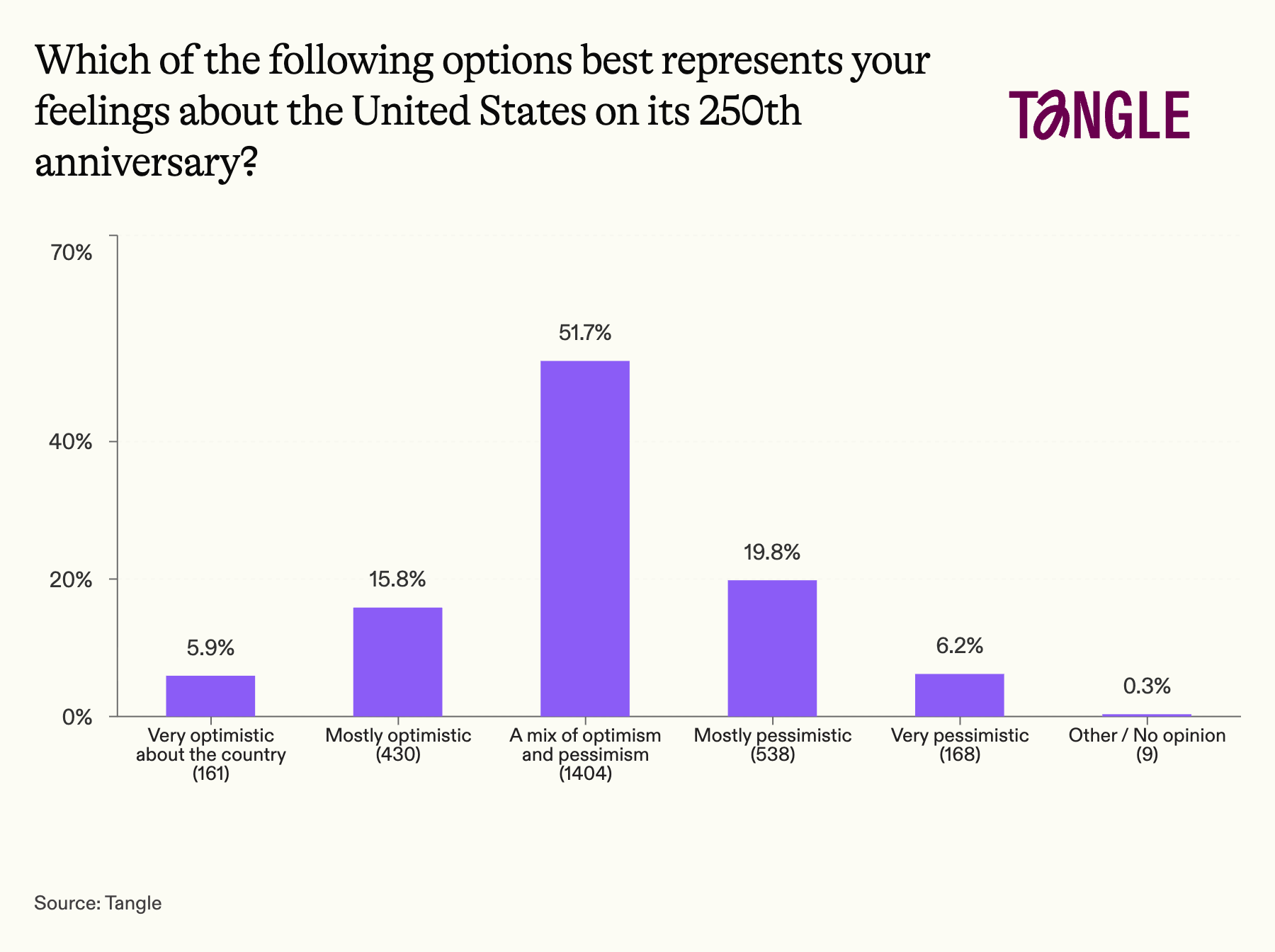
- Our last survey: 2,714 readers responded to our survey on America’s 250th anniversary, with 52% saying they feel a mix of optimism and pessimism about the country. “I don’t expect the U.S. to be a world power for much longer,” one respondent said. “It is still the greatest country in the world,” said another.
Have a nice day.
Lilyan Lauzon, an artist and bookstore community engagement manager in Minneapolis, Minnesota, wanted to give exposure to new artists in the area but was finding it challenging. Then, she had an idea: set up a vending machine in the bookstore, solicit submissions from local artists, and create the $1 Mini Art Vending Machine. Selected artists pay no fee, and buyers’ money goes directly to the artist. In eight months, the machine has featured nearly 3,000 pieces by over 80 local artists. “Artists have told me that people have come to their art fairs to buy more of their artwork because of what they got in this snapshot of their portfolio,” Lauzon said. CBS News has the story.

Member comments