




Today’s read: 7 minutes.
Dear readers,
As we celebrate America’s 250th anniversary, much ink will be spilled about where we are as a nation: what we’ve overcome, what’s broken, what works, and where we’re going.
Like many Americans (and American writers), I’ve been ruminating on this anniversary from many angles. But today, my mind is stuck on one specific part of our country’s story: The freedom of the press, and the power of the “publish” button.
I don’t take it for granted that I have the ability to immediately reach half a million readers directly, and millions more indirectly, at any moment, with a few clacks on the keyboard and a couple clicks of the mouse. Despite the ease of that feat, it was never guaranteed — not technologically, culturally, or legally — until very recently. Few of us have taken time to reflect on how we got here, why we’re here, and how important it is to spend the next 250 years keeping the spirit of the American press and press freedom alive.
Tangle, like all daily news publications, descends from Acta Diurna (“daily acts”), the posted announcements of political and social events in Rome. Starting in 59 BC, these notices were often carved into stone or metal and alerted the citizenry to the happenings of the government. Despite serving as an act of transparency — and functioning as a new democratic norm — Acta Diurna were distinct from today’s news outlets in an important way: They were authorized narratives of the government, first ordered by Julius Caesar.
Still, every newspaper and form of mass media can trace its origins back to this practice, though the posted notices would evolve over millennia into myriad new formats and media. By the 17th century, the Dutch had “corantos” (currents of news), which pulled together foreign journals and translated them for the country’s citizens. Rudimentary newspapers were popping up across European countries and Japan at this time, too. In 1621, the first English corantos appeared in London, and by 1702, The Daily Courant was publishing, well, daily.
But it was never easy.
For decades, England maintained a stranglehold on the press through a licensing system, which prohibited any new publication from popping up without a government license. The idea that an American newspaper today would have to apply to the United States government to publish is, of course, abhorrent and offensive for most people. But it was the norm until 1695.
John Milton, widely credited with developing the concept of the “marketplace of ideas,” (though the phrase would not be coined until much later) was a key challenger to the practice of licensing. He argued, forcefully, that individuals were capable of using reason to assess right and wrong, and that having unfettered access to the ideas of others was central to a well-ordered society. The system in which the government could choose who could publish and criminalize criticism of itself was self-evidently broken in Milton’s eyes.
Across England, journalists spent most of the 18th century fighting for the right to put pen to paper — without oversight — about their leaders. Parliament treated the publication of its debates as a breach of privilege, arguing that its members should be able to speak freely behind closed doors without fear of their words being reported or distorted outside the chamber. When printers published those proceedings, they’d often get fined, imprisoned, or hauled before the chamber to be reprimanded publicly. Some printers got creative, publishing “fictionalized” accounts of what was happening behind closed doors to avoid the bans, while making it clear they would not so easily put their pens down.
In 1771, John Wilkes, an alderman of the city of London, a former and future member of Parliament and a British radical, sparked a legal standoff by protecting printers inside London’s own jurisdiction. He refused to hand over the printers to Parliament for punishment while encouraging them to continue publishing, and the House of Commons responded by imprisoning city officials. This, predictably, only intensified public furor and ignited more support for press freedom.
As that support exploded, and in the midst of the legal obstruction organized in London, Parliament folded. Rather than repeal a legal ban on publishing accounts of parliamentary proceedings, Parliament simply stopped enforcing it. The printers (and public) had won, and press freedom advanced, sparking a crop of new newspapers across Europe. Today, we might expect and accept that certain government meetings will happen behind closed doors, but we demand (and receive) access to the happenings of Congress and regularly have reporters fleshing out the back-door deals with leaks, recordings, and deeply sourced reporting. This precedent can be traced back to the era of the Parliament printers.
It was nearly a century earlier when the first American newspaper, Publick Occurrences Both Forreign and Domestick, published its first edition in 1690. Publick Occurrences lasted exactly one issue before colonial authorities shut it down for printing unlicensed content. A few decades later, James Franklin, the brother of Benjamin Franklin, helped launch both The Boston Gazette and The New-England Courant, setting off a kind of news frenzy in the colonies.
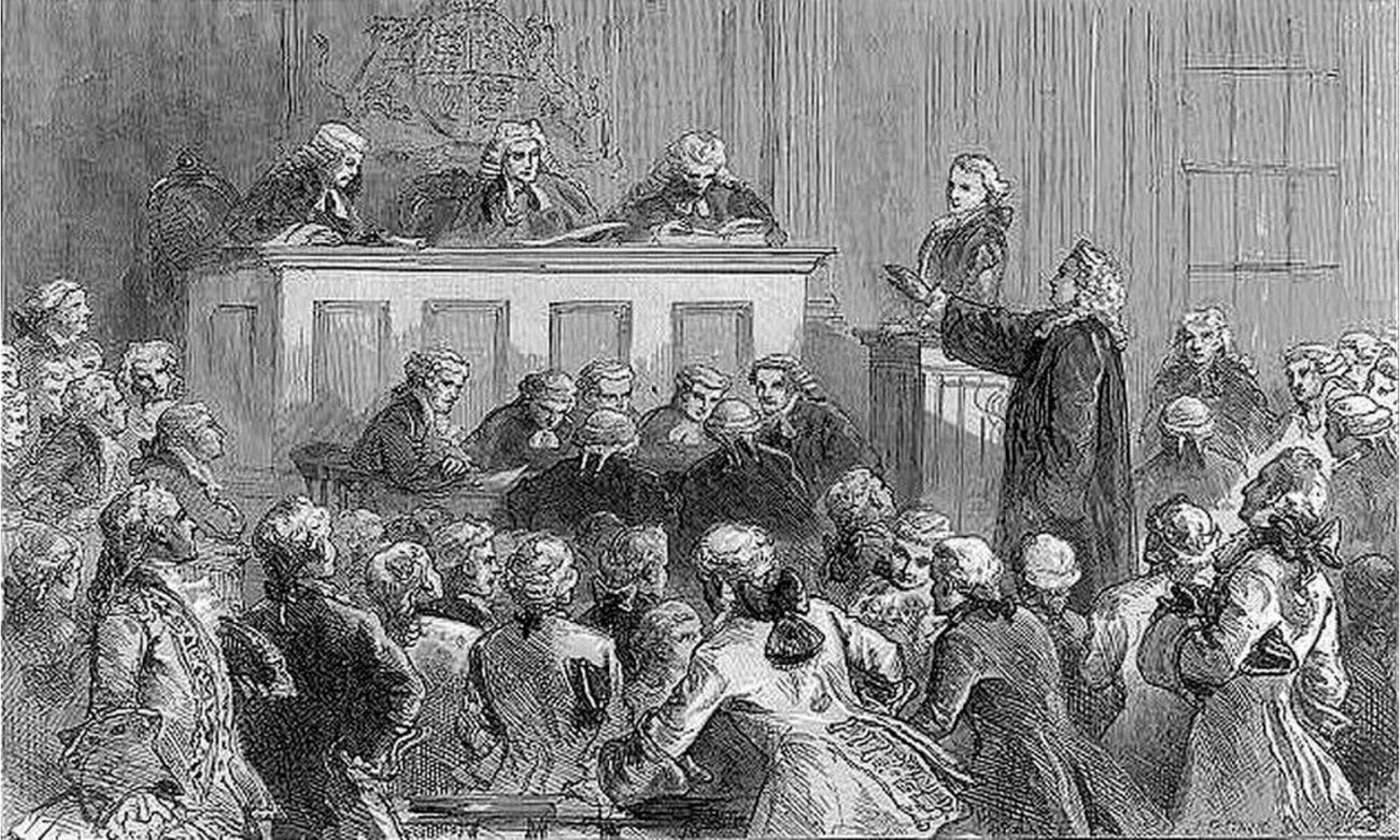
In 1734, a convoluted political battle ended with seditious libel charges against John Peter Zenger, the publisher of The New York Weekly Journal, which was regularly critical of then–New York Gov. William Cosby. That crime was different from modern-day libel; it was defined as the “intentional publication, without lawful excuse or justification, of written blame of any public man or of the law, or any institution established by the law.” Imagine a world where blaming a public official for wrongdoing in print was a crime, regardless of whether your accusations were true.
Though two grand juries were summoned, both refused to indict Zenger, forcing Gov. Cosby to turn to more extreme measures. Initially, he ordered a ceremonial burning of the publication's papers, an order the popularly elected assemblymen refused. The governor then demanded a sheriff burn the papers; upon receiving his orders, the sheriff sought authorization from a court of aldermen. The court adjourned without granting an authorization. The sheriff ended up handing the papers to a servant, who burnt them without an official sanction, making the episode a public embarrassment for Cosby. Since his initial plan failed, Cosby resorted to an unusual and highly unpopular legal procedure to move forward in prosecuting Zenger without a grand jury indictment.
Zenger pleaded not guilty and, while awaiting trial, spent months in prison. The jury’s sole task was to determine if Zenger was responsible for the libelous statement. His lawyers tried to get the case thrown out by challenging the appointment of the judges overseeing it, and instead were themselves barred from practicing law in the court. John Chambers, a Cosby loyalist, was appointed to represent Zenger, but Chambers defied expectations by doing the work honorably. The case eventually drew the attention and the help of a preeminent colonial attorney named Andrew Hamilton.
In the final days of the trial, a remarkable moment unfolded: Chambers argued that the prosecution could not prove who was responsible for the libel and that the attorney general would not present evidence to prove it was Zenger. Then Andrew Hamilton rose on behalf of Zenger and pre-empted the attorney general’s case: He admitted that Zenger published the journals as alleged, but told the jury they must consider the fact that the statements Zenger published were the truth. Famously, Hamilton addressed the jury:
The question before the Court and you, Gentlemen of the jury, is not of small or private concern. It is not the cause of one poor printer, nor of New York alone, which you are now trying. No! It may in its consequence affect every free man that lives under a British government on the main of America. It is the best cause. It is the cause of liberty.
The chief justice tried to insist to the jury that it only consider whether Zenger had published the offending issues of The New York Weekly Journal, but Hamilton’s words were impossible to unhear. The jury found Zenger not guilty, and the idea that truthful statements could be exempt from charges of “libel” was officially a seed planted in American soil. It would grow like wildflowers.
But it was the 19th century that truly formed the media ecosystem we are operating in — or departing from — today. In the early 1800s, most newspapers had circulations in the low thousands and were primarily read by wealthy, educated Americans. When Benjamin Day launched the “penny paper” in New York City in the 1830s, thousands more Americans could suddenly access the news. Then some names you might still recognize began to pop up:
The Associated Press arrived in 1846. An independent paper called The New York Times launched in 1851, and was widely known for being less flamboyant and sensational than its peers. Paul J. Reuter began serving newspapers in 1858 from London. By mid-century, 400 dailies and 3,000 weekly newspapers were smattered across the United States, each protected by the First Amendment’s promise that the government could not infringe upon the freedom of the press — and each descendants of Hamilton’s promise that protecting a free press was inseparable from the cause of liberty.
It wasn’t until the late 19th century that Joseph Pulitzer and William Randolph Hearst were also competing for readers, and by then the first newspapers were circulating 500,000 copies (roughly the audience of this newsletter), all nearly 2,000 years after the Acta Diurna were being passed around on slabs of stone.
So it’s not lost on me that I get to write this essay, press send, and reach as many (or more) people than some of the most prolific names of journalism ever did.
It’s also not lost on me that I get to do this job in an era where my work, and the work of my colleagues, is better protected than ever. In other countries, and sometimes here in the U.S., journalists still go to prison for their writing or get killed in war zones while reporting. President Trump is notoriously litigious with the media. But these events are front-page news when they happen because, contextually, they are now quite unusual.
Many Americans I’ve spoken to have adopted a notion that we are in the most dreadful days of the American media. On the one hand, I get that impulse. As we ring in 250 years of these United States, the press is facing historically low trust, it is fractured and segmented, and it’s facing challenges from every direction: the rise of influencers, attacks from the president, the advent of artificial intelligence, and financial struggles.
But on the other hand, the press is rising to the moment. More people than ever in world history have access to and are consuming the news. New models of journalism — from independent newsletters to gonzo YouTube journalism to hedge funds as news outlets — are succeeding. The “fractured” media is also an accessible one; we’re less prone to being silenced or censored than we’ve ever been. You can no longer just burn the paper my words were printed on to shut me up. Take away my TV show and I’ll take it to X. Ban my X account and I’ll go to YouTube. Throttle my YouTube channel and I’ll start a newsletter. Bury my newsletter and I’ll launch a texting service.
Despite so many people pining for the days of trusted legends like Walter Cronkite, every era of the American press has been marred by threats of censorship, sensationalism, misinformation, partisan hackery, and error. All one needs to do is observe a brief moment in the 16th-, 17th-, 18th-, 19th-, and 20th-century experience to choose the 21st century as the most ideal time to be producing or consuming the news — without hesitation. The institution isn’t just still strong with robust freedoms, it’s the strongest and most protected it has ever been, even if the very real threats to the press today are different than those of recent memory.
Of course, the downside of all these options is that it’s also very easy for people to just hunt down the outlet that confirms their priors. This is, of course, part of why I started Tangle: To get people out of their echo chambers and information silos. But the upside is far greater: No one newspaper tycoon, television network, or radio station is in control. Nor is a single, or even a group of, social media platforms. Governors can’t and won’t order the mass burning of newspapers when they face harsh criticism, then imprison publishers when all else fails. We are free to speak, report, write, criticize, and be as loud-mouthed and bloviating as we want — sometimes to our own detriment.
Conspiratorial, partisan hackery is easy to see as a cancerous tumor on our society, but it’s harder to recognize as the byproduct of a free and open ecosystem. The liars and snake-oil salesmen with massive platforms frustrate but also comfort me. They are a callback to the days of yellow journalism and a reminder that there is no parliament or king or lord coming to knock down my door and drag me to jail, whether I’m speaking truth plainly or sensationally.
So as we carry the torch of our professional ancestors into the future, and as we celebrate our 250th birthday, I’m thinking today about the men and women who came before me whose wisdom and sacrifice I want to draw on. Here at Tangle, we are striving to be a news outlet as affordable and accessible as the Penny Papers, with a Miltonian devotion to the marketplace of ideas, a Hamiltonian promise of free speech guaranteeing liberty, and a Wilkesian commitment to the notion that our government owes us transparency. These virtues aren’t just timeless but wise — and perhaps more relevant now than ever.
So, a happy Fourth of July to you all, a happy 250th to this great country, and a toast to 250 more years of a fearless, free, and informative press.
Best,
Isaac Saul, Executive Editor
P.S. As part of our 250th celebrations, we are (right now!) offering 25% off our yearly newsletter membership. If you want to unlock all our content, support this work and help us continue to fight for a free press into the future, take advantage!
Supreme conversation.
On Thursday, Kmele Foster and I got to sit down with Sarah Isgur — the attorney, political commentator, author and Supreme Court expert — to talk about the latest Supreme Court term and its long-term implications. You can watch the episode here:
Our interview with Sarah Isgur


Member comments