





Happy Monday. I’m Isaac Saul and today, I’m feeling the American pride. On Friday, I wrote about the history of press freedom in the U.S. On Saturday, I had an old-fashioned, Americana Fourth of July, complete with barbecue and a small-town fireworks show. Today, I’m contemplating the significance of America’s 250th anniversary. And tonight, we get another chapter in the USA World Cup journey. Huzzah!
We’ve also got a reader question about the United States Triumphal Arch, a story you may have missed about gun regulations being rolled back, and a request for you to vote in a very special election. It’s a 14-minute read.
Vote for Tangle!
We’re nominated for the 2026 People’s Choice Newsletter Awards, and we’d appreciate it if you could take a moment and cast a vote for us. It’s quick and easy (just be sure to confirm your vote in your email after you submit the form) — the link to vote is here.
Quick hits.
- Iran held a public funeral for Supreme Leader Ayatollah Ali Khamenei, who was killed in U.S.–Israeli airstrikes on February 28. Khamenei’s son and Iran’s new supreme leader, Mojtaba Khamenei, was not seen, adding to speculation about his health. (The funeral)
- FIFA, soccer’s global governing body, lifted the red-card suspension of United States men’s national team player Folarin Balogun after President Donald Trump intervened on his behalf. The decision allows Balogun to play in the team’s World Cup match against Belgium on Monday. (The intervention)
- Venezuelan authorities said that the death toll from two earthquakes that hit the country on June 24 has risen to 3,342 as of Sunday. (The update)
- President Trump spoke separately with Russian President Vladimir Putin and Ukrainian President Volodymyr Zelensky amid heightened attacks by each side in recent weeks. (The calls)
- State Sen. Mallory McMorrow (D) suspended her campaign for Michigan’s Senate seat. The decision leaves U.S. Rep. Haley Stevens and epidemiologist Abdul El-Sayed as the top candidates for the Democratic nomination in the key Senate race. (The announcement)
22 Things To Cut When Living On Retirement (Many People Ignore #11)
Whether you’re already enjoying retirement or just eyeing the exit ramp, the math of a fixed income can feel like a daunting puzzle. The rising cost of living often turns "relaxing" into "calculating," but your golden years shouldn’t be defined by what you can’t do.
The good news?
You don’t need a radical lifestyle overhaul to find breathing room. Often, it isn't the big-ticket items that drain a nest egg; it’s the steady drip of outdated services and inefficient accounts.
Efficiency isn't about deprivation — it's about intentionality.
Our partner FinanceBuzz curated a list of simple cutbacks and financial tools to help you reclaim your budget for what actually matters.
Today’s topic.
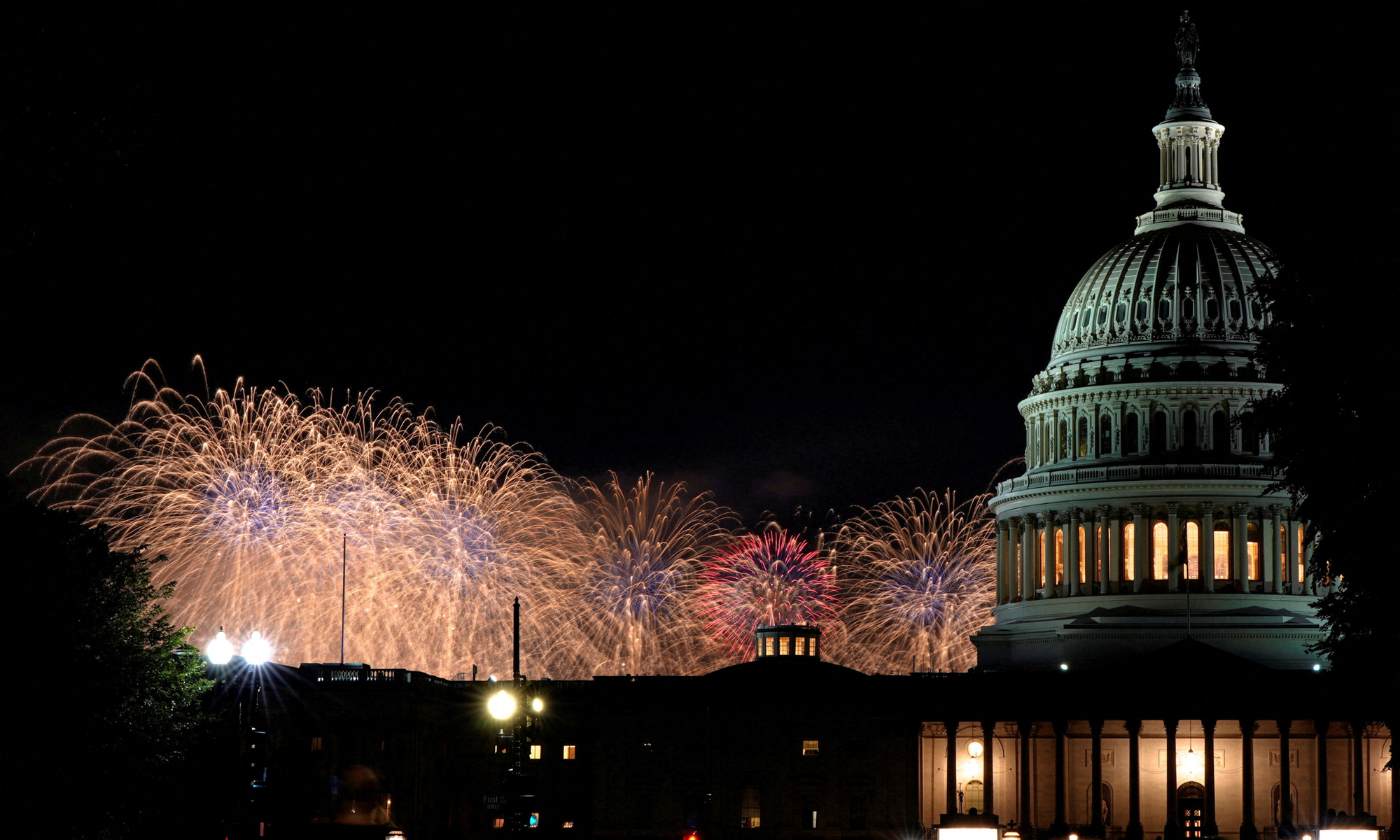
America’s 250th anniversary. On Saturday, the United States marked 250 years since the Second Continental Congress adopted the Declaration of Independence on July 4, 1776, establishing the original 13 American colonies as a new, independent nation. In addition to the traditional fireworks and parades, cities and states held special celebrations reflecting on the country’s history for its semiquincentennial. In Washington, D.C., large crowds gathered to celebrate across the capital. While some of President Donald Trump’s “Salute to America” event was canceled or delayed due to extreme weather — including a temporary evacuation of the National Mall — the president delivered an address on the Mall, followed by a massive fireworks display.
In his address, President Trump highlighted the United States’s achievements through its first 250 years, painting an optimistic picture of its future as well as attacking some of his political enemies. “This country has been the greatest force for peace and justice on earth in the last century. We defeated tyrants, demolished evil, and saved freedom again and again and again,” Trump said. The address also focused on political topics, with the president renewing his call to pass the SAVE America Act, touting his military actions in Iran, and decrying the purported rise of communism in the United States.
The celebrations in Washington, D.C. were also marked by controversy after a large group identified as members of the white nationalist organization Patriot Front marched through neighborhoods around the Capitol, chanting “reclaim America.”
Separately, the anniversary prompted reflections on political polarization and national unity. Some criticized President Trump for creating a separate group — Freedom 250 — to arrange celebrations for the anniversary instead of working through the nonpartisan America250 organization established by Congress in 2016. Others expressed concern about whether the country is capable of overcoming internal divisions in the years ahead.
Today, we’ll share perspectives from the right and left on America’s semiquincentennial, followed by Executive Editor Isaac Saul’s take.
What the right is saying.
- The right celebrates the anniversary, reflecting on the symbolic importance of the United States to the world.
- Some contrast President Trump’s vision for the country with that of the democratic socialist movement.
- Others argue America remains the greatest country in the world despite its flaws.
In his Substack, Erick-Woods Erickson praised “the greatness and uniqueness of the United States at 250.”
“The only people who don’t seem to want to be Americans anymore are progressives in the Ivy League madrasas and, increasingly, a slice of the online right that has convinced itself we’d all be better off apart. They’re both wrong, and history proves it,” Erickson wrote. “Read the Declaration of Independence for yourself. What strikes you is that these were not bloodthirsty radicals. They didn’t want something new… They thought they already had these rights, and Great Britain, in its arrogance, told them they were second-class colonists who didn’t deserve them. So they fought for what they believed was already theirs.”
“We are the only nation founded on an ideal. Not blood, not soil, not a king’s bloodline — an idea. That all men are created equal, endowed by their Creator with certain unalienable rights, among them life, liberty, and the pursuit of happiness,” Erickson said. “The shot heard round the world really was heard round the world. Go read the monument at the entrance to the parliament of Trinidad and Tobago — it echoes our Declaration almost word for word. Nations you’ve never thought about built their own foundings on ours.”
In American Greatness, Roger Kimball wrote “America’s story is cast as either triumphant inheritance or unfinished grievance.”
“All across the world, spectacular light shows, fireworks, and other red, white, and blue extravaganzas have rung out their grateful and congratulatory chorus. And quite right, too. For the Declaration marked the opening foray of what would become the greatest country the world had ever seen,” Kimball said. “Others were more astringent in their reaction. On Friday, July 3, Zohran Mamdani, New York City’s smiling Uganda-born mayor, sat in front of George Washington’s desk in the mayor’s office at City Hall and delivered a dark admonition.”
“The irony is, Mamdani said, ‘that the story of America has so often been written by those who were told by others with power and influence and wealth that they were anything but exceptional.’… It’s Us versus Them, Comrade, and class warfare must go on forever,” Kimball wrote. “Donald Trump, speaking that same day at Mt. Rushmore, provided another, very different vision… He [noted] what a magnificent anniversary this was: imagine 250 years of extraordinary prosperity, martial vigor, and unparalleled generosity to others.”
In Townhall, Rep. Abe Hamadeh (R-AZ) said “America is worth fighting for.”
“America is not perfect. It never has been. But perfection has never been our promise. Opportunity has. Only in America could a first-generation son of Syrian immigrants, born right here in the United States, grow up with nothing more than his parents’ faith in the future, serve as a U.S. Army Intelligence Officer, and one day stand on the floor of the House of Representatives to take the oath as a Member of Congress,” Hamadeh wrote. “My story is proof that the American Dream is not a slogan. It is a living promise.”
“Too often today, the media and those who hate our country ask us only to dwell on its perceived shortcomings. We are told to apologize for our history rather than celebrate it. We are taught to focus on what divides us instead of what unites us. But gratitude and patriotism are not signs of ignorance,” Hamadeh said. “Travel the world, as I have, and you quickly realize just how extraordinary the United States truly is. Billions of people do not dream of coming here by accident. They come because America remains the greatest engine of freedom, opportunity, and human flourishing ever created.”
What the left is saying.
- The left also celebrates America’s 250th, with many sharing an optimistic view for the future despite the present challenges.
- Some argue the patriotism represented by Trump deviates from the nation’s founding ideals.
- Others explore key questions for the country in its next 50 years.
In The Washington Post, David Ignatius offered “a toast to America at 250.”
“If we’re honest on this July Fourth, we must admit that the sturdy American men and women who made the revolution are a distant historical memory. Today, we resemble the imperial Britain of 1776 more than the scruffy patriots who rebelled against it,” Ignatius wrote. “At 250, America is a nation in late middle age showing unmistakable signs of decline. Our political system is broken, and our politicians seem unable to solve big social or economic problems… Our social cohesion has unraveled so much we often feel like two nations rather than one.”
“And yet, as [the poet Robinson] Jeffers wrote, America retains ‘a mortal splendor.’ Beyond the Washington tar pit, Americans remain willing to take risks and fail, and know how to fall and get up again. We’re a muscular nation that weirdly seems to grow tougher as it ages. We still invent the best technology, make the best movies, record the best music. We may elect dreadful leaders, but we survive them,” Ignatius said. “We’ve had good leaders and terrible ones, but each year, whatever the adversity, we remember what this story is about. And we think how lucky we are, still, to be part of the American story.”
In his Substack, Robert Reich explored “the real meaning of July 4, 2026.”
“On this July 4 — the 250th anniversary of the start of this country — many people, including the current occupant of the Oval Office, believe that celebrating America means waving the flag or standing for the national anthem or shouting, ‘America First.’ That’s not what real patriotism is,” Reich wrote. “It means paying taxes proportional to your wealth… It means paying your workers a living wage so they can thrive… It means fully reckoning with how racial oppression and white supremacy have shaped this nation, not whitewashing our history and ignoring racism’s continuing legacy.”
“Real patriotism means protecting American democracy and our form of government, not trying to overturn an election that was upheld by 60 federal courts and the Supreme Court, or lying about election fraud when it barely exists,” Reich said. “Real patriotism means not flooding our politics with big money, so the voices of the people can be heard… And it means putting the interests of our country over partisanship.”
The New York Times editorial board wrote about “five questions that will determine America’s next 50 years.”
“Asked what kind of government the framers had produced, [Benjamin Franklin] is said to have replied, ‘A republic, if you can keep it.’ The conditional part of that sentence — the if — comes fresh to every generation, and it is now the work in front of us,” the board said. “The work will most likely come down to a handful of questions whose answers are genuinely uncertain. The first question is whether self-governing people still share a common reality… The second is whether we can still bear to lose. Self-government is, in part, a system for handling disagreement without bloodshed, and its indispensable habit is the willingness of the defeated to accept defeat.”
“The third is whether the country can still keep its central material promise that those who work can rise and that their children can rise further… The fourth is the oldest American question in its newest form: whether the most pluralist nation in history can remain one people,” the board wrote. “The fifth question is about the future, about whether we can pass tests that unfold slowly and yet ask for sacrifice now. A dangerously changing climate presents one of those tests. Another involves debts handed to people who never voted on them.”
My take.
Reminder: “My take” is a section where we give ourselves space to share a personal opinion. If you have feedback, criticism or compliments, don't unsubscribe. Write in by replying to this email, or leave a comment.
- America remains a unique and exciting country, and taking in this year’s World Cup reminds me of that.
- The weekend also offered speeches that I appreciated from political leaders on both sides.
- We can hold both pride and cynicism at once while honoring our founding story.
Executive Editor Isaac Saul: On this great anniversary, it is hard not to be of two minds.
The positive case is almost always easy for me to see. Anyone with even a rudimentary understanding of world and U.S. history knows that our country is uniquely significant, awesome, and aspirational. We talk about being the richest nation on earth, but that wealth is really a byproduct of centuries of innovation, labor, and resilience. We talk about being the most powerful nation on earth, but that power comes from balancing might with diplomacy. We talk about being the most free, but those freedoms don’t just come from a document — they really are held, and have been earned, by the people themselves.
I don’t want to overindex on my sports devotion, but I have to say the timing of the World Cup has created a serendipitous tie-in for this 250th anniversary. Sports don’t always have to have some great meaning, and despite being a sports junkie, I often roll my eyes at attempts to inflate competition for entertainment into something much deeper. Yet it’s difficult to be tuned in to the World Cup and not feel a sense of pride in America.
In all likelihood, at least dozens, if not hundreds, of people from every single country in the world reside in the United States, something that is probably true of only a handful of countries on Earth. Or, as The New York Times put it, “In the United States, Every World Cup Team Is a Home Team.” Bosnians rejoice at a watch party in St. Louis, Missouri. Moroccans gather in the Little Morocco neighborhood in Queens. Japanese fans come together in San Diego. Iranians (in complicated fashion) watch, rejoice, or protest their team from Los Angeles. In Provo, Utah, Messi-mania took over as fans gathered to cheer on Argentina.
My social media feed during the tournament has been a never-ending tour of “things that make me proud”: The University of Kansas band learned the Algerian national anthem to welcome the team for training. The Spanish national team released a beautiful tribute to Chattanooga, Tennessee. A Japanese tourist tried Dallas barbecue for the first time and had his mind blown. Perhaps the coolest, most imposing, most gifted striker in all of soccer is embracing his Texas spirit. A German man broke down on local TV describing how incredible America has been. Even the controversy — an apparent behind-the-scenes pressure campaign led by President Trump to overturn a U.S. player’s controversial red card — gives me a wry smile. What is America but a blunt-force instrument to reverse injustice?
The world, soccer tourists, and American citizens themselves are learning that behind the big scary headlines and partisan warfare, America is more welcoming than almost any place on earth. We’re used to different — different languages, different colors, different attitudes, different faiths, different people. And the truth is that with a little bit of cash, you can show up here from anywhere on earth, rent a car, tour the country, meet tons of strangers who become fast friends and have a delightful, carefree time.
Even our politics had a relatively normal — if not inspirational — weekend. President Donald Trump and New York City Mayor Zohran Mamdani, two of the most influential elected officials on the right and left, each delivered remarks on the anniversary. It was a remarkable thing, as an American, to read both of their July 4 speeches and feel pangs of pride at each. Some moments made me wince, of course: Trump warned of communism in the water, misquoted the Declaration of Independence, and couldn’t help but riff about a stolen election and his political opponents. Mamdani needlessly stoked the embers of class warfare, invoked warnings of an authoritarian regime, and centered ethnic and religious minorities as the Americans to celebrate.
Yet, both emphasized the “exceptional” nature of our country — and the need for us to keep striving to improve. Both retold the revolutionary “underdog” story of the founders. Both centered George Washington in their visions of America at its best. Both ruminated on the idea that all men are created equal. Both spoke to the need for a triumph over tyranny and for liberty to defeat oppression.
I took comfort in that shared rhetoric, even if I cringed at times. The addresses offered welcome surprises, like Trump celebrating the first African-American to win a Medal of Honor and Mamdani proudly retelling the tales of military battles won.
I hold all this and feel a sense of pride, and gratitude, for the sheer luck and good fortune of being born into such a place. Yet it’s hard not to be cynical, too.
The same president celebrating our break from kings and lords is gathering obscene amounts of power — the kind that would give our founders a heart attack — bringing in $2.2 billion in the first 18 months of his second term, much of which came from an extraordinary level of self-dealing and corruption. The left (including Mamdani) is backing a soon-to-be member of Congress who has opposed borders, police, interracial relationships, and has called America a “fucking disgrace.” Postliberal right-wingers are responding to a Supreme Court case by pondering banning pregnant women from traveling here or sterilizing foreign visitors. The richest man in the world is using his self-purchased social media platform to insist that he’s “wised up” about universal suffrage and the threat of classical liberalism, a system of thought valuing individual liberty, free markets, and the natural rights of man. Pardons are for sale, and so — seemingly — are elections. Literal white supremacists are marching through neighborhoods in Washington, D.C. Even the World Cup tales are more complicated than my feel-good narrative suggests. Ordinary fans from Haiti, Iran, and Senegal couldn’t attend matches in the U.S. due to a travel ban on their countries. A top referee from Africa was denied entry in Miami despite a valid passport and visa, and some African fans avoided the U.S. altogether for fear of being detained — instead opting to only attend games in Mexico and Canada.
I consume all this news and wonder if I’m holding onto an illusion about some great thing that was but no longer is. There are moments, frankly, when it’s easy to submit to the cynicism.
But then I remember how much of that feeling is rooted in some twisted human desire to be experiencing something historic, even — or especially — historically bad. We talk about today’s political violence as if nothing in America has ever come close, as if the 1960s — or the 1860s — just didn’t happen. Brains go haywire over a 6–3 Republican-appointed Supreme Court, as if we haven’t survived the post-Truman and Roosevelt Court (9–0 Democratic-appointed) or the 8–1 Republican-appointed Court that existed as recently as 1992. Is confidence in elections plummeting, especially among Americans? Yes. But go back to Bush vs. Gore in 2000, or transport yourself to 19th-century America (when elections were actually being tampered with at scale), and you’ll realize this seemingly novel period is not entirely so.
The truth, whether it’s comfort or caution, is that in our relatively brief 250 years as a nation, we have always faced challenging bursts of tumult, controversy, corruption, war, and division. These features might just be natural byproducts of a free, pluralistic society, because they exist in every chapter of our American story. Yet that story remains one of extraordinary triumph, success, and bittersweet change. So long as we cling to the principles we celebrate this week, and keep a level head going forward, I suspect the next 250 years will bring much more of the same. And, honestly, thank goodness for that.
Take the survey: How do you feel about America on its 250th birthday? Let us know.
Disagree? That's okay. Our opinion is just one of many. Write in and let us know why, and we'll consider publishing your feedback.
Your questions, answered.
Q: Can Tangle provide a balanced report on the proposed Arc de Trump? The project has raised questions about historic preservation, environmental review, legal authority and public safety, and I’d appreciate an objective overview of the competing arguments and where the proposal currently stands.
— Michael from Pasco, WA
Tangle: In October 2025, President Trump unveiled models for a monument in the neoclassical style to be built in celebration of the United States’s 250th birthday, called the United States Triumphal Arch (and nicknamed the Arc de Trump). The 250-foot structure would be located inside a currently empty traffic circle at the end of the Arlington Memorial Bridge, just south of the Potomac River.
A National Park Service (NPS) assessment says the arch will be installed “in a manner consistent with the avenue’s established role as a ceremonial gateway and ‘Avenue of Heroes’ celebrating valor, sacrifice, and American heritage.”
However, according to the most recent polling, Americans disapprove of the administration’s plan by a roughly two-to-one margin. In February, a group of Vietnam War veterans sued to stop the construction, arguing that placing a structure more than twice as tall as the Lincoln Memorial near the Arlington National Cemetery would “dishonor their military and foreign service.” In June, protesters gathered outside the National Capital Planning Commission (NCPC) to express concerns over the monument’s design and placement near Ronald Reagan National Airport (the Federal Aviation Administration recently found no adverse impacts in an initial review). House Democrats have also introduced a bill to stop construction. The NPS assessment drove other concerns over potential traffic delays and an intense construction period.
In May, the Commission of Fine Arts, a seven-member panel appointed by President Trump, gave the arch’s design final approval. In June, the National Capital Planning Commission (NCPC) reviewed the NPS assessment and requested more information on the arch’s specs and potential impacts. The NCPC is scheduled to hear comments and potentially vote at its meeting on Thursday, July 9; public comment is open until Wednesday. To proceed with construction, the plan must receive the NCPC’s approval and overcome the legal challenges against it.
Want to have a question answered in the newsletter? You can reply to this email (it goes straight to our inbox) or fill out this form.
Under the radar.
On Sunday, The New York Times reported that the Trump administration is rolling back over three dozen firearms regulations implemented during the Biden administration. The rescinded regulations include rules that had lowered the legal threshold for revoking a firearms dealer’s license, restricted access to would-be buyers with a history of mental illness or inability to manage their own finances, and barred certain accessories that have been used in mass shootings. The president of the Brady Campaign to Prevent Gun Violence said the rollbacks will “decimat[e] [the Bureau of Alcohol, Tobacco, Firearms and Explosives’s] ability to regulate this industry,” while the Trump administration said the moves are part of the president’s commitment to upholding Second Amendment rights. The New York Times has the story.
Travel Europe, Your Way, With Tourlane
At Tourlane, we believe life’s too short for standard travel. Our local experts design custom European trips tailored to your preferences, with no generic packages.
Start with a free 30-minute call to get your personalized travel plan, with flexible booking options and transparent pricing every step of the way.
Tangle readers get 3% off bookings using code TRAVEL2026W.
Numbers.
- 38. The approximate length, in minutes, of President Trump’s speech on the National Mall on Saturday.
- 12. The number of times Trump mentioned “freedom” in the speech.
- 10. The number of times Trump mentioned “communist,” “communists” or “communism” in the speech.
- 30%. The percentage of U.S. adults who think America is the greatest country in the world, according to a June 2026 Reuters–Ipsos poll.
- 40% and 26%. The percentage of Democrats and Republicans, respectively, who think the United States will not exist as a single country 250 years from now.
- 40% and 59%. The percentage of U.S. adults who think America’s best years are ahead of it and behind it, respectively, according to a January 2026 Pew Research poll.
The extras.
- One year ago today we had just published Isaac’s essay on why he loves America.
- The most clicked link in our last regular newsletter was the report on heightened immigration enforcement activity.
- Nothing to do with politics: Check out the tall ships parade to celebrate America’s 250th.
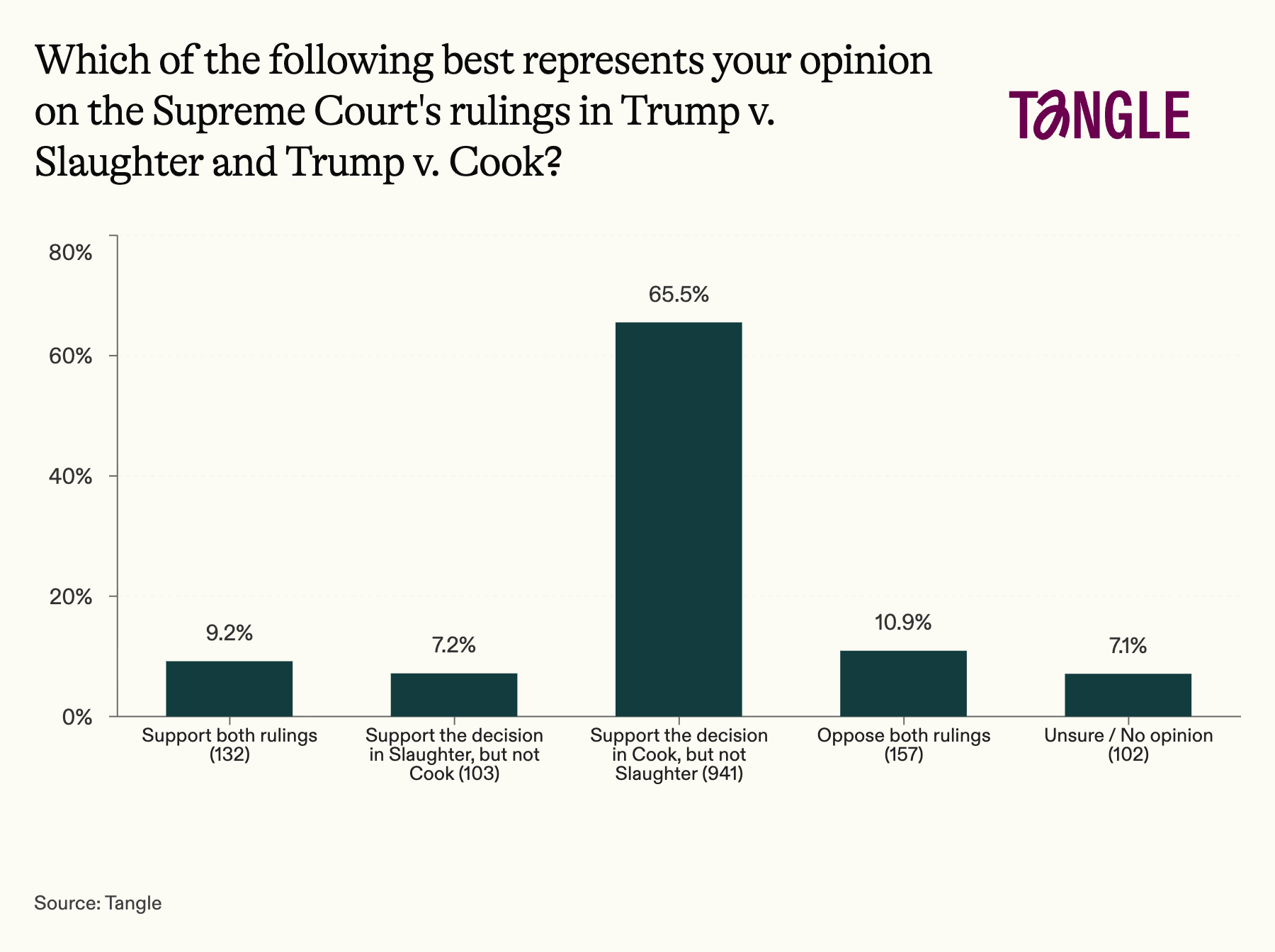
- Our last survey: 1,436 readers responded to our survey on the Supreme Court’s rulings on executive power in Trump v. Slaughter and Trump v. Cook, with 66% saying they support the decision in Cook, but not in Slaughter. “This Court is consistently inconsistent,” one respondent said. “This is an open and shut case. A president… has the complete right to fire someone that doesn’t follow their policy,” said another.
Have a nice day.
In April, the Josey family’s 13-year-old Shih Tzu, Apollo, disappeared after slipping through a gate at their property. The family searched for weeks to no avail, but they never gave up hope. In June, they got the call they were waiting for: A Long Island animal shelter said it had found Apollo after identifying him by his microchip. While some mystery remains — the dog arrived at the shelter wearing a name tag that read “Yuri” — the family has now been reunited with its beloved pet. “We definitely kept the faith, held out hope,” Vera Josey said. “We knew Apollo was gonna come home. It was just a matter of when.” FOX 35 Orlando has the story.

Member comments