






I'm Isaac Saul, and this is Tangle: an independent, nonpartisan, subscriber-supported politics newsletter that summarizes the best arguments from across the political spectrum on the news of the day — then “my take.”
Are you new here? Get free emails to your inbox daily. Would you rather listen? You can find our podcast here.
Today’s read: 11 minutes.
Yes, things are pretty bad right now...
On Friday, Executive Editor Isaac Saul published an opinion essay on his view about this current political moment: Things are pretty bad right now. The piece has now driven over 1,000 comments, the most in Tangle history. Later this week, a Tangle staff member will write a dissenting piece arguing a different perspective. Additionally, since Isaac’s piece was aggregated by some other news outlets over the weekend, we’ve decided to drop the paywall so all Tangle readers can access it. You can find the piece here.
Quick hits.
- President Donald Trump began the first leg of a five-day Asia trip in Malaysia, where he participated in a regional summit of Southeast Asian nations and announced preliminary trade agreements with Malaysia, Thailand, Cambodia, and Vietnam. Trump plans to meet with newly elected Japanese Prime Minister Sanae Takaichi on Monday. (The trip) Separately, the United States and China announced the framework of a trade deal, which President Trump will discuss during a meeting with Chinese leader Xi Jinping later this week. (The announcement)
- Argentinian President Javier Milei’s La Libertad Avanza party won approximately 41% of the vote in the country’s national elections. The party outperformed polling expectations following months of protests against his administration’s spending cuts and the country’s economic challenges. (The vote)
- Two U.S. Navy aircraft crashed during separate incidents over the South China Sea. The Navy said both aircraft were performing routine operations, and all crew members were rescued. (The crashes)
- Defense Secretary Pete Hegseth ordered the USS Gerald R. Ford aircraft carrier to relocate from the Mediterranean Sea to the U.S. Southern Command region off of South America. Hegseth said the deployment will support the military’s efforts to “disrupt illicit actors and activities” in the region. (The order)
- Hurricane Melissa strengthened to a Category 5 storm, with maximum sustained winds of 160 miles per hour. The hurricane is expected to make landfall in Jamaica early this week. (The storm)
Today’s topic.
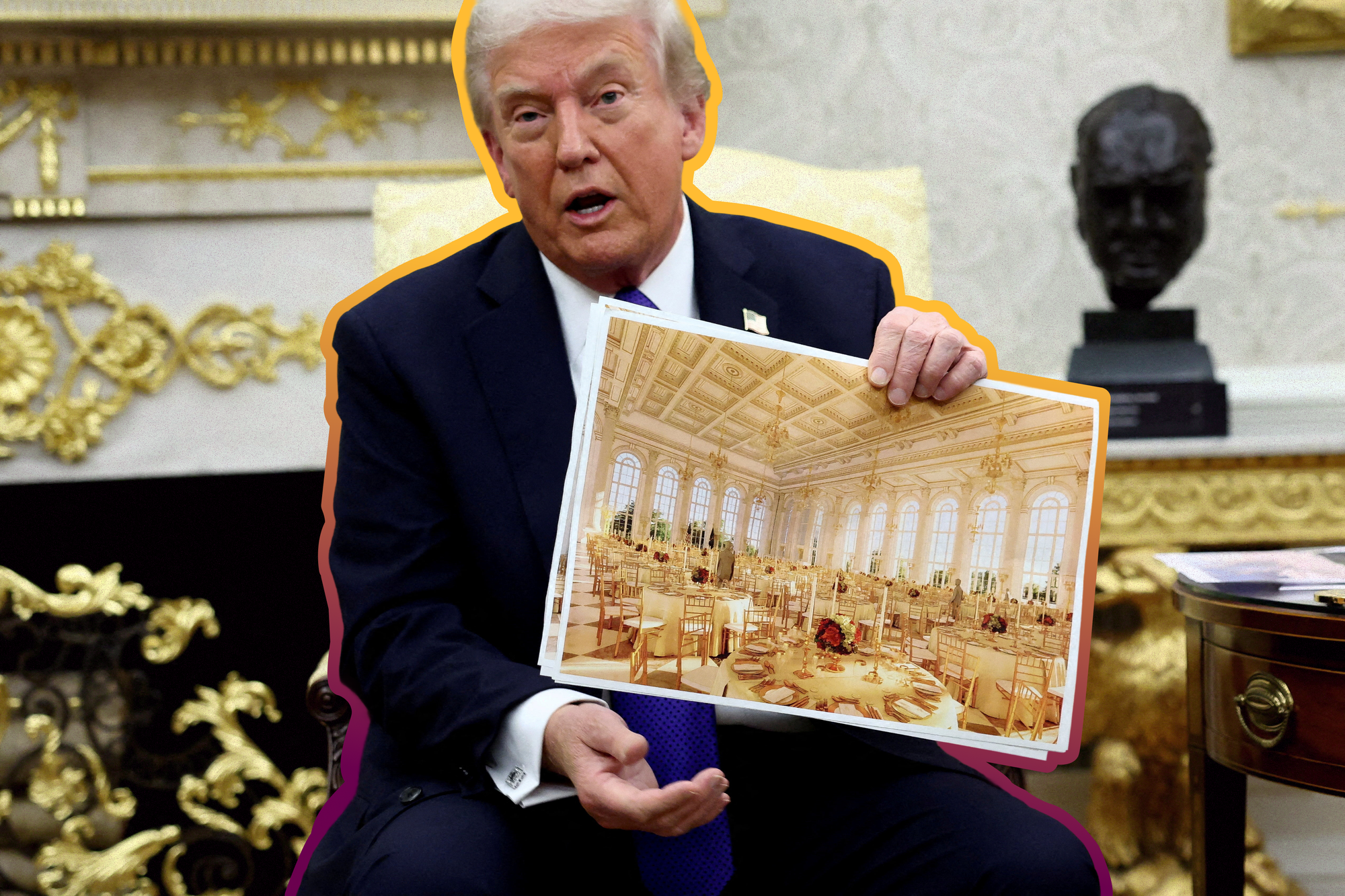
The East Wing demolition. Over the past week, construction crews have demolished the White House’s East Wing to make way for a new ballroom to host large events for world leaders and other guests. After initially saying the project would not impact existing infrastructure, President Donald Trump acknowledged on Wednesday that the entire East Wing would be destroyed; by Thursday, it was completely razed. The Trump administration says a new East Wing will be built along with the ballroom.
Back up: In July, President Trump unveiled plans to construct a 90,000-square-foot ballroom that would cost approximately $200 million. Trump also said the project would be funded entirely by himself and private donors (the White House has since released a list of 37 of those donors). White House Press Secretary Karoline Leavitt said the East Wing would be “modernized” as part of the construction process.
The White House is one of a few federal buildings, along with the U.S. Capitol and the Supreme Court, that are not subject to review under the National Historic Preservation Act, which assesses new construction projects impacting federal buildings. Instead, by law, the current renovation falls under the purview of the National Capital Planning Commission (NCPC). The NCPC board is composed of the chairs of House and Senate oversight committees; Washington, D.C. mayoral appointees; heads of federal agencies; and three presidential appointees. The Trump administration says it will submit its ballroom plans to the commission but contends the oversight panel does not have authority over the East Wing demolition.
The demolition has drawn criticism from Democratic lawmakers and some historians over its speed and scale. “It’s not his house. It’s your house. And he’s destroying it,” former first lady and Secretary of State Hillary Clinton wrote on X. In a statement, the Society of Architectural Historians said, “Such a significant change to a historic building of this import should follow a rigorous and deliberate design and review process.” Others have questioned the private funding structure and cost of the project, particularly after President Trump said the new estimated cost was “in the neighborhood” of $300 million.
In response to this criticism, the Trump administration published a list of White House renovations and additions under previous presidential administrations, including the building of the West Wing in 1902, the construction of the modern Rose Garden in 1962, and the refurbishment of the Executive Mansion in 1993. Leavitt attributed the change in initial plans to “counsel from the architects and the construction companies” that a more substantial construction project was required to build “a truly strong and stable structure.”
Today, we’ll share views from the right and left on the East Wing demolition and ballroom construction. Then, my take.
What the right is saying.
- The right mostly finds Trump’s project in line with past renovations.
- Some say the ballroom meets a real need for present and future administrations.
- Others criticize Trump’s disregard for the history of the East Wing.
National Review’s editors wrote “no, Trump isn’t destroying the White House.”
“This, to put it plainly, is a non-story, a freakout, a fiction spun from whole cloth,” the editors said. “As a general matter, there is nothing intrinsically wrong with a president making changes to the White House. Nor, for that matter, is there anything sinister about his approving complicated construction projects that involve the temporary removal of one of its walls. Over the years, presidents of both parties and of all leadership styles have done precisely this, and nobody has cared one whit.”
“There is nothing different — or even particularly interesting — about President Trump’s decision to replace a bunch of 1940s-era East Wing office buildings with a ballroom. Nor is it unusual for this alteration to have been paid for with private funds,” the editors wrote. “Adding a ballroom is not akin to ‘destroying’ the White House. Using mechanical diggers to prepare for renovations is not moving or scary or poignant or worthy of elevated emotions. Altering a modern part of the executive branch’s headquarters is not in any sense sullying ‘your house.’”
In The New York Times, Ross Douthat argued the demolition “needed to happen.”
“Trump being Trump, the ballroom project is proceeding without much external consultation and with a whiff of private-donor corruption. But many of the complaints from outraged liberals are more historical and aesthetic, accusing Trump of bulldozing American heritage to build something crass and gaudy in its place,” Douthat said. “And those arguments illustrate a consistent problem with progressive stewardship of American cities, which mixes admirable impulses toward aesthetic preservation with two related failures: a failure to make room for the necessity of substantial development and change and a failure to apply the same aesthetic sensibility to new developments that it applies to older ones.”
“It is simply good to build a White House ballroom; the presidency has needed one for a long time, and it’s absurd that the leader of a superpower has to host state dinners inside temporary tents,” Douthat wrote. “Exquisite care and sensitivity are part of the reason that, in so many liberal-leaning jurisdictions, apartment towers, power plants and high-speed rail lines vanish into developmental limbo. It’s just a small example of why Trump’s bull-in-a-china-shop approach appeals; the president’s eagerness to pre-empt objections and just do something that seems necessary is part of why voters find him attractive.”
In The Wall Street Journal, Collin Levy called the demolition “unprecedented.”
“We now live in a democracy in which a president, with neither public notice nor permission, demolished part of the White House and no one tried to stop him. Such is the astonishing fiasco unfolding at 1600 Pennsylvania Ave. A piece of American history lies in rubble as conservatives dismiss objections from historic preservationists as silly overreaction,” Levy said. “Yes, alterations to the White House are natural as presidencies’ needs change over time, but such projects are meant to be incremental… Demolishing the East Wing and appending a 90,000-square-foot ballroom is, quite simply, not the same thing.”
“The response to the fall of the East Wing has been incomprehensibly political, as if desire to preserve a piece of American history was a partisan question. But the instinct to protect something quintessentially American is patriotism, not politics,” Levy wrote. “History is important, monuments matter. And the home of the U.S. president isn’t just a building to be optimized for function. It is a symbol of power, legacy and national identity. Respect for the nation and all that it has built still matters.”
What the left is saying.
- Many on the left say the demolition embodies Trump’s disregard for rules and norms.
- Some suggest Trump misled the public about the nature of the project.
- Others say the new ballroom will be a boon for the White House.
In The Architect’s Newspaper, Jack Murphy called the demolition “the perfect metaphor for what Trump is doing to the United States.”
“The demolition of the East Wing is likely illegal, as it proceeded without proper approvals from entities like the National Park Service and the National Capital Planning Commission during a government shutdown,” Murphy wrote. “But legality doesn’t seem like a concern for the current administration. Like so many Trump operations, facts and precedent were set aside in pursuit of power and personal enrichment. At first, $250 million was the listed price; this week, the number ballooned to $300 million, and Trump floated that he had received $350 million in donations, which may exceed the construction cost.”
“The problem is not the renovation prompted by the supposed need for an event space with increased capacity, but rather the dismissal of proper procedure to alter what is one of the most recognizable symbols of American democracy. The images of the rubble, some even with American flags in the background or foreground, offer a perfect metaphor for what many believe the Trump administration is doing to the country,” Murphy said. “Basically, taking a wrecking ball to tradition and then assembling a slapdash new build.”
In The Atlantic, Jake Lundberg said “more than the East Wing got demolished.”
“The White House, as the administration’s defenders of the project are keen to point out, has never been fixed in time. It has changed and grown with the presidents who have lived there — a living organism changing along with the nature of the presidency and the meaning of the republic,” Lundberg wrote. “But summarily smashing part of it without telling people threatens the fundamental idea of the republic — government by the people and for the people, conducted in public view.”
“The demolition of the East Wing steps outside the long-standing framework that has governed changes to the building. In balancing the ideas of grandeur and restraint, the White House has been the site of a running conversation about what the presidency should say to the people it serves,” Lundberg said. “In its scale and placement, the addition leaves the site unbalanced: a structure now thrown off center, its sense of proportion lost. Draped in oversize classical garb, it borrows the forms of tradition but not its discipline.”
The Washington Post editorial board wrote “in defense of the White House ballroom.”
“In classic Trump fashion, the president is pursuing a reasonable idea in the most jarring manner possible. Privately, many alumni of the Biden and Obama White Houses acknowledge the long-overdue need for an event space like what Trump is creating. It is absurd that tents need to be erected on the South Lawn for state dinners, and VIPs are forced to use porta-potties,” the board said. “Preservationists express horror that Trump did not submit his plans to their scrutiny, but the truth is that this project would not have gotten done, certainly not during his term, if the president had gone through the traditional review process.”
“Trump joins a long list of presidents who have left their imprint on the White House. Theodore Roosevelt replaced greenhouses to construct the West Wing. William Howard Taft constructed the first Oval Office in 1909. Richard M. Nixon converted a swimming pool into the press briefing room in 1970. The modern East Wing wasn’t even built until World War II to cover up an underground bunker. Harry S. Truman gutted the White House interior and added the balcony that bears his name. Purists decried it. Now it’s a hallmark.”
My take.
Reminder: “My take” is a section where I give myself space to share my own personal opinion. If you have feedback, criticism or compliments, don't unsubscribe. Write in by replying to this email, or leave a comment.
- I have a hard time caring about this in the context of other current issues.
- The White House could benefit from larger and modern hosting space.
- Trump’s new ballroom looks garish, and he’s bulldozing norms to build it, but this story just isn’t a big deal.
Executive Editor Isaac Saul: Is it okay to say that I honestly just… don’t care that much?
Given everything I wrote about on Friday, I’m having a hard time becoming emotionally invested in a White House construction project. Frankly, I struggle to understand why this event is dominating the news over the Changpeng Zhao pardon, the incoming Obamacare subsidy cliff, the latest inflation numbers, or the controversy over Maine’s Democratic Senate candidate Graham Platner.
I get that a lot of people strongly feel the need to attack or defend this construction project, but ultimately it is still a construction project on the White House, like others before it. The stakes of the president renovating his residence are just quite obviously much lower than sending the National Guard into U.S. cities, extrajudicial killings, or using the Justice Department to prosecute his enemies (all things I wrote about last Friday). And yet, the ballroom story is dominating them all right now. We found far more analysis about the ballroom project than the George Santos pardon, which I found shocking. One might expect a presidential pardon of a former Congressman who was a convicted fraudster and spent time in prison only to come out with a promise to dedicate himself to prison reform would generate a lot more commentary, but alas.
As we always say, “My take” is just one of many — and if this story matters to many other commentators, then we should cover it. This story seems like an example of liberal media bias — one where the sensibilities of a typical left-leaning voter are offended, so the story generates an outsized amount of coverage in the left-leaning press, and then the conservative media ecosystem feels the need to respond. Since one of the biggest biases at media companies is story selection, my lack of conviction about this story’s importance isn’t enough to justify us not talking about this issue. So, let’s talk about it.
As I see them, here are the three best arguments in support of this project: 1) Many presidents have renovated the White House throughout its history, 2) Hosting large state events at the White House in pop-up tents (albeit very nice ones) really is embarrassing, and 3) Sensitivity over preservation and aesthetics, along with heavy-handed oversight and regulation, showcases why it’s so hard to build in liberal-run jurisdictions.
And these are the three arguments critical of this project that most appealed to me: 1) This is the people’s house, not Trump’s, and a project like this demands more care and transparency, 2) Soliciting private donations provides another wide avenue for corruption, and 3) The desire to preserve American history is not silly, it’s patriotic.
When it comes down to it, the arguments in favor are simply more convincing to me. Do I like the look of Trump’s proposed ballroom? Not really — I think, like other “upgrades” he’s made throughout the White House, it looks garish and tacky and a bit out of place. But I really don’t care enough to write 1,000 words about why I don’t like the look of a renovation. And my reaction is similar to what it is for a lot of Trump stories: He’s pursuing a reasonable goal that I support (upgrading the White House) in an absurd and bullish manner (ignoring preservation standards and opening the door for private donors to give the White House cash).
I think the most likely outcome, in this case, is that the White House gets a new, perfectly acceptable ballroom while a few historical artifacts get lost to time — and I expect this story will seem like a giant nothingburger in a few weeks. I’d be surprised if the latest extension is anything but normal to pretty much everyone the moment a new occupant of the White House arrives — and I’m personally excited to move on to the many more pressing political stories we have to cover this week.
Take the survey: What do you think of the East Wing renovations? Let us know.
Disagree? That's okay. My opinion is just one of many. Write in and let us know why, and we'll consider publishing your feedback.
Help share Tangle.
I'm a firm believer that our politics would be a little bit better if everyone were reading balanced news that allows room for debate, disagreement, and multiple perspectives. If you can take 15 seconds to share Tangle with a few friends I'd really appreciate it — just click the button below and pick some people to email it to!
- Email Tangle to a friend by clicking here.
- Share Tangle on X/Twitter by clicking here.
- Share Tangle on Facebook by clicking here.
Your questions, answered.
Q: I’m wondering how the current U.S. deficit compares to last year. We hear how DOGE and the Office of Management and Budget (OMB) are taking money away, but then we also hear about funding National Guard deployments, a new ballroom, military parade, etc., so I’m curious how much has been saved.
— Jeff from Rochester, MN
Tangle: For various reasons, the deficit is pretty similar to what it was last year.
According to the Bipartisan Policy Center, which tracks the federal deficit from month to month, the government has spent $1.78 trillion more than it has taken in throughout fiscal year 2025. The previous fiscal year ended in September, a month in which the government ran a $164 billion surplus due to increased revenues from tariffs and decreased spending at the Department of Education (last year, the department spent much more than it had in years prior to pay off the massive student-debt cancellation program approved by President Joe Biden).
After September’s surplus, FY2025’s total deficit comes in just under FY2024’s mark of $1.83 trillion. Some of the more visible measures that you listed in your question — the military parade, White House construction, and National Guard deployments — have not moved the needle much in spending. Similarly, DOGE cuts have not amounted to significant savings, nor have personnel cuts through the OMB (although the Congressional Budget Office estimates that the unpaid salaries of federal employees during the government shutdown, which are not included in last month’s numbers, could total as much as $400 million a day).
All in all, government spending was 3% higher ($228 billion more) in FY2025 than it was in FY2024. The largest line-item increases were $245 billion in mandatory spending programs (Medicare, Medicaid, and Social Security), $80 billion in interest on existing debt, and $41 billion for veterans benefits. Meanwhile, payments to the Department of Education decreased by $234 billion (again, due mostly to last year’s mass debt cancellations), individual and payroll tax collections increased by $260 billion (6%), and tariffs collections increased by $118 billion (153%).
The bottom line is this: The estimated federal deficit is slightly smaller than it was last year, but the government still tacked nearly $2 trillion onto the national debt, which now totals over $38 trillion.
Want to have a question answered in the newsletter? You can reply to this email (it goes straight to our inbox) or fill out this form.
Under the radar.
According to final rates approved by the Centers for Medicare and Medicaid Services, premiums for the most popular plans on the Healthcare.gov insurance marketplace will increase by 30% on average in 2026. Since the federal marketplaces launched in 2014, annual premium increases have only surpassed 30% once — in 2018, when premiums rose 37% from the year prior. Furthermore, expiring federal funding for tax credits that subsidize many insurance plans could double or triple health insurance payments for millions of Americans. Some insurers say they are increasing premiums because they expect relatively healthy people to drop their health coverage if Congress fails to extend enhanced Affordable Care Act subsidies. The Washington Post has the story.
The holidays can be full of joy… and chaos.
Between family dinner table debates and endless headlines, it’s easy to feel overwhelmed.
If you’re craving peace and perspective this season, you’re not alone.
That’s why The Pour Over exists.
Join 1.5 million Christians who are already prepared for the holidays.
Numbers.
- 1902. The year the White House’s East Wing was built (during the Theodore Roosevelt administration).
- 1942. The year the East Wing was expanded to its modern size (during the Franklin Delano Roosevelt administration).
- 12,000. The area, in square feet, of the East Wing, prior to its demolition.
- 90,000. The area, in square feet, of the proposed White House ballroom that will be built in its place.
- 55,000. The area, in square feet, of the White House’s main building.
- 140. The seating capacity of the White House State Dining Room.
- 200. The seating capacity of the White House East Room.
- 650. The planned seating capacity of the new White House ballroom.
- 23% and 53%. The percentage of U.S. adults who say they approve and disapprove, respectively, of demolishing part of the White House’s East Wing, according to an October 2025 YouGov poll.
- 33% and 50%. The percentage of U.S. adults who approve and disapprove, respectively, of plans to renovate and build additions to the White House.
The extras.
- One year ago today we had just written a Friday edition about election fraud.
- The most clicked link in Thursday’s newsletter was the ad in the free version for the Aqua Vault charge card.
- Nothing to do with politics: A Spanish town banned black cat adoptions out of fear of Halloween rituals.
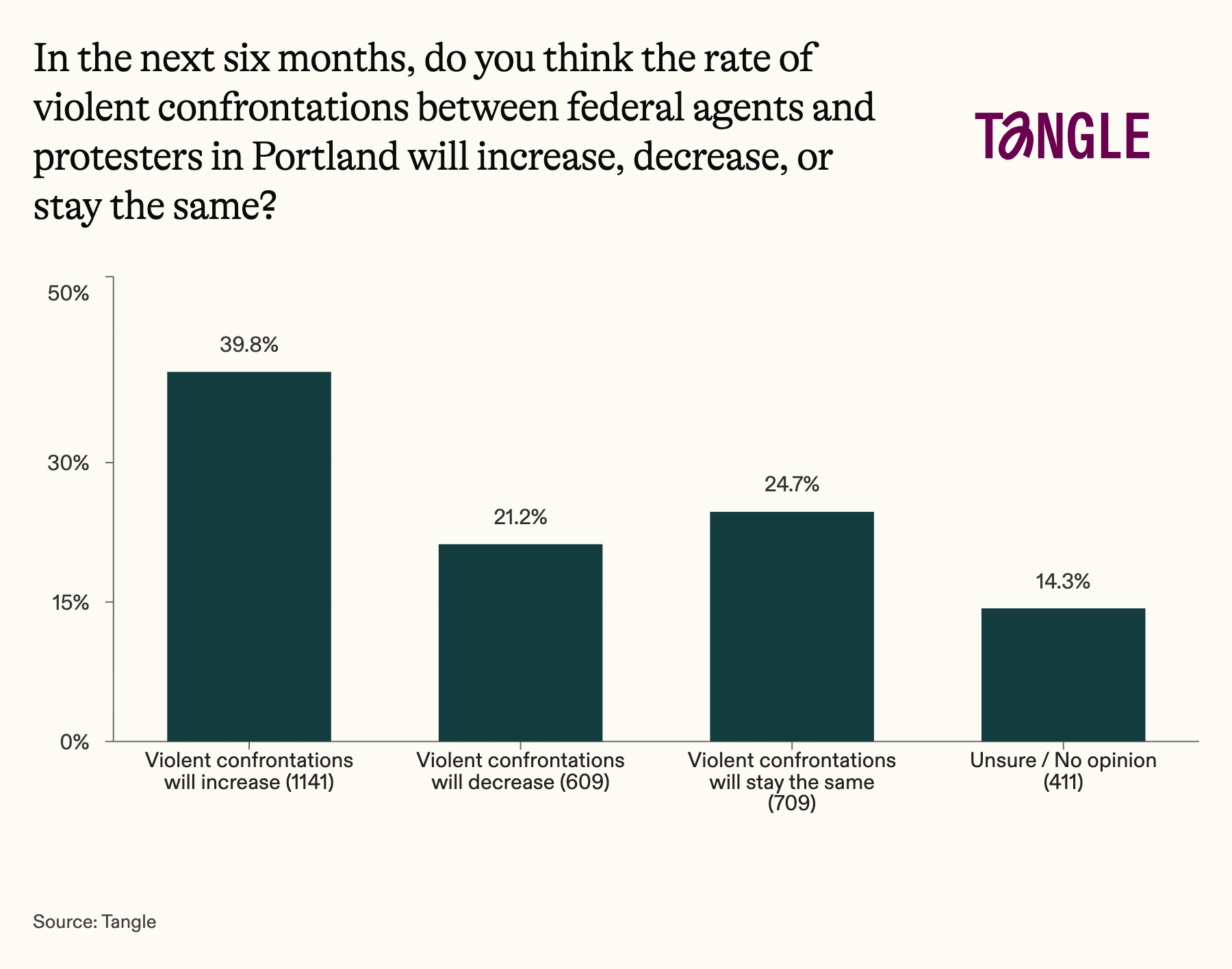
- Thursday’s survey: 2,870 readers responded to our survey on the National Guard deployments to Portland, Oregon, with 40% saying they expect violent confrontations to increase. “I think Portland has figured this one out, but I also fear they are a bit of a unicorn in this sense and am deeply concerned about other cities,” one respondent said. “These idiots are mostly cowards. When real force shows up they will cave,” said another.
Have a nice day.
Around 5 million people around the world suffer from the advanced form of dry age-related macular degeneration (AMD), which causes gradual, incurable vision loss through the death of light-sensitive cells in the central retina. Last Monday, however, a clinical trial led by University of Bonn ophthalmologist Frank Holz showed promising results for people who receive a wireless retinal implant called PRIMA. Of the 32 patients in the trial who were tested a year later, 26 experienced a clinically meaningful improvement in their vision. “Where this dead retina was a complete blind spot, vision was restored. Patients could read letters, they could read words, and they could function in their daily life,” Holz said. Nature has the story.

Member comments