
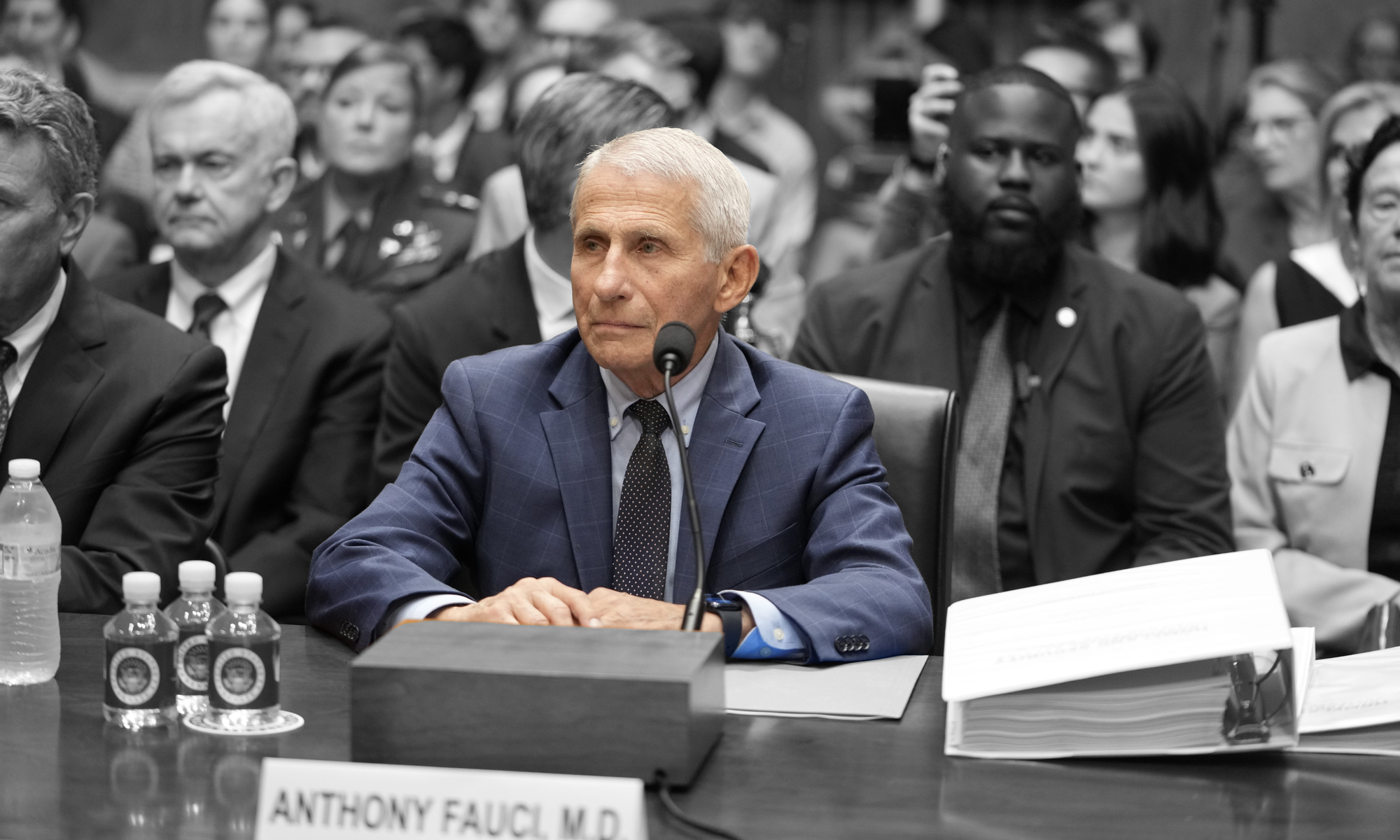


Covering the release of Fauci’s diaries and the debate over his testimony has thrown me squarely back into the peak-pandemic era. It reminded me of how stressful, uncertain and divisive that time period was, and how glad I am we are no longer in it. It also reminded me of how conflicted I felt about Fauci and our pandemic response. So here are 16 thoughts on Anthony Fauci, his diaries, and his testimony.
- Whenever I think of Covid-19, I come from this framework: Hindsight is 20/20, but this was an impossibly difficult time. We were living through a terrifying spread of a novel virus, the global response was disjointed and broken, and no country succeeded in stopping the spread while preserving even a semblance of normal life. Fauci and President Trump (and later President Biden) made a lot of mistakes, but so did everyone else. In the United States, over one million people died of or with Covid. Many businesses were destroyed. Many children were scarred by school closures. Many people who questioned the government or mainstream scientific consensus were publicly ridiculed, ostracized, or lost their jobs. It feels like we got the worst of everything, and yet, given the success of the vaccine rollout and our economic recovery, it’s also a miracle it wasn’t worse.
- In the court of public opinion, I think Fauci’s decision to plead the Fifth was a big mistake that makes him look guilty to anyone unsure how they feel about him. Practically, I understand it — everyone is constitutionally protected against self-incrimination, and it is a smart move legally in many scenarios. Fauci has testified before Congress hundreds of times, and Sen. Rand Paul indicated that he expected Fauci to be dishonest, and that if Fauci perjured himself before the committee, he’d be open to new prosecution outside the bounds of the sweeping pardon President Biden issued. If I were Fauci, I would believe Paul was on a hunt not for answers but more charges, and I’d also follow legal advice to keep my mouth shut, but that doesn’t mean it’s a good look.
- Speaking of that pardon… I’m really unsure how to feel about it now. This is the latest in a laundry list of reminders about how excessive the presidential pardon power is. Biden gave sweeping pardons to his family members and people like Fauci, who are now protected from federal prosecution in a way that invites suspicion, and the whole thing stinks of political corruption. It could also backfire on Fauci, who now may not be protected by the Fifth Amendment because he’s not at risk of federal prosecution. At the same time, Republicans have done exactly what Biden predicted they would — try to put Fauci in jail — which retroactively justifies his rationale for the pardon in the first place. It’s a lose-lose situation, and it makes the whole system look very ugly.
- It’s remarkable that Fauci’s journal entries are public, and some are quite eye-catching. There’s debate about whether we should have access to these entries at all, but as a journalist, I am pro-leak, pro-transparency, and pro-information. I think they add a great deal to our understanding of the pandemic and the man Fauci is, so I’m glad to have them. Still, the black-and-white claim that Fauci’s diary confirms he covered up that the virus leaked from a lab is overstated. The frustrating thing is that the entries, like Fauci’s public comments and the virus itself, are a moving target. And some of them are damning. But many of his critics are exaggerating what the diary reveals.
- For example: Fauci and the mainstream scientific community long labeled the lab-leak theory a conspiracy. Scientists who publicly argued that Covid was engineered were isolated from academia and labeled right-wing quacks. Politicians who explored the idea were called conspiracy theorists. For even considering the lab leak theory in Tangle, readers canceled their subscriptions and called me a conspiracy theorist, even when I was deferring to Fauci’s expertise. People who talked about a potential lab leak were also labeled racists. And yet, we now know that a very live debate about the virus’s origins was playing out behind the scenes, despite Fauci taking a long time to acknowledge the possibility publicly.
- In his diary, Fauci noted that he convened a call of leading virologists and evolutionary biologists after a respected scientist expressed concerns that Covid could have been engineered. Of the 11 scientists on the call, just two were convinced the virus emerged naturally. The others were not sure. Fauci did not state his view in that specific entry, but publicly, just months later, he and other officials were insisting the “engineered virus” idea was implausible. Behind closed doors, though, it seemed that many respected scientists thought it was possible.
- Perhaps the most damning portrait these documents paint of Fauci is one where he was manufacturing scientific consensus when none existed. With incredible fame and as head of NIAID, Fauci had the press wrapped around his finger and was operating a $6 billion research budget many scientists could only dream of. He used that power to brow-beat scientists into his view, or dismiss dissidents as quacks, all while working behind closed doors with sympathetic journalists to manufacture the “right” public messaging (i.e. amplifying his view). Dissent was very rarely met with an open mind. Some emails even show him seeking nominations for cash prize awards from researchers he had given money to.
- At the same time, some commentators have offered poorly reasoned takeaways. Megyn Kelly zeroed in on a January 2020 entry where Fauci wrote, “Now we know the market was not the source, it was the amplifier.” Kelly told her audience this was proof Fauci knew as early as January that Covid-19 didn’t come from a market but had come from a lab. This is the same framing Sen. Rand Paul has used. However, Fauci says in the very next sentence, “Having said that, somewhere the virus jumped from animals to humans.” So he still believed the virus originated from an animal; he just thought it pre-dated the market. He said this publicly to USA Today just a few weeks after that entry. And in a separate entry from the same period, he also called it a “conspiracy theory” to believe the virus came from gain-of-function research.
- Some other Fauci entries caught my eye: He privately recalled pushing New York City and California to close their schools, despite publicly saying he had nothing to do with school closures. In another, he recounts telling former CDC Director Rochelle Walensky that “as good as some of the CDC people are, as an institution they have hubris and are often incorrect. She needs to follow her good instincts and question what they are doing in a friendly, non-threatening manner,” which seems like a remarkably dismissive view for the top scientist in the government to hold about the CDC. In another entry, Fauci recalled going on background with Politico to defend the Biden administration from a forthcoming article about how it was bungling the vaccine rollout.
- In one startling, under-discussed example, Fauci recounts the CDC’s Advisory Committee on Immunization Practices (ACIP) voting 9–6 not to extend eligibility for boosters to people at elevated risk through their jobs, like teachers and healthcare workers. ACIP had already approved boosters for people 65 and up and those with underlying conditions. Fauci considered the exclusion of at-risk workers illogical and, by his own account, the committee's decision “had nothing to do with safety.” He texted Walensky repeatedly that night, described it in his diary as having “literally begged her to override that decision,” and credited his own “very intensive persuasion” late into the night for her decision to reverse her committee the next morning and extend booster eligibility to that occupational risk group.
- A lot of critics focused on Fauci’s seeming self-obsession. Even The New York Times describes “a portrait of Dr. Fauci as obsessed with himself, reveling in his own importance and the celebrities he knows.” I have mixed feelings here, too. On the one hand, Fauci went from being well known in the scientific community to one of the most famous people in America overnight. The coverage was unbelievably fawning, and it’s hard to imagine what being called a “superhero” everywhere you go would do to your ego. It’s not surprising to me that he would recount these celebrity interactions and behind-the-scenes meets in his private journal entries, either, for personal posterity. I think most people criticizing him would probably do the same. Even with the world burning, if I met Julia Roberts and she told me I was her personal hero, I might make note of it in my journal.
- At the same time, those same entries are really hard to read. In his Substack, Tom Elliott notes that the words “peer review,” “meta-analysis,” “learning loss,” and “mental health” appear zero times in his journal entries. Yet words like “award” (80), “hero” (49), “Instagram” (36), “bobblehead” (23), “selfie” (19), and “press” (514) are omnipresent. It’s reasonable to draw the conclusion that, in private, Fauci spent far too much time preoccupied with himself, his fame, and his public image and not enough time worrying about the on-the-ground experiences of Americans.
- There’s quite a bit of hypocrisy going around. Sen. Joni Ernst (R-IA) grilled Fauci about the hundreds of billions of dollars in Covid relief that was stolen by fraudsters, and how he needs to answer for that… when that wasn’t Fauci’s job, and she was a sitting senator who voted to pass that relief. Sen. Josh Hawley (R-MO) proclaimed that “no honest person pleads the Fifth.” Is he sure that’s the line he wants to take? Here is President Donald Trump in 2022: “Anyone in my position not taking the Fifth Amendment would be a fool, an absolute fool. One statement or answer that is ever so slightly off, just ever so slightly by accident, by mistake, such as it was a sunny beautiful day, when actually it was slightly overcast, would be met by law enforcement at a level seldom seen in this country, because I’ve experienced it.”
- There are also some entries that make Fauci look sympathetic which his critics are conveniently ignoring. In July 2020, Andrew Cuomo pushed Fauci to resign and dangled a lucrative private sector consulting career if he did. Fauci responded curtly: “Sorry, not for me.” In March of 2020, Fauci described being embarrassed by all the attention he was getting, and being uncomfortable in moments where Trump asked people to clap for him. Throughout 2020–2022, he also describes the horror of nonstop death threats, people stalking him, showing up at his house or threatening his wife and kids, and through it all he hung tough.
- Let’s not rewrite history, either. Trump got mad at states for reopening too early and ended his first term by honoring Fauci, while simultaneously spreading actual conspiracies and brow-beating some places to open up earlier than they wanted to. States and counties that had voted for Trump had lower vaccination rates and far higher Covid death rates. A lot of Americans bought into shutdowns and social distancing to “flatten the curve,” but those efforts were incongruent across states. Just as it’s true that Fauci got a lot wrong, it’s also true that if every American had done everything he said in the first few months of the pandemic, many more people would probably be alive.
- If we could go back and do this all again, I think we’d undeniably do things differently: We’d have reopened schools sooner and had many fewer restrictions on outdoor gatherings. Public health officials like Fauci would have been more honest about the necessity of masks in the early days of the virus’s outbreak. Mask recommendations would have been limited to N-95s and used in narrower circumstances. We’d have leaned into the advantages of natural immunity, knowing reinfections were less serious and less likely to seriously harm you. We’d have clearer communication about vaccine risk and vaccines not being 100% effective at stopping the spread, all while still making it clear you and those around you were much safer from death if you were vaccinated. We’d have been much more open-minded about the possibility of a lab leak or an engineered virus. We’d have built policy around the reality that the virus presented a much lower risk for people under the age of 40. We wouldn’t shame others for the decisions they made for themselves and their families. We wouldn’t have accepted hypocritical, nonsensical guidance like outdoor gatherings being unsafe, but mass protests against police violence being perfectly acceptable. This is all much easier to say now, but even with that knowledge and 20/20 hindsight, wrangling a divided country of 330 million people to a public health cause in a time of emergency was never going to be easy (or, frankly, even possible). Fauci, Trump, Biden, the CDC and FDA all had an incredibly difficult job. Candidly, I have a hard time fully blaming any one of them when so many of us got so much wrong about the pandemic.
It would have been nice, in my view, to hear Fauci testify along the lines of, “We got some things wrong, and for that I apologize” — to take ownership of some of the embarrassing diary entries, and to concede that he would have done some things differently. I don’t think that would have satiated those calling for him to be jailed — but I think it would have felt like closure for a lot of normal people who are still nursing scars from all manner of pandemic mistakes and injustices, both big and small.
Member comments