






I’m Isaac Saul and it’s a news-packed Monday morning. A few months ago, I read a story about younger Americans rediscovering malls as a hangout spot, and I have to say I had a hard time imagining it. That was until I spent my Sunday afternoon at the local mall with my wife. It was the first time I'd been in a mall in decades, and I felt like I was instantly transported to my teenage years: high schoolers running around in gaggles, the elderly shopping with their grandchildren, families out for the day, 20-somethings on dates. It was oddly happening and retro and, even weirder, brought me some joy.
Today, we’re diving into another pastime: Election chicanery in New Jersey, but the modern kind — with alleged “software errors” and public blame games instead of mafiosos and smoke-filled rooms. Also, a reader question about cyclosporiasis and a feel-good wedding story. It’s a 14-minute read.

A guest essay.
Megan Phelps-Roper was raised in the Westboro Baptist Church, a group widely condemned by other Christian churches and organizations for its extreme, vulgar rhetoric. As an adult, Phelps-Roper left the congregation and became one of its chief critics, as well as a writer and activist. In a guest essay for Tangle, she wrote about what she lost when she left — and what aspects of her upbringing she’s now reclaiming. You can read it here.
Quick hits.
- The U.S. and Iran paused strikes over the weekend, following roughly two weeks of attacks by each side. President Donald Trump has reportedly opted against escalating the U.S. campaign amid discussions of renewed peace talks and concerns over missile interceptor stockpiles, though the president has denied that munitions are a concern. (The latest)
- Three people were killed and four wounded in a mass shooting at the Seattle Center in Seattle, Washington. One suspect has been arrested, and police are searching for a second. (The shooting)
- A federal appeals court rejected the Trump administration’s request to overturn a lower court decision and allow the administration to implement stricter mail-in voting rules ahead of the 2026 midterm elections. (The ruling)
- Maine Democratic Party delegates selected former state Senate President Troy Jackson to replace Graham Platner as the party’s nominee in the Senate race against Sen. Susan Collins (R). (The selection)
- The Centers for Disease Control and Prevention said that four additional states are experiencing a cyclosporiasis outbreak linked to shredded iceberg lettuce, bringing the total number of states in the outbreak to nine. (The update)
11 ways to pocket an extra $2,648 — without a second job
Forty hours should be enough. But when costs keep climbing, picking up more shifts isn’t the only option.
The Penny Hoarder rounded up eleven practical, legitimate ways people are bringing in extra money — smarter shopping, cash-back programs, and trimming what they already owe.
Some will fit better than others — worth a look.
Today’s topic.
Noncitizen voting in New Jersey. On Tuesday, July 21, New Jersey Gov. Mikie Sherrill (D) announced that an error in the state’s motor-vehicles system software resulted in approximately 6,600 noncitizens being registered to vote, and a preliminary assessment showed roughly 400 of them cast a ballot in at least one election. Sherrill said the improper registrations occurred during former Gov. Phil Murphy’s (D) term and ordered an investigation into the error.
New Jersey’s Motor Vehicle Commission (MVC) allows people applying for drivers’ licenses or identification cards to simultaneously register to vote if they certify that they are U.S. citizens and eligible to cast ballots. Gov. Sherrill said that between June 2023 and June 2024, an error in the state’s registration software mistakenly registered people who indicated they were not citizens. She added that the issue was eventually caught and corrected by the Murphy administration, but criticized the former governor for a “lack of transparency” in failing to disclose the discovery.
IDEMIA, the contractor that operates the state system, refuted Sherrill’s claim that a software glitch caused the issue. Lisa Shoemaker, a company spokesperson, said the company does not register voters on behalf of the state. Instead, it accurately collected and stored applicants’ responses to a series of questions about their interest in registering to vote, citizenship status, and (if eligible) party affiliation. According to Shoemaker, the state was responsible for how it used the information in the MVC’s database.
In response to Sherrill’s announcement, the White House reaffirmed its call for Congress to pass the SAVE America Act, which would require states to use a federal system to confirm a prospective voter’s eligibility before they can be registered to vote in federal elections. Separately, Rep. Jeff Van Drew (R-NJ) and a group of Republican lawmakers sent a letter to Gov. Sherrill asking for a “complete accounting of how this failure occurred.”
Sherrill and other Democrats have rejected claims that the incident validates broader concerns over election security and voter fraud. “Donald Trump has zero credibility on the issue of election integrity. For the past 10 years, he’s cried wolf and peddled bizarre conspiracy theories about fraud with no evidence,” Sherrill said.
Today, we’ll share views from the right, left, and New Jersey writers on the incident. Then, Executive Editor Isaac Saul’s take.
|
What the right is saying.
|
In the Washington Examiner, Zachary Faria said “New Jersey admits that the voter fraud that doesn’t happen was happening.”
“Democrats and liberal media have said that evidence of voter fraud, specifically fraud committed by noncitizens, is essentially nonexistent. Now, New Jersey’s Democratic governor has effectively killed that talking point,” Faria wrote. “We have gone from the New York Times saying just two weeks ago that ‘widespread noncitizen voting’ is ‘a problem that doesn’t exist’ to the Democratic governor of a state admitting that around 400 noncitizens illegally voted after the state gave over 6,000 of them the ability to do so.”
“The Democratic Party, willfully or not, is only making this problem worse. Aside from giving noncitizens (including illegal immigrants) driver’s licenses while running an automatic voter registration program through the DMV, many Democrat-run cities want to (or do) allow noncitizens to vote in local elections. Democratic politicians also rabidly oppose any efforts to require voter identification,” Faria said. “When you combine that with the fact that Democrats are making it easier for noncitizens and illegal immigrants to vote (both unintentionally and intentionally) and oppose any safeguards under the guise of ‘voter suppression,’ you have a blooming voter fraud issue.”
In Cato at Liberty, Stephen Richer explored whether “the SAVE America Act [would] have prevented the New Jersey noncitizen voter snafu.”
“Arizona was the first state to require documented proof of citizenship. The overwhelming majority of Arizona voters satisfy this requirement by showing a passport or birth certificate to the state’s Motor Vehicle Division when getting a driver’s license,” Richer wrote. “If New Jersey had the same system as Arizona, the 6,600 noncitizens in question still would have indicated that they are not citizens; accordingly, they wouldn’t have provided documented proof of citizenship. Nothing would have changed. The software error would have still indicated that they met the citizenship requirement. The registrar still would have relied on this inaccurate information.”
“It’s possible that the final version of the SAVE America Act could be structured differently. It could require that even if the individual provides documented proof of citizenship to a motor vehicle division, he or she must also provide a birth certificate to the registrar for a new voter registration and every subsequent registration modification,” Richer said. “This would have made the New Jersey error less likely, but it would impose new burdens on hundreds of millions of voting Americans.”
|
What the left is saying.
|
In USA Today, Chris Brennan said “New Jersey’s noncitizen voter disclosure shows the system works.”
“The loudest view [about election integrity and voter fraud], shouted at every opportunity by President Donald Trump but not supported by evidence, is that voter fraud is rampant in our country, especially among noncitizens allegedly casting ballots,” Brennan wrote. “The more nuanced view, with a foundation in actual evidence, is that voter fraud and noncitizen voting are rare occurrences that our election infrastructure is designed to catch and eliminate, and to prosecute as necessary. The news out of New Jersey proves that second point of view.”
“Trump has been banging away at Republicans in Congress to pass his so-called SAVE America Act, which he casts as crucial for election integrity, but which is really just an unconstitutional power grab,” Brennan said. “Any American who interacts with the government in any way knows mistakes happen. That applies to elections and how they’re run. Trump and his Republican allies in Congress would have you believe that those mistakes are intentional. But these kinds of problems crop up in red states, too.”
In New York Magazine, Ed Kilgore suggested “New Jersey shows Democrats need a better voter-fraud strategy.”
“To be clear, the 6,600 noncitizen voter registrations is well below the 35,152 DHS claimed for New Jersey in the recent report Trump cited, based on a database created for an entirely different purpose that is reported to be full of errors. But it’s like a camel’s nose under the tent, validating all sorts of MAGA suspicions that the real fraud is vast and underreported,” Kilgore wrote. “Sherrill has not yet offered a proactive proposal to prevent the sort of errors she detected and reversed… Sherrill and every other state-level Democrat should clarify their own views about election integrity and possible noncitizen voting.
“At the federal level, Democrats should also modify their long-standing national voting-rights proposals to include a modest and reasonable system for verifying voter eligibility at the polls and for obtaining and casting mail ballots. It may need to be no more extensive than the signature-verification system California and other universal voting-by-mail states already use,” Kilgore said. “With their own approach (either state by state or nationally) to voter-eligibility verification, Democrats would be in a far stronger position on the topic and more in line with the large majority of Americans who support some form of voter ID.”
|
What New Jersey writers are saying.
|
In Save Jersey, Matt Rooney called the error “fraud by design.”
“For years, New Jersey’s political class dismissed election integrity concerns as paranoid fantasy. They insisted every safeguard was in place… This week, reality finally caught up,” Rooney wrote. “Software may have failed (the company is pushing back, for what it’s worth), but software merely executed the system politicians deliberately built… It was the predictable consequence of a policy architecture that prioritized making registration effortless over ensuring only eligible citizens were added to the rolls.”
“The foundation was laid in 2018, when Democrats enacted automatic voter registration through the Motor Vehicle Commission. Registration became the default… One year later (2019), they expanded driver’s licenses to illegal aliens. Anyone paying attention could see the obvious question: What happens when those systems collide?” Rooney said. “When government intentionally dismantles safeguards, expands eligibility for driver’s licenses to people who cannot legally vote, automates voter registration, weakens accountability, and then expresses surprise when ineligible people wind up on the voter rolls, the real failure isn’t the software.”
In the New Jersey Monitor, Terrence T. McDonald said “Phil Murphy gives NJ Democrats one more kick in the teeth.”
“[Former Gov.] Murphy, who ended his two terms as governor in January, spent his final years in office stripping Democratic Party leaders of their chief ballot advantage, cozying up to Donald Trump as Trump sought reelection, and attempting to install his wife as a U.S. senator,” McDonald wrote. “And now Gov. Mikie Sherrill alleges that Murphy’s administration dropped the ball as the state Motor Vehicle Commission accidentally registered about 6,000 non-citizens to vote.”
“If the claims she made on Tuesday are true, Murphy not only left Sherrill with a massive mess to clean up and New Jersey with a black eye; he also made it harder for New Jersey Democrats, and potentially Democrats nationwide, to argue that Trump’s allegations of widespread voter fraud are wrong,” McDonald said. “Trump’s push to convince Americans that non-citizens are flipping election results — which is really just a personal crusade to convince America that he did not lose reelection in 2020 — has been strengthened thanks to incompetence in our state government.”

- This story didn’t look great for New Jersey when it broke, and it looks worse with more detail.
- The state’s contractor and the noncitizen voters aren’t totally blameless, but I think the state is primarily at fault.
- Using this episode as evidence for some massive voter fraud is a total overreach.
Compared to how straightforward this story seems on the surface (“6,600 noncitizens were erroneously registered to vote in New Jersey”), it’s actually pretty complicated.
To recap: New Jersey allows people renewing their drivers’ licenses or government-issued ID cards to simultaneously register to vote if they certify that they are U.S. citizens. The state contracts part of that process to IDEMIA, a French company that sells software to help Departments of Motor Vehicles in the United States with everything from testing to voter registration. New Jersey Gov. Mikie Sherrill said that software erroneously registered 6,600 noncitizens to vote despite marking themselves as ineligible, allowing roughly 400 to actually cast ballots.
In her announcement last week, Sherrill said these 6,600 noncitizens committed no fault but had simply been registered to vote because of a software error. This turned the public gaze and criticism toward IDEMIA.
IDEMIA’s side of the story is meaningfully different. It said that all 6,600 of the individuals in question said “yes” to an initial question about wanting to register to vote, but “no” to a subsequent one about being a U.S. citizen. This is where details are unclear and disputed: IDEMIA says that the Motor Vehicles Commission (MVC) erroneously included these responses when it sent its registration to the state Division of Elections. In other words, it recorded the responses accurately and the state was at fault; the MVC didn’t have to send ineligible voter data to the state, and New Jersey’s elections office could have filtered those responses out. In June of 2024, MVC requested the software to automatically mark anyone who indicated they were a noncitizen as declining to register to vote, which solved the issue going forward. But the 6,600 erroneously added people from the year before were never removed or disclosed.
When that side of the story broke on Friday, the narrative changed to something like this: The state of New Jersey incompetently used a system that resulted in 6,600 noncitizens being registered to vote, and the state was so incompetent (or trying to cover it up) that this was not fixed immediately or disclosed publicly for more than two years. If you wanted to be really cynical, you could also argue that the noncitizens — by virtue of selecting “yes” — were also expressing some intent to break the law (I would not argue that, but the Trump administration is already pursuing prosecution).
Candidly, it’s impossible to know without complete records and (probably) a court case who was really at fault here. But if you’re asking me: IDEMIA’s story strikes me as far more plausible. MVC had the right data, the registration issue was fixed once they requested IDEMIA “change its settings,” and the state is trying to pin blame on some vague “software error.” Given that IDEMIA can point to a specific moment in time when the problem was fixed, it really seems like the software was doing what it was told to initially — it was just being told the wrong thing. In an even worse look for the state, the elections office then failed to recognize that it had registered 6,600 noncitizens on its voting roll.
Yet, even if this is the case, I wouldn’t count IDEMIA as blameless here. Presuming their version of events is accurate, how is it possible they didn’t give clear enough instructions for something this important with a client this big to avoid a mistake like this? Is there no auditing or oversight? Are we really just leaving government workers a few clicks or one malformed query away from meaningfully corrupting our election systems? None of that feels particularly exonerating for the private contractor in this case.
Gov. Sherrill, for her part, continued lambasting IDEMIA publicly on Friday, saying the state had already begun the process to end its relationship with the vendor because this company was the heart of the issues with New Jersey’s MVC: “long wait times, bureaucracy, red tape.” Maybe Sherrill is overreaching there, but ending the relationship is probably for the best. And it’s a tough break for Sherrill, who had nothing to do with any of this (thank you, Gov. Phil Murphy), yet is now left to clean it all up.
Meanwhile, the Trump administration has signaled it’s going to prosecute the noncitizen voters, which doesn’t feel like a just solution to me. In most cases, I’d support any noncitizen voting illegally facing criminal charges — but this situation seems unique. A noncitizen lying about their citizenship to register to vote is illegal, but a noncitizen indicating on a form that they want to participate in elections while also making it clear that they are not a citizen, and then being told they can vote, does not strike me as the sort of thing that is worth a prosecutor’s time. If I walk into a bar and the bartender asks me if I want a drink and I say “yes, but I’m only 20 years old,” and then the bartender says “that’s okay, you can drink here,” then hands me a beer and I take a sip, who do we think is the person worthy of prosecution?
This story is also a reminder of the reality of voter fraud. Noncitizen voting is vanishingly rare. A quick look around the country shows that most states have mere hundreds, if not single-digit numbers, of noncitizens who cast ballots among millions of registered voters. Even here, in an incident where 6,600 noncitizens were erroneously added to the voter rolls, 94% didn’t actually cast a ballot. Of the 6% who did, it’s much more difficult to suss out intent when the state seems to have given them a green light to vote in the first place. To draw on my previous analogy, if I told you that 94% of 20-year-olds offered a beer inside a bar then turned the beer down, you’d probably be more worried about the socialization of 20-year-olds than you were about their capacity to commit a crime.
And not for nothing, but this story seems directly related to the Trump administration effectively killing the Election Assistance Commission (EAC). IDEMIA, after all, says its systems functioned perfectly well and, as proof, noted that the state of New Jersey tested and approved the systems before they were implemented. The EAC was a federal agency that helped states standardize this kind of election-related software, and this is just the kind of thing that supporters of the EAC worry we’ll see more of with it taken off the table.
All things said and done, I’m glad this mistake is finally coming to light and that both the federal and state governments are giving it some attention. What’s critical, to me, is that this all reinforces the single most important element of election security: a paper trail. In this case, we got lucky. The mistake was caught using the digital tools at hand. But what if the software system itself had been compromised? What if the error was smaller and less noticeable, or larger and more difficult to unwind? As with vote tabulators, having a paper record is our best last defense for audits and record-keeping, and as we become more and more reliant on software tools and computerized systems, we need to stay diligent about preserving the primary documents those tools are processing.
It’s virtually impossible to accurately judge the intention or culpability of each noncitizen who actually cast a ballot, but in most cases, I ascribe as much agency to an individual as possible, even if I’m sympathetic to their situation. If you live in a foreign country and receive notice that you are registered to vote, you have several ways to understand whether you can legally vote in state or federal elections. Google is probably the easiest.
Separately, if the state mistakenly registered you to vote via a software glitch or other mishap, and you disclosed you are a non-citizen, then you are not to blame. But I also believe if you actually cast a ballot just because you were registered to vote, you’re breaking the law, even if you didn’t know it. Saying “these people couldn’t know better” assumes a very low bar of critical reasoning and denies these noncitizens of any agency. And what precedent does it set if we let voter fraud, at any scale, go unpunished, especially if we definitely know it happened? I can’t get behind the idea that New Jersey should just let this one slide. If we want to send a serious message about election security, all parties — the software company, the MVC, and the individuals who cast votes — should be held to account.
Take the survey: Should the noncitizens who voted be prosecuted? Let us know.
Disagree? That’s okay. Our opinion is just one of many. Write in and let us know why, and we’ll consider publishing your feedback.
Your questions, answered.
Q: In the past, the sources (both the pathogens and foods carrying them) of deadly and sickening food-borne illnesses have been reasonably quickly identified, the foods recalled, and people are instructed about what to avoid, or how to clean, etc., the possible sources, when safe. But none of those normal procedures seems to apply to the recent outbreak of cyclosporiasis. Why?
I understand that it’s a parasite and not bacteria, but why do we have so little information about the sources of it, what to avoid eating or handling, etc.?
– Katheryn from Clinton, NY
Tangle: While Managing Editor Ari Weitzman was out on paternity leave, a rotation of guests came onto Suspension of the Rules to fill out the roster and offer their opinions on pertinent topics. Two weeks ago, author of the newsletter Your Local Epidemiologist Dr. Katelyn Jetelina joined the show to talk about cyclosporiasis (and has discussed it in depth in her newsletter).
First, what it is. Cyclospora is a microscopic parasite that spreads through food or water contaminated with human feces. An infection of Cyclospora is called cyclosporiasis; it can cause explosive diarrhea for weeks, and its symptoms tend to set in more gradually than what you might experience with other illnesses or food poisoning.
The Centers for Disease Control (CDC) may have struggled to detect the outbreak for a few reasons. First, tracing the source is slow work. Since the parasite is not part of standard parasite panels, detecting it requires an infected person to report their condition, public health experts to find and interview that person, and then for the infected person to recount all the food they’ve eaten in the past 10 days. Second, reported cyclosporiasis cases have been trending up for years, making it harder to detect spikes that indicate an imminent outbreak. Third, the infection is not centralized and is actually clustered around four separate outbreaks, with the largest spike in Michigan linked to iceberg lettuce from a supplier in Mexico distributed to Taco Bell restaurants.
Lastly, federal funding. Many outlets have reported on funding cuts to FoodNet — a federal program managed jointly by the CDC, the Food and Drug Administration, and the Department of Agriculture to analyze trends in foodborne illnesses — linking those cuts to this current outbreak. The government’s food-surveillance program may not be perfect, but those cuts probably did not contribute to the CDC’s delayed communications because FoodNet was not designed to prevent and respond to outbreaks. As Jetelina said in her newsletter, “FoodNet was never designed for real-time outbreak detection or response… The more accurate culprits are the lack of centralized coordination by the federal government, our siloed health systems, and insufficient capacity at state and local health departments.”
Want to have a question answered in the newsletter? You can reply to this email (it goes straight to our inbox) or fill out this form.
Numbers.
- 24. The number of states with automatic voter registration policies as of November 2025, according to Ballotpedia.
- 18. Of those states, the number with Democratic governors when the automatic voter registration policy was enacted.
- 53%. The percentage of eligible U.S. voters who live in a state with some form of automatic voter registration, according to Movement Advancement Project.
- 2.5 million. The approximate number of people in New Jersey who registered to vote through the state’s Motor Vehicle Commission between fiscal years 2023 and 2025.
- 3.4 million. The approximate number of ballots cast in New Jersey’s 2025 general election.
- 15,783. Of those ballots, the number that were rejected.
More income, same 40 hours
Covering the bills shouldn’t mean working longer. There’s plenty of bad advice in this category, so The Penny Hoarder filtered it down to eleven options that actually hold up.
Most take an afternoon to set up, and none of them require a second job.
The extras.
- One year ago today we had just published Isaac’s essay on five things he’d gotten right about President Trump.
- The most clicked link in our last regular newsletter was our newest episode of Suspension of the Rules.
- Nothing to do with politics: A game that tests how fast you can identify a random song.
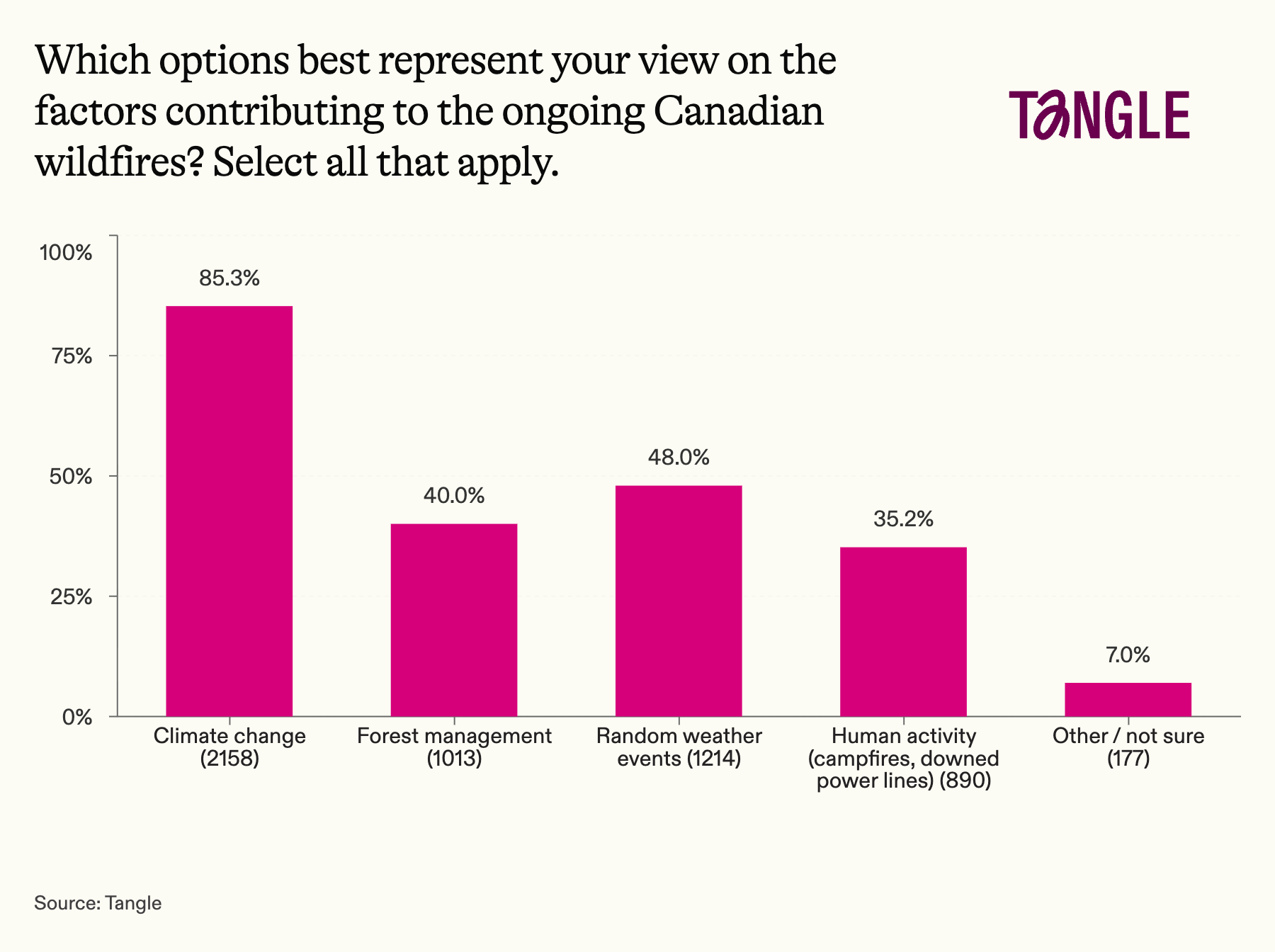
- Our last survey: 2,530 readers responded to our survey on the Canadian wildfires, with 85% saying climate change is one of the factors contributing to the ongoing fires. “It’s a mix of things, but climate change is definitely the primary factor,” one respondent said. “Better management and mitigation priorities — especially budgets and resources,” said another.
Have a nice day.
Many little girls dream about what their wedding day will look like, so for their daughter Jordan Rosenberg’s wedding to her now-husband Max Creamer in May, Rosenberg’s parents unearthed an old video of their four-year-old daughter talking about her future wedding. She told them the celebration would have a range of attractions you may expect a four-year-old to list off: clowns, face paint, dancing, and a moon bounce among them. When asked who her groom would be, Jordan exclaimed, “Max!” The kicker: Rosenberg and Creamer did not meet until college. The audio was put together as a surprise and played during the father–daughter dance, much to the guests’ delight and Creamer’s surprise. “He couldn’t believe it!” Rosenberg said of her husband’s reaction to her serendipitous, sentimental prediction. People has the story.

Member comments