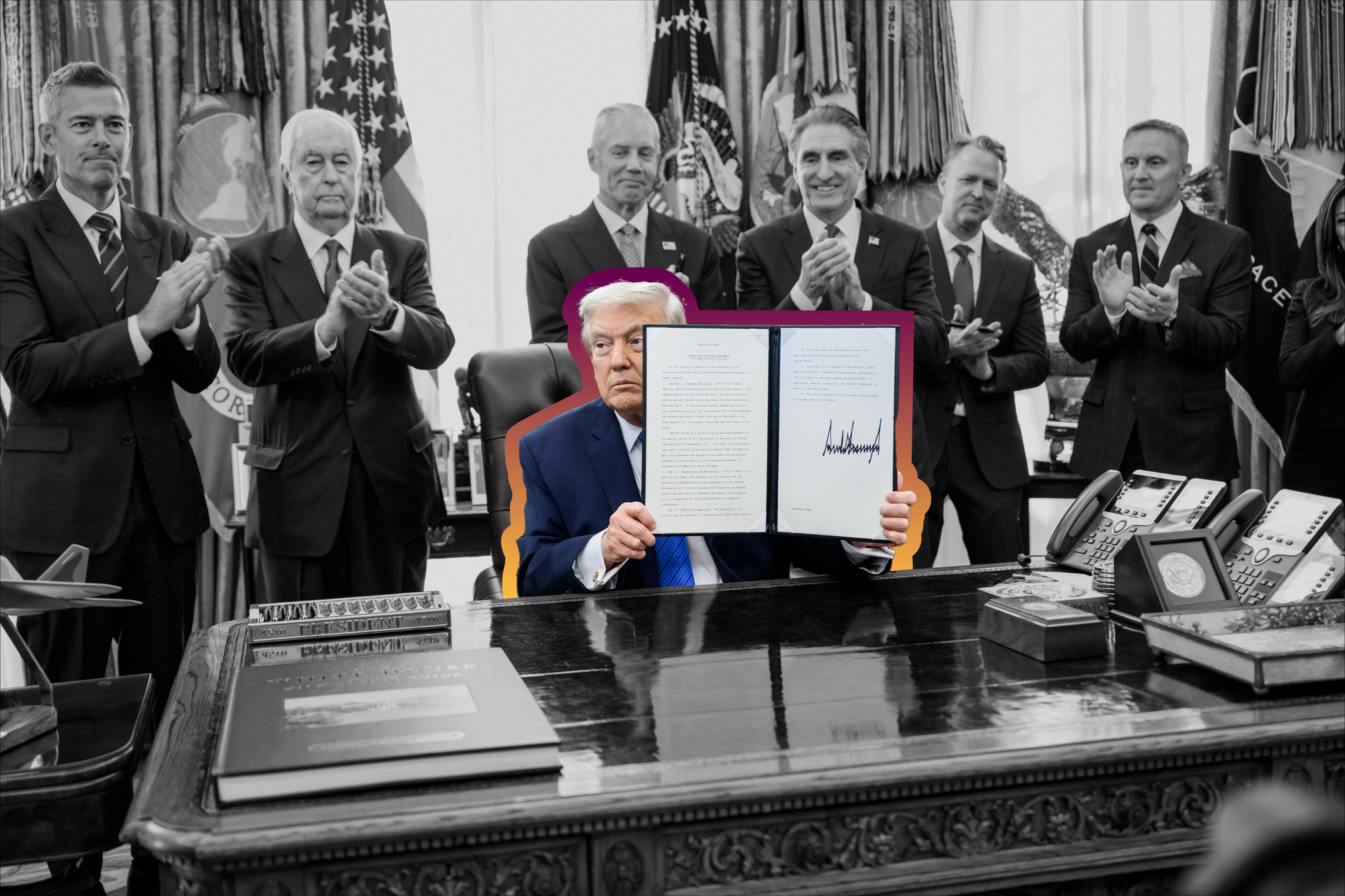
A year and a half ago, we published an explainer on Project 2025. At the time, it was one of the most requested Tangle topics ever.
In that piece, we explored the connection between Trump’s campaign and Project 2025, as well as the overlap between the project’s goals and Trump’s Agenda 47. For more information, we interviewed Paul Dans, a former Trump administration official who was known as the “architect” of Project 2025.
At the time, Trump claimed he had nothing to do with and knew nothing about Project 2025, likely in response to poor polling for some of its stated goals. We cast doubt on that assertion, describing links between Trump’s first administration and Project 2025; however, we also emphasized the space between the document’s calls and Trump’s likely actions. We wrote:
Trump is lying when he says he knows nothing about Project 2025 and doesn't know any of the people involved. He has deep connections to its organizers, and he has been a featured guest at events promoting Project 2025 since at least 2022. Many of his goals are clearly aligned with Project 2025’s. Yet, at the same time, he has distanced himself from the project publicly, and we have good reason to believe he’ll take the policy recommendations he likes and leave behind many of the ones he doesn’t. Simply put: Trump’s agenda and Project 2025’s are not the same, as evidenced by the differences in the agendas Trump has endorsed and the one Project 2025 has put forward.
Just over a year into Donald Trump’s second term, one of the most common requests from readers has been to revisit that conclusion and my prediction that much of the Project 2025 agenda would be struck down through legal challenges or abandoned by Trump. Today, we’re doing just that.
We’ll start with a refresher on Project 2025, then lay out which policy goals from Project 2025 have been implemented, which goals the administration is pursuing but hasn’t yet implemented, and which goals it has abandoned or actively undermined. Finally, I’ll revisit our coverage of Project 2025 from before the election.
Project 2025
What it is.
In the simplest terms, Project 2025 was a proposal for how the next Republican president should navigate the administrative state when they take office. The cornerstone of the project was a set of written policy prescriptions called Mandate for Leadership: The Conservative Promise, a 30-chapter book developed by the Heritage Foundation, a conservative think tank that has had significant influence in the Republican Party for decades. Overall, Project 2025 had four pillars: Mandate for Leadership, a database of personnel who could serve in the potential incoming administration, a “Presidential Administration Academy” designed to train that personnel, and a playbook of actions that the next president should take in their first 180 days in office.
Key Project 2025 authors in the Trump administration.
Russell Vought: Vought is currently Trump’s Director of the Office of Management and Budget (OMB); he was also a major author of Mandate for Leadership, writing a chapter on how the president could leverage OMB to exercise greater control over the executive branch and ensure full alignment with White House policy. Over the last year, Vought has helped cut the federal workforce and been tasked with winding down agencies like the Consumer Financial Protection Bureau (CFPB) and the U.S. Agency for International Development (USAID).
Peter Navarro: Navarro served as the director of the Office of Trade and Manufacturing Policy during Trump’s first term and is now senior counselor to the President for Trade and Manufacturing. He wrote a chapter of Project 2025 titled “The Case for Fair Trade,” outlining how America could strengthen its manufacturing and defense industrial base while onshoring the supply chain. Over the past year, Navarro has been a key advocate for Trump’s use of tariffs.
Brendan Carr: During his first term, Trump appointed Carr to serve as a commissioner on the Federal Communications Commission (FCC). While serving in that role, Carr wrote Project 2025’s chapter on the FCC. He identified four main goals for the commission: 1) reining in Big Tech, 2) promoting national security, 3) unleashing economic prosperity, and 4) ensuring FCC accountability and good governance. Carr made headlines in September for his role in ABC’s decision to temporarily suspend Jimmy Kimmel’s late-night show.
Other contributors: Mandate for Leadership also lists 277 “contributors” who were not the lead author for a chapter but “generously volunteered their time and effort to assist the authors in the development and writing of this volume’s 30 chapters.” Some of these people have gone on to have significant roles in the Trump White House:
- Paul Atkins — Chairman, Securities and Exchange Commission
- Steven G. Bradbury — Deputy Secretary of Transportation
- Elbridge Colby — Under Secretary of Defense for Policy
- Troy Edgar — Deputy Secretary of Homeland Security
- Joseph Edlow — Director, U.S. Citizenship and Immigration Services
- Jon Feere — Chief of Staff, U.S. Immigration and Customs Enforcement
- Tom Homan — White House Border Czar
- John Ratcliffe — Director of the CIA
Project 2025 policy proposals pursued.
Justice Department–Executive Branch Alignment
Mandate for Leadership specifically calls for issuing “guidance to ensure that litigation decisions are consistent with the President’s agenda and the rule of law.” The administration followed this up on June 11 by directing the Civil Division of the DOJ to use its authority “to advance the Administration’s policy objectives.”
Additionally, the Justice Department has brought several cases against political adversaries of the president after Trump specifically called on Bondi to do so. The DOJ has obtained indictments against John Bolton, Letitia James, and James Comey; James and Comey indictments have since been dismissed. It also sought indictments against six Democratic members of Congress after they urged service members to resist unlawful orders.
Civil servants and Schedule F
In 2020, Trump issued Executive Order 13957, which allowed for the reclassification of many career federal workers to “Schedule F,” a new service category that would remove many of their normal employment protections. Positions moved into the new category would remain career jobs — meaning they are intended to be filled on a nonpartisan basis — but would become at-will positions. Many critics argued that jobs falling under this schedule would become more akin to political appointees. The order applied to roles that were determined to be “confidential, policy-determining, policy-making, or policy-advocating,” eventually becoming known as “Schedule F” positions after the classification federal workers would have fallen into had the order been implemented and Trump stayed in office.
Reinstating Schedule F became one of the marquee proposals of Project 2025, and on his first day back in office, Trump did just that. The name of this schedule was changed from “F” to “Policy/Career,” and the Office of Personnel Management (OPM) issued a final rule on the matter last week, clearing the way for the change to be implemented as soon as March. Which jobs will be reclassified is currently unclear, but estimates suggest about 50,000 employees could be affected. President Trump — rather than OPM — will make the final call on which positions fall into the category. Agencies are expected to create a list of positions they intend to reclassify over the next month and send it to the White House for review.
Trade reform
Tariffs have been a defining policy thus far in Trump’s second term. A large portion of Navarro’s chapter advocated for the passage of the United States Reciprocal Trade Act (USRTA), which would have allowed the president to raise U.S. duties when a trading partner refused to lower non-reciprocal trade barriers. While the USRTA never passed, Trump has pursued similar powers by declaring a national emergency under the International Emergency Economic Powers Act. Trump used this declaration for his “Liberation Day” reciprocal tariffs. However, Trump’s authority to implement these tariffs may end abruptly, as the Supreme Court is set to rule on the legality of his emergency declaration in the current court term ending in June.
Dismantling DEI and Civil Rights policies
Project 2025 issued several recommendations on decreasing Diversity, Equity, and Inclusion (DEI) initiatives in the federal government and beyond. While many proposals are department-specific, the playbook also promotes changes to government-wide race-based policies. Mandate for Leadership called for the abolition of the Office of Federal Contract Compliance Programs (OFCCP), which exists to prevent certain federal contractors from discriminating in employment based on race, color, religion, sex, sexual orientation, gender identity, or national origin. On Trump’s first full day in office, he rescinded the 1965 executive order that the OFCCP is designed to enforce, then attempted to reduce the office’s budget to $0. However, after recent budget negotiations, the program will receive $101 million. Relatedly, Trump repealed President Biden’s executive order to establish a White House Gender Policy Council. These moves align closely with Project 2025’s recommendations for rolling back DEI-related requirements across the federal government.
Rescinding the endangerment finding
On day one of his second term, Trump signed an executive order directing Environmental Protection Agency (EPA) Administrator Lee Zeldin to submit a report “on the legality and continuing applicability” of the endangerment finding, which serves as the basis for much of the United States’s greenhouse gas regulations. In March 2025, Zeldin announced the EPA would move towards eliminating the finding, and on Thursday, he announced it was formally rescinded.
School vouchers
The administration has pushed school vouchers — government-funded subsidies redeemable for tuition at non-public schools or for homeschooling — including funding the first federal private school choice program.
Adding a citizenship question to the census
During his first term, Trump attempted to include a question on the census asking if respondents were American citizens. After a lengthy court battle and the Supreme Court stepping in, the Census Bureau printed the questionnaire without the citizenship question. However, the Court did not say that a citizenship question would be illegal, instead finding Trump’s rationale for including it to be “contrived.” Project 2025 called for a conservative president to resume these efforts, and as of February 2026, the Trump administration has begun testing a citizenship question for the 2030 census.
Certain abortion reform
HHS suspended, then restored, Title X funding to Planned Parenthood and other abortion providers, and Veterans Affairs no longer provides abortions to its patients. The FDA has also initiated a review of the abortion pill mifepristone in an apparent effort to determine whether to revise federal rules on the drug.
Project 2025 policy proposals that Trump has not enacted.
Comprehensive abortion reform
One of Project 2025’s most widely covered sections focused on abortion policy. In the lead-up to the 2024 election, abortion was a key issue for Democrats, and fears about Project 2025’s recommendations were central to their attack ads. While the playbook stopped short of calling for a law banning abortion nationwide, it laid out several recommendations to restrict access domestically that would act as a ban, and it called for removing U.S. involvement with international organizations that promote or permit abortion.
Most notably, Project 2025 called on the DOJ to enforce the Comstock Act, an 1873 law that prohibits drugs, medicines, or instruments used for abortions from being sent through the mail. Additionally, the proposal called for the permanent codification of the Hyde and Weldon Amendments into law. These amendments are typically renewed each year; Hyde bars most federal funds, including Medicaid, from paying for abortion with few exceptions, and Weldon blocks HHS from giving funds to agencies or localities that “discriminate” against a “health care entity” because it doesn’t provide or cover abortions.
Before his election, Trump said he would not enforce the Comstock Act. Though the FDA is reviewing mifepristone, the DOJ has asked courts to reject state lawsuits that would restrict mifepristone access until the FDA review is completed. President Trump has not pushed Congress on the Hyde and Weldon Amendments’ permanent codification, and in January even suggested Republicans become “flexible” on Hyde in order to pass a funding deal.
Prioritizing funding for home-based childcare, not universal day care
Project 2025 argued that children who spend more time in daycare were more likely to experience anxiety, depression, and neglect as well as worse educational outcomes. Instead, it advocated for prioritizing funding to offset the cost of parents staying home with a child or to pay for in-home childcare.
The Trump administration has begun the process to change payment rules and oversight requirements with childcare funds in response to alleged fraud in Minnesota daycares. However, these changes have yet to shift priority to at-home childcare.
Ban TikTok/WeChat
Navarro’s chapter also calls for a ban on Chinese social media apps, particularly TikTok and WeChat, arguing they pose a national security threat. Despite a law requiring a TikTok ban to go into effect, President Trump delayed the enforcement of the act, giving himself time to find a buyer for TikTok. He has not moved towards banning WeChat.
Entitlement reform
Several chapters of the book suggest reforms to entitlements. These proposals usually include adding work requirements for Medicaid, installing stricter eligibility determinations for other programs, and tightening controls on funds. While the One Big Beautiful Bill Act (OBBB) adds work requirements for Medicaid and rules for the Supplemental Nutrition Assistance Program (SNAP), it overlooked several other Project 2025 proposals. For example, Mandate for Leadership called for moving SNAP and the Women, Infants, and Children (WIC) program from the Department of Agriculture to Health and Human Services; converting federal Medicaid funding to block grants; and launching a “personal option” allowing recipients to use Medicaid funding to secure coverage outside the Medicaid program.
Not just Project 2025.
In our initial coverage of Project 2025, we noted that many groups — not just the Heritage Foundation — were working to shape the potential second Trump administration’s policies. One of the most important is the America First Policy Institute (AFPI).
AFPI was formed at the end of Trump’s first term by senior policy advisers Brooke Rollins, Larry Kudlow, and Robert O’Brien. It started when they began mapping an agenda for Trump’s re-election; after he lost, the group formally became AFPI, working with Linda McMahon in 2021 to accelerate “America First” policies. In the lead up to the 2024 election, the group gained the moniker of Trump’s “White House in Waiting,” as many officials in the organization were expected to get prominent positions in Trump’s second administration. And they did.
McMahon, after chairing AFPI’s board, became Education Secretary and was tasked with dismantling the department. Rollins became Agriculture secretary and has been a major domestic policy player. Pam Bondi, who ran AFPI’s legal arm, is now the U.S. attorney general. John Ratcliffe leads the CIA, Kash Patel leads the FBI, Kevin Hassett runs the National Economic Council, Lee Zeldin runs the EPA — all of them were in the AFPI orbit.
Like Project 2025, many of AFPI’s specific policy aims have been implemented through the people who used to work at the organization. On education, Trump has pursued school choice through federal guidance that loosens laws on how states can use Title I funds, and also cemented a national private school choice program in the OBBB. On drug prices, the administration has followed AFPI’s guidance to fight foreign “freeriding,” and Trump has launched a direct-to-consumer platform, TrumpRx, based around several “most-favored nation” pricing deals. AFPI’s immigration priorities are also in full force: a cartel task force, worksite enforcement, and the re-establishment of the Victims of Immigration Crime Engagement (VOICE) office. At the EPA, Zeldin is executing the deregulation framework he laid out through AFPI; sweeping executive orders on oil drilling, nuclear development, and deregulation priorities (like cutting multiple regulations for every new regulation) are all live.
Also like Project 2025, some of the AFPI’s most impactful proposals have not been pursued by the Trump administration. Major healthcare reform, including ending the Affordable Care Act employer mandate, maximalist pro-gun proposals, and narrowing Section 230 or banning congressional stock trading were all on AFPI’s docket but have been ignored or actively attacked by the Trump administration (the stock trading ban, for instance, actually got support from Republican Sen. Josh Hawley (MO), who Trump then lashed out at as a “second-tier senator”).
If AFPI and Project 2025 are pipelines of personnel and policy, then America First Legal (AFL) is like the sword and shield to advance and defend those personnel and policies in court. AFL, notably, was founded in 2021 by Stephen Miller, who now serves as a senior adviser to the president. Reed Rubinstein, who was a senior vice president at AFL, is now a senior legal adviser at the State Department.
During Trump’s second term, AFL has spent its time filing amicus briefs, backing lawmakers who support the administration, and advancing legal theories in public in an effort to justify the Trump administration’s actions. Fundamentally, AFL is at the center of Trump’s efforts to expand executive authority and build the precedent for more presidential power. While Miller left AFL to work as Trump’s deputy chief of staff for policy and Homeland Security adviser, AFL’s work reflects his priorities: It has taken on immigration fights like birthright citizenship, culture-war battles, and even cases defending the administration’s use of tariffs.
My take.
Executive Editor Isaac Saul: I’ll be honest: Going into this deep dive, I was pretty worried about what we’d find.
Sorry to cut you off, but the rest of this edition is for paying subscribers only. To upgrade your membership and read the rest of the piece, click here!
If you don't want to upgrade today but still want to hear more from us, head to YouTube where we’ve been publishing full-length editions of our flagship podcast, Suspension of the Rules, every week. They’re looser, more freewheeling discussions than you normally get in the newsletter, covering everything going on in the world of politics. Watching the show is a great way to ease into the weekend — you can check out our latest episode here or watch the video below!