




This is Senior Editor Will Kaback — hope you’re having a great Tuesday. Today’s edition dives into the potential nuclear agreement between the United States and Saudi Arabia. This deal flew a bit under the radar last week, but it could be one of the most impactful non-Iran developments in the Middle East in some time. That is, if they can actually get it over the finish line. Stay tuned for my take, a concurrence, and a dissent — the Tangle trifecta.
Later on, we’ve got another under-the-radar story about a voter-registration controversy involving Motor Vehicle Departments in Alaska that you might have missed while all the attention was on New Jersey’s own voting scandal. It’s a 13-minute read.

We won!
A few weeks back, we asked Tangle readers to support our nomination for the inaugural Newsletter Awards. On Friday, we learned we won the top prize — the People’s Choice award — for receiving the most votes among over 100 nominees. Thanks so much for voting for us; every bit of recognition like this helps spread the word about our work. It’s a proud day for the entire Tangle community.
Quick hits.
- Sen. Mitch McConnell (R-KY) said in a statement that he remains in rehabilitation care and is not yet able to return to in-person work. The senator’s office did not provide a timetable for his return to the Senate. (The update)
- The Trump administration filed an emergency application with the Supreme Court, asking it to allow an executive order implementing new restrictions on mail-in voting to go into effect before the November midterms. A federal appeals court upheld a block on the order last week. (The appeal)
- Temporary Protected Status for Haitian and Syrian nationals expired on Monday at midnight. Immigration and Customs Enforcement is reportedly planning a large-scale operation to deport Haitians who no longer have legal status. (The expiration)
- President Donald Trump will meet separately with Israeli Prime Minister Benjamin Netanyahu and Ukrainian President Volodymyr Zelensky at the White House on Tuesday. (The meetings)
- Sen. Rand Paul (R-KY) released over 1,000 pages of diary entries from Dr. Anthony Fauci, covering Fauci’s thoughts during a three-year period overlapping with the Covid-19 pandemic. Fauci will testify before the Senate Homeland Security Committee on Wednesday. (The release)
Americans Born Between 1941 and 1979 Can Receive These 10 Benefits This Month
You could be missing out on $1,000s, and you might not even realize it.
Sure, you might know about some senior discounts at diners or retail stores. But what you might not know is there are a number of lesser-known programs that can help slash bills, reduce insurance costs, and unlock powerful financial perks — right now.
We pulled together some of the most valuable money moves for 2026. Cut expenses, boost your retirement, and recession-proof your finances.
But act fast — we don’t know how long these programs will last!
Today’s topic.
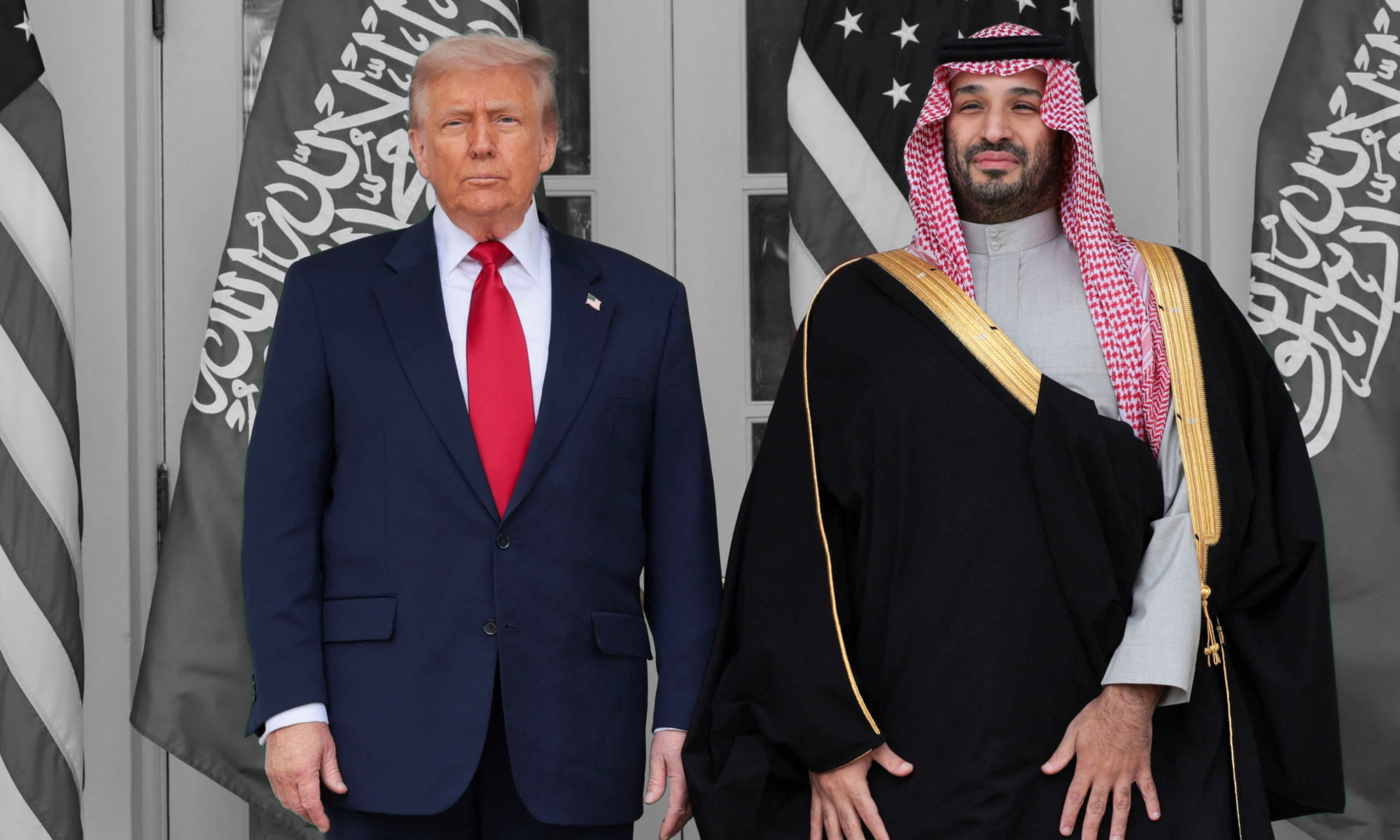
The U.S. nuclear deal with Saudi Arabia. On Wednesday, July 22, the United States and Saudi Arabia signed a civil nuclear-cooperation agreement. The deal is a “123 Agreement,” named after Section 123 of the U.S. Atomic Energy Act, outlining a partnership between the two countries to establish a civilian nuclear program in Saudi Arabia. However, the status of the deal is now in question after President Donald Trump said on Thursday that it was conditional on Saudi Arabia normalizing relations with Israel.
Under the reported terms of the deal, the Saudi government can enter into contracts, potentially worth billions of dollars, with U.S. companies to develop nuclear energy programs over the course of the next 30 years. One such provisional development is a joint uranium-enrichment facility, conditional on the results of a two-year study. If the study finds that uranium enrichment would have significant energy benefits, the U.S. will construct a “black box” facility to allow enrichment while preventing Saudi officials from accessing the underlying technology.
The U.S. and Saudi Arabia had previously discussed a civilian nuclear agreement during past presidential administrations, but the two countries haven’t been able to reach a deal. For years, Saudi Arabia has resisted adopting nuclear non-proliferation protocols that have characterized other nuclear agreements, including the“gold standard” provision of abstaining from domestic enrichment of reactor fuel. Additionally, Saudi Arabia has refused to adhere to the Additional Protocol (AP) from the International Atomic Energy Agency (IAEA), which would strengthen the organization’s oversight authority. Though the text of the U.S.–Saudi deal is not public, it reportedly does not include either the gold standard or AP provision.
Historically, Saudi Arabia’s refusal to normalize relations with Israel has also prevented a nuclear agreement with the U.S. The Trump administration’s initial agreement did not include a normalization provision; however, on Thursday, President Trump posted on Truth Social that the deal was “totally subject” to Saudi Arabia joining the Abraham Accords.
Democratic lawmakers have been critical of the deal. Rep. Jamie Raskin (D-MD) said, “So, the Saudis enrich the Trumps, and the Trumps allow the Saudis to enrich uranium and then we're going to have more nuclear weapons in the Middle East to set off another nuclear arms race there.”
Republican lawmakers have been mixed. Rep. Tim Burchett (R-TN) said developing allies is important as long as the U.S. could “verify” effective safeguards. Sen. John Kennedy (R-LA) said a deal is possible “maybe someday, but not right now” while the U.S. is at war with Iran.
Below, you’ll hear from the left, right, and writers in the Middle East about the U.S.–Saudi deal. Then, Senior Editor Will Kaback gives his take.
|
What the left is saying.
|
In Bloomberg, Marc Champion argued “in the world of security, such assurances can’t suffice.”
“The administration has some strong arguments for making such an agreement [with Saudi Arabia]. Top of the list is the concern that Riyadh will eventually go to Russia or China if Washington refuses to supply nuclear technology,” Champion wrote. “Moreover, like any other nation, the Kingdom has the right and the rationale to add nuclear power to its civilian energy mix. And let’s not forget the commercial gain that would result for U.S. companies. But all of this misses the forest for the trees, because two tests that override all other considerations must be applied here.
“The first is that any nuclear deal with any country in the Middle East must assure its neighbors that it is not pursuing a nuclear arsenal,” Champion said. “This reported agreement by no means guarantees a Saudi enrichment let alone weapons program, but… [other Middle Eastern countries] can only read it as opening the door to one. The second test is whether the case for risking nuclear proliferation in this way is dependent on the current leadership in Riyadh. In other words, can the US feel confident that if the house of Saud were one day to be replaced or to change its ideological complexion, it would remain in US interests to have it enriching uranium? The answer to that question is an emphatic no.”
In Slate, Fred Kaplan said Trump’s “deal reversal is right in line with the rest of his foreign policy.”
“It’s becoming a standard feature of Donald Trump’s second presidency: He makes an announcement or sets in motion a new, significant policy — then he utters a remark or posts a caveat on social media, and the ship of state is cast into chaos,” Kaplan wrote. “[The Saudi Arabia nuclear agreement] was a very big deal. The Saudis have been seeking such a deal for many years. It could wean the kingdom away from its reliance on oil — but it could also lay the foundations for a Saudi nuclear weapon… Then, on Thursday, at 7:52 AM, Trump posted on social media that the deal ‘is totally subject to Saudi Arabia joining the very respected and successful Abraham Accords.’”
“Trump’s new condition — which was not included in the deal negotiated earlier this week by Secretary of Energy Chris Wright and his Saudi counterpart — pretty much scuttles the deal,” Kaplan said. “It’s unclear why or how Trump changed his mind, if he did change his mind. Did he know, or just not notice, that the agreement signed by his energy secretary contained no Saudi concessions on Israel (or much else)?… If you’re an American ally (or adversary or something in between), it’s basically impossible to believe anything our president says at this point, or to view us as anything close to a reliable partner.”
|
What the right is saying.
|
In Townhall, Kevin McCullough called the agreement “diplomacy with teeth.”
“Saudi Arabia has spent the better part of a decade quietly signaling that it wants integration with the West — investment, technology, security guarantees, a seat at a table that used to exclude it,” McCullough wrote. “Trump has placed a single condition in front of the Saudis that costs Riyadh very little to accept in principle, since it was already the direction the kingdom was leaning, and that delivers an enormous strategic prize to Washington, Jerusalem, and every Gulf state watching how this plays out.”
“Every additional country that joins the Abraham Accords framework — and Riyadh is by far the biggest remaining prize — knits the region tighter into a coalition organized around commerce, security cooperation, and mutual defense against exactly the kind of Iranian-backed disruption that's defined the last decade,” McCullough said. “Saudi Arabia gets a modern civilian nuclear program and deeper integration with the world's most advanced economies. Israel gets a security partner it has sought for years. The United States gets a more stable, more prosperous, more predictable Middle East.”
In National Review, Noah Rothman asked “what do we get out of the Saudi Nuclear deal?”
“The Trump administration has provided ample assurances that its nuclear deal with the Kingdom of Saudi Arabia is nothing to worry about. Trust us, they say. All the necessary checks and safeguards are in place. And yet, even those with faith in this presidency’s competence and forthrightness should be cautious about what the future will hold when the Trump administration is gone,” Rothman wrote. “Saudi strength has played a key role in the Trump administration’s efforts to reshape the geopolitical landscape in the Middle East. A Riyadh that is flush with cash and a model for regional development augments the regional Sunni bulwark against Iranian influence and aggression. That’s the pro side of the ledger.
“The con side is, however, more voluminous and more compelling,” Rothman said. “The Kingdom is not like France, Britain, or even Israel — nations that nuclearized with America’s tacit acceptance — because its government does not enjoy the consent of the governed. It’s an authoritarian regime with plenty of ominous domestic challenges and a lively culture of Islamist radicalism. America should not make an enemy out of Riyadh, as the Biden administration foolishly attempted. But neither should U.S. policy take the House of Saud’s stability for granted and rule out the prospect of a profound change in Riyadh.”
|
What writers in the Middle East are saying.
|
In the Middle East Eye, Ahmed Altuwaijri argued “tying a Saudi nuclear deal to Israel is a strategic mistake.”
“If the United States conditions a civilian nuclear agreement with Saudi Arabia on the kingdom's immediate accession to the Abraham Accords, it would be collapsing two fundamentally different policy objectives into a single diplomatic test. Such an approach may appear to increase American leverage. In practice, it is more likely to diminish US influence while accelerating the emergence of a more multipolar Middle East,” Altuwaijri wrote. “The question is whether Washington can realistically expect Riyadh to abandon a position it has articulated with remarkable consistency for more than two decades: that formal normalisation must follow — not precede — a credible pathway towards Palestinian statehood.”
“A civilian nuclear agreement should be evaluated on its own merits: its contribution to energy security, technological cooperation, economic development and nuclear non-proliferation. Tying it to an issue on which Saudi Arabia has consistently articulated a non-negotiable position risks sacrificing practical cooperation for unattainable political leverage. Diplomacy succeeds when it recognises political realities rather than attempts to wish them away,” Altuwaijri said. “The task facing Washington is not to compel Saudi Arabia to abandon its stated principles, but to create conditions in which regional peace and strategic cooperation are both achievable. Conditioning one upon the immediate surrender of the other is unlikely to accomplish either objective.”
In Arab News, Abdulrahman Al-Rashed called the agreement a “cornerstone of the strategic relationship between the two countries.”
“Among the criticisms leveled against US President Donald Trump is that he favors Saudi Arabia at the expense of the supreme interests of the US. The facts, however, indicate otherwise. The deal itself is considered, from the perspective of US state institutions, part of those supreme interests, and has been negotiated by three US presidents and four successive administrations,” Al-Rashed wrote. “Ten years of technical, legal, and political negotiations represent a long history that leaves no room to claim the agreement was rushed due to the war with Iran, or that the Trump administration ignored supreme American interests.”
“Washington realizes that Riyadh is moving forward with its nuclear project, and that refusing to cooperate would prompt Riyadh to search for an alternative partner, whether in Europe, China, or Russia. This would weaken American influence and potentially risk losing a strategic partner the US is keen to maintain over the next two decades… The same logic applies to the Saudi side. It is also in Riyadh’s interest to maintain its partnership with the major global power,” Al-Rashed said. “Regardless of differing assessments, this war has proven Washington’s readiness to activate the concept of defending its supreme interests, rather than retreating from them.”

- I’m more optimistic than many about the potential of this deal — except on one major provision.
- Critics raise reasonable concerns, but I think many risks can be mitigated.
- However, the potential for further corruption looms over the entire discussion.
The obvious caveat overshadowing this deal is that, well, it may already be dead. President Trump’s post-signing demand that Saudi Arabia normalize relations with Israel immediately imperils the chances of enacting any agreement.
Perhaps the president tried to squeeze in the Israel provision based on advice from the last person he talked to (a trend that Isaac and other writers have highlighted), or perhaps it’s a negotiation tactic to extract last-minute concessions, as Kevin McCullough (under “What the right is saying”) proposed. No matter the motivation, Trump's after-the-whistle about-face casts the whole deal into doubt. Furthermore, the actual text isn’t public yet, so any discussion of what it does or doesn’t accomplish rests on the Trump administration’s statements, anonymous sources, or pure speculation.
That creates a weak foundation for a levelheaded analysis, but one thing is certain: That discussions over a Saudi civilian nuclear program have even reached this point is a Big Deal, one that signals the country’s further embrace of the West. It wasn’t long ago that the U.S. relationship with Saudi Arabia was defined by anger over 9/11, criticism of military intervention in Yemen, and outrage about human-rights abuses. But the relationship has grown friendlier over time, with President Obama visiting the kingdom in 2009, Trump traveling to the country for the first international trip of his first term, and President Biden proposing a “grand bargain” with the country during the back half of his term — one that may have come to fruition had it not been for Hamas’s October 7 attack on Israel. That attack (and Israel’s response) still looms over U.S.–Saudi relations, but these nuclear discussions suggest it won’t be a permanent impediment.
The risks of this agreement are easy to spot: nuclear enrichment for an authoritarian regime, a lack of political realism, and the potential for more presidential self-dealing. But the upside is also visible, if you’re willing to look.
Deeper ties with Saudi Arabia create immediate economic opportunities, but the strategic offerings are even more important. I see deals like this — which link economic and security interests — as the most realistic path to stability in the Middle East. The United States already has a nuclear agreement with the United Arab Emirates (UAE), and a similar deal with Saudi Arabia would further tie Gulf interests to our own while giving the U.S. singular influence in how the Saudis develop their civilian nuclear program. Saudi Arabia will likely pursue such a program regardless of U.S. involvement, and we aren’t the only country that could help them do so. However you feel about our current government, I’d rather the United States be the country at the table than allow China or Russia to take our seat.
Even bigger picture: Achieving a long-sought vision of a more stable, peaceful Middle East requires strong partnerships with its leading countries. That means dealing amicably with countries with non-democratic governments or divergent values, like Saudi Arabia. Optimistically, it could also mean tempering their worst impulses. Atrocities like Jamal Khashoggi’s killing could become less likely if Saudi Arabia’s nascent nuclear program (and broader economy) are more reliant on U.S. companies and technology. And the economic benefits of access to Western markets could guide the region away from constant conflict and toward a more prosperous peace.
The U.S. benefits from all of that, too. In the near- and long-term, moving forward with this deal would bring economic opportunities to American companies and technological advancements to our economy. The contours of those advancements may not be evident now, but the potential for billions of dollars in contracts over a multi-decade timeline would, in theory, strengthen the U.S. nuclear industrial base, promote competition and innovation, and elevate the industry’s leading companies. Advancement in the nuclear sector might sound like a given whether or not we strike this deal, but it’s not. Nuclear technology development in the U.S. has been stagnant in recent years, and the appetite for greater adoption of nuclear energy is uncertain. A motivated, deep-pocketed partner like Saudi Arabia would be a boon for the industry.
Of course, the risks of this deal are still significant. As Matthew Kroenig and Henry Sokolski said in The Wall Street Journal, Saudi Arabia hasn’t agreed to the IAEA Additional Protocol for safeguards or to abstain from domestic uranium enrichment, key provisions in the UAE agreement. Without those provisions, assurances about what Saudi Arabia will or won’t do in the future are just words.
Relatedly, an agreement with these terms will likely prompt other Middle East countries to seek out deals to develop their own nuclear programs on the assumption that the Saudis will eventually build up the capacity for domestic enrichment. That’s the exact kind of “arms race” that a deal like this is meant to avoid.
Then there’s Iran. The Trump administration doesn’t seem currently capable of halting Iran’s nuclear ambitions through diplomacy or force, but any hope of an Iranian deal becomes even more distant if the U.S. sponsors Saudi Arabia on a path to its own nuclear program (with flimsy oversight). That kind of a deal would all but ensure Iran doubles down on its pursuit of a nuclear weapon, short of its complete surrender to the U.S. (unlikely).
Lastly, the potential for self-dealing. The New York Times reported that the Trump family and its associates (as well as political allies) could stand to benefit from the explosion of investment and business opportunities in Saudi Arabia. For example, one company that is expected to play a central role in designing a reactor for the Saudis just happens to be partially owned by a business partner of Brandon and Kyle Lutnick — Commerce Secretary Howard Lutnick’s sons. Those links aren’t inherently corrupt, but the Trump administration doesn’t deserve the benefit of the doubt on its motives, especially when it comes to deals with the Saudis. Separately, the potential for cronyism would also mean that the U.S. companies winning contracts to work on the program may not be the best equipped for the job.
Taking all these concerns into account, I still think the core provisions of the deal are worth pursuing, but only if Saudi Arabia agrees to the same “gold standard” as the UAE — independent oversight and a commitment to permanently forgo domestic enrichment. With those guardrails in place, the agreement would have teeth, and its benefits would be more likely to be realized.
Ultimately, the upsides of such a deal would outweigh the risks of another roadblock with Iran and another opportunity for self-dealing. To mitigate the risks of the latter, my best-case scenario would be that President Trump’s erratic posture in negotiations scuttles any agreement during his term, but allows a new, less opportunistic administration to finish the deal.
For now, we can only wait for more details and watch how each side navigates Trump’s last-minute demands. It’ll be a while before any action is taken: Congress still has 90 days to review the terms, and if the two sides do enact the agreement, then the first uranium-enrichment technology won’t be transferred for at least two years. If the past is prologue with this administration, expect more twists and turns before any kind of resolution is reached.
Consider this, too: A nuclear deal with Saudi Arabia looks to me like another instance of Trump’s “Obama Derangement Syndrome.” Under that theory, our current war with Iran is downstream of Trump’s fixation on President Obama’s Joint Comprehensive Plan of Action (JCPOA) with Iran as a “bad deal.” After campaigning hard against the JCPOA in 2016, 2020 and 2024, Trump began the war in Iran as an effort to wipe the slate clean and strong-arm the Islamic Republic out of a nuclear program. Now that that’s going poorly, Trump is once again trying to outdo Obama’s Iran deal, but with Saudi Arabia. And if you think that the JCPOA was better than any compact with Iran that came before or since, then you should probably support a Saudi Arabian deal — with gold standards attached — for the same reason.
Take the survey: What do you think of the deal? Let us know.
Disagree? That’s okay. Our opinion is just one of many. Write in and let us know why, and we’ll consider publishing your feedback.
Under the radar.
Alaska’s Division of Elections recently removed 3,048 registered voters from the state’s active voter list on suspicion that they were noncitizens or incorrectly registered. However, on Wednesday, Director of Elections Carol Beecher said that many of those removed may have been citizens erroneously flagged by the Alaska Division of Motor Vehicles (DMV). Beecher suggested that the unusually large number of flagged voters could have come from “old data” in the DMV, but she added that her office is required to act on the information provided. Anyone affected by the review will now receive a letter asking them to confirm they are citizens by contacting the Division of Elections. Alaska Beacon has the story.
The extras.
- One year ago today we covered the humanitarian situation in Gaza.
- The most clicked link in our last regular newsletter was Megan Phelps-Roper’s guest essay on leaving the Westboro Baptist Church.
- Nothing to do with politics: How to catch this week's large meteor showers.
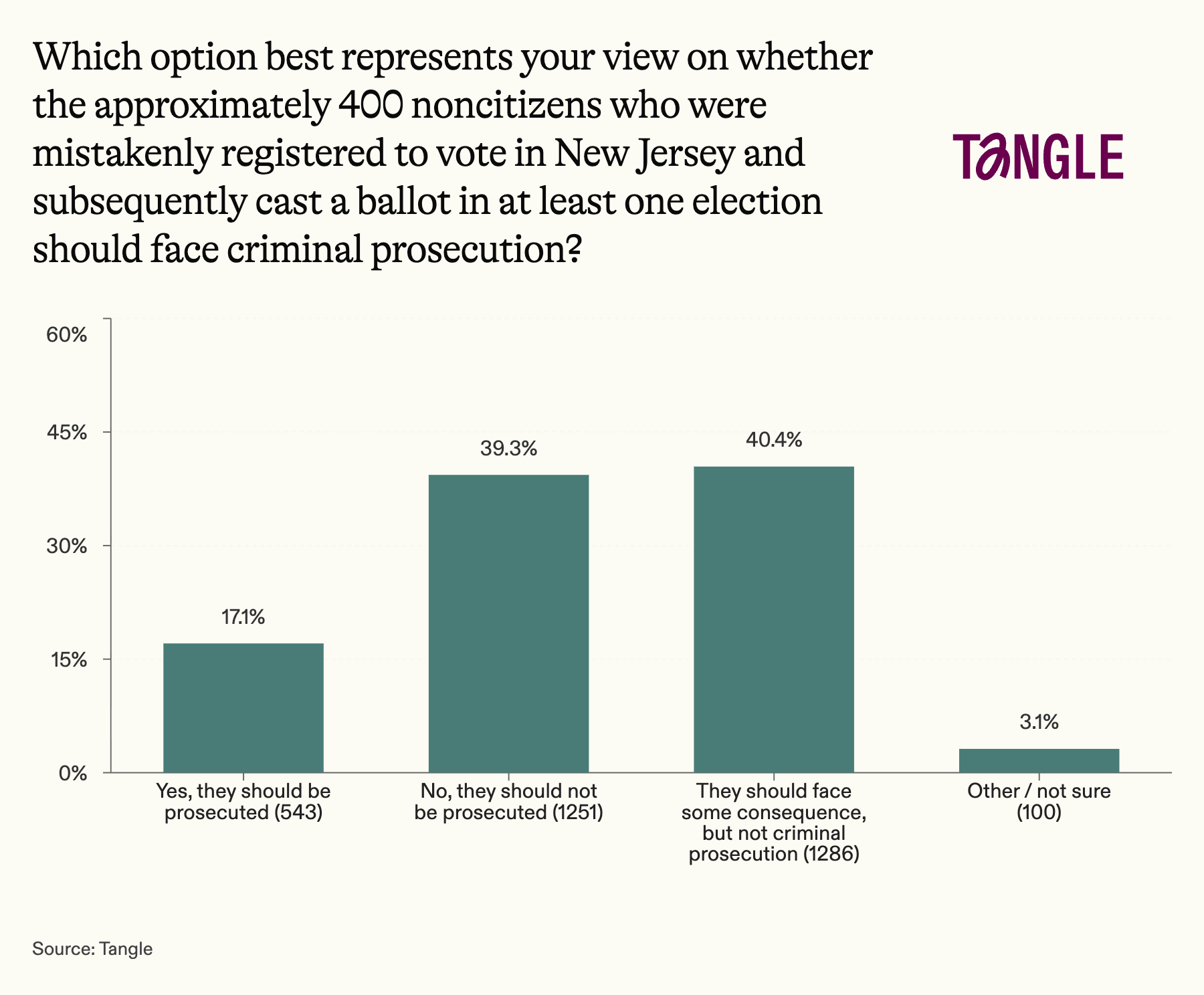
- Our last survey: 3,180 readers responded to our survey on whether to prosecute the noncitizens who voted in New Jersey’s elections after being mistakenly registered, with 40% saying the noncitizen voters should face some consequence, but not criminal prosecution. “This was not a nefarious intention on the part of those who voted illegally, but a software glitch that falls on the state to fix,” one respondent said. “Ignorance of the law, in all of our history, has never excused a person from being held accountable for breaking it,” said another.
Have a nice day.
Cape Cod ponds are often full of trash — beer cans, wine bottles, cracked golf balls, cinder blocks, wooden pallets, and tires. Many years ago, Susan Baur started removing trash from the ponds while swimming. She recruited friends and eventually formed a nonprofit called “The Old Ladies Against Underwater Garbage.” Members must be at least 64, able to swim half a mile in 30 minutes, and able to free dive to eight feet. The group cleans about 20 ponds a year and has hauled out an estimated 6,000 pounds of trash from Cape Cod ponds. Lisa Weiss, 65, said, “You’re exhausted, you’re maybe a little sunburned, you’re filthy, and it’s the best feeling.” The New York Times has the story.

Member comments