





I'm Isaac Saul, and this is Tangle: an independent, nonpartisan, subscriber-supported politics newsletter that summarizes the best arguments from across the political spectrum on the news of the day — then “my take.”
Are you new here? Get free emails to your inbox daily. Would you rather listen? You can find our podcast here.
Today’s read: 14 minutes.
Help us reach 100,000.
The Tangle Instagram has grown into a valuable source for breaking news and political analysis that tens of thousands of followers rely on. Soon, that number will tip into six figures (shoutout Russell Nystrom, our social media editor!). Unlike many other news organizations or influencers, we don’t buy followers. We grow the channel organically — and we’re currently sitting at approximately 91,000 followers, with an internal goal of reaching 100,000 by the start of summer. So… if you haven’t already — and are looking for a dependable breaking-news source to complement the newsletter’s in-depth analysis — please consider giving us a follow!
Quick hits.
- The Bureau of Labor Statistics reported that the consumer price index rose 0.6% on a monthly basis and 3.8% from the year prior. The annual rate increase is the highest since May 2023, with energy prices as a significant driver. (The numbers)
- The Supreme Court overturned a lower court order that had blocked Alabama from using a congressional map adopted in 2023 because it violated Section 2 of the Voting Rights Act. The Court did not explain its ruling, which follows an April 29 decision that narrowed the application of Section 2. The Court’s three Democrat-appointed justices dissented. (The ruling)
- Supreme Court Justice Samuel Alito extended the administrative stay on a federal appeals court’s ruling barring mail-order distribution of mifepristone, a drug used in medication abortions. The pause will now remain in place until May 14. (The extension)
- 18 Americans who were on board a cruise ship that experienced a hantavirus outbreak arrived back in the United States, and 16 were taken to a facility in Nebraska for observation and treatment. Two other passengers were taken to a facility in Atlanta, Georgia, where one is receiving care in a biocontainment unit for mild symptoms. (The return)
- The family of a man killed in a shooting at Florida State University in 2025 sued OpenAI, alleging the company’s artificial intelligence chatbot ChatGPT provided “input and information” to the suspected shooter and acted as a “co-conspirator.” OpenAI denied the charges. (The suit)
Today’s topic.
The latest in Iran. Over the past week, the United States and Iran have exchanged communications over plans to end the war between the countries, though talks have yet to produce a breakthrough. On Monday, President Donald Trump said the pause in fighting is on “life support,” calling Iran’s most recent response to a U.S. peace proposal unacceptable. Separately, the Strait of Hormuz remains mostly closed to commercial traffic, with the U.S. and Iran exchanging fire in the waterway last week.
Back up: In April, President Trump announced a two-week ceasefire, which both sides say is still in effect. During that time, however, attacks have continued, primarily concentrated in the strait, where the U.S. Navy has imposed a blockade against Iranian ports. Furthermore, on Sunday, the United Arab Emirates, Kuwait, and Qatar reported drone attacks believed to be from Iran.
Last week, the U.S. and Iran reportedly discussed a one-page plan to reopen the Strait of Hormuz and continue the ceasefire for at least 30 days; however, the future of Iran’s nuclear program remains a sticking point. Iranian officials claim the U.S. wants the country to give up its stockpile of highly enriched uranium, close three nuclear facilities, and suspend enrichment for 20 years. The officials said Iran has countered with a proposal to dilute some of the uranium, transfer the rest to a third country, and suspend enrichment for 10–15 years.
Iran formally responded to the one-page plan on Sunday. The text of the communication has not been made public, but Iranian state media reported that the country demanded an end to the U.S. blockade of the Persian Gulf, an end to U.S. sanctions, and an end to the fighting.
President Trump responded critically, posting on Truth Social, “I have just read the response from Iran’s so-called ‘Representatives.’ I don’t like it — TOTALLY UNACCEPTABLE!” On Monday, he again criticized the Iranian response as “a piece of garbage.”
As discussions have stalled, gas prices have risen, with the national average for a regular gallon of gas reaching $4.52 on Monday — an increase of over 50% since the war began. President Trump told CBS News that he supports suspending the federal gas tax “for a period of time” to lessen the cost burden on Americans. “We’re going to take off the gas tax for a period of time, and when gas goes down, we’ll let it phase back in,” Trump said on Monday. Pausing the tax would likely require an act of Congress.
Today, we’ll share views from the right, left and Middle East writers on the latest in the conflict, followed by Executive Editor Isaac Saul’s take.
What the right is saying.
- The right is mixed on the war’s trajectory, with some urging Trump to wind down operations.
- Others say it’s time for Congress to authorize the war.
In American Greatness, Fred Fleitz argued “Trump should end the Iran war now with an ultimatum.”
“President Trump delivered on his promise of a short, decisive action without US boots on the ground rather than another endless quagmire. Now is the time to declare victory, exit on our terms, and lock in the gains,” Fleitz wrote. “US and Iranian representatives are [reportedly] trying to negotiate a one-page memorandum aimed at ending hostilities and launching yet another round of negotiations. I am deeply skeptical that this is the right approach. I believe the best way forward is not another round of negotiations with a shattered regime but a clear and uncompromising American ultimatum.”
“In his ultimatum, President Trump should declare that Iran must immediately cease all threats to the Strait of Hormuz and guarantee safe passage for commercial shipping. In exchange, the US will halt military operations against Iran. Any failure by Iran to comply will result in the immediate resumption of the war,” Fleitz said. “This ultimatum must also state unequivocally that the United States will never tolerate Iran restarting its nuclear weapons program — nor will America ever allow Iran to acquire a nuclear weapon. Any attempt to do so will be met with overwhelming military force.”
In National Review, Andrew C. McCarthy said “Congress should authorize military force against Iran.”
“It’s past time for Congress to assert its constitutional power and authorize force, at least to reopen the Strait of Hormuz. No matter what one thinks of how we got here, Iran cannot be allowed to annex a vital global trade route whose closure is hurting Americans,” McCarthy wrote. “This should not be hard for the Republican majority, which wants to be seen as backing the president and being tough on Iran. Democrats should support it because it is essential to national security and economic stability.
“The partisan political temptation, of course, is to let Trump keep flailing away with inconsistent, incoherent justifications for an unpopular war. Yet, no matter how we got to this point, the nation cannot afford to allow Iran, an implacable American enemy, to control a vital international waterway as if it were sovereign Iranian territory,” McCarthy said. “The public has already made up its mind about the president’s performance, but it might reward congressional statesmanship in dealing with what, undeniably, is a security challenge from a committed American enemy.”
What the left is saying.
- The left views the war as a disaster, arguing the U.S. is achieving none of its objectives.
- Some worry about how Trump will respond as the conflict continues to spiral.
In The American Prospect, David Dayen wrote “there is no end to the war with Iran.”
“Every day we wake up to talk of a peace deal, and every day an oil trader makes money off it. There’s so much peace breaking out that the U.S. initiated military strikes on Thursday aimed at Iran’s Qeshm Port, a round of fire that was somehow deemed too ‘low level’ to break the cease-fire. But sure, we’ll get to peace someday soon,” Dayen said. “The Iranian leadership is biding its time before making its next move. And why wouldn’t they? It’s become public that President Trump desperately wants a deal completed before his summit in China on May 14–15. Every day closer to that gives the Iranians more leverage to set terms.”
“The U.S. and Israel said they wanted to eradicate Iran’s nuclear program and change its regime. The regime is now composed of more hard-liners than before, and Iran’s nuclear capability has not budged since last summer. Now the two sides are negotiating the opening of the Strait of Hormuz, which was open before the conflict, and the terms of Iran’s nuclear program, which they were negotiating before the conflict,” Dayen wrote. “All this war has done is killed thousands of people, opened a new front for Israel in Lebanon, [and] damaged most U.S. military sites and most energy production facilities in the region.”
In The Guardian, Robert Reich suggested “Trump’s looming defeat in Iran is a personal and political crisis.”
“Iran is unlikely to give in. It can withstand the economic pressure of a blockade better than Donald Trump can withstand the political pressure that comes with rising gas prices (now nearly $4.50 a gallon, on average), soon followed by rising food prices,” Reich said. “[Trump’s] ego cannot accept a humiliating loss, as we saw after the 2020 election. His need to bully, dominate and gain submission is so hardwired inside his insecure head that the defeats he’s now facing — to Iran and to Democrats — are already setting off explosions.”
“Regardless of what happens in Iran, he’ll claim victory. That will be difficult to do convincingly when gas prices remain more than $4 a gallon, but he’ll undoubtedly try. What if Democrats win control of one or both chambers of Congress in the midterms and he claims they lost or cheated? The nation barely survived the last time Trump’s fragile ego faced a major loss,” Reich wrote. “We’ll also have to cope with Trump as a lame-duck president who can no longer dominate and gain submission as he did before. Will he try to remain president beyond his second term to avoid this?”
What writers in the Middle East are saying.
- Some writers in the Middle East suggest Iran’s internal challenges loom large as the war persists.
- Others say the U.S. must consult Gulf allies to achieve a lasting peace deal.
In Ynet, Raz Zimmt said “the war may end, but Iran’s internal crisis is just beginning.”
“Whether the talks between Iran and the United States lead to a permanent ceasefire and the end of the war or collapse into renewed fighting, it is clear that the Islamic Republic will not emerge from the current conflict unchanged,” Zimmt wrote. “The regime faces a deep and ongoing legitimacy crisis stemming from a widening gap between the authorities and the public, particularly younger generations, alongside a worsening economic crisis and growing shortages of water and electricity.”
“For now, the leadership in Tehran is focused primarily on survival, preparing for the possibility of renewed war and efforts to bring the conflict to a definitive end. Once the war ends, however, it will have to direct most of its efforts toward rebuilding the country,” Zimmt said. “Even if regime change does not currently appear likely, the end of the war could force Iran’s new leadership to confront the realities of daily life, and it remains doubtful whether it has solutions to the country’s deepening crises.”
In Arab News, Osama Al-Sharif argued “only a win-win formula can break [the] US–Iran gridlock.”
“Trump has rejected all Iranian overtures, dismissing them as unacceptable. While the full details remain undisclosed, it is understood that Tehran is using the Strait of Hormuz card as a bargaining chip for a comprehensive settlement,” Al-Sharif wrote. “Washington’s conditions, by contrast, remain as maximalist as they were on the eve of the war… These are not American conditions alone — they are, in substance, Benjamin Netanyahu’s conditions. The Israeli prime minister is the only foreign leader who has been treated as a full and equal partner in this war. And it is here that Washington is committing a grave strategic error.
“America’s Gulf allies were neither consulted nor informed before the war on Iran was launched. Yet they are the ones who have absorbed multibillion-dollar losses to their energy and civilian infrastructure… Washington would do well to consult its Gulf partners before deciding its next move,” Al-Sharif said. “Short of a return to full-scale military confrontation, the two sides must come to terms with a simple reality: only a formula in which both sides can claim a measure of victory will end this crisis.”
My take.
Reminder: “My take” is a section where we give ourselves space to share a personal opinion. If you have feedback, criticism or compliments, don't unsubscribe. Write in by replying to this email, or leave a comment.
- A timeline of events shows how unreliable the U.S. and Iran are as narrators.
- It also shows that, despite our military successes, Iran’s control over the Strait of Hormuz is a disaster.
- I don’t know how we proceed from here, but I don’t like our options.
Executive Editor Isaac Saul: On April 1, President Trump gave a national address announcing that the war in Iran was nearing completion “shortly, very shortly” and we were “on track to complete” our military objectives.
On April 3, Iran shot down two U.S. military aircraft, setting off a search-and-rescue operation for the pilots on board. April 5: Trump threatened the “crazy bastards” in Iran to open the Strait of Hormuz before his deadline. April 7: Trump posted on Truth Social that “A whole civilization will die tonight, never to be brought back.” That same evening, he announced a ceasefire with Iran, saying he’d received a 10-point plan he believed to be “workable” towards a peace agreement. April 8: The president said it was a “big day for world peace” and that the U.S. Navy would safeguard traffic through the Strait of Hormuz. Later that day, Trump threatened that U.S. military forces would stay in place around Iran until the two sides reached a “real agreement.” April 12: He said “most points were agreed to” for a potential deal, but added that any Iranian who fires at the U.S. will be “blown to hell,” and then announced a Naval blockade.
April 17: An Iranian official declared the Strait of Hormuz “completely open for the remaining period of ceasefire,” and Trump said the Strait was “completely open and ready for business” but said the U.S. blockade would remain. April 18: Iran resumed its blockade of the waterway. April 19: The U.S. attacked an Iranian cargo ship that tried to avoid its blockade of the Iranian coast. April 21: Trump announced an extension of the ceasefire while keeping the blockade in place. April 22: Trump gave Iran three to five days to offer a peace deal before resuming attacks; that day, Iran seized two commercial vessels. April 25: Trump canceled a planned envoy to Islamabad.
May 1: Trump, in a letter to Congress, claimed hostilities with Iran had terminated. On the same day, Trump rejected Iran’s latest proposal to end the war. May 3: The administration announced “Project Freedom” to force the reopening of the Strait of Hormuz. May 5: Trump announced Project Freedom “will be paused for a short period of time.” May 6: He said Iran wanted to “make a deal badly,” citing “very good talks over the past 24 hours.” He also called Iran “difficult” to negotiate with, but said that we were “doing unbelievably well” in the “skirmish.” May 7: Iran attacked three U.S. destroyers transiting the strait. The president said they “trifled” with us and “we blew them away”; he also claimed the ceasefire was still in effect. May 10: Trump announced on Truth Social that he had received Iran’s counterproposal to end the war but called it “TOTALLY UNACCEPTABLE.” May 11: Five days after saying “very good” talks were happening, Trump said the ceasefire was “the weakest right now after reading that piece of garbage they sent us.”
When you zoom out and look at even just the last six weeks together, a few things become pretty obvious: First, the messaging and characterization of the war changes so much day to day that it isn’t valuable to follow every little update, tea-leaf reading, and Truth Social post about the war. The president is not a reliable narrator. Iranian representatives are even less reliable narrators (and increasingly prone to trolling). The leaks about some breakthrough in negotiations never seem to precede actual breakthroughs. The conflict has reportedly neared its conclusion and resumed, or the Strait of Hormuz has been opened for transit and then closed, at least a half dozen times. Reality is determined by on-the-ground reports of strikes, traffic in the strait and the state of regional stability, not the president’s social media posts.
Second, we don’t have a genuine negotiating partner. Warring factions inside the Iranian government have made talks incredibly complicated and fraught, which is one of the downsides of killing several of the people you were negotiating with (as the U.S. and Israel have done throughout the conflict). Trump’s decisions demonstrate this; in late April, he extended peace talks to give Iran time to resolve its infighting and unify behind a counterproposal. That has not seemed to happen, and it might even seem like we are talking to one group about an agreement while another group actively undermines that progress… because we are.
Third, and finally: The U.S. might be winning a conventional military battle, but it’s losing the geopolitical war. Killing Iran’s leaders and destroying much of their military infrastructure does not, by itself, constitute a victory. I was struck by Robert Kagan’s piece in The Atlantic this week, titled “Checkmate in Iran,” in which he essentially argues that the United States has suffered a devastating loss whose consequences will not be easily undone. This was a gobsmacking message, considering the messenger. Kagan is the neocon of neocons — one of the most influential proponents of U.S. interventionism in American history. To read Robert Kagan declare the loss of the war and the disappearance of American dominance in the Gulf was a genuine stop-me-in-my-tracks moment.
Kagan defined “losing” as Iran maintaining control of the Strait of Hormuz, which it can now use to threaten global energy flows anytime its interests are challenged and assert leverage over Israel, Gulf adversaries, and the United States. Iran could, for example, respond to threats against its proxies like Hezbollah by simply shutting down the strait, thus exerting new pressure on the U.S. and Israel to leave Iran’s allies alone. Under these conditions, Kagan argues, Iran will become a more important global power as more nations need to appease its leadership to keep their own access to fuel. All of this seems pretty conceivable if not totally straightforward and obvious to me.
Trump is already trying to convince the American public that the war is over and we’ve moved on to Project Freedom, which is a mission to undo a problem we didn’t have before the war started. But is Operation Epic Fury over? Did we do it? If we’re being generous and accepting the idea that the administration’s goals have always been clear, I think those objectives are: obliterate Iran’s ballistic missile arsenal and production capability, annihilate its navy, sever its support for terrorist proxies, and ensure Iran never acquires a nuclear weapon (Rubio also once added destroying their air force). All four of these goals are incomplete, though we’ve made significant progress on destroying Iran’s navy and degrading its ballistic missile arsenal. Now, we’ve moved on to a new unrelated goal: reopening the strait in Project Freedom, solving a problem we didn’t have before Epic Fury.
I continue to worry about the prospect of an “ambient war” that goes on in the background, costing us billions of dollars, shedding American and Iranian blood alike, and disrupting the U.S. economy for months or years on end. But what do we do next? I truly don’t know. If the war is over, then I don’t know exactly what we’re doing right now. If the war isn’t over, then I don’t know exactly what will end it. I also don’t know how we get out of Iran without them admitting defeat (which they won’t) or it becoming a quagmire; all I know is that I won’t be relying on this administration, the Iranians, or anonymous leaks to figure it out.
Take the survey: How do you think negotiations between the U.S. and Iran are going? Let us know.
Disagree? That's okay. Our opinion is just one of many. Write in and let us know why, and we'll consider publishing your feedback.
Your questions, answered.
Q: With all these voting-related cases before the Supreme Court (mail-in ballots, deadlines, voter registration, etc.), I keep wondering why we can’t just use online voting. In a world where we can use ID verification and photos on our phone to verify identity, use encrypted passkeys and sign-ins to access bank accounts and other financially sensitive information — why can’t every American vote online?
What am I missing? Can you explain why we aren’t moving toward paperless voting practices?
— Laura from Gurnee, IL
Tangle: The answer, in a nutshell, is security. Voting with paper ballots has fewer vulnerabilities than internet-returned ballots and comes with an easy-to-follow paper trail that makes auditing possible. Unlike most other online activities, voting requires your identity to be verified and your ballot to be kept secret. Additionally, the tolerance for error is zero.
Our current system does pretty well at preventing voter fraud and errors. That’s due in large part to the paper-ballot system that has built-in redundancies in every step from the time the ballot is assigned to the voter to the time that it is counted. To cite just one example, only one ballot can be printed per person. Any additional ballots printed (if you made a mistake before casting it and want a new one) must be signed off by election officials and documented, and the original ballot must be marked as invalid so that it cannot be counted. Of course, it’s not a perfect system, but it’s at least traceable.
Replicating the same kind of audit trail online is difficult, if not impossible, because of the layers of security that would need to be implemented to keep the ballot secret. The internet also introduces vulnerabilities that are unique to the digital environment, like the susceptibility to cyberattacks. The American Association for the Advancement of Science declared that “Internet voting is not a secure solution in the United States, nor will it be in the foreseeable future.” Additionally, according to an interdepartmental government risk assessment from 2020, “Electronic ballot return, the digital return of a voted ballot by the voter, creates significant security risks to the confidentiality of ballot and voter data (e.g., voter privacy and ballot secrecy), integrity of the voted ballot, and availability of the system. We view electronic ballot return as high risk.”
With all of this said, 34 states and U.S. territories currently allow internet voting in limited, specific instances — usually for military personnel and, less often, for people living with disabilities. That does not mean that it’s a secure best practice. In the end, there must be a balance between voting access and security, and as of now, paper ballots, whether cast in person or by mail, are our best option.
Want to have a question answered in the newsletter? You can reply to this email (it goes straight to our inbox) or fill out this form.
Numbers.
- 73. The number of days since the U.S. and Israel launched their initial strikes against Iran.
- 250. The approximate number of senior Iranian officials Israel says it has killed as of April 23.
- 13,000. The number of targets the U.S. military says it has struck as of April 23.
- 29. The number of days the U.S. military’s blockade of the Strait of Hormuz has been in effect.
- 17. The number of ships that transited the Strait of Hormuz over the past 24 hours, according to the Hormuz Strait Monitor.
- 10%. The number of ships that transited the strait over the past 24 hours as a percentage of normal daily transit before the Iran war.
The extras.
- One year ago today we wrote about the arrest of the mayor of Newark, New Jersey.
- The most clicked link in our last regular newsletter was Isaac’s recent Friday edition responding to criticism of his Trump–corruption piece.
- Nothing to do with politics: Why some of the best athletes in the world pretend to be someone else.
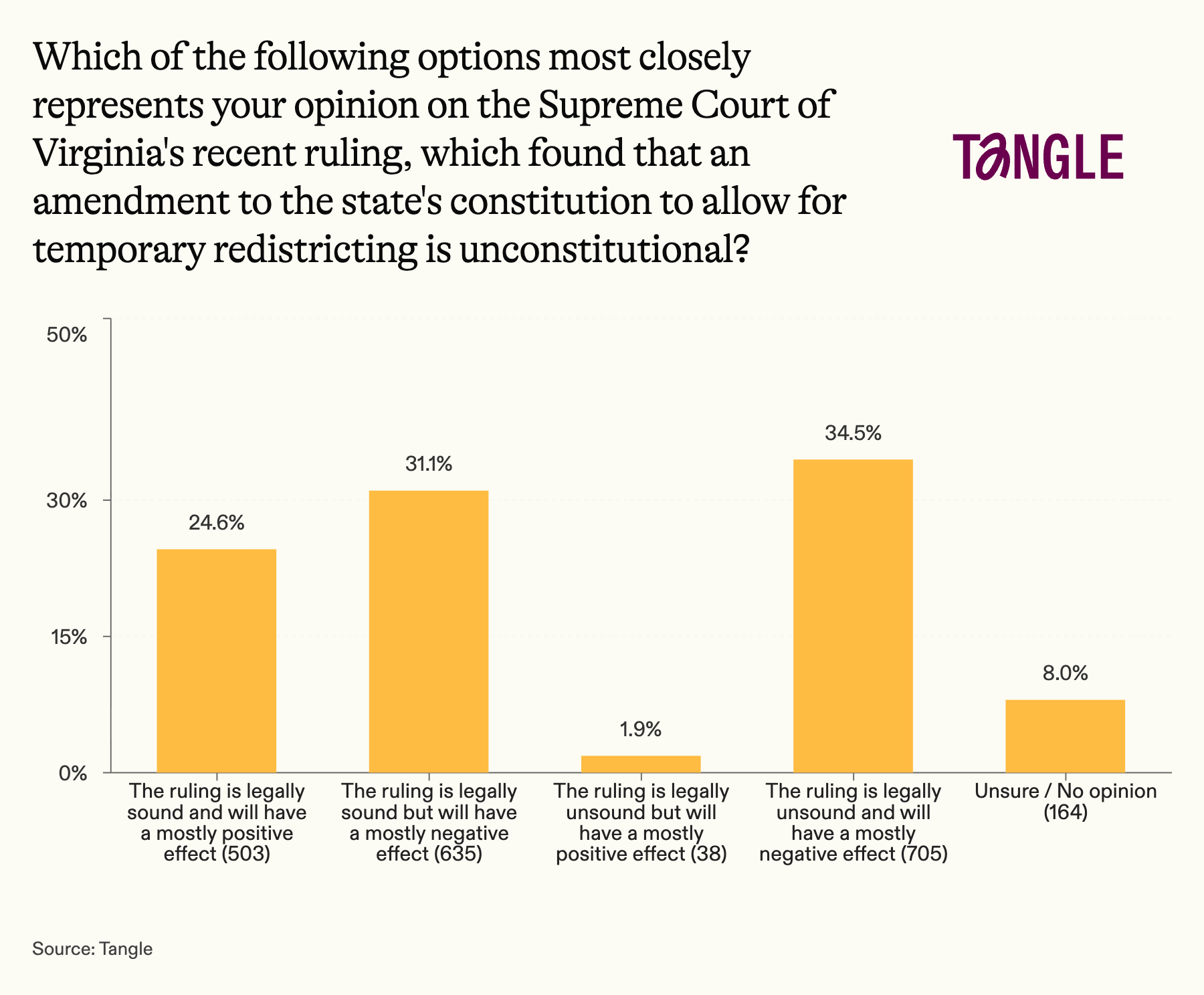
- Our last survey: 2,045 readers responded to our survey on the Supreme Court of Virginia ruling a temporary gerrymandering effort unconstitutional with 35% saying the ruling is unsound and will have a mostly negative effect. “It sucks both ways,” one respondent said. “As a Virginian, I am so frustrated by this entire situation. I very reluctantly voted in favor of the question, only because it was temporary and because Texas did it first, and for what? What a waste of Virginians’ time and money this whole situation has been. I’m fed up with both parties, honestly,” said another.
Have a nice day.
Four decades after the nuclear disaster at the Chernobyl Nuclear Power Plant, much of the land surrounding the site remains unsafe for human habitation. The lack of human pressure in this “exclusion zone” has caused it to explode with other residents: wolves, moose, deer, and lynx are just some of the species whose populations have rebounded. Wild Przewalski’s horses introduced in 1998 are also adapting to the area, which has not been associated with widespread animal die-offs despite persistent radiation. “For those of us in conservation and ecology, it’s kind of a wonder,” Denys Vyshnevskyi, the zone’s lead nature scientist, said. “This land was once heavily used — agriculture, cities, infrastructure. But nature has effectively performed a factory reset.” The Associated Press has the story.

Member comments