
I’m Isaac Saul, and this is Tangle: an independent, nonpartisan, subscriber-supported politics newsletter that summarizes the best arguments from across the political spectrum on the news of the day — then “my take.”
Are you new here? Get free emails to your inbox daily. Would you rather listen? You can find our podcast here.
Today’s read: 13 minutes.
Science Links Mitochondria & Muscle Strength
As our muscles age, they naturally lose mass, strength, and function – a result of certain muscle fibers shrinking – contributing to fatigue and weakness beginning as early as our 30s. Recent research highlights that the key player in this aging process is our mitochondria, tiny-but-mighty organelles that produce more than 90% of our body’s energy.
Importantly, scientists have found a strong link between decreased mitochondrial health and muscle health decline with aging, emphasizing the importance of maintaining these cellular engines.
A new way to support and improve muscle health as we age, Mitopure® by Timeline is clinically shown to meaningfully boost our mitochondrial health to improve muscle strength and endurance, without any change in exercise required.
Ready to feel stronger, for longer with Mitopure?
Tangle readers can take 30% off their first month with code 30NEWSLETTER for a limited time. While supplies last.
*This message is from one of our sponsors. Advertise with Tangle here.
Hey, thanks!
Quick hits.
- President Donald Trump announced he will fire Federal Reserve Governor Lisa Cook, citing allegations of mortgage fraud. Trump’s legal authority to remove Cook is unclear, and Cook said she would not leave the position. (The latest)
- President Trump signed an executive order directing Defense Secretary Pete Hegseth to create specialized units in the National Guard to respond to “public order issues.” (The order) Separately, the president signed an executive order directing Attorney General Pam Bondi to identify jurisdictions that have eliminated cash bail, then pause or eliminate their federal funding. (The order) Separately, Trump signed an executive order calling for penalties for people who burn the American flag “in a manner that is likely to incite imminent lawless action.” (The order)
- Israeli tank shelling on Nasser Hospital in the southern Gaza Strip killed at least 20 people, including five journalists. Israeli Prime Minister Benjamin Netanyahu said Israel “deeply regrets the tragic mishap” and is investigating the incident. (The strikes)
- Thousands of homes in California and Oregon are under evacuation orders and warnings due to ongoing wildfires. (The fires)
- A federal judge instructed the Trump administration that it is forbidden from deporting Kilmar Abrego Garcia until a hearing is held on his removal. (The order)
Today’s topic.
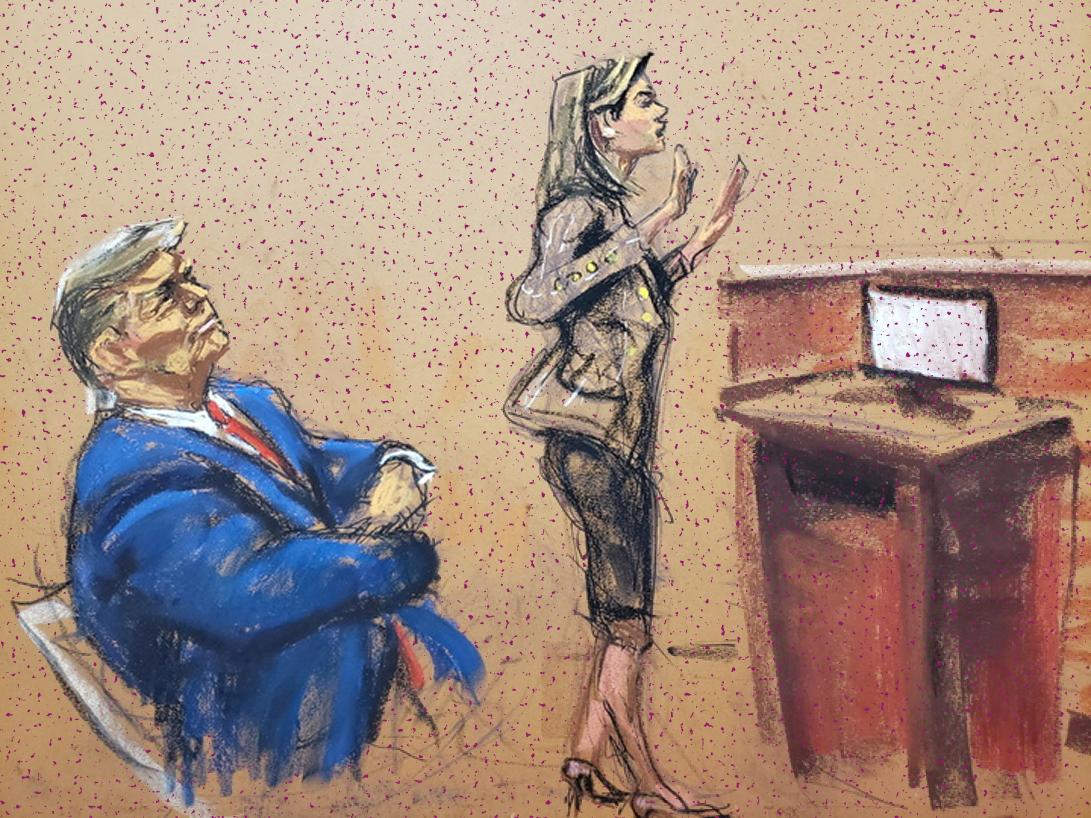
The voided civil fraud penalty against Donald Trump. On Thursday, a New York appeals court threw out a $527 million penalty against President Donald Trump resulting from a 2024 civil fraud judgment. The five-justice panel unanimously agreed to dismiss the fine but disagreed on other points, ultimately deciding to leave the other penalties against Trump in place — including barring Trump from serving in top roles at any New York company for three years, extending a similar ban to his sons (Eric and Donald Jr.) for two years, and installing an independent monitor for the Trump Organization.
Back up: In September 2022, New York Attorney General Letitia James filed a civil fraud lawsuit against then-former President Trump, the Trump Organization and other associates (including three of Trump’s children) in a Manhattan court, alleging that they had misled banks by falsely inflating the value of their assets to benefit the company. James sought $250 million in financial penalties and to appoint an independent monitor for the Trump organization.
In February 2024, following a contentious trial, Judge Arthur Engoron ordered Trump to pay over $354 million in penalties and barred him from serving in a top role of any New York company for three years. The fine accrued interest, and totaled over $450 million with pre-judgment interest at the time of the verdict. Trump immediately appealed the judgment, asking an appeals court to determine if Judge Engoron “committed errors of law and/or fact” and whether he “acted in excess” of his jurisdiction.
We covered Trump’s civil fraud judgment here.
In Thursday’s ruling, Justice Peter Moulton wrote that the penalty against Trump was “an excessive fine that violates the Eighth Amendment of the United States Constitution,” adding, “while harm certainly occurred, it was not the cataclysmic harm that can justify a nearly half billion-dollar award to the state.” Four of the five justices voted to uphold the fraud finding against Trump, but each found problems in Engoron’s handling of the case. In their written opinions, two justices expressed support for the other issued penalties, two favored a new trial, and another pushed to dismiss the case altogether.
President Trump celebrated the outcome, claiming “TOTAL VICTORY” in a post on Truth Social. “I greatly respect the fact that the Court had the Courage to throw out this unlawful and disgraceful Decision that was hurting Business all throughout New York State,” he added.
Attorney General James said she will appeal the decision to New York’s highest court, the Court of Appeals. James is an outspoken critic of the president and ran for attorney general on promises to “use every area of the law” to investigate the president and his businesses.
While Trump had not paid the full fine prior to the ruling, he was required to post a $175 million bond to prevent collection while he pursued his appeal; he is now eligible to have that money returned. Separately, the president can still appeal the civil fraud finding (and associated non-financial penalties) against him and the Trump organization.
Today, we’ll share arguments from the right and left on the ruling, followed by my take.
What the right is saying.
- The right welcomes the decision, framing it as a rebuke of Trump’s politicized prosecutions.
- Some note the appellate justice’s criticism of Judge Engoron’s handling of the case.
- Others say Trump’s claims of “lawfare” against him have been vindicated.
The New York Post editorial board called the ruling “the latest blow to Dem lawfare.”
“The ridiculously enormous fine was meant to hamstring him as he ran for president, though James and trial-court Judge Arthur Engoron pretended it was about warning others not to imitate his supposedly fraudulent actions. Actions that harmed . . . exactly no one,” the board wrote. “Their decision doesn’t void Engoron’s finding that Trump defrauded lenders and insurers by overestimating the value of his assets, though the Court of Appeals (the state’s top court) may do so. But either way it makes the case appear even more pointless than it already was.”
“Remember, James campaigned on promises to find something (anything!) to target Trump for — a witch-hunt, that is, that should have disqualified her from the start. These nothingburger civil charges were the best she could find; if they’d wound up before a less-biased judge than Engoron, they would’ve died long ago,” the board said. “As Judge Friedman suggested, Democrats thought if they couldn’t stop Trump through normal democratic means, they’d get the courts to stop him (to save ‘democracy’!). They failed on both fronts.”
In Fox News, Jonathan Turley said Engoron “gets the books thrown at him.”
“In New York, a court revealed that a leading citizen had cooked the books by inflating questionable figures without any support in reality. Moreover, his wild overvaluation was widely viewed as motivated by his self-aggrandizement. The final reported figures are so absurdly inflated that they were rejected in their entirety. In the end, he was off by over half a billion dollars. That man is Judge Arthur Engoron,” Turley wrote. “Judge David Friedman gave Engoron a close-up… He detailed how the underlying law ‘has never been used in the way it is being used in this case — namely, to attack successful, private, commercial transactions, negotiated at arm’s length between highly sophisticated parties fully capable of monitoring and defending their own interests.’”
“Trump can now appeal the residual parts of the Engoron decision imposing limits on the Trump family doing business in New York. Some of those limits could be moot by the time of any final judgment. Ironically, if Engoron had shown a modicum of restraint, he might have secured a victory. During the trial in New York, I said that he would have been smart to impose a dollar fine and limited injunctive relief,” Turley said. “Instead, Engoron chose to walk down the stairway into infamy. He was off by half a billion dollars, which could put him in the Bernie Madoff class of judges.”
In National Review, Andrew C. McCarthy suggested the outcome is “a significant victory for the president.”
“Trump has not been completely vindicated — at least not yet. The appellate division was divided on the underlying merits of the case, but it left in place the lower court’s fraud verdict. Moreover, some of the nonfinancial injunctive penalties meted out by Judge Arthur Engoron (like James, an elected progressive Democrat) will remain in place,” McCarthy said. “Still, Trump could ultimately be vindicated in full… The case will now move on to the Court of Appeals, the state’s highest tribunal.”
“The appellate division was skeptical from the outset about the astronomical penalty. The patent lack of fit between the wrong and the punishment explains why, in one of its first actions in the case, the appellate court slashed the amount of the bond Trump was required to post in order to stop James from enforcing the judgment while the now-president pursued his appeal,” McCarthy wrote. “Today is a very good day for President Trump. But he is playing with fire in seeking retribution against his tormentors by using the very same lawfare tactics. He can have a much more successful presidency if he accepts that he got his retribution by winning the election.”
What the left is saying.
- The left is mixed on the decision, with some calling it sound but arguing Trump should also heed its findings.
- Others highlight the non-financial penalties that remain in place.
- Still others question why Trump would celebrate when the fraud conviction remains in place.
The Washington Post editorial board wrote about “Donald Trump and ‘selective’ prosecution.”
“A New York court not known for its friendliness toward Donald Trump threw out on Thursday an outrageous judgment against him. The White House will rightly celebrate this development, but it’s also a good moment for the president’s advisers to rethink the administration’s own escalating lawfare campaign,” the board said. “The Thursday decision comes as the Trump administration is launching its own version of show-me-the-man-and-I’ll-show-you-the-crime lawfare. ‘Mortgage fraud’ seems to be the administration’s weapon of choice, and it has referred James, Sen. Adam Schiff (D-California) and Lisa Cook, a member of the Federal Reserve Board of Governors, for criminal investigation.”
“Trump officials would be wise to pay attention to the warning of David Friedman, the New York judge on the appeals panel most sympathetic to Trump’s arguments. Friedman argued that James’s case amounted to ‘selective enforcement’ of a fraud statute ‘in retaliation for President Trump’s exercise of his First Amendment right to participate in the political process,’” the board wrote. “Courts can mitigate the destructiveness of lawfare — but if politicians keep abusing the legal system, maybe not for long.”
In Slate, Shirin Ali suggested the ruling “was not nearly the Trump victory it’s being billed as.”
“This is how the 2–2–1 ruling shook out: Justices Peter Moulton and Dianne Renwick concluded they would only vacate Trump’s financial penalty, Justices John Higgitt and Llinét Rosado would vacate the penalty and send the case back down for a retrial, and Justice David Friedman, alone, would have thrown this case out in its entirety and banned New York state from retrying the president on this issue,” Ali said. “Ultimately, New York’s high court will decide whether the fraud verdict stands and if Trump is actually off the hook. For now, it seems like the price tag for wrongdoing will shrink, but that’s as much as we can say.”
“Meanwhile, James’ office has promised to appeal the appellate court’s decision, while also reminding us that only Trump’s financial penalty has been vacated. Other limitations on the Trump Organization’s ability to do business in New York remain in place, including a ban on Trump serving in top-level positions at his own company for three years while his sons, Donald Trump Jr. and Eric Trump, are banned for at least two years,” Ali wrote. “Despite how the headlines read, that real consequence might still arrive in this case, though, even if not in the form of a half-a-billion-dollar penalty.”
In Above the Law, Joe Patrice said “most people don't consider being called a fraud a ‘win.’”
“The good news for Donald Trump is that a New York appellate nixed the nearly half-billion dollar disgorgement judgment the Trump Organization owed for consistently defrauding financial institutions. The bad news is that the fractured court still agreed with the underlying judgment and his business operations are rightly enjoined,” Patrice wrote. “The appellate opinion struck down that award, ruling that it amounted to an unconstitutionally excessive fine as opposed to mere disgorgement of ill-gotten gains.
“The court affirmed that Trump lied, cheated, and cooked the books to inflate his wealth, and it left intact the structural injunctions effectively barring his family from running a business in New York. But, pop the champagne, Donny! You ‘won,’” Patrice said. “All but one of the justices agreed that Attorney General Letitia James was well within her rights to bring this case… Without any path to a three-justice majority and desperately in need of getting this opinion out the door, Higgitt and Rosado conceded to join Moulton and Renwick in the decretal alone. Now the basketcase of an opinion can be appealed to the New York Court of Appeals.”
My take.
Reminder: “My take” is a section where I give myself space to share my own personal opinion. If you have feedback, criticism or compliments, don't unsubscribe. Write in by replying to this email, or leave a comment.
- James ran on prosecuting Trump, overreached, and now a key part of her work has been rightfully undone.
- It does feel unfair that normal people get busted for fraud that richer people routinely get away with.
- Now, Trump is retaliating against James (and others), and I worry about what will come next.
This latest development is not particularly surprising.
Yesterday, I wrote about how the case against Trump for mishandling classified documents was the most airtight lawsuit he faced; by contrast, this case was the weakest — a classic example of nakedly partisan prosecution.
Since the early days of James’s lawsuit, I was skeptical about the case she was building. James centered her fraud case on a vague and broadly written statute, and leveraged it into seeking retribution that far exceeded the damage to the public she was representing (if she could even prove such damages at all). Remember: No private party sued Trump. The banks, lenders and real estate entities James said he defrauded all made money from working with him, and entities like Deutsche Bank testified on Trump’s behalf during the trial. Furthermore, James campaigned for her job by explicitly promising to find a crime to prosecute Trump for. I wasn’t the only one who thought she was out over her skis: Plenty of people, including former prosecutor Steven M. Cohen, warned about the danger of this prosecution at the time.
These problems were all exacerbated by Judge Engoron, whose comments inside the courtroom sparked (rightful) concern that he had his own vendetta against Trump. As I said right after Engoron issued his ruling: “In seeking to rein in Trump's behavior, James and Engoron have gone far beyond what seems reasonable.”
This was not particularly hard to decipher in real time, so this new judgment should not come as any big surprise.
But, as usual, this decision isn’t the complete vindication Trump claims it to be. The appeals court was divided on how to right Engoron’s wrong: Two judges believed that the half-billion-dollar reward was too excessive because Trump didn’t cause that much harm, two said James had the authority to sue but wanted a new trial with a new judge, and one said the case was politically motivated and should be thrown out. And while the court ultimately decided to let the fraud ruling stand (for now), every single judge raised issues with how the case was handled and Engoron’s actions in particular.
Part of what makes this case so divisive is how it fits into the “prosecute them all” standard I laid out yesterday. Normal people — people with far less power and influence than Trump — get prosecuted for similar crimes on a much smaller scale all the time. In the Coffman Chronicle, a writer who goes by the name General Azmundus made the case like this:
When a single mother lies about her income to qualify for food stamps, prosecutors call it welfare fraud. The penalties include jail time, criminal records, and lives destroyed. When a working-class man exaggerates his wages on a mortgage application, banks call in the feds. People have been sentenced to years in prison for fraud measured in the tens of thousands of dollars… When billionaires can cheat and appeal their way out of punishment while ordinary people are jailed for far less, the rule of law becomes a hollow slogan.
I don’t have much to say about this perspective except that I think it’s true. I could raise a counterpoint and argue that in all those cases the federal government had much clearer standing to sue or bring charges than in this one, but that doesn’t change the underlying unfairness of class disparity.
The fraud that Trump committed for decades (per the civil court’s finding) was not unusual — plenty of other people in the real estate business commit similar kinds of fraud regularly, which is less of an excuse for Trump and more of an indictment of a system that prosecutes poor and middle-class people for fraud but allows it to be routine for the wealthy. The solution, to me (and to this panel of judges), is that Trump should have faced repercussions for his actions, but not the excessive penalties that he received in February 2024. Again, I’ll refer back to my writing at the time:
Paying any back taxes he owes or has evaded — money that belongs to the public — would be appropriate. He did lie, he has a history of harmful fraud, and the idea that "nobody got hurt" in this case is not enough to wave it all away (someone who drives drunk without crashing their car should not be exempted from any kind of accountability). But, to steal a line from The Wall Street Journal editorial board, “this remedy is like using a Hellfire missile to annihilate a shoplifter”... What we're left with is the peculiar sense that Trump is both guilty of something real but simultaneously the victim of something more insidious and far-reaching.
Now, of course, the president has promised revenge.
While the massive penalty James sought looks poised to be thrown out for good, she herself is under investigation by the Department of Justice for possible mortgage fraud — which appears to be Trump’s new go-to allegation for prosecuting his enemies.
In other words: James campaigned for office by promising to prosecute Trump, found a crime to try to pin him for, and then pushed an excessive penalty that would eventually be thrown out. Trump campaigned for office by promising vengeance against the people who wronged him, and now that he is in office the DOJ is probing James over the allegation that she claimed a Virginia home as her primary residence to secure advantageous (and fraudulent) loan terms. The allegation is of a similar color to the ones James prosecuted Trump for, which is less ironic and more of a signal of Trump’s intent here.
And around we go.
Ultimately, Americans of all political stripes would be wise to ruminate on the larger takeaways of this story. I have no idea when this hell-cycle of prosecutions will end, but the genie-out-of-the-bottle effect that comes every time the Overton window moves should now be obvious to Democrats, who were cheering this prosecution just a year or two ago. In the same vein, Republicans who are confidently backing Trump should apply some caution to the gerrymandering arms race, or Trump’s suppression of speech, or his domestic deployments of the military.
We should all nervously wonder about what is on the other side of these executive power grabs in a few short years when Trump isn’t president.
Nobody can see into the future, but the truth is you don’t have to. The present has plenty of valuable lessons.
Take the survey: What is your favored outcome in this case? Let us know!
Disagree? That's okay. My opinion is just one of many. Write in and let us know why, and we'll consider publishing your feedback.
Your questions, answered.
Q: Is it true (in what the left is saying) that the tax cuts [in the OBBBA] benefit the top one percent significantly and to the rest of the citizens hardly at all?
— John from Belmont, MA
Tangle: Yes and no. It is not true that the bill disproportionately benefits the ultra wealthy when it comes to income: The tax benefits enshrined by the One Big Beautiful Bill Act (OBBBA) favor the higher income brackets, but within the top 20%, the benefits decrease as incomes increase. However, the wealthiest 1% accrue tax benefits in other ways.
Let’s start with income. According to an analysis from the Yale Budget Lab, about 3% of the bottom fifth of earners will come out with an additional $500 in post-tax income thanks to these tax cuts, while a statistically insignificant portion will have an increase of $5,000 or more (mostly due to their already low levels of income). Comparatively, around 65% of the top fifth of earners will receive a tax break of $500 or more, and 7% will get an increase of $5,000 or more. Within that top group, however, the trend reverses as income increases, as shown in the below chart from the Yale Budget Lab.

As a refresher, the OBBBA introduced only a handful of novel tax cuts: Expanding the Child Tax Credit helps people across income brackets, increasing exemptions on tips and overtime pay benefits mostly lower-income earners, and temporarily expanding the state and local tax (SALT) deduction benefits primarily higher-income earners. However, most of the benefits from the OBBBA come from making permanent the otherwise-expiring tax cuts first introduced by the Tax Cuts and Jobs Act passed during the first Trump administration in 2017.
Still, the non-income tax benefits enshrined by the OBBBA are much greater — particularly the tax benefits for passthrough businesses and cuts to the estate tax, which predominantly favor the wealthy. According to an analysis by the Tax Policy Center, the changes will reduce the tax bill for lower-income households by less than 1% of their income, by just over 2% for middle-income households, and by 4.3% for high earners.
Want to have a question answered in the newsletter? You can reply to this email (it goes straight to our inbox) or fill out this form.
Under the radar.
On Friday, the U.S. Department of the Interior halted construction on a major offshore wind project off Rhode Island's coast. The department’s Bureau of Ocean Energy Management cited “concerns related to the protection of national security interests” as justification for the pause, instructing the company behind the project, Orsted, not to resume work until the bureau had completed “its necessary review.” According to Orsted, the project, which was originally approved under the Biden administration, is 80% complete; however, the second Trump administration has taken a critical stance on offshore wind, attempting to block many planned wind projects. Axios has the story.
Unlock your body's natural energy source. Your mitochondria power 90% of your body’s energy, but they slow down with age.
Mitopure® is clinically proven to recharge your cells and support muscle strength, energy, and recovery. The product of 15 years of research and 11 clinical studies, now 30% off.
Numbers.
- 1,065. The number of days between New York Attorney General Letitia James filing her civil fraud lawsuit against President Donald Trump, the Trump Organization, and its leaders and the appeals court decision throwing out the financial penalty against Trump in the case.
- 323. The length, in pages, of the appeals court’s decision.
- 44. The number of days of testimony in President Donald Trump’s civil fraud trial.
- 25 and 19. The number of witnesses for the New York attorney general’s office and witnesses for the defense, respectively, during the trial.
- $355 million. The approximate amount Trump was ordered to pay in penalties in his civil fraud case.
- $454 million. The approximate total fine with interest at the time the judgment was handed down.
- $112,000. The approximate additional penalty for each day that Trump had not paid the fine in full.
- $0. The amount Trump owes after Thursday’s appeals court ruling.
The extras.
- One year ago today we covered Robert F. Kennedy Jr. dropping out of the presidential race and endorsing Trump.
- The most clicked link in yesterday’s newsletter was the Pentagon planning a military deployment to Chicago.
- Nothing to do with politics: “Skibidi,” “tradwife,” and the other new additions to the Cambridge Dictionary.
- Yesterday’s survey: 2,610 readers responded to our survey on the FBI raid on John Bolton’s home and office with 46% calling it likely unjustified and motivated by personal animus. “I'm not going to believe this is anything other than revenge until I see evidence otherwise,” one respondent said.

Have a nice day.
Michelle Last’s father was a veteran of the Vietnam War, and after he took his own life in 2006 Michelle founded a nonprofit wolfdog sanctuary to aid other veterans struggling with mental health issues. Based in Wisconsin, Apex Angels & Warriors provides non-traditional therapy for veterans through connection with wolfdogs, a hybrid species between domestic dogs and gray wolves. For Jeff Yunk, who served two tours in Afghanistan, the organization has provided support and helped him in his relationships with friends and family. CBS News has the story.
Don’t forget...
📣 Share Tangle on Twitter here, Facebook here, or LinkedIn here.
🛍 Love clothes, stickers and mugs? Go to our merch store!

Member comments