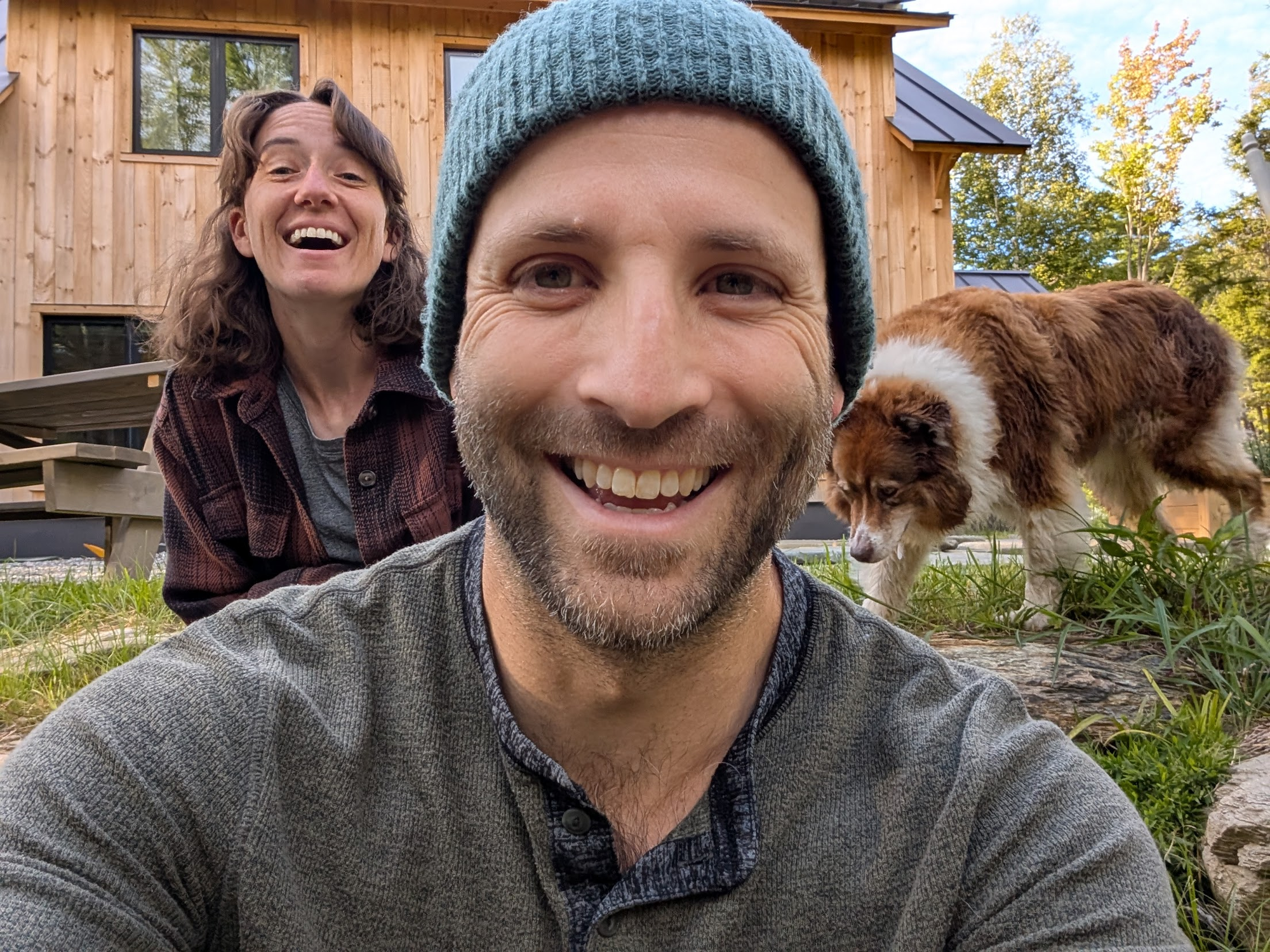
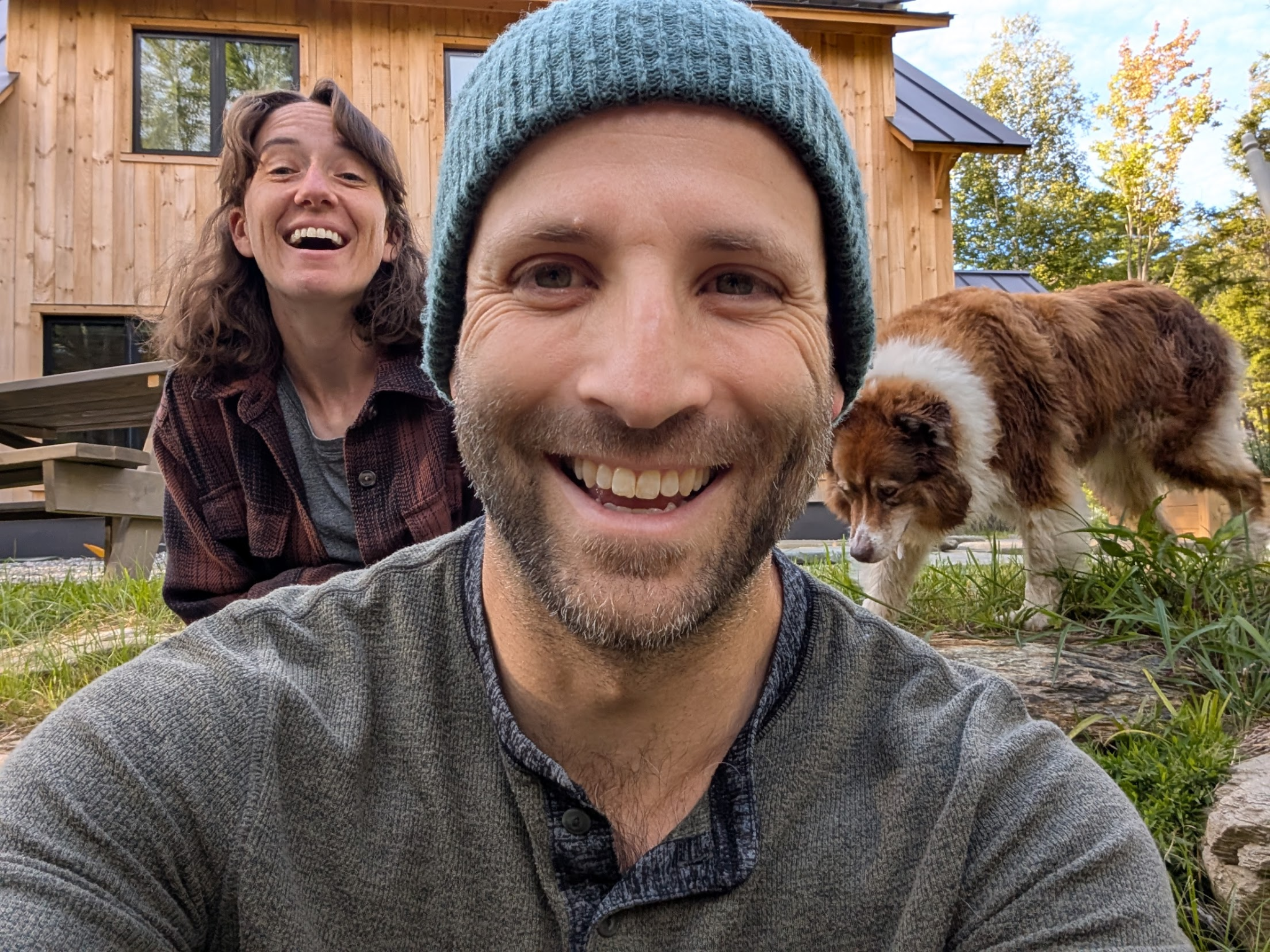
This month's featured employee is Tangle Managing Editor Ari Weitzman, pictured above with his wife and dog. Image: Ari Weitzman
Note: This is a free preview of our members-only edition of Press Pass, our once-a-month behind-the-scenes look at Tangle. To unlock the full edition, you'll be asked to subscribe.
“Is this your life’s work?”
That’s a question a friend and mentor asked me recently as we discussed a larger media organization’s offer to buy Tangle.
“You have to decide,” he told me. “Is this a business you are running? Or is this your life’s work?”
The question’s simplicity and profundity stopped me in my tracks. I thought about it all day, then for a few more days, and after a week I’m still thinking about it. This is my life’s work is the obvious answer. I have my dream job serving a mission I care deeply about, and I’m on this great big beautiful crazy ride with a bunch of people I love, an audience I respect, and for a country I’m obsessed with (in all the good and bad ways obsessions manifest).
I write, and people read what I write, and I make a good living doing it. Bonus points: I get to build a team and employ a crew of some of the best people in the business. What could be better than that?
But I’m also running a business. And practically speaking, the business keeps my life’s work alive. If the business doesn’t work, the life’s work dies. So I have an answer to my friend’s question, but also a tough calculation to make about how to endure. Will the business do better under my stewardship or someone else’s? And if I’m unsure, how much financial security would actually make me bet on someone else over myself?
One of the primary reasons I haven’t sold Tangle — and don’t plan to anytime soon — is that we just have so much left to do, and I like betting on myself. I don’t feel finished; I feel energized. Despite how well the business is operating, I also don’t feel like we’ve come close to fulfilling our potential. 500,000 people read our newsletter, but three million people watch Fox News every night. Our audience could — and should — be much bigger, and I know that if we continue to produce great coverage, that will happen. It’s a build it and they will come attitude, except many of them (you) already have, and I believe many more of you are out there.
In that spirit, we’re building. This month, we’ll be onboarding a new salesperson, a new associate editor, and a new video editor. We’re also bringing in some fractional help on the growth side to scale up the audience of our newsletters and videos. And down the road, we’re thinking about bringing in more contributing writers to further diversify the ideological views of our editorial staff. After going through the interview process for all these roles, I was reminded of how many unbelievably talented people live in our country — how many smart, gifted, likable, hard-working people are ready to commit to a company like ours. It’s amazing and rewarding to just go through the process, even if the decision-making itself is fraught and difficult.
This month, we are also, for the first time, bringing our live show to a very small American town. We’re headed to Berkeley Springs, West Virginia, this weekend for a VIP dinner on Saturday night and a matinee live recording of our podcast on Sunday afternoon. Most of the Tangle team will be there, and we’re excited to prove that we don’t just have to hit major U.S. metropolitan areas like New York, Philadelphia, or Los Angeles to fill a room with Tangle fans. The VIP event is sold out, but general admission tickets are still on sale. Special shoutout to our title sponsor Dignity Index and our VIP experience sponsor Incogni.
As a reminder: Berkeley Springs is a gem of an American town, and if you’re looking for some last-minute weekend plans, you should come down to spend time with the Tangle team. It’s a short drive from D.C., Philly, and Pittsburgh.
Speaking of Pittsburgh, this week we’re putting everyone’s favorite Yinzer in the staff hot seat: Managing Editor Ari Weitzman.
Meet Ari.
Katie, Ari, and Callie's first summer in their new home. Image: Ari Weitzman
I regularly invoke an expression from an old coach of mine: The meaning of life is doing hard things with the people you love.
That outlook has served me well for a decade now, and with each year that passes I believe it more and more. Difficult things are often meaningful; meaningful things are meant to be shared; sharing meaningful things with people you love is the best.
I first met Ari my freshman year of college. We were teammates on the University of Pittsburgh’s ascendant ultimate Frisbee team. Ari, four years my senior, had just transferred to Pitt from the University of Chicago to use his fifth year of college eligibility to play in his hometown. We were both new to the team but on different ends of our college experience, and the squad itself had made it to the quarterfinals of college nationals for the first time the year before. Opportunities abounded.
At tryouts, one of the first things I noticed about Ari was his incredible catching skills. We were all athletes, and all good at catching Frisbees, but he was different; he’d snatch a Frisbee in the most precarious and difficult scenarios that exist in the sport, sometimes by launching himself fully sideways while running full speed in a forward direction, often at a full extension and about shoulder height, before grabbing a disc with a finger or two by its rim and then gracefully rolling to the ground and back to his feet (video proof, for the haters).
Over the course of our now 16-year-long friendship (wow), Ari’s catching abilities have been a central theme. For many years, I took to randomly throwing all manner of objects at him at unexpected times just to see how he’d do: Ketchup bottles, knives, balls, keys, pieces of food, and, yes, Frisbees. He’d rarely disappoint. He was especially good at beer die, a favorite drinking game of ours, which (in part) requires snatching a die as it bounces off a table and before it hits the ground.
The second thing I noticed about Ari was that he wore the number 19, which inconveniently was my number and meant I’d have to find a way to ensure he wasn’t wearing it at the season’s start. I’m not sure how to say this tactfully, but I didn’t think I’d have much trouble. Ari was a fifth-year transfer from an ultimate program that had never really won much of anything, and I was a hotshot blue-chip recruit from the best high school team in the country who was part of a longer-term plan to turn Pitt’s team into a national champion. Despite his seniority, I figured I’d get what I wanted. Ari had different plans.
I can’t quite remember the deliberations, or how we arrived at our particular solution, but the team ultimately landed on a battle of oratory persuasion (the irony of what Ari and I now do for work is not lost on me). We’d both get to make our case to everyone about our number, and then the team would vote on who got to wear 19. I went first, explaining that the number was a dedication to the loud-mouthed, swaggy, always-dominant former NFL wide receiver Keyshawn Johnson, and that I’d never worn another number in my career. Also, I was Isaac Saul and I wanted the number.
Ari went second, explaining to the team that when he was a teenager he’d had a surgery to remove a tumor from his small intestine, a procedure which came with a one in 10 chance of death, and as he went under anesthesia the doctor asked him to count down from 20. The last number he said aloud before losing consciousness was “19,” and before he woke up a few hours later it could have been the last word he ever uttered. He said the number was both a reminder of how fragile and precious life was, but also of how resilient he could be.
Needless to say, I wore the number 91 that year. And Ari and I have been best friends pretty much ever since.
We went on to win two college national championships together (Ari coached for both of them, after we lost in the semifinals during our one year playing together), and throughout my time in college we grew closer and closer. Among other things, we started a bridge club, had a writer’s group, devoted inordinate time to all manner of sports, and once spontaneously jumped on a moving train in downtown Pittsburgh and rode it out of town together. Ari moved west for a bit, and I ended up in Israel after college, but we never lost touch; in fact, we’d keep in touch through lengthy, multi-thousand-word email updates on each other’s lives, always written with the intent to inform, debate, converse, and entertain. Occasionally, I’ll go back and read those emails now, blown away at what our lives used to be like and how much of it we documented.
When I started Tangle, Ari made a regular habit of writing in and replying to emails. Sometimes he’d offer edits to my writing, or pushback on my political views, or just a compliment about how helpful an edition was. He was so persistent that eventually I asked if he’d want to make it formal, start editing the newsletter part-time, and see where it went. We were in a writing group with his friend Craig (shoutout Craig!) at the time, so he was already familiarizing himself with my tone, style, and voice. It quickly became a delight, having someone who knew me so well and my writing so closely who could also communicate to me on a personal and honest level about what was working and what wasn’t.
In the early years, we were still more friends than colleagues. Somewhere in there, Ari married a wonderful woman and fellow Frisbee player (whom I actually knew before I knew Ari), and I got to serve as de facto best man at their wedding and sign their marriage certificate as a witness. I got married, too; we survived Covid; and then ended up living relatively close to each other again in the Northeast. The editing started and never really stopped, and eventually Ari’s edits became so invaluable we laid out a plan for him to leave his job and come work for Tangle.
Now, Ari is our managing editor. I guess to this day, I still rely on him to catch everything.
There’s a whole subset of entrepreneurs who insist that you should or shouldn’t “hire your friends” to build great companies. I always had mixed feelings about the practice before hiring Ari, and I wish I could tell you something unambiguously good or bad about it now. But the truth is… it’s complicated. I love Ari, and our closeness is almost always an asset. It makes communicating with each other easier and understanding each other close to seamless. There’s institutional knowledge of each other’s person that saves time in a way I can’t quite articulate. Yet the proximity can breed frustration, we butt heads a lot, and we communicate with each other in ways that other team members probably never would. So it’s a dynamic — mostly good, but sometimes hard — and I’d be lying if I told you we hadn’t exchanged some sharp Slack messages with each other over the years.
Still — and maybe this is what the Ben & Jerry’s of the world have learned — I wouldn’t trade it for anything. The meaning of life is doing difficult things with people you love. Ari feels like a brother I’ve been to war with, a friend who’d eulogize me, and now a partner in a business we’re both betting our livelihoods on. It’s hard. It’s meaningful. And it’s full of love. It doesn’t hurt that he’s got an encyclopedic knowledge of just about every topic under the sun, he’s the best editor I’ve ever had, and he’s allergic to people who think in black and white terms. All of that has made him one of the most important and valuable hires in Tangle history.
So, this month, I’m proud to introduce my dear friend Ari Weitzman.
Q: Can you start by telling us a bit about your hometown and upbringing?
I grew up in Plum, Pennsylvania — a small town in the eastern suburbs of Pittsburgh — the middle child between an older sister and younger brother. My parents’ parents were close friends growing up, so my extended family kind of always felt like one family. They were classic Pittsburgh Jews; my dad went to Taylor Allderdice High School (where Wiz Khalifa and Mac Miller would eventually go) and my mom went to Baldwin in the South Hills.
My family and I were practicing Jews — technically. Us kids were bar and bat mitzvahed, but we were the kinds of Jews who only went to temple on the holidays, when they removed the temporary walls in the synagogue for the people like us to make our pilgrimages to Murrysville. Both my parents were extremely left-coded, in a kind of 1980s workers’ rights way. My mom worked out of a trailer next to the city’s last steel mill, overseeing a program to teach mill workers new skills as U.S. Steel downsized. My dad worked for the Department of Labor, first out of the Pittsburgh office, then Philadelphia’s, then D.C.’s, which meant he was traveling constantly.
Growing up, the person who had the biggest impact on me was my best friend Ryan. He was unbelievably cool (to me), and I eventually gave up my lame hobbies (playing soccer and running track) for his much cooler ones (musical theater and cutting gym). A strict nonconformist, he clearly didn’t care at all what people thought about him; and he loved to argue.
Ryan grew up in a Mormon (the preferred term at the time) home, but like me he wasn’t religious. Unlike me, he was aggressively not religious. He used to share all the pamphlets the church handed out with me so we could laugh at them, like the ones that said Mormons should be nice to the Jews because they were basically God’s pets. Still, family influences seeped through; his family was red team, and mine was blue team. He and I used to argue all the time about anything and everything: the Iraq War, Democratic tax policy, and things like moral relativism or which Ben Folds album was the best. If you were to open up my skull, you’d find Ryan’s thumbprint pressed upon my brain.
Q: Why did you decide to work at Tangle?
I have reasons: I believe in Tangle’s mission. I’ve always been a writer at heart, and I think I’m naturally suited to be an editor. I like being able to shape public discourse. I like working with one of my best friends, even on the days when we can’t stop arguing — maybe especially on those days, because I feel like it’s my job sometimes to keep you uncomfortable. I think this company is going to be successful, and I believe I can be a big part of what helps it to succeed.
But, listen: I believe every major decision we make in life is one we make on intuition, and then we come up with credible post-hoc reasons for why we made them to tell ourselves later, to tell other people later — the friends who want to know, the people we want to impress at parties, the readers who want answers in the newsletters that we edit. The real reason I decided to work at Tangle was that I knew I was supposed to. Before joining Tangle full time in 2023, I had spent about a year helping out by volunteering time in the mornings to edit the newsletter, even drafting some responses to readers in the inbox. It was work I was supposed to do, and I think we both knew it. We just had to keep going until the economics made it justifiable for both us.
Q: What’s the hardest part of your job? What’s the part you enjoy most?
The hardest part is just the hours, man. Every day at lunch, I finish a full day of work. I’m online between 6:00 and 6:30 AM to start reading the news and catching up on my email. Then, I’m drafting portions of the newsletter and editing others basically constantly until noon. After that, it’s a million little things for the rest of the day, which sometimes goes late into the evening. Some days, you can feel how the pace is not sustainable; for over a year I’ve been working to try to make sure I’m not the only one who knows how to do anything, trying to plan for a future where I can commit fewer daily hours to Tangle without the quality dropping. That’s selfish, yes — after all, we’ve got a kid on the way and I just need more time away from the screen. But I also think Tangle will be better if I have more time to think, write, and help the business grow.
Relatedly, the best part is being a small, contributing factor in the growth of my colleagues. Will, Audrey, Lindsey, and you, Isaac, have all grown as people and as writers since I’ve been here. Russell is finding an impressively mature and well rounded voice, Candida published a massively informative Friday edition this past week, and Aidan’s YouTube videos are becoming appointment viewing. It’s been deeply rewarding to be a part of that development.
Q: What’s your favorite story (fit for the public) about our friendship?
There are many answers, but there’s really only one answer.
This post is for paying subscribers only
Sign up now and upgrade your account to read the post and get access to the full library of posts for paying subscribers only.