




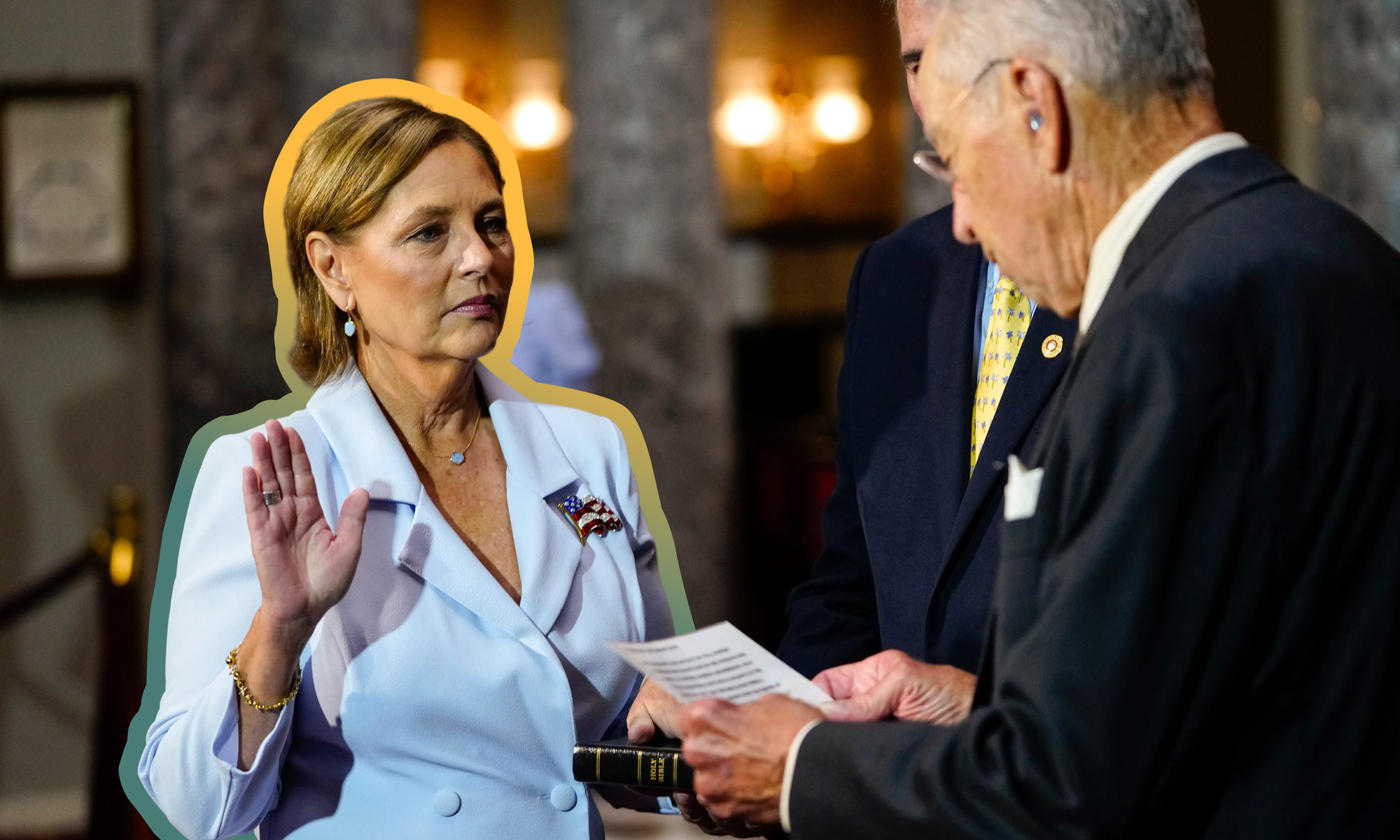


Happy Wednesday. I’m Isaac Saul and all I can think about while I sit at my desk is how to find an excuse to drive my newly purchased (and previously used) Chevy Colorado pickup truck. If you have any errands you need to run — Groceries? Moving? Laundry? Friend stuck atop a muddy trail? — just drop me a line. I would treat any excuse to climb in, roll the windows down, and bumble down the street as a blessing. Thank you.
While I’m stuck here writing, though, I suppose it’s time to discuss Darline Graham’s decision to run for her brother’s Senate seat, a story that I think should be way more controversial than it seems to be. We also have our new video on Alaska’s ranked-choice voting system and a deeper look at the history of family members replacing elected officials. It’s a 15-minute read, and I’m a little fired up.
ICYMI.
Yesterday, we released our report on the fight over Alaska’s novel election system, which uses a top-four primary and ranked-choice voting in the general election. Senior Editor Will Kaback traveled to the state to talk with proponents and opponents of the system — and how it’s already changed Alaskan politics. What he found might surprise you. Check out the video here:
Quick hits.
- New Jersey Gov. Mikie Sherrill (D) said that an error in the state’s Motor Vehicle Commission system between June 2023 and June 2024 led to approximately 6,600 noncitizens being registered to vote. Sherrill claimed that fewer than 400 of those erroneously registered had subsequently voted and did not impact any election outcomes, but ordered an investigation into the error. (The announcement)
- President Donald Trump approved a civilian nuclear-development agreement with Saudi Arabia; American companies are expected to play a leading role in establishing the program. (The agreement)
- New York City Mayor Zohran Mamdani (D) said the city does not have the “independent legal authority” to arrest Israeli Prime Minister Benjamin Netanyahu, days after saying his administration was exploring the possibility of executing an arrest warrant from the International Criminal Court for the Israeli leader if he visited the city. (The comments)
- Defense Secretary Pete Hegseth and Joint Chiefs of Staff Chair Dan Caine testified before the Senate Appropriations Committee, requesting a roughly $80 billion emergency funding package to support military operations in Iran. Hegseth said the estimated cost of the conflict is $37.5 billion to date. (The testimony)
- French lawmakers passed a ban on social media access for children under 15, the first such ban in the European Union. (The ban)
Hackers don’t guess. They buy your data.
In 2025, the FTC received over 3 million fraud reports, with consumers losing $15.9 billion — much of it tied to identity theft from dark web data.
Criminals can use stolen details to claim benefits, take loans, rent apartments or cars, rack up medical bills, and trigger warrants in your name. When you finally find out, the debts and legal nightmares are already piling up.
Coveron scans the dark web 24/7, sends instant alerts, provides up to $1 million in identity theft recovery coverage with expert recovery support and offers further protection from online threats.
Use code TANGLE for 71% off.
Today’s topic.
Darline Graham’s candidacy. On Monday, Sen. Darline Graham (R-SC) said she will run for a full, six-year term to succeed her brother, Sen. Lindsey Graham (R), who passed away suddenly on July 11 after suffering an aortic dissection. Republicans will hold a special primary on August 11 to select a new candidate to run against physician Annie Andrews (D) in the general election.
Back up: South Carolina Gov. Henry McMaster (R) appointed Graham to serve out the final months of her brother’s term shortly after his passing. President Donald Trump recommended the appointment and has expressed support for Graham’s full-term candidacy. Several other Republican candidates are expected to run in the August primary; if no candidate receives more than 50% of the vote, a runoff will be held on August 25.
Graham has not previously held elected office. In her career, she has worked in roles with Clemson University, the South Carolina Department of Employment and Workforce, and the South Carolina Department of Vocational Rehabilitation. Currently, she is serving on the state’s Workforce Development Board and is president-elect of the National Council of State Agencies for the Blind.
In her announcement of her full-term Senate bid, Graham said that she wants to “step in and carry on [my brother’s] legacy,” adding that she feels an “inner peace” about the decision. She said she plans to focus her platform on domestic issues in contrast to her brother, who was an influential voice on foreign policy throughout his career. However, Graham said that she also views national security and border control as important issues.
Rep. Russell Fry, Rep. Ralph Norman and businessman Mark Lynch are among the Republicans who have announced they will run for the nomination, while former Gov. Mark Sanford and Lt. Gov. Pam Evette have also signaled interest. Most candidates have sought to align themselves with the president despite his endorsement of Graham, with Rep. Norman saying the endorsement “helps a great deal” but the nomination is “up to the people.”
Today, we’ll have perspectives from the right and left on Graham’s candidacy, followed by Executive Editor Isaac Saul’s take.
|
What the right is saying.
|
In the Washington Examiner, Byron York described “the unknown Darline Graham.”
“[Graham’s campaign announcement] was all very exciting, but then people began to ask: What do we really know about Darline Graham? Yes, she was Lindsey Graham’s beloved sister, but what are her positions on the zillions of issues and questions she would face as a U.S. senator?” York wrote. “Graham gave an initial hint when she discussed her brother in an interview with Fox News’s Sean Hannity… [saying] ‘Protecting our borders, national security, [is] absolutely [important]. But talk about also what matters to the average person.’”
“With that brief statement, interim Sen. Darline Graham made clear she would be a much different lawmaker from Sen. Lindsey Graham,” York said. “The important part here is that Darline Graham’s views on so many issues, as well as her qualifications to serve in the Senate, are just not known… An adversarial campaign is still the best way for voters to learn about a candidate. It seems unlikely that will happen this summer in South Carolina. So if that is the case, how will voters learn enough to make the best possible decision?”
In The Dispatch, Nick Catoggio asked “why are the president and his party lining up behind Lindsey’s sister?”
“It’s strange that Donald Trump and his party are so keen to have her in the seat, it’s strange that Graham is eager to compete for it, and it’s strange that Republican voters… will likely end up rubber-stamping the Beltway-approved sister of a politician whom many of them long disdained as a ‘RINO,’” Catoggio wrote. “If Darline Graham governs as a centrist, she’ll be more vilified by South Carolina’s Republican base than Lindsey was… If, on the other hand, she intends to be a rubber stamp for the president on legislation — which would be in keeping with her brother’s legacy — then how is she planning to do some good with her new power?”
“As for the rubber-stamp effect, literally any Republican who’s elected to the seat will be a dutiful stooge who follows the president’s lead unless he or she is willing to be ousted after one term,” Catoggio said. “So if Darline Graham ends up winning a six-year term, it won’t bother me. In a legislature that’s about to make one of the president’s most sinister henchmen attorney general and to fund a war that it was never asked to authorize, all because he says so, who cares who the members are anymore? A Congress of horses couldn’t do any worse.”
In Daily Wire, Nicholas Fondacaro criticized The View for “[going] all in against Lindsey Graham’s sister.”
“When your goal is to keep your audience whipped up into a perpetual state of outrage and fear, you treat the mundane and the routine as an egregious breach of norms with questionable legality,” Fondacaro wrote. “That’s exactly what happened on ABC’s ‘bona fide news program’ The View this week when Joy Behar and Sunny Hostin clutched their pearls over Darline Graham getting appointed as a South Carolina senator following the death of her brother, Lindsey Graham.”
“Ignoring how it’s been common practice by both parties for decades to have relatives appointed to their loved one’s seat upon their death, Behar and Hostin suggested Republicans were being hypocritical and equated Graham to a DEI hire benefitting from nepotism,” Fondacaro said. “Ultimately… Behar and Hostin were more interested in stoking fear and outrage among their audience than in ensuring that the citizens of South Carolina were properly represented.”
|
What the left is saying.
|
In New York Magazine, Ed Kilgore argued “Darline Graham isn’t scaring off rivals as Trump hoped.”
“One of the crosses Donald Trump has had to bear recently is a less-than-perfect record in endorsing Republican primary candidates. His choices in high-profile gubernatorial nominating contests in Iowa and Georgia both lost to rivals who claimed to adore the 47th president despite their manifest willingness to rebel against his wishes,” Kilgore wrote. “And now, Trump is having fresh endorsement-obedience problems in the Palmetto State, where absolutely every Republican pledges allegiance to him incessantly.”
“It turned out [Graham’s] Trump-blessed march to nearly seven years in the U.S. Senate (pretty good for someone who had never run for office) wasn’t a cakewalk after all. It was perhaps not so surprising that lame-duck congressman Ralph Norman… jumped into the race before Trump’s endorsement and then didn’t jump out,” Kilgore said. “The contest could easily extend to an August 25 runoff if nobody wins a majority on August 11. The days and weeks ahead may be painful for White House political advisers, whose lives could take a turn for the worse if Trump flubs another endorsement.”
In Bloomberg, Jonathan Tamari said Graham’s possible election gives Trump “another chance to shape [the] Senate.”
“Donald Trump is getting another chance to put his imprint on the Senate. Darline Graham, appointed last week to replace her brother and close Trump ally, the late Senator Lindsey Graham, announced Monday she’ll run for a full six-year term in South Carolina — after the president encouraged her to do so,” Tamari wrote. “She has competition. Representatives Russell Fry and Ralph Norman also plan to seek the Republican nomination… Fry — who arrived in Congress by defeating a Republican who voted to impeach Trump in 2021 — hammered that point home in announcing his Senate run.
“‘South Carolina doesn’t need just another senator. It needs President Trump’s strongest ally,’ Fry posted on X. Norman, meanwhile, enters with endorsements from two of the Senate’s most Trump-aligned figures, Rick Scott and Mike Lee,” Tamari said. “No matter who wins, one result is certain: the Senate GOP is going to get even more Trumpy… The near-certain outcome is that the president, and GOP voters, will keep chipping away at the one piece of the party that arguably has the most remaining ties to old guard Republican ideology.”
In The 19th, Sara Luterman wrote “Graham’s career centered disability. Now she could help shape national policy.”
“[Darline Graham] has worked in vocational rehabilitation, publicly funded programs that help people with disabilities overcome barriers to employment,” Luterman said. “To former colleagues and the disability advocates who have worked with her, there is little doubt in Darline Graham’s capabilities. They describe the 62-year-old as a dedicated civil servant who is uninterested in the spotlight and deeply knowledgeable about issues facing the disability community. And they are optimistic she will bring that experience to Capitol Hill.”
“This is a very political moment for disability rights advocates. Massive cuts to Medicaid from the One Big Beautiful Bill Act, which Lindsey Graham supported, threaten disability services in many states. The Trump administration has also moved to dismantle the Department of Education and transfer oversight of special education services to the Department of Health and Human Services, a shift that many experts believe will put students with disabilities at risk,” Luterman wrote. “[David Houck, who has worked closely with South Carolina’s Commission for the Blind,] has nothing but praise for Graham’s career, which, from Houck’s perspective, gives her knowledge and connections that will serve his community well.”

- Open seats should be filled as democratically as possible, not by anointing a family member of the deceased.
- Darline Graham’s media exposure from her appointment — plus Trump’s public support — gives her an unfair edge over other primary contenders.
- There should be a new process for appointments that doesn’t rely on outdated precedents.
I am genuinely shocked at how normally everyone seems to be treating this very abnormal thing.
Darline Graham is the first person to ever succeed their deceased sibling in the Senate, and now she’s using that temporary appointment’s momentum to campaign for a six-year Senate term — fully backed by the president of the United States. Of course, spouses have been temporarily appointed to their deceased partners’ seats before. But as I argued last week, that should be viewed as an equally absurd and outdated practice, even without the novelty of the seat going to a sibling.
The most popularly accepted example of this outside of politics is probably a family member taking over businesses from a deceased relative, but in those examples the story almost always involves some kind of planned succession. A son is being raised to take over his dad’s firm, or a wife knows the wish of her deceased husband was for her to take his position when he died. If I were to die, I suppose my wife would immediately inherit ownership of Tangle, but my wishes wouldn’t be to task her with running Tangle, and (no offense, Phoebe) she probably wouldn’t be very good at it because it’s not her line of work. None of that applies here Graham’s death was a shock, his sister was never prepared in any way to fill his seat, and we have no idea if that is even what he would have wanted.
Somehow, I feel like this perspective has put me on an island. Nearly all the commentators above are arguing about her qualifications, whether someone else should have the seat, or whether she’ll be a fair representative of her brother’s views. But what about the fundamental practice of a system that allows a state governor to pick any person they want to replace a U.S. senator, and how often that system produces a family member? That, to me, feels like the actual paradigm we need to discuss and shift. Imagine how genuinely crazy you’d feel if you showed up for surgery and found out your doctor had died, but don’t worry, their sister replaced him. Or, alternatively, you dropped your kid off at school only to learn that their teacher had passed away, but the principal subbed in the teacher’s sister, who had no experience teaching. Or, to reverse my previous example, imagine if you showed up for court as a client of my wife’s and were then told I was going to be your lawyer for the day.
Maybe Darline Graham’s appointment isn’t quite as extreme as those examples, but — to me — it’s not far off.
It’s not as if we don’t have alternatives. An obvious one is that Graham’s seat just stays vacant until a special election takes place. Politically, this would be a bad break for Republicans, but there is plenty of precedent: Supreme Court justices are not simply anointed when one dies, they have to go through the normal process of a Senate confirmation. In this case, the analogous process is an election.
Alternatively, if we want to hold onto gubernatorial appointments, we could institute rules. Perhaps the appointee has to be an elected official in the state where they are taking the Senate seat. In this case, a member of the House of Representatives in South Carolina or a sitting state representative would do just fine. At least then we’d have an elected official — chosen by the people — replacing an elected official. Or, maybe, accepting an appointment means you don’t get to run in the special or upcoming election, thus ensuring the appointed official doesn’t gain an unfair advantage over the field.
On last week’s Suspension of the Rules podcast, Editor-at-Large Kmele Foster and Senior Editor Will Kaback both, essentially, shrugged at the idea Graham was tapped to take her brother’s spot in the Senate. I expressed shock that nobody was shocked. I may have even cursed a bit, or suggested it was “insane.” In a team discussion about this topic, Associate Editor Audrey Moorehead empathized with my discomfort but said she couldn’t find a solid principle guiding her to oppose Graham’s run. My principle: anti-nepotism.
Nepotism is, in simple terms, the practice of using influence to elevate family or friends to positions of power, often unfairly and regardless of their qualifications. I have a hard time imagining a better example than helping shoehorn in the sister of a deceased senator to the most powerful deliberative body in the country. We could even take a more recent example: When President Biden dropped out, I begrudgingly acknowledged that tapping Harris was the democratic thing to do, but only because she was already first in line to the presidency and had won the 2020 election as the vice presidential candidate on the ticket. Yet even then, I called for an open convention to replace him.
In this case, Darline Graham wasn’t democratically in line for anything, nor has she ever won a public election. We simply have the will of the president and a governor getting to pick who takes a Senate seat — and then doing the most nepotistic thing possible.
The best argument I can think of, which Will made on our show last week, is that Lindsey Graham was tapped by the voters, and the most democratic outcome in response to his death would be to replace someone who is effectively a proxy for his vote. It’s what justified widow succession all those years. From that angle, Darline Graham would seem like a safe bet.
I think that is a good argument, and I understand it. But the fundamentals have changed since last week. First, that was an argument for a temporary, monthslong appointment. Graham is now going to get a massive leg up in earned media as a sitting senator as she campaigns for a full term. She’ll have access to the president, Senate briefings, chances to vote on legislation to bolster her campaign, party fundraisers, and many of the insider advantages that come with even brief incumbency. Second, Darline may not be much like her brother after all. Lindsey prioritized foreign policy and American strength abroad, and from the limited statements Darline has made about her views, she would not. And third — an argument that was just as true last week as it is this week — Darline Graham is not the only person who could function as a proxy for her brother’s vote. There are doubtless dozens of other South Carolina Republicans who would be aligned with Lindsey Graham 99% of the time.
The difference, at least, is those Republicans would have actual experience working in the government. In the next few months, the Senate will likely vote on wartime issues, hundreds of billions of dollars of Pentagon funding, a massive reconciliation bill, and maybe even an immigration bill. If two weeks ago I had suggested that Lindsey Graham’s sister should get a vote on those issues, you would have looked at me like I had seven heads. Sen. Graham’s death is not a great reason to view that prospect as any less absurd.
Last week, I myself made some arguments in favor of Graham’s appointment that I now view in a different light. I said it was a “green flag” that she didn’t seem to want the job and was having a totally normal response to her brother’s death. I described her as a seemingly nice person who did amazing work (helping people with disabilities get jobs) and even acknowledged the argument that members of Congress used to be more “normie” Americans. Given that the job has become over-represented by highly educated lawyer-types in the modern era, maybe Graham would be a nice respite.
But now she does want the job, making the prospect of her getting it much more alarming given how little we know about her views and qualifications, and how un-democratic it is for her to have such a huge advantage over the other people throwing their hat into the ring for her brother’s seat.
But, despite my instinct that she’d have a cakewalk to the Senate, plenty of people believe things are about to get messy. She’ll have to defeat several staunch Trump and Graham allies in the primary, people with actual governing experience for voters to look at and consider. While all of them are running as MAGA-aligned candidates, none are just accepting Graham as the foregone successor to her brother, despite the fact she has the president’s backing. In POLITICO’s words: There is a power struggle brewing, and Trump may not win.
Still, Darline Graham now looks like the odds-on favorite in the South Carolina primary. I’m not 100% sure if she’ll win — perhaps she’ll falter under the limelight — but I am sure of this: I hope she doesn’t prevail. It’s a bizarre, unfortunate, and wholly unfair institutional practice to allow governors to appoint the husbands, wives, or siblings of deceased or otherwise incapacitated senators to take their jobs, a practice we should uniformly recognize as archaic and off-putting. If Darline Graham had spent her life apprenticing under her brother to become a senator, or working in the South Carolina House or even aspiring to understand how the government works, maybe I’d feel differently. Yet until a few days ago, it seemed she had never even conceived of doing this job.
This entire situation strikes me as an odd societal quirk — some relic of the past — that we should view as more akin to mafia behavior than some righteous adoption of civic duty. Hopefully, South Carolina voters will agree.

Take the survey: What do you think of family members filling deceased relatives’ seats? Let us know.
Disagree? That's okay. Our opinion is just one of many. Write in and let us know why, and we'll consider publishing your feedback.
A deeper look.

Family members have replaced deceased elected officials many times in U.S. history. In fact, in the early 20th century, “widow’s succession” was the practice by which many women entered Congress. The first widow to succeed her husband in the federal government was Mae Ella Nolan, who ran for her late husband’s House seat representing California’s 5th district in 1923.
The first woman to win a Senate election was also a widow successor. In late 1931, Arkansas Sen. Thaddeus Horatius Caraway died, and his wife Hattie Wyatt Caraway was appointed to fill his seat until a special election for the remainder of his term could be held. In January 1932, Caraway won that special election, becoming the first woman elected to the Senate. Later that year, Wyatt Caraway surprised many by running for a full term in the Senate. She secured victory with the help of Louisiana Sen. Huey Long on the campaign trail; Caraway would go on to win two more terms before losing her party’s nomination in 1944.
In total, 48 women — 8 senators and 40 representatives — have succeeded their husbands in Congress. While the practice has become rarer in recent years, for much of the 20th century it was the easiest way for women to gain footholds in politics.
$15.9 billion lost to fraud in 2025.
Many victims only realized it when benefits were drained, fake medical debts appeared, or arrest warrants showed up in their name — all from their identity being sold on the dark web.
Coveron helps catch identity theft early with nonstop dark web scans and credit alerts, then helps you recover with expert support and up to $1 million in identity theft coverage.
Use code TANGLE and get 71% off.
The extras.
- One year ago today we covered Congress’s “crypto week.”
- The most clicked link in our last regular newsletter was our video on Alaska’s election reform.
- Nothing to do with politics: Internet history roulette.
- Our last survey: 2,144 readers responded to our survey on New York’s data center construction moratorium, with 37% saying they strongly support the pause. “I’m in favor of slowing down and doing more thoughtful planning that gives communities time to react, question, and respond,” one respondent said. “New York is already horribly over-regulated. The stagnation this produces drives people out,” said another.

Have a nice day.
After 15-year-old Delhi resident Parth’s parents were in a motorcycle accident caused by an unseen pothole, he knew he had to do something about his city’s poor road conditions. Parth used his budding skills in computer science and artificial intelligence to build an app that allows citizens to report potholes to the government, using AI to flag legitimate submissions for quicker review, cutting down on the tedious processes used by current systems. At first, Parth used grant money to hire workers to fix the reported potholes; but as the app has gained traction, the government has stepped in to do some repairs. Parth hopes to expand access to the app across India, then into other Asian and African countries. The Better India has the story.

Member comments