By Christian Gray, Yinka Onayemi, and Frank Obermeyer
At the beginning of law school, my co-author, Yinka, and I both enrolled in Georgetown Law’s alternative first-year curriculum known as Section 3. The purpose of Section 3 is to teach traditionally distinct legal courses together in order to demonstrate the shared philosophical underpinnings of the law (or something like that). So, while traditional curriculums involve one semester of contracts and another in torts, we spent our full first year in the combined “Bargain, Exchange, and Liability,” blurring the lines between contractual and civic duties and waxing poetic on the potential socio-political motivations underlying the evolution of law.
We will admit, Section 3 occasionally felt needlessly academic for both Yinka’s (from Chicago, Illinois) and my (from Dayton, Ohio) pragmatic, midwestern, meat-and-potatoes sensibilities. And yet, despite its sporadic intellectual indulgences, we continue to find ourselves altogether grateful for the way in which Section 3 challenged us to not only learn the law but also to step outside of its structure, interrogate its origins, and measure its effects on the merits. And so when Yinka and I — later joined to our great benefit by a childhood friend, Frank Obermeyer — began considering how America might solve the problem of gerrymandering, we approached the issue in the only way we knew how: instead of asking how we might make districting more “fair,” we asked ourselves why we maintain geographic districts in the first place.
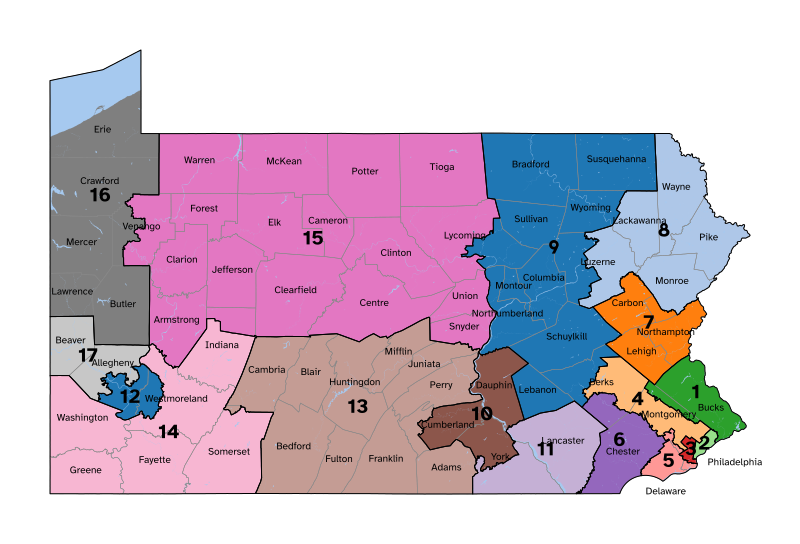
The ultimate problem of gerrymandering begins and ends with the way we divide the electoral constituencies of the U.S. House into geographic districts. By prioritizing geography over other potential divisions, we empower the ruling party in each state to draw geographic districts in ways that dilute the voting power of minority-party voters. Given that, in 2019, the Supreme Court declared claims regarding partisan gerrymandering political questions beyond the reach of the federal judiciary, perhaps the only surprise is that state officials took until now to push gerrymandering to the brink.
But gerrymandering is not inevitable because the Constitution does not actually require that states divide their electoral constituencies into geographically-divided districts; it only requires, to the extent districts are drawn, that states draw such districts with roughly equal populations. By forgoing geographic districts entirely and restructuring the electoral constituencies of the House into less manipulable voting blocs, we can deprive state legislators of the power to disenfranchise minority-party voters in red and blue states alike. After consideration, we feel the best replacement for geographic districts would be state-wide, age-based voting blocs.
Here’s how this would work: