Sign up for the Free Tangle Newsletter Highly curated unbiased news for busy, open-minded people.
Processing your application
Please check your inbox and click the link to confirm your subscription.
There was an error sending the email
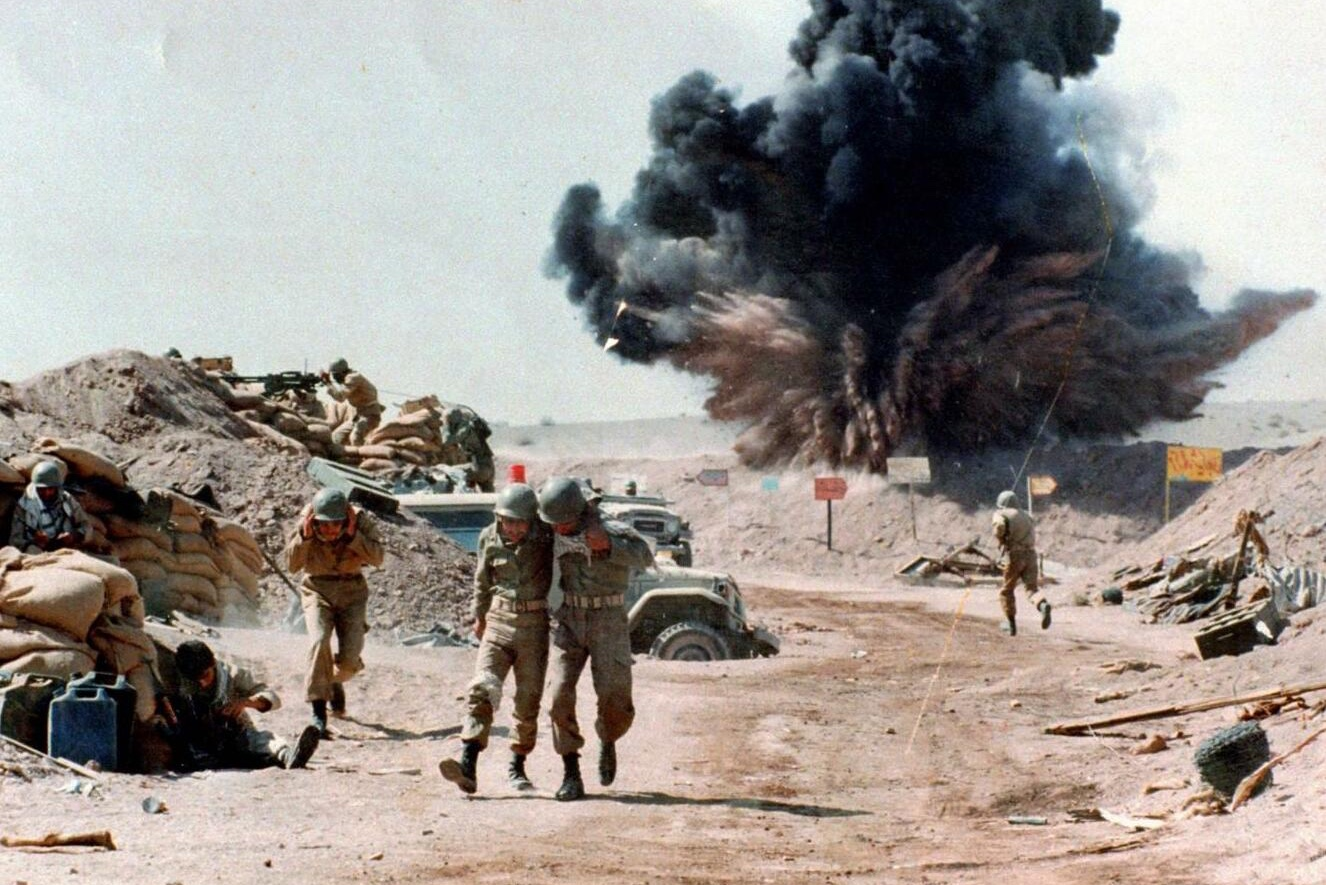
Soldiers helping each other in the foreground and bombs blasting in the background | Wikimedia Commons

By Brian Gilette


In March of 2003, as the United States launched its invasion of Iraq, a Gallup poll found that 72% of Americans supported military action. I was not among them. At the time, I wrote an essay called Bad War. I didn’t write it for publication. Instead, I wrote it for myself — to help myself understand how a country like ours decides to go to war, and whether this one met the standard such a decision demands.

I’ve spent my career in leadership — building organizations, making decisions that affect people’s livelihoods, and living with the consequences of those decisions. That experience shaped how I think about responsibility, accountability, and the weight of choice.

I believe in America. In our best moments, we have demonstrated how a nation should operate. In those times, America has been a force for good, using its power to make the world more stable, more just, and more humane. For these reasons, questions of war matter deeply to me, and they should matter to all of us.

In 2003, writing this essay led me to a simple yet difficult conclusion: No matter how it went militarily, the war was morally unjustified.

I didn’t come to my belief through ideology or the benefit of hindsight. Instead, I applied a basic set of questions. Questions that should be difficult to answer. Questions that force us to confront what war actually is, not the language often used to make it sound controlled, precise, and necessary.

More than two decades later, as the United States is once again engaged in conflict in the Middle East, I find myself returning to those same questions to see if that same reasoning I used then can help me understand this new situation today

Before evaluating Iraq then or Iran now, let me explain my simple framework for deciding when war is justified.

  • Is there a clear, reasonably imminent threat that cannot be averted by nonlethal means?
  • Have nonmilitary options been seriously and genuinely exhausted?
  • Can we reasonably expect the war to produce greater benefits than the foreseeable harms?
  • Is there a credible plan for what comes next?
  • Has the decision been made through a legitimate constitutional process?

These are concrete, answerable questions that set a minimum standard that I think is broadly reasonable and supportable.

What follows is the framework I used then and return to now. It is not perfect, but it forces the kind of clarity these decisions demand.

Iraq, 2003

Was there a clear and imminent threat?

As I argued at the time, war inflicts massive, random death and misery no matter how carefully targets are chosen. Therefore, no war is just that is initiated without a clear, reasonably imminent threat that could not be averted by nonlethal means.

That standard was not met. Inspections were ongoing and, by many accounts, working. The threat was not imminent in any meaningful sense. Yet the case for war shifted constantly, moving between weapons of mass destruction, terrorism and regime change, often relying on fear and obfuscation.

Were nonmilitary options exhausted?

As I wrote then, intrusive inspections could have been made more effective with stronger support, more inspectors, and better intelligence sharing. A long-term inspection regime could have continued to contain Iraq’s capabilities.

Nonmilitary alternatives were not exhausted. They were abandoned.

Was there a reasonable expectation of a better outcome?

At the time, the promised benefits were asserted rather than demonstrated. We were told this would be a swift liberation, that democracy would take hold, that the region would stabilize.

But even then, it was clear that removing a regime in a complex society carried enormous risks. The foreseeable harms — destabilization, sectarian violence, regional spillover — were real and significant. The idea that this would produce a clearly better outcome was not grounded in evidence.

Was there a plan for what came next?

There was no credible plan for occupation, reconstruction, or governance. War planners spoke confidently about the opening phase and far less about what would follow.

And what followed, as we now know, was the real war.

Was the decision made through a legitimate process?

As I argued at the time, Congress treated its responsibility more as a procedural requirement than a substantive one. Absent a direct attack, war should follow careful deliberation with clearly defined objectives. Instead, vague authorization substituted for meaningful debate.

Even then, it was clear that something fundamental was changing. The standard was being lowered.

Iran, 2026

Is there a clear and imminent threat?

Much of the justification for this war centers on Iran’s nuclear ambitions. That concern is real and serious. Iran is an authoritarian state with a record of repression and regional destabilization. None of that is in dispute. A nuclear-armed Iran would change the strategic balance of the region in ways that are difficult to reverse. But that doesn’t mean their threat is imminent. The pro-war argument is not that Iran is on the verge of launching a nuclear attack, but that it may eventually develop the capability to do so. That distinction matters. Preventing a hypothetical future threat is a far more elastic standard than responding to an immediate one.

Have nonmilitary options been exhausted?

Diplomacy with Iran has been difficult and inconsistent, particularly following the collapse of earlier nuclear agreements and years of mutual distrust. However, difficulty with diplomacy doesn’t mean all efforts have been exhausted.

In fact, negotiations were ongoing in the lead-up to this war. Over the past year, the United States and Iran engaged in multiple rounds of talks, often indirectly and mediated by third parties, focused primarily on Iran’s nuclear program and regional activity. Those talks produced some limited progress, but also revealed deep and persistent disagreements, particularly regarding uranium enrichment, sanctions relief, and security guarantees. 

Even in the weeks immediately preceding the conflict, diplomatic channels remained open. Back-channel efforts continued, mediators attempted to arrange additional talks, and both sides publicly acknowledged that negotiations had not reached a final resolution. 

Progress has been stilting and slow, when you could call it progress at all. Talks stalled. Deadlines passed. Frustration grew. But diplomacy was never truly exhausted. And the shift from negotiation to military action occurred while the process was still unresolved.

Admittedly, diplomacy with Iran has been largely unproductive. However, it has not definitively failed. War, in this case, appears to be the point at which the process became too slow, too uncertain, or too unsatisfying to continue. It was not the last resort chosen reluctantly after all other options failed.

Will this produce a better outcome?

The conflict has expanded across the region, and one of the clearest signs is the Strait of Hormuz itself. Rather than becoming more secure, it has become less so. After a brief reopening, the strait has again been restricted by mutual blockades, constricting one of the world’s most important economic chokepoints.

Military gains have been made, but they may not prove durable. Even while Iran’s military and naval capabilities are severely degraded, Reuters reports that Iran is already replenishing and upgrading its missile and drone launchers at a faster pace than before the war. U.S. officials have said a significant portion of Iran’s missile capability has been destroyed, but other assessments suggest that a large share of its arsenal remains intact. Furthermore, China is reportedly preparing new air-defense deliveries to Iran. Instead of Iran’s defenses being obliterated, they are adapting — and a strengthened relationship with China could offset losses dealt by American military superiority.

Regime change has also been fleeting, but also may have produced a worse outcome. Leadership aligned with the Iran Revolutionary Guard Corps (IRGC) appears to have tightened its hold over wartime decision-making and may drive a more hardline strategy going forward. 

Part and parcel with removing the previous regime was improving the safety of the Iranian people. In fact, the well being of protestors in Iran was one of the main communicated goals of intervention in the lead-up to the war. A more extreme IRGC will not make for a more secure populace.

We were told war would reduce danger,  improve strategic balance, and secure the Iranian people. Instead, the strait is again in crisis, the leadership may be more hardline than before, and the Iranian people are no better off. 

Is there a plan for what comes next?

A clear exit strategy may exist behind the scenes, but it has not been communicated, leaving us to guess at its existence. The stated objectives of the war include degrading Iran’s military capabilities, preventing nuclear development, and limiting proxy activity. Those objectives have shifted over time, degrading the idea of a clear exit strategy. 

Recent reporting and analysis point to ongoing uncertainty about how the conflict ends. Some officials have suggested that continued pressure could reshape Iran’s behavior over time, while others have raised the possibility of internal political change. Again, these are goals — or possible outcomes — but they are not plans for a post-war future. And possibilities without a defined path have a way of becoming open-ended commitments.

We have seen this before.

In Iraq, the absence of a clearly defined and realistic end state ensured that the most difficult phase would come after the initial success. That is a recipe for quagmire. The mission expanded, the commitment deepened, the exit became harder to find — and into the muck we sank. These same ingredients are present in Iran.

To be clear, that does not mean that a prolonged engagement is ensured. What it does mean is that a plan for a post-war future does not appear to exist.

Has the decision followed a legitimate process?

Straightforwardly, this war has not followed a legitimate process — that has been the case for U.S. military engagements for quite some time. The United States has not formally declared war since World War II. In the decades since, presidents from both parties have relied on broad authorizations or executive authority to initiate military action, often justified by the need for speed, flexibility, or secrecy in a modern threat environment.

Congressional debate does more than authorize action. It forces clarity about objectives, surfaces disagreement, and requires those advocating for war to make their case publicly and withstand challenge. When that process is abbreviated or bypassed, those pressures weaken. 

In Iran, the executive branch not only acted without the authority of Congress but without its advisory process totally. As in 2003, the Constitutional process does not appear to have been applied. The decision to use force moved forward without the level of sustained, explicit deliberation that the Constitution envisions for war.

The Question That Matters.

My aim in writing this essay is to demonstrate how applying the same principles and ideals to a situation we can see with the benefit of hindsight can help us understand another situation unfolding in real time. I am not intending to argue that all war is unjust — instead, I’m trying to apply a standard for what makes wars just. If I had applied all of these conditions to World War II, they all would have passed easily.

Supporting some wars does not mean supporting all wars. And opposing a war is not weakness. It is a refusal to lower the standard.

War is the most consequential decision a nation can make. It is a test of judgment, restraint, and honesty. And like any test, it only has value if we are willing to apply it consistently.

We have a framework for doing that. We know the questions to ask. We have seen what happens when they are ignored.

So before we go further, before this conflict expands, before more lives are lost and more consequences unfold, we should ask the only question that ultimately matters:

Are we applying that standard honestly? Are we demanding clear necessity, exhausted alternatives, a credible path to a better outcome, a realistic plan for what comes next, and a process that reflects the weight of the decision?

Because if we are not, the outcome is not uncertain. It is predictable.

And we have seen it before.


Brian Gillette is an Assistant Teaching Professor at Iowa State University, where he teaches business communication and professional speaking. Before entering academia, he spent more than two decades in business leadership roles, where he was responsible for high-stakes decisions affecting people, organizations, and outcomes.

Member comments

More from Tangle News related to this article

Recently Popular on Tangle News