Sign up for the Free Tangle Newsletter Highly curated unbiased news for busy, open-minded people.
Processing your application
Please check your inbox and click the link to confirm your subscription.
There was an error sending the email
The Shadow Side of Resilience
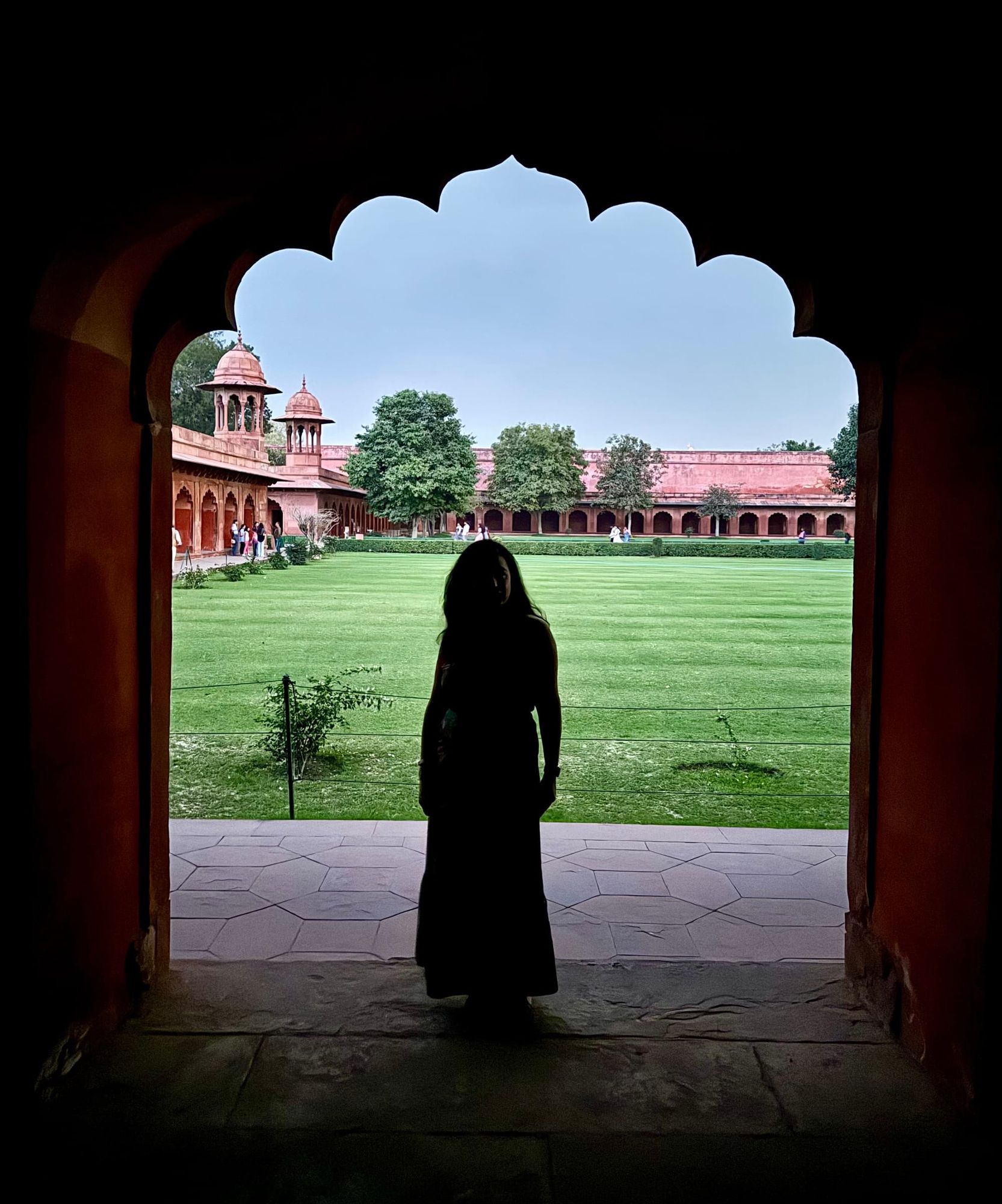
The author in an archway | Photo from Jo Madnani

By Jo Madnani


If resilience was a tarot card, the Nine of Wands would fit nicely. In an upright position it means grit done right; reversed it means exhaustion and fatigue. It also reflects my lived reality as a first-generation immigrant. I have built a career across continents, straddling the corporate, entrepreneurial, and agency worlds (I am currently consulting and living the author life). Twenty years of living between worlds will teach you a thing or two about being resilient.

Let’s explore the imagery of the card from a classic deck: A traveler holding a staff, slightly leaning on it, with a bandage around his head indicating hurt after a fight. Research showed me that the background — eight widely spaced wands standing against a mountain range before a cautiously happy blue sky — symbolize challenges that have been overcome. 

Let me take you on a journey as the weary but hopeful traveler would in this card.

Unlike my father, I migrated voluntarily. It was shaped by the post-colonial 1947 Partition granted independence to the subcontinent known as India, but only after cleaving it in two. His family left Sindh, now Pakistan, to resettle in India; but they stayed true to their beliefs. He grew up in post-colonialism’s shadow, watching his parents rebuild from nothing. He barely finished high school and never had the opportunity to go to college. By his twenties, he had started his own business, holding tradition and innovation simultaneously without ever calling it a skill. He saw people for who they were and who they could become.

He died when I was fourteen. I didn’t understand what I was losing. He carried more than anyone knew. The weight of a displaced family, a business built from nothing, a life held together by quiet will.

It took my own displacement to understand what I had inherited from him. I moved countries in my early twenties, trailing my spouse’s career. When life led us from India to Florida, I arrived with no map, no network, and no blueprint of my own— just a blank page and the belief that I would figure it out. The move demanded resilience in its highest form, a fiery, gritty energy that helped me find work, build a semblance of community, and find the courage to start a family. 
But I also encountered the seething indignities of tokenism and the model minority myth. The assumptions funnel South Asian immigrants toward STEM and IT, treating creativity as a frivolous detour rather than a legitimate calling. Even comedic tropes shamelessly feed this stereotype. The sweet irony is that my father, sibling and spouse all have STEM backgrounds, but I am proudly creative. 

In Florida, I felt “othered” not just by strangers, but by people with similar backgrounds who clung to traditions more than I ever did back in India. Belonging seemed to require an unspoken ticket to entry that I wasn’t sure I wanted to pay for, and the exclusion sometimes felt suffocating. I realized that second-generation immigrants didn't face the same challenges. And sometimes, without meaning to, they made my contributions invisible — while I quietly kept showing up for theirs.

This is why immigrant lives, identities, and career trajectories can feel so fragmented; it results in what I call having a “split heart.” When you move countries the math doesn’t add up. Your sense of self is divided; you encounter some primes and odds. Primes don’t mingle and odds are stacked against you most of the time. The evens are whole, but their cups and communities are sometimes full and closed. 

Added to this fragmentation was first-time motherhood, which brought a very particular kind of loneliness. I remember my hands shaking as I filled out emergency contact forms, forced to write down the names of friends because my family was an ocean away. The village I needed didn't exist yet. During this time, a hospital CEO who became a mentor gave me life-changing advice: She told me to outsource the parts that drained me so I could show up fully for the parts that mattered. For someone who had been overcompensating since stepping off the plane, this was a game changer. 

Eventually, the math of life balanced itself out. You learn to roll the dice, take risks. I started to encounter more multipliers: kindred spirits, mentors, and allies who saw my light before I could see it myself. Thanks to them, I started teaching part-time, writing for fashion magazines, and running my own healthcare agency. Florida gave me some friends who quietly became family without me having to earn it, which reminded me of home. 

As the years flew by, home became a fluid construct. The visits back to my homeland became the occasions when I would feel like the other. I felt like an actor switching dialects and personas. When I find myself at the crossroads of nostalgia and heartbreak, I mourn a part of me that still lives there. And when I fly back to the hustle, I savor those memories as a campfire that warms my heart when things feel heavy.

Just as I found a semblance of feeling settled, it was time to move again, this time to the New York metropolitan area. But this time I didn’t even flinch, because I was always in love with New York (all my favorite shows of the ’90s were set there). Years later, I still cannot explain the attraction. I arrived with more experience, sharper instincts, and more scar tissue. I phased out clients and found my footing.  

Thanks to a kind soul, I inherited a group of friends who became my new chapter. Another unexpected gift arrived, a second child. After dealing with some health issues I had given up on the idea of more children. I endearingly call him my plot twist to date! Then, another plot twist: the pandemic. It recalibrated everything and everyone; I felt farther away from my family than ever. Yet somewhere in the chaos, I found work that finally felt right. The mentors came later, organically, as they tend to when you’re finally in the right room. Some of those connections remain among the most meaningful of my life. 

Then came the layoff I never saw coming.

I had earned my seat at the table, or so I thought. This setback landed differently. I had done everything right, built a career across continents, earned awards, led global teams, showed up decade after decade. And still. It made me question many things — not the drive, because working, contributing and creating is who I am, not just what I do. I questioned how I was going about it: the burnout, the childcare guilt that taxed my nerves when I overworked to a fault. 

When the stakes got real, I saw some personal and professional connections disappearing in thin air. Nothing clarifies a relationship faster than a layoff or a setback.

This is the exact moment when the mask of resilience drops, and you realize that grit alone was never the whole story. Here, the Nine of Wands is reversed. Resilience hardens into resistance.

Most politically correct “making it” stories don’t tell you what it took to get there. For immigrants, the life you left behind is always waiting in the wings to haunt you. I started to see patterns that went beyond immigration. Women, mothers and minorities are not running the same race. The invisible load is real, and the data is crystal clear. There is pay inequity and men are not so easily dislodged from top positions or questioned about why they’re unavailable in the evening. The 9–3 school days, doctor’s appointments, the endless extracurriculars all need to be managed. Eve Rodsky has rightly called this out in her book Fair Play.

Burnout, fatigue and a sense of purposelessness took over. The deep cracks felt like despair, but they were actually a wakeup call. I realized that rotating the tarot card back to its upright position would take deliberate time and intention. I needed to align with honest values rather than constant pressure, establish healthy boundaries, and simply do less. I took a beat and focused more on family and the creative pursuit I had filed away for later. My writer’s soul loved creating for brands and writing for fashion magazines. Why not turn that lens inward?

I knew it was time to answer to my own calling. Styled by the Morning Pages of Julia Cameron's The Artist’s Way, the books that lived inside me finally began to surface. The Immigrant Journey emerged. I worked with a coach who helped me organize the manuscript and submissions. Eight months of relentless rejection had me second-guessing everything. It was not an easy road. So-called experts tested my patience and my finances, but creating in the blank space was an act of love and resistance. Through The Immigrant Lens, I am extending the canvas to readers so they could reframe their own transition stories and draw from it the power it generates.

Even the weariest traveler finds a sudden clearing. For me it was a TEDx talk I landed with Princeton in February 2026, a full-circle moment, a massive yes amid so many nos. The theme all speakers had to follow was Wave and Particle, looking at perspectives beyond one lens. It was serendipitous because I based my entire talk on a line from my book: Your light has a place in this world: Why complexity is your superpower. And the hero of my TEDx talk was my father’s legacy: how his complexity was not just survivable but generative.

Two decades of living between worlds made me understand what I had inherited from my father. Not just resilience. His way of seeing. The belief that complexity is not a burden to manage but a lens to see further with. That has now become my operating system, too.

I am sharing this because I want to challenge us to reject binary modes of living. In a world of either/or, we can and must dare to be the “AND”. The “AND” is not a compromise; it is an integrated way of life.

I have learned that true resilience has two sides. We must take time to sit with its shadow side. To grieve, rest and recover. In a world losing its mind with algorithms, we have to take refuge in our own internal workings and gently create new and intentional pathways to forge ahead differently. This will allow fresh resilience to be born from a healthier place.

I hope my lived experience inspires you to “embrace your AND.”

Much like the traveler in the Nine of Wands card who returns with the gift of discernment, sometimes our strength will work for us, and sometimes it will hold us back. Know when to fight and when to walk away. 

Both take courage. Both are resilience.


Jo Madnani has lived between worlds her entire life — two continents, healthcare marketing and fashion journalism, corporate and agency, ambition and motherhood. She is the author of The Immigrant Journey and The Immigrant Lens and a TEDx Princeton speaker. www.authorjo.com

Member comments

More from Tangle News related to this article

Recently Popular on Tangle News