
I'm Isaac Saul, and this is Tangle: an independent, nonpartisan, subscriber-supported politics newsletter that summarizes the best arguments from across the political spectrum on the news of the day — then “my take.”
Are you new here? Get free emails to your inbox daily. Would you rather listen? You can find our podcast here.
Today’s read: 16 minutes.
Millionaires Don't Actually Do What You Think
Most wealth advice tells you to pick stocks or cut lattes. But when you look at what actual millionaires do with their money, the pattern is different: They invest in real estate deals, earn serious returns on cash accounts, and avoid getting fleeced on basics like car insurance.
The Penny Hoarder broke down 4 specific money moves wealthy people make—and the mechanics of how normal earners can copy them, from $10 real estate investments to accounts paying 3.90% APY.
Correction.
In yesterday’s “Your questions, answered” section, we mistakenly identified Sen. Josh Hawley (R) as representing Arkansas. In reality, he is the senator from Missouri. The error slipped through our fact-checking process, and we’ve corrected the identifier online.
This is our 149th correction in Tangle’s 335-week history and our first correction since December 15. We track corrections and place them at the top of the newsletter in an effort to maximize transparency with readers.
Quick hits.
- The U.S. military said it seized two oil tankers linked to Venezuela, including a Russian-linked ship that it had pursued over the past two weeks. The U.S. accused the ships of engaging in deceptive practices and carrying illicit oil shipments. (The seizures)
- The Departments of Health and Human Services and Agriculture released updated nutrition guidelines, encouraging protein consumption and discouraging sugar and alcohol consumption. (The guidelines)
- Two people were killed and six injured in a shooting outside a church in Salt Lake City, Utah. Law enforcement said they are still searching for the suspect. (The shooting)
- President Donald Trump asked Congress to increase the U.S. defense budget from $1 trillion to $1.5 trillion, saying that the larger budget would allow the country to build the “Dream Military.” (The request)
- Rep. Steny Hoyer (D-MD) announced he will not run for reelection in 2026. Hoyer is the third-longest-serving member of the House and served as House Majority Leader from 2007–2011 and from 2019–2023. (The announcement)
Today’s topic.
The ICE shooting in Minneapolis. On Wednesday, an Immigration and Customs Enforcement (ICE) officer shot and killed a woman in her vehicle during an operation in a Minneapolis, Minnesota, neighborhood. Federal officials claimed that the woman was attempting to run over ICE agents, while local officials said the officer acted recklessly. The incident comes amid heightened tension in the city and state, which has become a focus of the Trump administration’s deportation efforts.
Back up: This week, the Department of Homeland Security (DHS) deployed approximately 2,000 ICE agents to Minneapolis, which the agency called its largest-ever operation. 600 agents are investigating fraud schemes in the state after the issue gained national attention in the past month. Other officers are conducting immigration operations, one of which was underway when the fatal shooting occurred.
The victim was identified as Renee Nicole Good, 37, a Twin Cities resident. Good’s mother said she did not think her daughter would have been a part of any groups attempting to impede ICE agents.
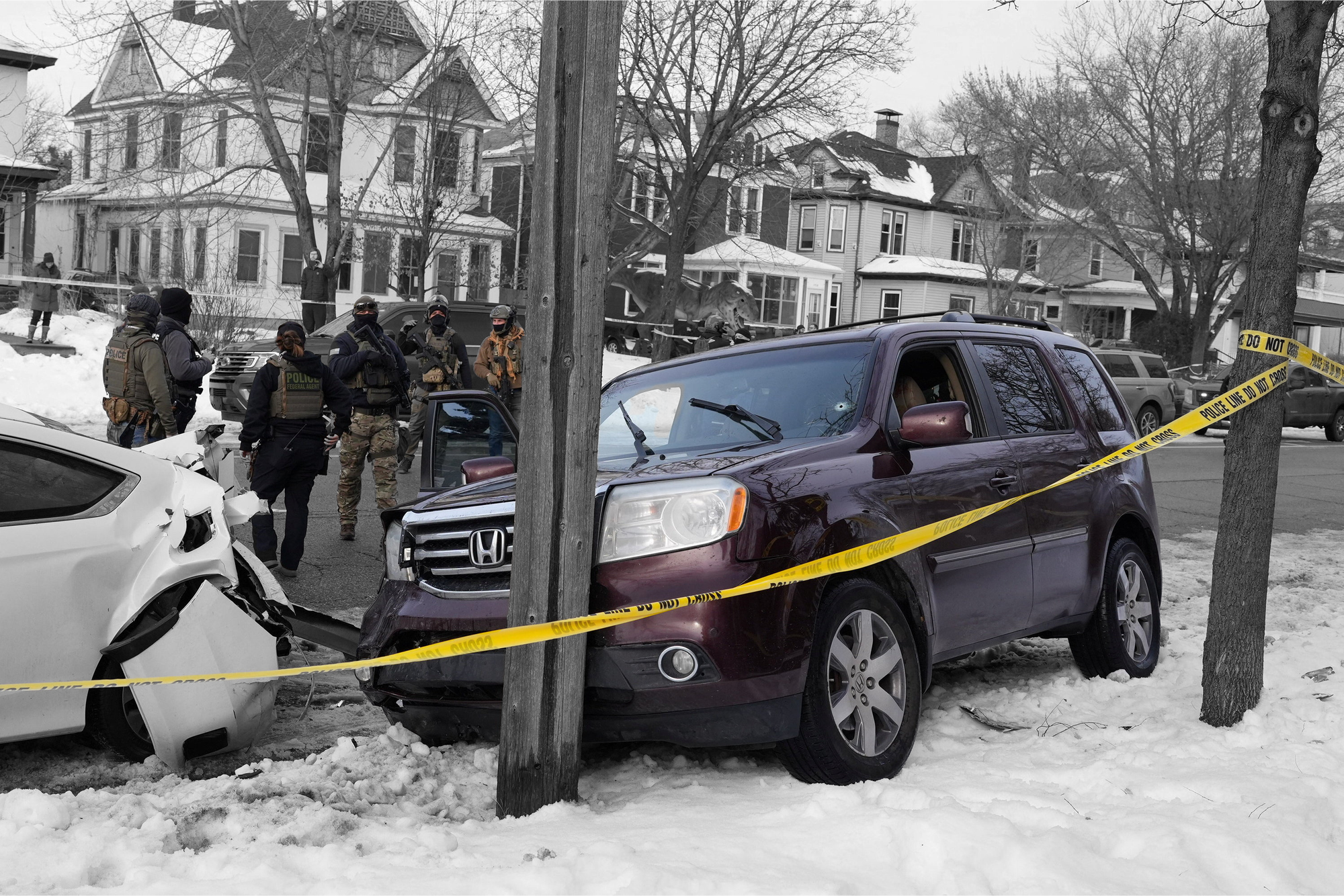
Video of the incident shows two cars in the middle of a road busy with ICE agents and vehicles. As another ICE vehicle approaches, one car drives off. Multiple agents exit their vehicle and approach Good’s car; at least one agent instructs her to get out, and one reaches for her driver's side door. Shortly after, Good’s car moves in reverse, then drives forward, at which point an agent who has moved to the front left of her vehicle fires at least three shots towards Good. DHS spokesperson Tricia McLaughlin said that ICE officers were injured during the incident but are expected to recover; she did not detail what injuries they sustained.
Whether Good intended to hit or drive away from the officers is a central point of contention. Many Republicans, including President Trump, say that Good posed a threat to the officers and the agent who fired his weapon — who has not been identified — acted in self-defense. At a press conference on Wednesday evening, DHS Secretary Kristi Noem described Good’s actions as “domestic terrorism” and said her death was preventable.
Many Democrats say that Good was turning her car away from the agents, and her actions did not necessitate lethal force. Minneapolis Mayor Jacob Frey (D) strongly condemned the shooting and ICE’s presence in the city. “We’ve dreaded this moment since the early stages of this ICE presence in Minneapolis,” Frey said at a news conference. “To ICE, get the fuck out of Minneapolis… Your stated reason for being in this city is to create some kind of safety, and you are doing exactly the opposite.” Minnesota Gov. Tim Walz (D) also criticized ICE’s deployment to Minneapolis, saying, “We do not need any further help from the federal government.” Walz also issued a “warning order” to prepare the Minnesota National Guard and shared that the State Bureau of Criminal Apprehension is investigating the incident.
In the aftermath of Good’s death, at least two protesters have been arrested, and Minneapolis Public Schools announced they would be closed on Thursday and Friday “out of an abundance of caution.”
Today, we’ll share perspectives from the left and right on the shooting. Then, Executive Editor Isaac Saul gives his take.
What the left is saying.
- The left is appalled by the shooting, and many worry about the fallout from the incident.
- Some say ICE’s presence in cities made violent confrontations inevitable.
- Others say the ICE agent involved in the shooting can — and should — be prosecuted.
In The Minnesota Star Tribune, Phil Morris called the incident “a death that did not have to happen.”
“We must not rush to judgment. But there is a primal scream stuck in our collective throat. Our heads are spinning as we try to make sense of what happened on a south Minneapolis street Wednesday, Jan. 7, in broad daylight, captured on video for a state and nation to absorb,” Morris wrote. “The secretary of Homeland Security, Kristi Noem… call[ed] the incident an act of domestic terrorism. The mayor, who has reviewed the video and been thoroughly briefed, called that explanation ‘bullshit.’ What is not in dispute is that a woman is dead. And that this death was tragically predictable once the federal government decided to turn Minnesota into a testing ground for the most aggressive street-level immigration enforcement yet deployed.”
“The federal government should immediately withdraw agents from the area, and likely from the Twin Cities altogether, to prevent further provocation. Meanwhile, a transparent, independent and untainted investigation is not optional.” Morris said. “This latest disaster will be framed by some as another blow to Minnesota’s reputation. That is dishonest. The reputational damage flows from a federal strategy that seems to openly court confrontation.”
In The Intercept, Natasha Lennard argued “[ICE’s] raids and impunity were always going to lead to death.”
“Given ICE’s violent, impunity-drenched core, at a moment when the Trump regime is leaning heavily into a vision of dominance grounded in aggression and lawlessness, such a killing was all but inevitable,” Lennard wrote. “This is not the first ICE shooting, and it is not the first time a civilian has been killed during a vile anti-immigrant operation. According to gun violence investigations in The Trace, federal agents have shot people 14 times since last January, killing at least four; on multiple occasions, officers shot at people observing ICE raids and people attempting to drive away.”
“Justice according to the criminal legal system would see the ICE shooter charged with murder. And that would no doubt be appropriate,” Lennard said. “This seems a tall order in our current context of fascist impunity. It has already been announced that Trump’s FBI will oversee the shooting investigation, after all. Even if this particular ICE agent is held accountable in a court of law, however, it would be an impoverished justice indeed.”
In The American Prospect, David Dayen said “ICE agents can be charged with murder.”
“The Department of Homeland Security (DHS), while confirming the broad details, claims that the ICE agent acted in self-defense to avoid being run over by the vehicle. These are the kinds of disputes that the courts are equipped to handle. Because if an agent shot directly into a car and killed the driver without some credible fear of personal harm, it would be called murder. And federal agents can indeed be prosecuted for murder,” Dayen wrote. “States can prosecute anyone for violations of state law, regardless of their rank or authority. Murder is a felony in the state of Minnesota, as it is in every other state.”
“The law does not confer automatic immunity to federal officers. ‘Federal officers and employees are not, merely because they are such, granted immunity from prosecution in state courts for crimes against state law,’ the Supreme Court wrote in Colorado v. Symes nearly 100 years ago,” Dayen said. “Of course, President Trump would be almost certain to act to punish Minnesota in some way if they dared to indict an ICE officer for murder. But Trump is already acting unilaterally to punish Minnesota! That’s why these agents were out hassling Minneapolis residents in the first place.”
What the right is saying.
- The right is saddened by the shooting, but many say the agent’s actions appear to be legally justified.
- Some argue the left’s demonization of ICE set the stage for violence.
- Others criticize political leaders for jumping to conclusions about the incident.
In National Review, Andrew C. McCarthy wrote about “the legal fallout from the Minnesota ICE shooting.”
“The battle lines are being drawn on what seems to me to be a flawed legal assumption, to wit: If the woman — who was allegedly blocking ICE agents with her car — was ‘merely’ trying to flee rather than run the agent over, she should be understood as a murder victim rather than a criminal engaged in a dangerous act that justified the use of lethal force by law enforcement,” McCarthy said. “It’s really not an either/or situation. Undoubtedly, if it is reasonable to construe the woman’s action as a deliberate attempt to mow down an ICE agent with a speeding vehicle, the use of force was justified. But even if the woman was mainly trying to get away (which is what it looks like to me), she was engaged in an actionable assault on a federal officer.”
“Even if you believe… that the woman was just trying to get away, she did so by swiping the car in the agent’s direction. She may not have intended to run him over, but she sure didn’t appear to be trying to avoid running him over if that was necessary to escape,” McCarthy wrote. “Either way, the agent’s life was jeopardized, and the responsive use of force would be reasonable. It is settled Fourth Amendment law that a police officer may use deadly force against a fleeing suspect if he has a good-faith belief that the suspect poses a significant threat of death or serious physical injury to the officer or others.”
The New York Post editorial board argued “the left bears FULL blame for the Minneapolis ICE shooting.”
“Remarkably, Minnesota Gov. Tim Walz is right: Wednesday’s deadly shooting in Minneapolis was ‘so preventable, so unnecessary’ — that ‘protester’ didn’t need to be blocking ICE agents in the first place, let alone gunning her SUV at them. The left bears full blame for this bloodshed. Her car hit the agent before he shot her; he wound up hospitalized,” the board said. “Attack someone with a deadly weapon — that’s attempted assault in the eyes of the officers — even if it wasn’t intentional.”
“Yes, it was aggressive for the feds to deploy some 2,000 immigration agents in Minneapolis this week — but far more aggressive for protesters to try to block them. This follows months of Democrats cheering law-breaking protesters, calling for resistance to ICE as if it weren’t a duly constituted law-enforcement agency,” the board wrote. “The last year has seen hundreds of attacks on ICE and Border Patrol agents, all too often egged on by elected Democrats. That madness has to stop; anyone who doesn’t like how the law is enforced is free to work to elect different leaders, and to advocate for different laws.”
The Free Press editors offered “the right response to the Minneapolis ICE shooting.”
“A fatal shooting in Minneapolis on Wednesday launched an immediate information war, in which politicians drew lines and exchanged accusations long before they knew the facts. From President Donald Trump down to Mayor Jacob Frey, the supposed authorities showed little interest in learning what happened and guiding the public with sound conclusions,” the editors said. “The videos leave room for reasonable debate about the nature of the incident and who was at fault. It isn’t clear whether Good intended to strike the officer when she turned her vehicle, or if she meant to steer beyond him and accelerate away.”
“Mistakes and distortions like those that followed Wednesday’s shooting are hard to avoid at a moment when so many public figures prejudge every news story. Partisans witness messy events like a rapid standoff-turned-shooting and instantly cram them into neat lines that confirm their worst impressions of their political opponents,” the editors wrote. “There’s a large audience for the quick takes among the polarized public. But that doesn’t absolve officials of their responsibility to wait for the facts and state them clearly.”
My take.
Reminder: “My take” is a section where we give ourselves space to share a personal opinion. If you have feedback, criticism or compliments, don't unsubscribe. Write in by replying to this email, or leave a comment.
- This killing is a predictable result of the Trump administration’s aggressive, provocative deportation campaign.
- Debate over legality is justified, but the White House is spreading falsehoods.
- From a moral and practical standpoint, I think the shooting was clearly unjustified.
Executive Editor Isaac Saul: Renee Good was 37 years old. The mother of three children. A poet. A wife.
A woman — a human being — is needlessly dead. For me, this is most of what matters. At the same time, this shooting provokes genuine political and legal debates, and it’s my job to start with them, even on days like today when that feels increasingly difficult.
As preventable as her death was, it was also bound to happen. This is the totally horrific, tragic, obvious outcome of enforcing immigration laws this way. And it was predictable. It was so predictable that I actually predicted it. Right after Trump was elected, I warned, multiple times, that mass deportation efforts will lead to civil disobedience and clashes with law enforcement. After the arrest of Newark Mayor Ras Baraka, I warned that confrontations with immigration officials were getting dangerous and would inevitably end with a major violent event that would then be used to justify more law enforcement being deployed. On X, I shared clips of confrontations between citizens and ICE and warned that they were incredibly dangerous, stressing that most people would react defensively if they saw someone dressed like this trying to arrest their neighbor.
This is America. Distrusting government force is in our national DNA. Heavily armed, masked federal agents with unclear levels of police authority and training cannot reasonably expect to just traipse through our neighborhoods as if they were war zones, kicking down doors or descending from helicopters and snatching people off the streets en masse, and then think everyone will placidly accept it. That (thankfully) is not a circumstance of life we are built to accept.
Each tense interaction filmed and posted and dissected in the media makes it increasingly clear that these ICE agents are not prepared for these kinds of confrontations. Trump has put these officers in dangerous positions, demanding a kind of enforcement that is bold, aggressive and confrontational. Interacting in this manner with American citizens and noncitizens alike is not what these officers are trained to do.
Of course, this is America, so — also — this incident jumped straight from the phones of observers into the partisan wringer, with everyone lining up on their respective sides with their respective polarized takes. Many Democrats and political observers, particularly but not exclusively on the left, see a woman shot to death while driving away from the masked agents with guns. The president, DHS, and some Republicans in Congress have begun framing Renee Good as a “domestic terrorist” who tried to run over and kill an ICE agent. Some think the situation was simply dangerous enough that an ICE agent could fear for his life and was justified in using force. Reasonable people whom I respect, like National Review’s Andrew McCarthy (under “What the right is saying”), come to this conclusion honestly. And, for better or for worse, I think there is a decent chance our legal system absolves this agent of any wrongdoing.
But I have some pushback. First, setting aside the legal question, let’s state plainly that government officials are selling a narrative that is not attached to reality — one that is fundamentally different from what we can all see in the numerous videos available to the public. This event was filmed from several different angles, and it has been broken down at several different speeds, with audio. While I loathe going over the available evidence like it’s instant replay in a football game, I also think this use of force was clearly not necessary — and to make my point most strongly I have to start by playing the game everyone else is.
So here is what I can see and hear:
Renee Good’s car is in the street. The videos we have show her trying to wave ICE agents past her car as they pull up in a vehicle with police lights flashing. Two ICE agents exit and approach her vehicle, she is told to get out of her car, and she says, audibly, “I’m pulling out.” At least one agent begins yelling at her to get out of her vehicle, while one puts his hand on the driver’s side door. She puts the car in reverse with the two ICE agents on the left side of her, while a third circles around the car to the left-side front. She then drives forward and turns her wheels all the way to the right; the third agent moves to get out of the way and fires a shot through the windshield. One angle appears to show the officer actually leaning on the front of the vehicle as she drives past, and though it’s blurry and from a distance, that video looks as if the car pushes the officer’s body out of the way. As this is happening, the officer has pulled out his weapon and he then discharges it. As Good’s car passes him, he fires two more shots; photos of the vehicle after the event show one bullet hole in the front windshield, making it likely the other shots were through the driver’s side window, which was down.
As far as I’m concerned, everything after the guns are fired (the speed of the car, where it goes, etc.) is a moot point, since by then Good has been shot and may have been killed instantly. A man identifying himself as a doctor on scene begged to treat her, but the ICE agents refused to let him, claiming they had their own medics (even though none were visible on the scene in videos shot by eyewitnesses).
Did Renee Good make a mistake? Yes, she did. When someone working for law enforcement tells you to do something, barring the most extreme extenuating circumstances, it is a good rule of thumb to do it. Why? Because respecting and listening to law enforcement is the best way to keep yourself safe. Just or unjust (and in this case, I think it is very clearly unjust), this outcome is a distinct possibility when you don’t cooperate.
At the same time, Good was not the only person with agency here. Even if we concede that she did not respond to clear orders to get out of her car, that she should not have driven away and that an officer could reasonably construe her actions as a “lethal” threat, hers are not the only actions we should judge. The ICE agents are the ones with the guns and the authority who are supposed to be in control. So let’s talk about their choices.
One eyewitness said ICE agents gave Good conflicting instructions, with some telling her to leave while others told her to get out of the car. The video backs this up: You can hear a lot of yelling and barking orders, and the officers aren’t approaching her car with uniform calm, control, and clarity. Also, officers are never supposed to position themselves in front of a vehicle or approach it from the front for precisely this reason. DHS officers are generally prohibited from discharging a firearm at a moving vehicle, unless someone is using their car as a deadly weapon and “no other objectively reasonable means of defense is available.” DHS also has use-of-force rules, which are relatively straightforward and include a baseline “respect for human life” and “the communities we serve,” emphasizing de-escalation tactics as a core component.
It seems pretty clear to me from the available video evidence that several of these officers violated each of these rules. The agent who approached her car and grabbed the door handle needlessly escalated the situation. The agent who killed Good positioned himself in front of the vehicle with one hand on the hood and the other on his firearm; he then discharged his weapon into a moving vehicle. As a group, the officers did not display basic respect for human life or the communities they serve, and they did not attempt to de-escalate the situation. Remember, Renee Good looked to be trying to wave the officers past her and said explicitly and clearly, “I’m pulling out” before they surrounded her vehicle and demanded she get out of her car. On a street packed with law enforcement officers and civilians, it would have been safest to allow her to drive past them, then pursue her in their own vehicles if they wanted to detain her.
At the risk of speculating too much, I think the videos clearly show that the reaction from the ICE agents scared Good, and she simply tried to leave. The idea that a deadly use of force here is justified seems farcical to me, even for the agent toward the front of the vehicle who was at most risk of being hurt. McCarthy, for his part, argues (emphasis mine) that Good “may not have intended to run him over, but she sure didn’t appear to be trying to avoid running him over if that was necessary to escape.” What I see, actually, is the complete opposite: that she very clearly turned her vehicle away from them.
Now, I know people are looking to me for a measured, dispassionate analysis of these contentious debates, but, when I ask myself what should be happening — what appeals to my moral center — I really don't feel conflicted at all. At the end of the day, what are we really debating? ICE shot and killed an American citizen, a 37-year-old mom, whose glove box was stuffed with children’s toys and who — prior to being confronted — at the absolute worst committed the crime of blocking traffic to try to obstruct immigration enforcement.
When Charlie Kirk was assassinated, one of the things that struck me was that I could see myself in him — a young dad, political commentator, a podcast host, someone who does public events. As a result, I did my best to emphasize his humanity. Here, again, this killing hits home. My wife is a mom in her 30s and a public defender in Philadelphia. In the last few months, some of her clients have been snatched up by ICE while attending scheduled immigration hearings. What if she got caught in the middle, or responded with fear in a way that police viewed as “resisting” or “interfering”; would millions of people jump to the conclusion that she deserved to be killed? For the crime of standing between ICE and an immigrant alleged to be here illegally?
These feelings are tough for me to shake. Why did an ICE agent pull his firearm on a 37-year-old American woman who looked like she was trying to leave the scene in her car? What threat did she reasonably pose to them? What immigration enforcement are they conducting in preventing her from leaving? Would we have had a better outcome if they simply let her leave? What are we even doing here? An American citizen has been killed by immigration officers, and for what? Who was made safer? What community benefited?
From the very beginning, the idea that masked immigration agents roaming the streets of American cities would be empowered to this degree has been worrisome and frightening, precisely for this reason. They are not adequately trained for these interactions. More to the point, their authority and jurisdiction are, at best, murky in situations like this. They cannot legally detain a U.S. citizen without reasonable suspicion they are in the country illegally. They are not the police. They are not the military. They are not the National Guard. They are not the FBI. Yet they behave like they are all of the above, and are egged on by the president, his cabinet, and members of Congress.
Regardless of the minute details, which we could debate and interpret in all kinds of partisan ways, what’s very, very plain to me is that this woman was not a “domestic terrorist” trying to “kill” ICE agents with her car; nor is it a “miracle” they survived (when the video shows not a single one on scene was injured, and the one in the most danger was barely touched by a vehicle moving at a speed of a few miles per hour). These are lies — from the president, from DHS, and from sitting members of Congress. If you believe this account from the government, then we are beyond a Rorschach test on use of force. You are not attached to the reality of this moment.
As one neighbor and eyewitness, who self-identified as “right-leaning,” told reporters, “This is not how we’re supposed to be doing things in America.”
Take the survey: What do you think of the shooting? Let us know.
Disagree? That's okay. Our opinion is just one of many. Write in and let us know why, and we'll consider publishing your feedback.
Your questions, answered.
We're skipping the reader question today to give our main story some extra space. Want to have a question answered in the newsletter? You can reply to this email (it goes straight to our inbox) or fill out this form.
Under the radar.
On Wednesday, the Congressional Budget Office (CBO) projected that the United States’s population will begin shrinking in 2056, reflecting the country’s aging population and declining fertility. Previous estimates had forecast that it would reach 372 million people in 30 years; now the CBO says the population will grow to 364 million in that span before beginning to decrease. The office noted that, since foreign-born women have more babies than U.S.-born women on average, the Trump administration’s efforts to reduce immigration are likely to lower the overall fertility rate. The Wall Street Journal has the story.
The Money Moves Millionaires Actually Make
Wealthy people don't just pick stocks—they invest in private real estate deals, earn 3.90% APY on cash, and avoid overpaying on car insurance.
The Penny Hoarder breaks down 4 specific tactics you can copy, starting with as little as $10.
Numbers.
- 1,000. The approximate number of arrests made by the Department of Homeland Security in Minnesota since its expanded immigration enforcement operation began this week, according to the agency.
- 150. The approximate number of people alleged to be in the U.S. illegally who were arrested in Minneapolis on Monday.
- 39% and 50%. The percentage of U.S. adults who approve and disapprove, respectively, of the Trump administration’s approach to immigration, according to an October 2025 Pew Research survey.
- +9%. The change in the percentage of U.S. adults who say the Trump administration is doing “too much” on deportations between March 2025 and October 2025.
- +7%. The change in the percentage of Republicans who say the Trump administration is doing “too much” on deportations between March 2025 and October 2025.
- +11%. The change in the percentage of Democrats who say the Trump administration is doing “too much” on deportations between March 2025 and October 2025.
The extras.
- One year ago today we covered Facebook ending its fact-checking program.
- The most clicked link in yesterday’s newsletter was the printable one-page calendar.
- Nothing to do with politics: Headline of the week? “Beloved walrus penis stolen from N.J. cheesesteak icon. Owner is blubbering mad.”
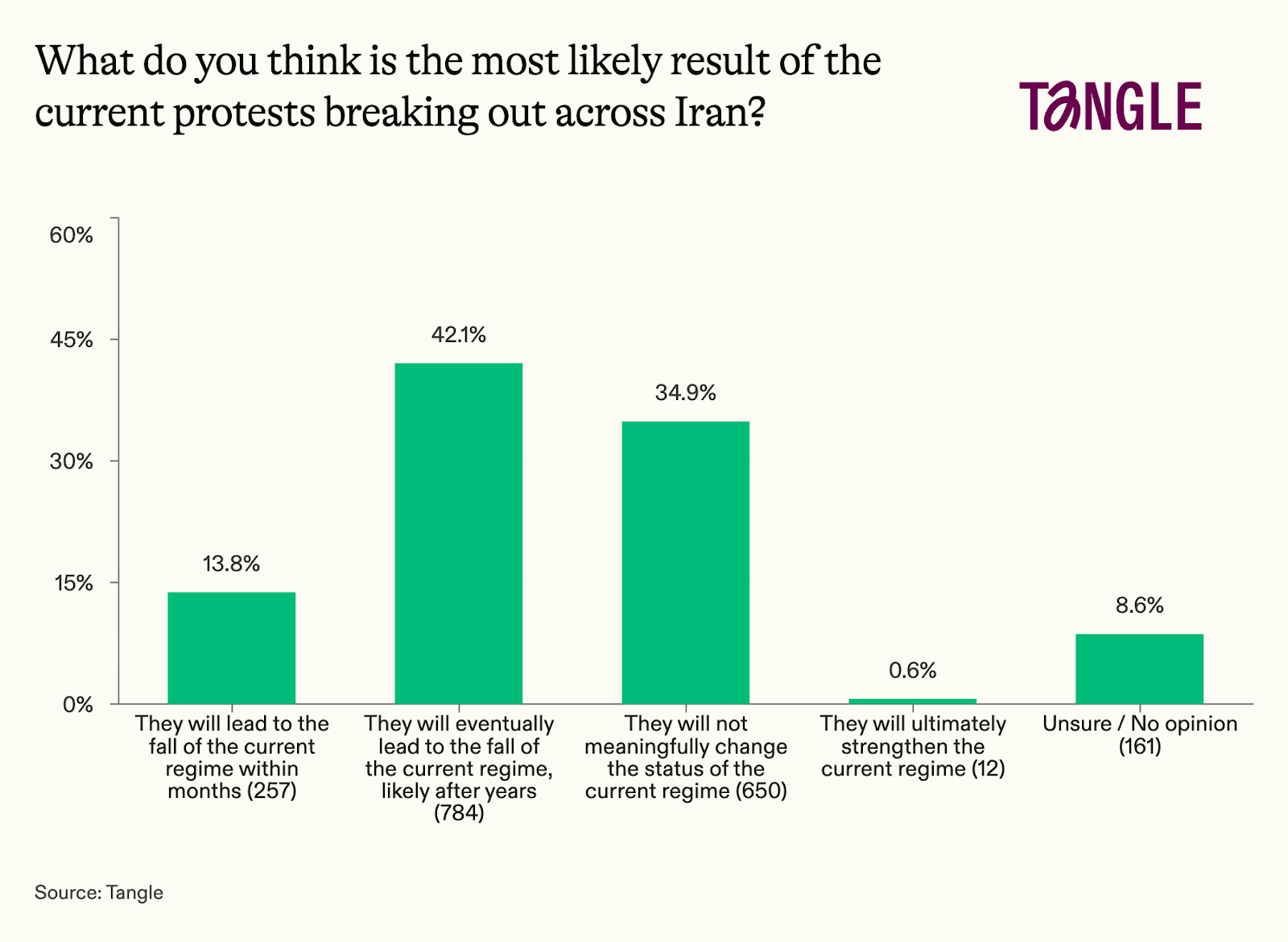
- Yesterday’s survey: 1,864 readers responded to our survey on the Iranian protests with 42% saying they will eventually lead to the fall of the regime. “I think the situation overall is becoming untenable for the Iranian people. I’m skeptical it will kick off change right away, but it feels like we’re sliding toward a change,” one respondent said. “I’ve seen this too many times before. Nothing will change,” said another.
Have a nice day.
On December 18, Tennessee Gov. Bill Lee (R) pardoned the singer Jelly Roll, who had previous convictions on robbery and drug charges. While the artist has risen to stardom in the last two years, he had a challenging youth and had amassed multiple felonies by age 23. Jelly Roll said that he found songwriting therapeutic, helping him turn his life around. Now, in addition to making music, he tours the country sharing his story and helping others experiencing similar challenges. The pardon will make it easier for him to travel internationally and perform missionary work. “His story is remarkable, and it’s a redemptive, powerful story, which is what you look for and what you hope for,” Gov. Lee said. The Associated Press has the story.

Member comments