Dear readers,
One of the only Tangle products I don’t have my hand in editing is our Sunday newsletter, which I get the pleasure of enjoying as a consumer (and is a highly-recommended Tangle member perk!). Last year, I was perusing The Sunday when I came across the week’s reader essay, written by a young reporter from Appalachia named Isaac Wood. The piece was about his experience as a white journalist producing a podcast about the historical experiences of black Americans living in East Tennessee.
It was an engaging, challenging piece that tackled uncomfortable questions about who should be “allowed” to tell what stories and why, and what the experience taught him about race.
A few months later, Isaac applied for a job with Tangle as a part-time editor. I was excited about the opportunity to bring him on board — save having to share my name with someone on staff — and he’s quickly proven himself to be a sharp editor with unique, thoughtful perspectives on the divisive issues we cover every day. So, a few weeks ago, when he pitched an essay about why he doesn’t pledge allegiance to the flag, I was intrigued and enthusiastic about hearing him out.
Today, I’m thrilled to share that piece as a members-only Friday edition, and glad to fully introduce Isaac Wood to the Tangle audience. Enjoy.
— Isaac Saul, Executive Editor
I remember sweating a lot in grade school. Lots of pre-pubescent pit stains and perspiratory cafeteria conversations over chicken patties.
But the sweat was always especially profuse at the annual Veterans Day program. Every year, all the elementary school students piled into buses and gathered in the junior high gym. The school choruses sang “America the Beautiful,” the school band played patriotic songs, and the smart students read poems and led the Pledge of Allegiance. And even now, as I think back to fifteen years ago, I can feel the faint onset of nerves.
“Coerced” is too strong a word, but I definitely felt a lot of pressure. The expectation that everyone participate, wholeheartedly, in honoring our country and its symbols was unspoken, but its presence was heavy. It reminded me of walking into a new church for the first time and feeling scrutinizing eyes on your back as you fumble to find the right page in the hymnal. Singing hymns isn’t necessarily bad — I like singing hymns — but that sense of pressure and judgment feels terrible.
My discomfort with flag-centered ceremonies, like processions and pledges, grew stronger with time. The traditions continued to feel forced, and I started feeling a disconnect. Are these bouncy songs and fervent flag wavings really the best way to raise good citizens? Does verbally pledging allegiance to my country actually make me a better American? Before I knew it, my sweaty, school-aged self was shifting my weight nervously at my desk and mouthing the words without conviction.
Over a decade later, I now don’t say the pledge at all.
But then something happened. This spring, at a cousin’s high school graduation, parents in the audience cheered for their graduating children during the posting of the colors, a violation of flag etiquette and ceremonial protocol (which calls for facing the flag and standing at attention). I found myself shaking my head, thinking, Who are they to not respect the flag? But then a moment of internal embarrassment: Why do I expect others to honor the flag during the posting of the colors, but at the same time I refuse to pledge allegiance to the flag myself?
I attended three other graduations for friends and family this spring, so I’ve had plenty of opportunity during other pledges, anthems, and processions to mull this question over.
Watching young graduates walk across the stage and hearing speeches about their futures began an internal dialogue about allegiance, citizenship, and patriotism. What does it actually mean to bring up a generation of good citizens? Is it just about teaching kids that they should vote, respect the flag, and honor the country? Or is it something else entirely?
The shortest distance I travelled for a graduation was to a small school just across my city in East Tennessee. My wife teaches there, and a good friend’s daughter was graduating from the 8th grade. The teachers and students processed in, and an administrator led the Pledge of Allegiance. Rows of adults instinctively rose, turned to the flag, put their hands over their hearts, and declared their allegiance. Not everyone, though — my friend beside me kept his hand by his side. Then I noticed he wasn’t saying the words of the pledge, either. It was a nice moment of, “Hey, you too?”
This reminded me why I resist pledging allegiance to the flag.
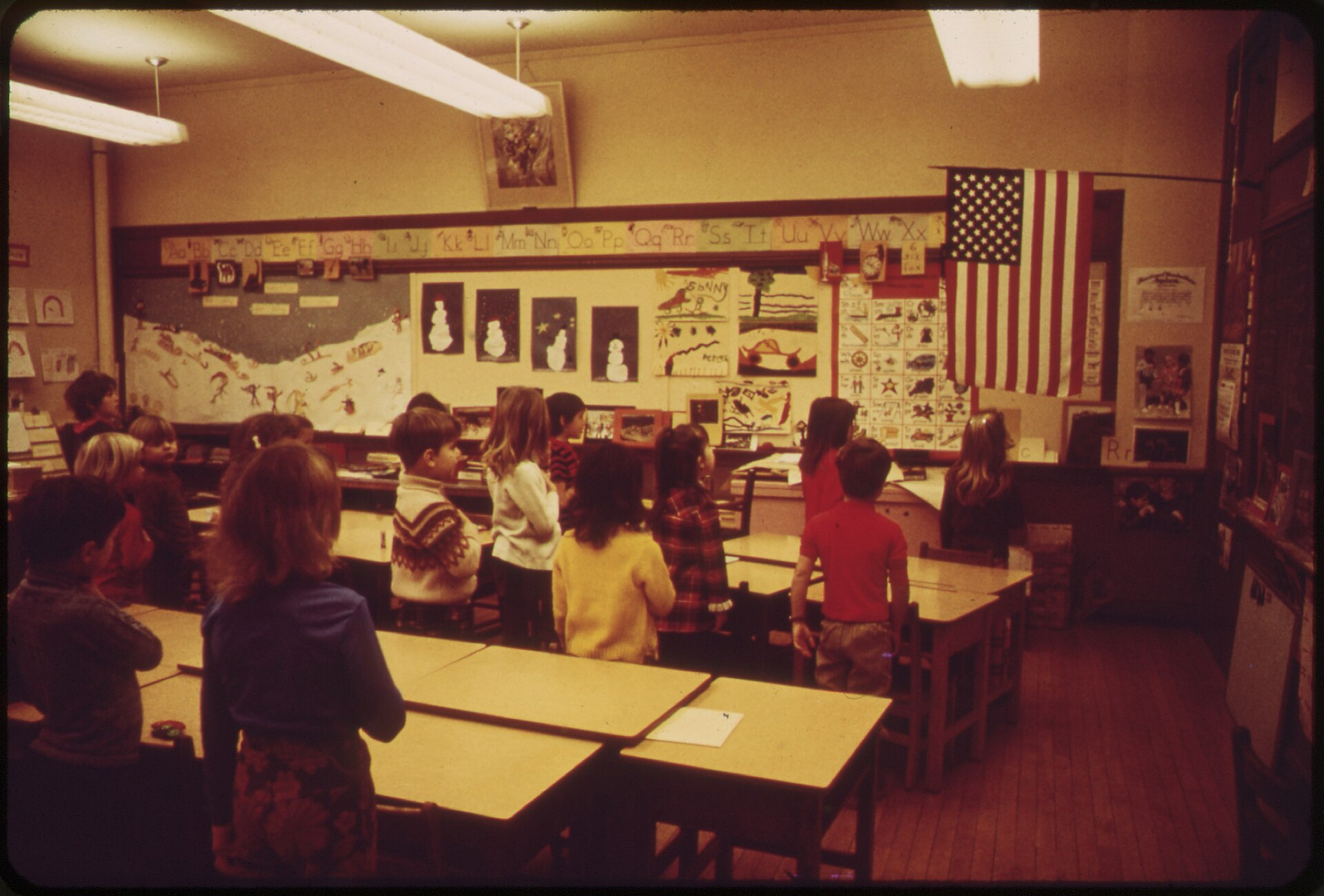
In my middle school and high school years, in typical teenage fashion, I started listening to music and reading books that gave teeth to the resistance I felt during those Veterans Day programs. Pink Floyd and 1984 crystallized the feeling that I was being forced to think and act in certain ways. Self-Reliance by Ralph Waldo Emerson and Joe Pug’s “Nation of Heat” album convinced me — for better and worse — that I should listen to my own thoughts rather than following the herd. All of a sudden, those forced pledges really did feel coercive, and I’ve never been able to shake that feeling. Looking back, it’s bizarre to think about how, every morning at the buzz of an intercom, 25 children in each school room would robotically rise and recite a 15-second oath of devotion.
Again, I was a teenager, so I thought I was the first person to discover these connections and resist them. But it turns out I come from a long line of people who resisted the pledge. A distant relative of mine began his high school teaching career during the tumultuous 1970s, and he would position his desk at the back of his classroom so that his students wouldn’t notice when he didn’t say the pledge. Another family member came up with a cheeky solution: If you don’t say the words “I pledge allegiance,” then the sentence magically becomes a nonsensical fragment, rendering the whole thing meaningless. This fix scratches my grammar nerd brain real nice.
You may find this arbitrary, but for him it resolves a serious concern stemming from his Christian faith. His ultimate commitment, loyalty, and devotion are to Christ. He considers himself loyal to America, but if Christ and country ever collide, he will pick Christ without question. The pledge very explicitly expresses a devotion to the republic, and for him, that’s just not true. To pledge allegiance to the republic would make his word meaningless. So he doesn’t say it.
My family members are not the first Christians to contend with this tension between loyalties. Early Christians were martyred for swearing fidelity to Christ instead of the Roman emperor. Some Christians in 17th-century Japan were executed for choosing not to step on an image of Jesus. Luckily, I’m not at the whims of the Romans or the Tokugawa Shogunate, but the principle stands. Since Christianity’s beginning, its adherents have made decisions about where their ultimate loyalty lies.
In 1943, Walter Barnette, a Jehovah’s Witness, won a Supreme Court case defending the right to not say the Pledge of Allegiance on religious grounds. Jehovah’s Witnesses still abstain from saying the pledge because it contains “wording that promises devotion to a country above all else.” They, therefore, “cannot in good conscience participate in such ceremonies.”
My feelings toward the pledge, at this point, are also pretty tied up with my relationship to religion. I was raised by a youth minister and worship minister, who were themselves raised in Christian households. In my George Orwell and Ralph Waldo Emerson years, I also doubted what all that “Jesus” stuff meant and interrogated why I should listen to a book from thousands of years ago. Those were tough years, as my whole worldview had been shaped by the stories and teachings of that old book. If I threw it all out, the world wouldn’t make much sense.
As I navigated some choppy religious waters, an unknown journey was lurking around the corner: trying to sort through my understanding of civic duty and patriotism.
For another graduation, my wife and I drove a few hours over the Appalachian range for my cousin’s commencement I mentioned earlier. He went to a huge high school near Winston-Salem, North Carolina — the school’s student enrollment is literally half the number of my hometown’s population — and the ceremony was held in the Wake Forest University basketball arena.
We were all settled in with aunts, uncles, and cousins when the 533-graduate ceremony began. Then came the posting of the colors. As we watched three young military recruits process the flags, the room remained loud. Parents and grandparents all throughout the stadium were cheering, calling out the names of their graduates. I was immediately flummoxed, if not downright angry — which of course led to the question: When I refuse to say the pledge, am I not being just as disrespectful?
I’m actually a big fan of ceremony and tradition. An old prayer, a holiday, a song, a sport — don’t get me started on processions. I like a ceremony that directs a group of people’s attention, binding us together for one shared purpose. If that purpose is shared with a long line of people who came before us, even better. I love that at every wedding I attend, I stand with everyone else at attention to honor and express support for the bride as the couple begins their life together. Anything that’s lasted hundreds or thousands of years immediately earns my respect and, on top of that, is plain old cool.
The pledge isn’t thousands of years old, but it is 134 years old (most of it, anyway). So when I make the decision not to say the pledge, I don’t make it lightly. But in a roundabout way, I refuse to say the pledge for the same reason I value silence during the posting of the colors.
Traditions and ceremonies shape us. That’s what is happening. But the how is more interesting: shared actions and shared words. They’re present in the Pledge of Allegiance — hand over heart, recite the script — and during other rituals like singing hymns or belting team chants at soccer games.
These activities express shared interests and values, but they also form them. Writers have considered the importance of shared activity for centuries — David Brooks thinks a lack of communal moral formation causes sadness and meanness in Americans; Alasdair MacIntyre believed people’s moral imaginations are shaped by the shared stories and practices of their communities; Aristotle wrote about how habits, or stable active conditions, form virtue.
Shared activities and traditions shape people, and patriotic ceremonies are no different.
That’s really why the Pledge of Allegiance was written in the first place. In 1892, Francis Bellamy wrote the pledge as a way to encourage patriotism in young people and bind them together under a shared commitment to the flag and the republic. But I think Bellamy took it too far: patriotism doesn’t necessitate allegiance.
In the last year or so, political writers on both the left and the right have written about the decline of patriotism and its causes. I agree. On a practical level, increased loneliness and division call for a strengthened social fabric, and love of country can be helpful for that.
But patriotism alone can’t hold together the social fabric; it should be only one thread among many other, far stronger threads.