




I'm Isaac Saul, and this is Tangle: an independent, nonpartisan, subscriber-supported politics newsletter that summarizes the best arguments from across the political spectrum on the news of the day — then “my take.”
Are you new here? Get free emails to your inbox daily. Would you rather listen? You can find our podcast here.
Today’s read: 13 minutes.
The modern moon race.
For more than 50 years, no human has set foot on the lunar surface. But now, the United States, China, Russia, and others are all planning to return — not just to visit, but to stay. In our latest video, Associate Producer Aidan Gorman explores why the world’s great powers are suddenly dead set on getting back to the moon, and how the race could shape the future beyond Earth.
Check it out below.
Quick hits.
- A senior Pentagon official told Congress that the estimated cost to date of the Iran war is $29 billion, up from a $25 billion estimate given at the end of April. (The update) Separately, U.S. intelligence agencies have reportedly assessed that Iran has regained access to 30 of the 33 missile sites along the Strait of Hormuz, in addition to most of its other missile sites, launchers, and underground facilities. (The report)
- Food and Drug Administration Commissioner Marty Makary resigned, reportedly over the agency’s decision to authorize fruit-flavored e-cigarettes, which he opposed. President Donald Trump was reportedly preparing to fire Makary before his resignation. (The resignation)
- The Senate voted 51–45 to confirm Kevin Warsh to the Federal Reserve’s Board of Governors. The chamber is expected to vote on Wednesday on confirming Warsh to be chair of the central bank. (The vote)
- President Trump arrives in China this morning for a summit with Chinese President Xi Jinping. The two are expected to discuss trade relations, energy, and the Iran war. (The summit)
- Russia launched an estimated 200 drones at Ukraine, attacking locations across the country. At least five people were injured, and Ukrainian President Volodymyr Zelensky said that over 100 Russian drones remain in Ukrainian airspace. (The attack)

Why Isaac Uses ButcherBox at Home
How livestock is raised affects more than ethics — it shapes the nutrition and quality of the meat we eat. ButcherBox partners with farms that raise animals in healthier, lower-stress environments.
What that means:
•A high-quality protein source — not a grab-and-go, shelf-stable option
• Higher levels of beneficial nutrients like omega-3s
• Zero antibiotics, growth hormones, or harmful additives
Simply put: healthier animals create healthier meat.
“I'm a meat eater and I love to cook. But I also worry about sustainable farming and impressing my wife. Maybe the biggest unlock for me in the last few years has been ButcherBox. I'm genuinely astounded at the quality of the meat, and the convenience of having the box show up on my front door once a month cannot be beat.” — Isaac Saul, Founder of Tangle
Code TANGLE gets you $60 off plus free protein for life!
Today’s topic.
The hantavirus outbreak. On Monday, 18 Americans returned to the United States from a cruise ship where passengers had contracted a rare strain of hantavirus. The Centers for Disease Control and Prevention (CDC) transported the passengers to specialized quarantine facilities in Nebraska and Georgia; one American tested positive for the virus. As of Tuesday afternoon, three deaths — a Dutch couple and a German woman — nine confirmed cases and two more suspected cases have been linked to the cruise ship outbreak. Health officials say the risk to the general public remains low.
Back up: Hantaviruses are a family of viruses typically transmitted between rodents, which can then infect humans who touch or breathe in rodent urine or droppings. The Andes strain, which the World Health Organization (WHO) identified in the cruise ship outbreak, is the only known subtype that allows for person-to-person transmission. Symptoms of the Andes strain include fatigue, fever and chills, and in severe cases, can cause a respiratory disease called Hantavirus Pulmonary Syndrome, which has a case-fatality rate of 38%.
Approximately 150 people were aboard the MV Hondius, a Dutch polar-expedition cruise ship which set sail from Argentina on April 1, when a 70-year-old Dutch man fell ill with respiratory symptoms and died on board of a then-undetermined cause. Thirteen days after his death, on April 24, the man’s wife and over two dozen other passengers disembarked from the vessel on the remote island of St. Helena in the Southern Atlantic. The Dutch woman then flew to South Africa, where she died from the virus. On May 2, a German woman still on board also died from the virus. That same day, the WHO identified the incidents as a hantavirus outbreak; shortly after, health organizations began isolation and evacuation efforts. Most passengers have now returned to their home countries, and the ship is expected to dock in the Netherlands on Sunday or Monday.
Health officials acknowledge the novel, multi-country nature of the spread but say a larger outbreak is unlikely. On Tuesday, WHO Director-General Tedros Adhanom Ghebreyesus said that “all suspected and confirmed cases have been isolated and managed under strict medical supervision, minimizing any risk of further transmission.”
Late last week, the CDC activated its Level 3 response, the agency’s lowest level of emergency activation. In a press conference on Monday, Health Secretary Robert F. Kennedy Jr. said the CDC has the outbreak “under control,” and that “we’re not worried about it.” President Donald Trump added that the CDC “acted very, very quickly” and called the disease “very hard to catch.”
Below, we’ll explore what the left, right, and epidemiologists are saying about the hantavirus outbreak. Then, Managing Editor Ari Weitzman shares his take.
What the left is saying.
- The left is concerned about the outbreak, particularly as the Trump administration has divested from global health systems.
- Some say health officials are overconfident in declaring what they know.
In The Bulwark, Jonathan Cohn asked “seriously, how nervous should we be about hantavirus?”
“Donald Trump has spent much of his second presidency waging an all-out assault on America’s global health infrastructure — by downsizing or eliminating existing agencies and programs, and transforming them in ways that make them instruments of other goals like extracting mineral rights or ending DEI. This assault has also included withdrawing from the World Health Organization, and from global health cooperation more generally,” Cohn wrote. “That has left the federal government without some of the tools, systems, and personnel it has deployed in the past. The result is a federal response to outbreaks that is weaker overall, and could falter in the face of a more serious threat.”
“The ability to assess this hantavirus outbreak so quickly is testimony to the sophisticated international infrastructure now in place for disease surveillance and response. And that infrastructure didn’t appear out of thin air. It was constructed over time, with much of the essential money, leadership, and expertise coming from the United States,” Cohn said. “The worry now… is that the infrastructure is losing American support, thanks to Trump.”
In The New York Times, Zeynep Tufekci wrote “a new viral outbreak. The same mistakes all over again.”
“During a press conference last week, a W.H.O. official addressed people who had disembarked, asking them to present themselves to health care authorities if they were developing symptoms. W.H.O. officials also kept defining transmission as happening through close prolonged contact,” Tufekci said. “But even these definitions still suffer from a lack of learning from the Covid experience, such as limiting exposure to being within about six feet for a cumulative period of more than 15 minutes. We know from the study of airborne transmission that that guidance may be too rigid and fail to capture the full risk profile of the virus.”
“Public health officials… would be more helpful if they stopped constantly reassuring people about the likelihood of future events they can’t accurately calculate — like the odds of a pandemic occurring or how long this outbreak could last — and just told us more details about the things that matter: mode of transmission, lengthy period of incubation and the inevitable uncertainty of something for which there is little actual knowledge,” Tufekci wrote. “If we’re lucky, this hantavirus outbreak will peter out… If we are unlucky? It should be unthinkable, but here we are.”
What the right is saying.
- Many on the right say the risk of a global health crisis currently appears low.
- Others note how the outbreak has fueled doomerism on the left.
In The Spectator, John Power suggested “hantavirus doesn’t look like the next Covid.”
“There is only one strain of hantavirus which we know can spread from person to person, the Andes strain of the illness. The Andes strain can only be spread through ‘very close contact.’ That generally means things like sharing drinks, hugging and other things we would not normally do with strangers,” Power said. “That means that the non-pharmaceutical interventions we saw during Covid, such as lockdown or ‘hands, face and space’ measures would have little impact on the transmission of the virus. And because the disease is so difficult to spread it is unlikely to develop into a full pandemic.
“The need for ‘very close contact’ for human-to-human transmission is a characteristic that hantavirus shares with monkeypox… Monkeypox has indeed been a challenge, particularly in parts of Africa, but most people and indeed most dogs have been able to avoid the worst of it,” Power wrote. “From what we know at this stage hantavirus is, in some ways, more like monkeypox than coronavirus. A problem, but a manageable one, one that the vast majority of people will be able to avoid by keeping calm and carrying on.”
In National Review, Noah Rothman wrote about “the market for a new pandemic.”
“There isn’t a cable news producer on earth who could resist the temptations presented by the outbreak of a rare and deadly communicable disease — and on a cruise ship, no less,” Rothman said. “There is a species of news consumer who has little interest in relative risk. They seek out stronger stuff in their media diet. For those who want the press to stimulate their already hyperactive amygdala, there is no shortage of irresponsible communicators who are willing to trigger their readers’ fight-or-flight response by evaluating the outbreak through the prism of their contempt for the Trump administration.”
“More perverse still is the unstated wish fathering the thought that this virus could bloom into the next global pandemic. Maybe if it did, and if many more people died, the ‘abundance of caution’ that typified the public health apparatus’s draconian response to Covid-19 would be retroactively vindicated?” Rothman wrote. “Fortunately for the rest of us, this hantavirus outbreak is unlikely to relieve this unhappy cohort of their bitterness. The mainstream news outlets that are covering this outbreak like a tragedy rather than a disaster are getting the story right. But there will always be a market for doomerism.”
What epidemiologists are saying.
- Epidemiologists say the risk level is still low, but some say the CDC can better communicate with the public.
- Others highlight the importance of international cooperation in limiting the disease’s spread.
In Your Local Epidemiologist, Dr. Katelyn Jetelina shared a “hantavirus update.”
“This virus has a long incubation period, up to 45 days (median 18 days), during which it can enter the body, latch on, and wreak havoc. Unfortunately, we are at the mercy of time and biology,” Jetelina said. “The international response has been fantastic so far. I continue to be impressed by WHO’s coordination across multiple countries, their public briefings, the swiftness of contact tracing and testing, and their success in negotiating with Spain to allow the boat to dock.”
“Public health scientists are on it. CDC scientists are actively involved behind the scenes, including standing up an Emergency Operations Center and coordinating with the WHO,” Jetelina wrote. “That said, I do have some major questions for CDC leadership and the administration. I want to know: Why haven’t they deployed a team to help with the international response? Why haven’t physicians been alerted through the Health Alert Network (HAN) as they typically would? Why is there zero communication with the public or updates to the website? This is abnormal. The muffling of scientists and the lack of transparency are unacceptable for Americans’ safety and security.”
In RTI, Claire Quiner and Lauren Courtney wrote about “what you should know about the Andes virus.”
“This scenario demonstrates, in real time, our vulnerability to infectious diseases. It shows how quickly infectious diseases that were previously isolated to a single location can reach distant corners of the globe. It underscores just how small our world has become,” Quiner and Courtney said. “It also highlights the important role of multi-country health agreements — such as the International Health Regulations (IHR) — that are put in place to handle these types of international events. Because of the IHR, ships like the MV Hondius have a responsibility to report to local authorities if people on board are sick and to follow stringent protocols to contain it.”
“Should we be concerned about another global pandemic? Many of our friends and family have been asking us this question, and our response has generally been, ‘probably not,’” Quiner and Courtney wrote. “Right now, the risk to the global population remains quite low, largely because the pathogen was detected and identified early. Cases are being contained and managed to prevent further spread and escalation. The type of international coordination that we are seeing for this outbreak, guided through the IHR, is what helps protect us from known infectious threats.”
My take.
Reminder: “My take” is a section where we give ourselves space to share a personal opinion. If you have feedback, criticism or compliments, don't unsubscribe. Write in by replying to this email, or leave a comment.
- It’s tempting to compare this outbreak to the onset of Covid-19, but the situations are very different.
- Hantavirus is deadly and scary, but its transmissibility is low and the cases are being closely tracked.
- We should all be careful not to overreact and to closely vet any information we learn before sharing it.
Managing Editor Ari Weitzman: I remember my moment clearly. After a few months of applications and interviews, I had just started working at my second-ever software engineering job for a health insurance company in Pittsburgh, Pennsylvania. My wife — well, then-fiancée — and I had just moved back east from California, where we had spent the previous four years, and were settling into our new home and new life. A higher-up in the company was holding an informal corporate-style roundtable with all the new hires, the kind of “rap session” where an exec flips her chair around to jam about what it’s like working for COMPANY, and COMPANY’s values, and all of that good stuff. I don’t remember really much of anything specific about that meeting, except for a question she asked us towards the end.
“Is anyone feeling nervous about this coronavirus?”
It was mid-February of 2020, and reports were just starting to circulate online. Some new viral respiratory infection was taking hold in China. People were calling it different things — coronavirus, Covid-19… SARS-CoV-2, if you worked at a healthcare company (or with very pedantic people). Apparently, it was like the flu, but like a really bad flu. Cases were being reported in Australia and Europe. Some people said it had hit California.
I raised my hand to respond with the wrongest, least informed answer I may have ever given in my life.
“No, I’m not nervous. It’s like the flu, right? I don’t know, I’m not too worried about it.”
That was my moment of reacting to news of Covid-19 for the first time. And I wasn’t an aberration; most people in the room nodded along, and even the healthcare executive leading our discussion didn’t correct me (remember, this was February 2020; we simply didn’t know yet). Most people I knew were as unconcerned as I was, or they were following along with case reports as an idle curiosity — an explainer about airplane circulation here, a report about a Wuhan lab there.
Two weeks later, and my entire team started working remotely, downloading Zoom, and learning how to use new terms like “hybrid office.” My fiancée and I had to scramble to make our planned August wedding “Covid-safe” (no one contracted a case from our wedding, more because it came rather fortunately in the middle of a blissful trough in the pandemic and less because of our attempted precautions, which quickly evaporated once the celebration began). The entire world was plunged into confusion, division, sickness and all manner of major disruption over the next two years, and the Covid-19 pandemic would prove to be the most impactful global event since 9/11.
Now, when I hear about the hantavirus cases across the globe, I find myself thinking similar thoughts as the ones I expressed in that first-floor conference room six and a half years ago: It doesn’t seem that bad… I don’t know, I’m not too worried about it. That symmetry, more than anything else, concerns me. Those three years at the beginning of the decade were like a giant hole in the middle of my life (okay, not the whole time — that span certainly offered its beautiful moments).
Pretty much every public health expert is saying the same thing: This is not like last time, this is a very different disease, the chance that this becomes a global pandemic is not likely — which translates from scientific language into plain English as, “No, you’re right not to be too worried about it.” But that unanimity feels oddly discomforting — and once more, I’m not an aberration. A lot of people I talk to are expressing a similar concern, which feels like a collective trauma response. That feeling is perhaps best articulated by a text a friend shared with me earlier this week: Everyone I know who has a PhD thinks it’s going to be nothing, so I think it’s going to be a huge deal.
But let’s pause there. Our personal reactions to Covid-19 — when public experts were sounding the alarm — have absolutely no bearing on what will happen now. Whether you were wrong before and over-correcting now, or you were so impacted by the pandemic that you’re in denial that this could happen again, basing your beliefs on personal narratives is not a logical chain of reasoning. This is magical thinking, not rational thinking. Only the facts of what’s happening now will have any impact on what happens later.
So let’s break down the facts. Hantavirus is a rare, but often severe, disease that causes heavy flu-like symptoms like fever, fatigue, and muscle aches. The virus spreads through rodent feces and urine, and the Andes strain is the only hantavirus known to spread from human to human. The Andes strain (or ANDV, if you work in healthcare or with pedantic people) has been a known entity for long enough for scientists to understand some key aspects of the virus. It transmits through what every medical source I’ve read describes as “close contact” with an infected person. Its incubation period (the time between exposure and onset of symptoms) is typically about 1–6 weeks but can be longer. A person who contracts a hantavirus can develop either Hantavirus Pulmonary Syndrome (HPS), which comes with breathing difficulty, or hemorrhagic fever with renal syndrome (HFRS), which impacts the kidneys. The Andes virus is associated with HPS, not HFRS. Much of our recent knowledge about the disease comes from studying a 2018–2019 event in Argentina, in which 34 people contracted the virus and 11 people died.
We also don’t know a lot about the disease. For example, transmission rates aren’t fully understood, nor is the specific way the Andes virus spreads (although we do know that it tends to spread through prolonged contact within households, likely transmitted through inhaling saliva). And while vaccines exist for one variation of hantavirus, they’re only approved in South Korea and China and offer limited long-term protection. There is no current treatment specifically for the disease variation represented by the Andes strain, only for its symptoms.
Some of that is very scary. The disease has high mortality, its incubation period is long, transmission isn’t fully understood, and we don’t currently have a treatment for it. Some of it is reassuring. This is not a novel virus, it can only be transmitted through close contact, and the current outbreak was detected early and is being closely monitored.
But one other frightening aspect of this current outbreak is a little harder to define: fear-based spread of misinformation.
As facts come out, it will be tempting to jump to conclusions based on unsubstantiated reports. Politicized echo chambers will have incentives to peddle you specific narratives based on ideology. Misinformation can travel fast in our media ecosystem, as it did during Covid.
But we know how to treat the virality of misinformation, even if that treatment is often painful: Be fast to learn, but be slow to know. As Noah Rothman wrote (under “What the right is saying”), “There is no shortage of irresponsible communicators who are willing to trigger their readers’ fight-or-flight response.” Be careful about stories that play to your emotions (Trump slashing the CDC is making you vulnerable, or people are trying to scare you with twisted pandemic fantasies so they can control you) — stories like those usually contain some truth, but are designed to elicit a certain response. Look outside editorial pages for news and check for multiple sources to confirm new information. Don’t repeat things you aren’t sure of. Be skeptical, but be curious. Remain informed about areas with confirmed reports of infected individuals and avoid those areas, and if you find reports about infected areas to be credible and reliable, share that information with others.
We can’t know what is going to happen next, but I feel confident about one thing: This will not be like last time. This is a different disease and a different situation, with a much different virality and a very different initial response from public health officials. Looking for irrelevant patterns is a trap, and magical thinking isn’t helpful — only the current facts of the current situation will determine where we go from here.
Block out the fear, be fast to learn, and be slow to know.
Take the survey: How much is your social circle discussing the current hantavirus outbreak? Let us know.
Disagree? That's okay. Our opinion is just one of many. Write in and let us know why, and we'll consider publishing your feedback.
Your questions, answered.
We're skipping the reader question today to give our main story some extra space. Want to have a question answered in the newsletter? You can reply to this email (it goes straight to our inbox) or fill out this form.
Under the radar.
On Monday, the Justice Department announced that Eileen Wang, the mayor of Arcadia, California, had been charged with acting as an illegal agent of the Chinese government. In 2022, Wang was elected to Arcadia’s city council, which selects a mayor on a rotating basis. According to her plea agreement, she worked at the behest of the Chinese government from 2020–2022, promoting pro-China content via a website that targeted the Chinese-American community. After agreeing to a guilty plea, Wang faces up to 10 years in prison. NewsNation has the story.
A deeper look.

From 1951–53, during the Korean War, more than 3,000 United Nations troops became sick with what was then known as Korean hemorrhagic fever. In the late 1970s, researchers in South Korea began testing trapped field mice and discovered the virus that had caused the fever. They named it the hantavirus, after the nearby Hantan River. As research into the new virus continued into the 1990s, scientists eventually realized that hantaviruses were not isolated to Korea, as they first thought; instead, different strains of hantavirus exist all over the world. For a long time, hantaviruses were thought to only occur in rodents; however, strains have been discovered in bats in Sierra Leone and in saltwater and freshwater fish in Europe and the South China Sea. Thus far, only rodent-borne hantavirus strains have been known to infect humans.
Hantavirus outbreaks have popped up throughout recorded history. The earliest likely outbreak occurred in Imperial China during the Warring States period and is recorded in the Chinese medical text the Inner Canon of the Yellow Emperor. Researchers now also believe that British soldiers in Flanders during World War I experienced hantavirus symptoms. And in 1993, a hantavirus outbreak in the Four Corners region of the southwestern United States prompted scientists to identify and research a new side effect of hantavirus, the hantavirus pulmonary disease.
The extras.
- One year ago today we covered the plane Qatar gifted to President Trump.
- The most clicked link in our last regular newsletter was the link to our Instagram page.
- Nothing to do with politics: A Spotify Wrapped, but for your entire listening history.
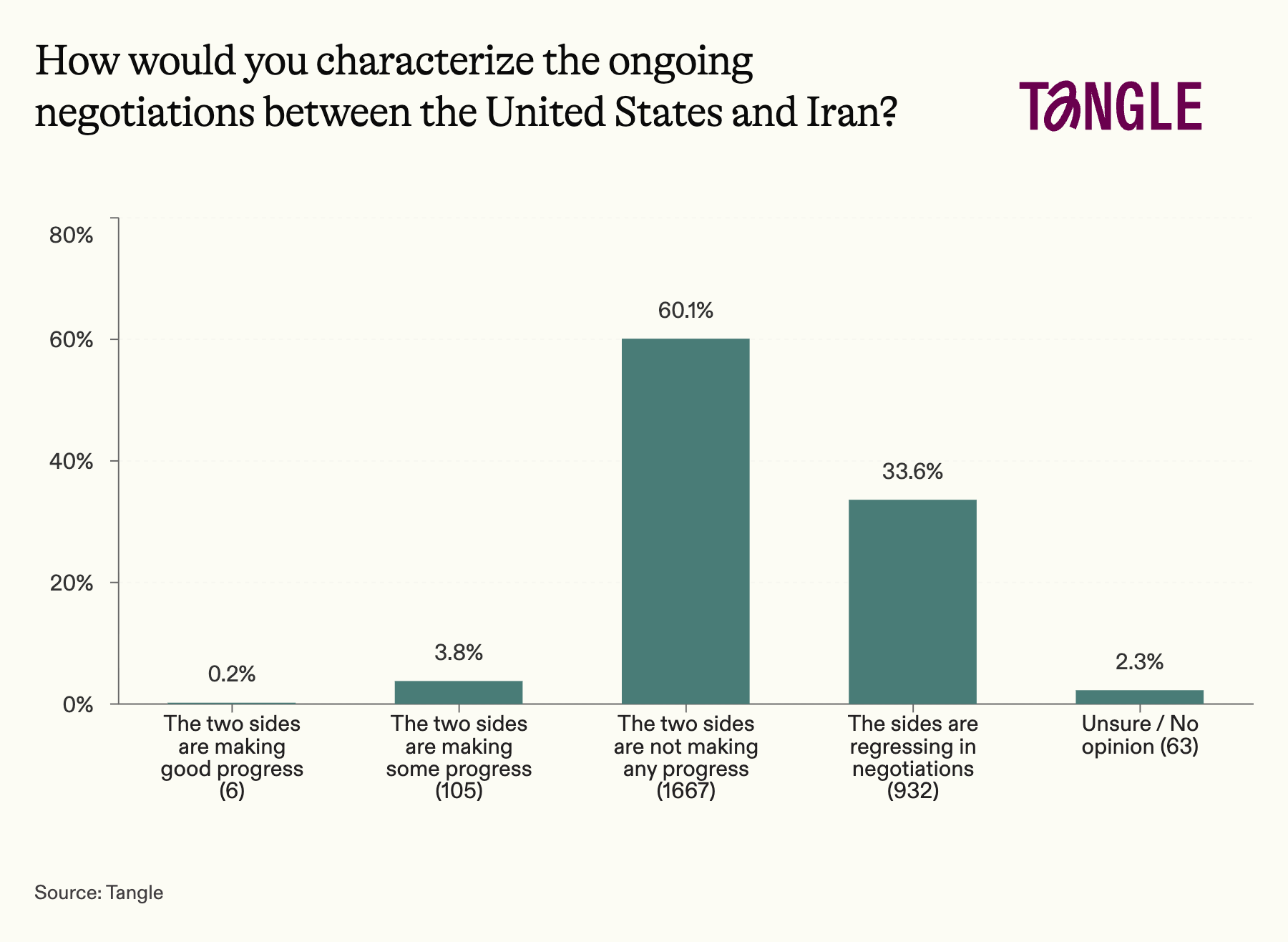
- Our last survey: 2,773 readers responded to our survey on the negotiations between the United States and Iran with 60% saying the two sides are not making any progress. “Iran is stalling until the midterms,” one respondent said. “Each time the U.S. is in peace negotiations, it attacks, and frequently kills the negotiators. This makes Iran justifiably concerned about peace negotiations,” said another.
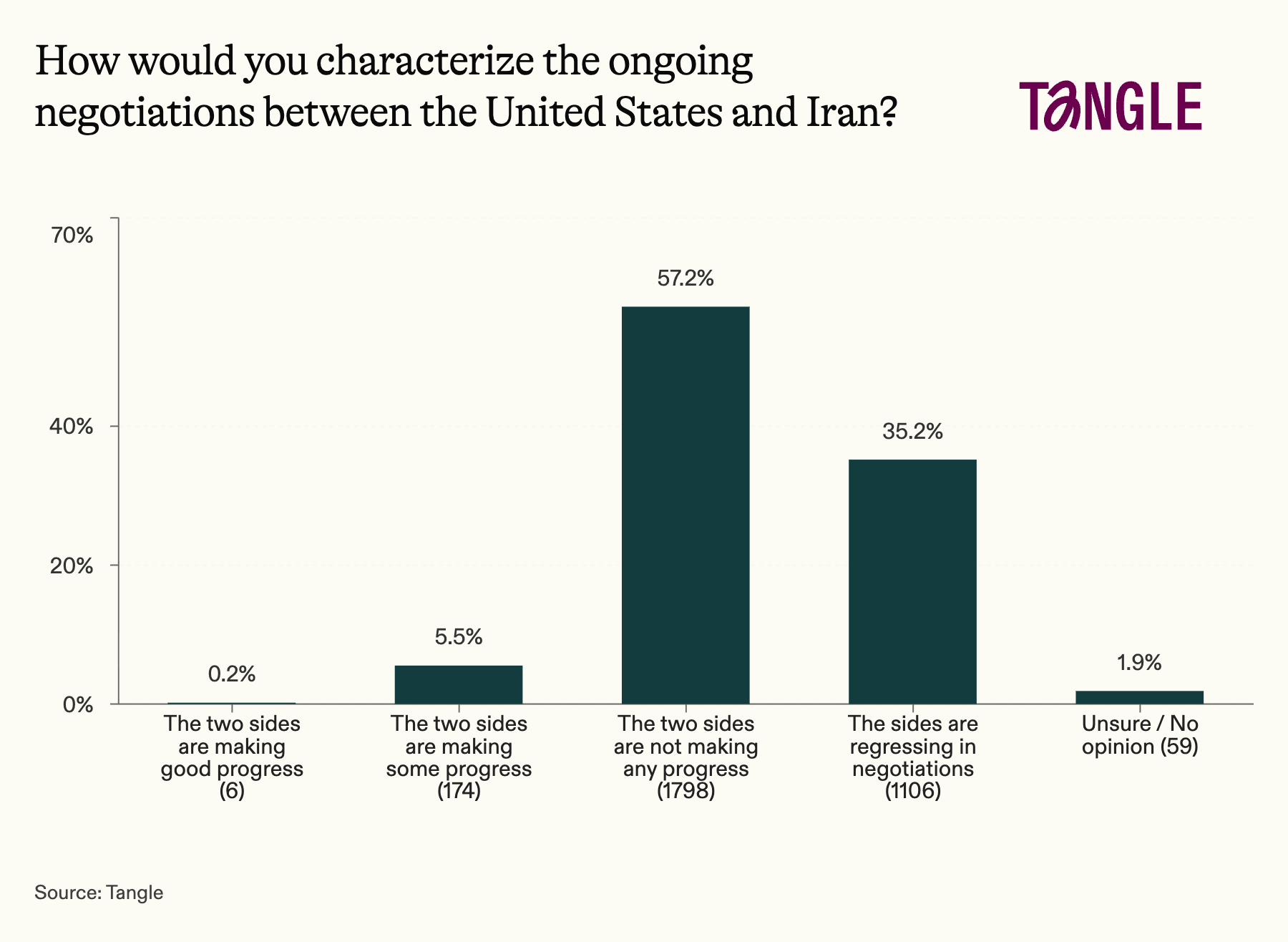
3,143 readers responded to the same question on April 13; those responses are below.
Have a nice day.
Last week, a tornado injured 12 people and flattened homes in a rural Mississippi neighborhood. Ashton Lemley, a storm chaser who is allergic to cats, was walking through the rubble when he heard a meow. After several minutes of looking and five minutes of paused meowing, Lemley dug under insulation to find the wet, scared kitten with his flashlight. Lemley held the seemingly-uninjured kitten for a few minutes, and a volunteer dried it off. People have expressed interest in adopting the kitten, and some have suggested naming it Tornado. In a video of the rescue, Lemley says, “It’s okay, we’ll get you cleaned up, baby. Don’t you worry.” The Associated Press has the story.


Member comments