
I'm Isaac Saul, and this is Tangle: an independent, nonpartisan, subscriber-supported politics newsletter that summarizes the best arguments from across the political spectrum on the news of the day — then “my take.”
Are you new here? Get free emails to your inbox daily. Would you rather listen? You can find our podcast here.
Today’s read: 14 minutes.
The Trump administration’s “under the radar” leaders.
Do you recognize these names: Rollins, Wright, Turner, Collins? If not, you’re not alone. These are secretaries of federal-level departments, the ones who have not been garnering as much attention so far in Trump’s second term in office. We’re going to put the spotlight on what these secretaries have been up to tomorrow, reviewing ten department heads and catching you up on everything the secretaries not named Hegseth, Kennedy, or Gabbard have been doing for the past eight months.
Reminder: Tangle Friday pieces are for paying subscribers only. To access this full article — along with all our Friday essays, special editions, and more — click here to subscribe.
Quick hits.
- The Senate failed to pass two short-term funding bills, extending the partial government shutdown until at least Friday, when the next vote is scheduled. Office of Management and Budget Director Russell Vought told House Republicans that the government would begin firing federal employees within the next two days. (The shutdown)
- The Trump administration will reportedly provide Ukraine with intelligence for long-range missile strikes on Russia’s energy infrastructure and has asked NATO allies to provide similar support. (The report)
- The Trump administration moved to end funding for the Council of the Inspectors General on Integrity and Efficiency, which serves as an umbrella organization for 72 inspectors general across the federal government. (The defunding)
- President Donald Trump signed an executive order directing his administration to invest $50 million in using artificial intelligence for pediatric cancer research. (The order)
- Germany arrested three suspected members of Hamas for allegedly planning attacks on Israeli and Jewish institutions in the country. Hamas denied any connection to the suspects. (The arrests)
Your car insurance company is probably overcharging you.
In fact, they're kind of counting on you not noticing. Same goes for your credit card company, your phone bill, and half the stuff you buy on Amazon.
We found a list of creative ways to fatten your bank account this month—from slashing your car insurance by $1,025/year to getting paid $225 a month just for watching movie previews.
Some of these sound too good to be true (getting companies to forgive your debt? Really?). But millions of people are already doing this stuff.
Check out which moves make sense for your situation right here.
*Our sponsors help keep Tangle free — thank you for supporting them when you can!
Today’s topic.
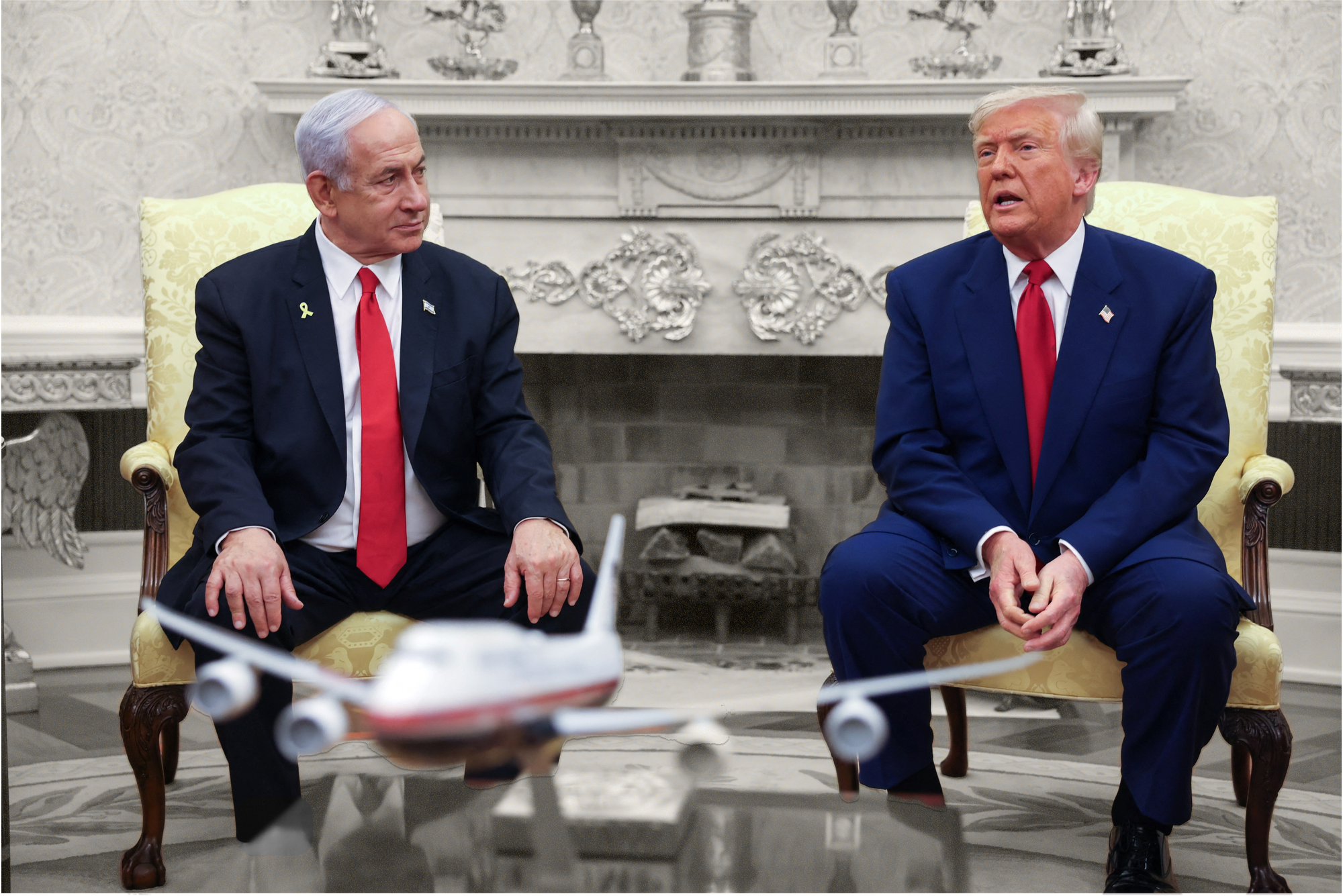
Trump’s new proposal for Gaza. On Monday, President Donald Trump met with Israeli Prime Minister Benjamin Netanyahu to discuss a new plan to end the war in Gaza. The president’s 20-point proposal outlines a series of actions to end the war between Israel and Hamas — including Hamas’s release of 48 hostages in exchange for nearly 2,000 Palestinian prisoners imprisoned by Israel — as well as a demilitarization plan, rebuilding framework, and governance structure for Gaza after the war. Prime Minister Netanyahu has endorsed the plan (though Israel has not officially accepted it), while Hamas has asked for more time to review its provisions.
Back up: In March, a three-phase peace plan between Israel and Hamas fell apart after one peaceful exchange of hostages and prisoners. Meanwhile, President Trump outlined a separate plan for Gaza in February, under which the United States would take over the enclave and “temporarily relocate” Gazans to surrounding countries. Hamas did not accept the proposal.
According to an Axios report, the new peace plan came together after Israel’s strike targeting Hamas leaders meeting in Qatar in September. While that strike imperiled ceasefire negotiations, President Trump reportedly organized a call for Netanyahu to apologize to Qatari leaders, which the president called “productive.” On Monday, Trump also signed an executive order declaring any attack on Qatar as a threat to the United States.
White House advisers Steve Witkoff and Jared Kushner developed the plan by combining an existing ceasefire proposal with a post-war plan for Gaza developed by Kushner and former British Prime Minister Tony Blair. In addition to a hostage and prisoner exchange, the plan requires Israel to allow aid deliveries to Gaza to resume in full and creates a special economic zone (with “preferred tariff and access rates”) in the strip. Furthermore, Gaza would accept a “technocratic, apolitical” committee as a transitional government, with oversight from a “Board of Peace” led by Trump and Blair. The United States would work with Arab and international partners to establish a temporary International Stabilization Force to maintain stability on the ground.
Arab mediators said that Hamas is open to the proposal and is still reviewing its details. The group is reportedly hesitant to fully disarm and destroy its weapons, and they have expressed concerns that the peace plan does not outline a clear path to Palestinian statehood. However, some Arab leaders have increased pressure on Hamas to accept the deal, saying that they will cut off diplomatic support if the proposal falls through. On Monday, the foreign ministers of eight Muslim-majority nations and the Palestinian Authority endorsed the plan, saying it “creates a path for a just peace on the basis of a two-state solution.”
President Trump said he will give Hamas three to four days to respond to the proposal and signaled that he is not open to further negotiations. “Hamas is either going to be doing it or not, and if it’s not, it’s going to be a very sad end,” Trump said.
Today, we’ll share views from the left, right, and Middle East writers on the proposal. Then, Executive Editor Isaac Saul gives his take.
What the left is saying.
- The left is mixed on the proposal, with some saying it rewards Israel for its brutal tactics in the war.
- Others commend Trump for proposing a substantive, realistic plan.
In Drop Site News, Jeremy Scahill and Jawa Ahmad called the plan “a rubber stamp of legitimacy on Israel’s subjugation of Palestine.”
“While the proposal includes a series of apparent concessions to Arab and Muslim countries in return for their endorsement, it makes no mention of how Israel would be prevented from violating the agreement. The plan also includes a nebulous mention of possible future Palestinian ‘self-determination and statehood’ after Gaza ‘re-development advances’ and the Palestinian Authority is reformed,” Scahill and Ahmad wrote. “At the heart of Trump’s plan is a thinly-veiled ultimatum to Palestinians: bend the knee to Israel, renounce the right of armed resistance, and agree to indefinite subjugation by foreign actors.”
“In previous ‘ceasefire’ negotiations, when Hamas has sought to propose amendments or even to clarify phrasing in draft texts, Israel and the U.S. denounced Hamas, falsely accusing it of rejecting peace, and then Israel intensified the military assault on Gaza,” Scahill and Ahmad said. “Israel, meanwhile, has offered the public perception it agrees to draft deals, while at the same time securing ‘side letters’ from Trump and his predecessor, Joe Biden, authorizing Israel to resume the war if it determines the agreement is no longer in its interests.”
In The Washington Post, David Ignatius suggested “Trump’s ‘New Gaza’ is opening a door to something different.”
“Peace is still a long way off, but Trump laid a strong foundation for it with his plan Monday to end the nightmare war in Gaza and begin the transition to a stable ‘day after’ there,” Ignatius wrote. “Trump often overstates the significance of his actions, but not here. His ‘Board of Peace’ to oversee political transition in Gaza is a potential game changer. Trump spoke in the third person in offering himself as board chairman, but if this plan succeeds, he will have earned a measure of his vanity.”
“A cynic — useful in any discussion of the Middle East — would caution that Trump’s plan is long on hope and short on practical tools for ravaged Gaza and a Palestinian population broken and embittered. But Trump has at least given up his initial ideas for forced relocation of Gazan Palestinians,” Ignatius said. “The only really sour note in Trump’s presentation Monday was his gratuitous attack on former president Joe Biden. In truth, Biden’s Middle East team laid the groundwork for the Gaza ceasefire and the plan for transitional governance that Trump outlined Monday.”
What the right is saying.
- The right is mostly supportive of the proposal, though some suggest it will be less straightforward in practice than on paper.
- Others doubt Hamas will abide by the terms, but say it will bring an end to the war either way.
The Wall Street Journal editorial board wrote “the pressure now shifts to Hamas to release all the hostages and disarm.”
“Quests to solve the Middle East typically end in disappointment, but the Trump deal is better understood as a way to move the region past the Gaza war and shift pressure onto Hamas. After a modest Israeli withdrawal, the deal requires Hamas to free all 48 Israeli hostages, dead or alive, ‘within 72 hours’ of acceptance,” the board said. “Hamas needs the hostages to manipulate Israelis. It needs weapons to stay relevant. Even under Qatari pressure, which U.S. officials believe was generated at last by Israel’s Sept. 9 strike in Doha, Hamas is unlikely to surrender all of its leverage up front.
“The deal, then, rests on a hopeful fiction. More relevant is what happens if the fiction is dispelled and Hamas clings to some or all of its hostages and arms. In that event, the plan is for the deal to proceed in the areas of Gaza under Israeli control. This means Arab states would build the government to replace Hamas’s authority in Gaza even as Israel continues fighting. For Hamas, it could be the worst of both worlds,” the board wrote. “Israel would have ‘full backing’ from the U.S. to ‘finish the job,’ Mr. Trump said, if Hamas rejects the deal or if the Arab states are unable to disarm Hamas. The key for peace, he recognized, is ending the threat from Iran’s terror proxy.”
In Newsweek, Josh Hammer assessed “the Trump-Netanyahu 20-point plan for Gaza.”
“Hamas is unlikely to accept the deal for a very simple reason: Hamas is a fanatical seventh century-aspiring sharia supremacist death cult that has as its exclusive maximalist goals the death and destruction of every Israeli, every Jew, and every other ‘infidel’ (i.e., anyone who is not a sharia supremacist Sunni Muslim) in the world. It's all laid out clearly in the terrorist organization's harrowing 1988 founding charter,” Hammer said. “Even if Hamas purports to ‘accept’ the deal, furthermore, the odds the group would then immediately violate its terms are pretty much close to 100%.”
“The Trump administration, through this latest peace initiative, will have only further buttressed its diplomatic credentials and statesmanship bona fides in the eyes of an ever-skeptical world… Even more important, if (when) Hamas rejects or fails to abide by the terms of the deal, Israel's final push to eradicate Hamas from Gaza will only be further legitimized in the eyes of both the American public and the Israeli public,” Hammer wrote. “One thing is entirely certain: The war in Gaza will end with Hamas gone, all hostages retrieved, and Israel victorious.”
What writers in the Middle East are saying.
- Israeli writers generally support the plan, but many argue there must be swift consequences if Hamas rejects or breaks the deal.
- Writers in the Arab world say the plan denies Palestinians’ agency.
The Jerusalem Post editorial board wrote “Hamas must step down to allow a new dawn for the Middle East.”
“Using a wedding analogy, there was a willing, if slightly reticent, bride at the huppah (wedding canopy), Israel, whose prime minister, Benjamin Netanyahu, embraced the plan with measured caution. There were the beaming parents of the bride, the US. And there were, while physically absent, the parents of the groom from all the aforementioned countries, who were signed on in earnest to the plan, according to Trump,” the board said. “But the groom, Hamas, the one party upon which the whole carefully crafted plan was dependent, was missing.”
“Hamas has reportedly received the Trump proposal and is holding a series of consultations. If the past is any indication, as initial reactions have hinted, the terrorists will have many reservations and will say ‘yes, but’ and demand changes,” the board wrote. “The parties involved must clearly state that this is a take-it-or-leave-it proposition. And, as Netanyahu said on Monday with Trump’s backing, ‘We can do this the easy way or the hard way.’ If Hamas hesitates or rejects the plan, Israel will have free rein to finish the job in Gaza.”
In Middle East Eye, Ismail Patel called the plan “a disaster for the Palestinians.”
“[The proposal] is characterised by profound asymmetry, conditional rights, and the imposition of external control, reflecting a continuation of colonialist logic rather than a genuine pathway to self-determination,” Patel said. “While the present proposal asks Hamas to surrender its weapons, it essentially means that all future Palestinians relinquish their right to self-defence, in effect surrendering Palestinian security to the Israelis. This demand, coupled with the insistence that Hamas and other factions have no role in Gaza's governance, amounts to a call for political submission and disarmament in exchange for acknowledging Israeli colonisation.”
“The plan offers no guarantee for the creation of a Palestinian state. Instead, it uses ambiguous language, suggesting that only after Hamas is removed, and after the Palestinian Authority (PA) has ‘faithfully carried out’ a reform programme, might the ‘conditions... be in place for a credible pathway to Palestinian self-determination and statehood,’” Patel wrote. “This pathway lacks any details regarding borders of a Palestinian state, independence to elect its political leaders and is not guaranteed… Furthermore, the implementation depends heavily on the judgment and discretion of the Israeli side.”
My take.
Reminder: “My take” is a section where I give myself space to share my own personal opinion. If you have feedback, criticism or compliments, don't unsubscribe. Write in by replying to this email, or leave a comment.
- This is a good proposal, and Hamas should take it.
- The plan includes some carrots and sticks for both sides and could actually lead to peace.
- I’ve been critical of Netanyahu’s actions and Trump’s past proposals, but Hamas needs to accept reality and this deal.
It’s time for Hamas to surrender and end the war.
As many readers know, covering this conflict has caused me a great deal of emotional strife. Since the beginning, I feared the worst; then the worst came. I started calling for a ceasefire in March of 2024, openly questioned my Zionism, and made it clear that I believe Israeli Prime Minister Benjamin Netanyahu is a failed, corrupt leader whom Israelis should vote out of power the first chance they get. Since the start of the war, I’ve focused mostly on what Israel has to do, because Israel is clearly in control here. The terror, death, destruction and suffering Palestinians are experiencing is orders of magnitude worse than anything Israel is experiencing, which has been true for many decades now.
And yet, despite all of the above, the war hasn’t ended. International calls (and efforts) for a ceasefire have not broken through. Anti-war protests in Israel, and across the globe, have not moved the needle. The hard truth, whether you believe Israel is waging a conventional war or conducting an ethnic cleansing or committing genocide, is that Israel is winning decisively. It has the leverage to decide what happens next. And it is now giving Hamas — an organization that has failed its own people for decades, been totally decimated during the fighting, and ignited this war with their October 7 attacks — a way out.
Hamas should take stock of the situation, and it should take the deal.
In the last few months, Trump and Netanyahu have proposed a definitional ethnic cleansing (a plan to remove all Palestinians from the strip) and then a half-baked, hare-brained crypto scheme to build “AI-powered cities” in Gaza and give Palestinians “digital tokens” to go rebuild their lives somewhere else. So, suffice it to say, when I first heard reports of a new plan Trump and Netanyahu were offering Hamas, I was not optimistic.
But then I read the proposal and, well… it’s actually pretty reasonable. It’s well thought out, with some novel elements, and it includes important carrot-and-stick measures to get both sides to a “yes.”
The plan is structured to achieve an immediate end to the war, an eventual full Israeli withdrawal, a return of all the Israeli hostages, and a prisoner exchange that releases Palestinians back to Gaza. It gives members of Hamas a final opportunity to disarm and receive amnesty, a surprising inclusion that points toward a genuine effort at reconciliation. Aid would immediately begin flowing unobstructed into the strip, and its distribution would be coordinated by the United Nations. An apolitical committee of Palestinians and international experts would administrate a redevelopment plan in Gaza, overseen by a so-called “Board of Peace” (which would include Trump and other world leaders).
Trump’s previous proposals for Gaza were ill-conceived and unrealistic; this plan is thoughtful and grounded in reality. It recognizes that Israel will never stop its war until Hamas is no longer in control, it offers the “carrot” of amnesty for members of Hamas to disarm, or the “stick” of — well — the war continuing if their answer is no.
Importantly, the plan does not require anyone to leave Gaza. In fact, it encourages Gazans to stay and be a part of redeveloping the strip, while also inviting leaders from across the Middle East to have a say in what comes next. Hamas will be demilitarized, and all the military installations and weapons depots in Gaza will be destroyed. This provision is controversial, as it undermines the Palestinian right to its own defenses — but given where we are, and the way Hamas has marshalled those defenses throughout its time governing the strip, it’s pretty much the only option. And again, the plan has an appropriate carrot for Hamas: It prevents Israel from annexing Gaza, and it articulates that “the conditions may finally be in place for a credible pathway to Palestinian self-determination and statehood, which we recognize as the aspiration of the Palestinian people.”
Of course, voices on both sides are calling for changes. The plan is imperfect. The fury and lack of trust Israelis and Palestinians now feel towards each other is going to take generations to resolve. Israelis will loathe the release of thousands more Palestinian prisoners and bristle at any discussion of a Palestinian state. Israeli military leaders will rightly doubt that Hamas, or its leadership, will refrain from further rocket attacks or organizing terrorism in the streets of Jerusalem. Any agreement will be tenuous and fragile.
Gazans, meanwhile, will abhor a plan that requires their disarmament before Israel fully withdraws and explicitly invites international overseers to have a say in determining the future of the Palestinian people. They will also rightly distrust Netanyahu to follow through on an actual withdrawal. This is the same leader who tried to assassinate Hamas leadership in the middle of ceasefire negotiations in Qatar — the same leader who has already said he will “forcibly resist” a Palestinian state, a sentiment completely at odds with the plan he just endorsed.
But these complicating factors aren’t bridges that need to be crossed now as much as reasons Gazans should welcome the removal of Hamas as part of any ceasefire deal — peace is simply not possible with Hamas in control. As for Israelis, they should immediately demand new elections after the war is over, as a future peaceful relationship with Gaza is tenuous at best with Netanyahu in power.
Obviously, these are no small pills to swallow for either side, especially the Palestinians. But this is where we are: Tens of thousands of people are dead, vast swathes of the strip are destroyed, and Israel is uninterested in relenting until Hamas submits. Hamas has no pathway to “winning” the war, and there is no clear picture of what that might even look like. Israel’s own definition of victory is “destroying Hamas,” a nearly indefinable achievement that gives them carte blanche to keep fighting indefinitely. It has, until now, articulated no realistic future for Palestine that involves its own self-determination.
So, for the good of its people and the good of the region, Hamas should surrender. They should have done so a long time ago. As of this writing, we don’t have a good sense of which way they’re leaning, but they should take the deal — it’s a reasonable offer and they have no more cards to play.
If they do accept, Israel should honor the plan as it is laid out, withdraw from Gaza quickly, and allow a genuine collaboration between Palestinian and global leaders to build a better future for Gaza and Palestinians. And, again, it would be supremely helpful if the Israeli people celebrated a return of the hostages and an end to the war by immediately ridding themselves of Netanyahu, who oversaw the worst security failure in modern Israeli history and then dragged the country into a multi-front war across the region that has destroyed its global credibility, killed tens of thousands of innocent people, and invited more danger upon Israelis and Jews across the world.
For now, though: A glimmer of hope, and major kudos to the Trump administration for landing on a more thoughtful, in some ways novel, and genuinely practical proposal worthy of both sides getting on board. Let’s hope there are enough wise leaders left in play to make it a reality.
Take the survey: Do you think Hamas should accept this proposal? Let us know.
Disagree? That's okay. My opinion is just one of many. Write in and let us know why, and we'll consider publishing your feedback.
Your questions, answered.
Q: If Tangle existed in early to mid-1930s Germany, how do you believe you would have covered Hitler and his regime?
— Sarah from Estes Park, CO
Tangle: We’d probably have to shut down, honestly. The Nazi Party suspended freedom of the press after the Reichstag fire and then prevented Jews from leading companies, marrying gentiles, and moving freely. So, as a company with an editorial team led by two Jews (married to two non-Jews), we’d either be disbanding and scrambling for survival or running pirate wires from Poland.
That’s not an attempt to be glib — that’s how we’d actually have to respond to what was actually happening. Bluntly, the present-day United States is not analogous to 1930s Germany, and Trump is not analogous to Hitler. And it is really, truly, not close. Not by a long shot.
Maybe you’re implying that the current administration is taking steps towards an autocratic regime like the one Hitler installed in the 1930s. But consider just how extreme the actions taken by the Nazi Party were. We struggle to imagine something like the Reichstag fire — and the actions the German government used it to justify — happening now, but this would be the modern analogy: Congress is burned down, the executive branch declares full autonomy over all the government (each branch and every level), and the government systematically reduces 1% of U.S. citizens to second-class status.
That is simply not at all what is happening right now.
As for the things the Trump administration is actually doing, we have been highly critical of some of its most aggressive actions: chilling free speech, violating due process, unilaterally declaring tariffs, and pushing our military into U.S. cities (where it has not participated in arrests). Those things legitimately represent an authoritarian style of governance. But they aren’t autocratic, and they aren’t 1930s Germany executive overreaches.
We’ve got to have different words and terms to refer to different kinds of actions we’re critical of or oppose. Not every executive overreach makes the president Hitler — whether that’s Bush, Obama, Biden, or Trump.
Want to have a question answered in the newsletter? You can reply to this email (it goes straight to our inbox) or fill out this form.
Under the radar.
On Tuesday, German prosecutors announced the arrest of a Ukrainian national in Poland on suspicion of involvement in the Nord Stream gas pipeline attacks in 2022. The attack ruptured three of the four pipelines, which run under the Baltic Sea from Russia to Germany to provide Western Europe with natural gas, raising suspicions that Russia may have been responsible. However, two Ukrainian nationals have now been arrested as suspects, and prosecutors allege they were part of a group that coordinated and carried out the attacks. The suspect, identified as a trained diver, will challenge his pending extradition to Germany. The BBC has the story.
There's a good chance you're leaving money on the table
There are companies that'll pay you cash just for doing simple online tasks, watching videos, or sharing your opinion.
Others will help you stop overpaying for insurance, cut your phone bill to $15/month, or slash credit card debt.
Check out these surprisingly legit ways to pocket extra cash this month.
Numbers.
- 48. The number of hostages taken during Hamas’s October 7, 2023, attack that the group still holds.
- 20. The number of those hostages believed to be alive.
- 66,000. The estimated number of Palestinians killed in the Israel–Hamas war, according to the Hamas-run Gaza Health Ministry.
- 71%. The percentage of Israelis who say they support President Trump’s proposed Gaza peace plan, according to an Agam Institute and Hebrew University poll published this week.
- 93%. The percentage of Arab Israelis who say they support the plan.
- 12%. The percentage of Israelis who believe that Trump’s plan will be fully and successfully implemented.
- 47% and 20%. The percentage of U.S. voters who said they sided with Israelis and Palestinians, respectively, in December 2023, according to a New York Times/Siena poll.
- 34% and 35%. The percentage of U.S. voters who said they sided with Israelis and Palestinians, respectively, in September 2025.
The extras.
- One year ago today we covered the vice presidential debate.
- The most clicked link in yesterday’s newsletter was the 20 international foods most commonly mispronounced by Americans.
- Nothing to do with politics: These are the cheapest cars to insure in the United States.
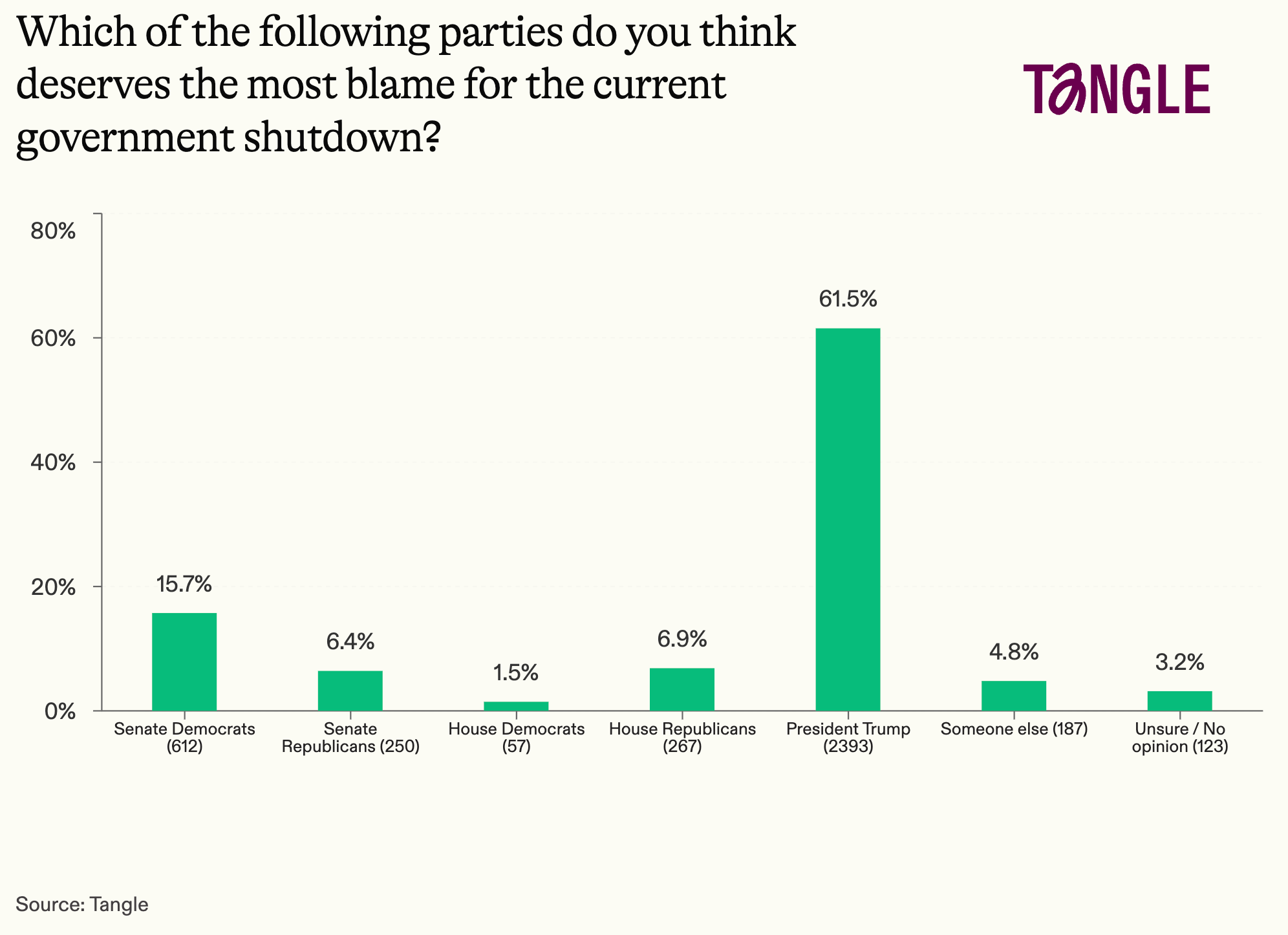
- Yesterday’s survey: 3,889 readers responded to our survey on the government shutdown with 62% primarily blaming President Trump. “He isn’t willing to negotiate. He’s a bully who insists on his way,” one respondent said. “Senate Democrats chose this path,” another said.
Have a nice day.
Human overhunting eliminated the puffin population of the U.S. Mid-Atlantic region more than a century ago. In 1973, ornithologist Stephen Kress began efforts to start a new puffin colony on Eastern Egg Rock Island in Maine. 50 years later, hundreds of puffins live on the island — but Kress continues to protect them from new threats, including predatory laughing gulls. Kress’s research team has started using decoy birds and nests to repel the gulls on the island, and the decoys they produce have since been used in over 800 other seabird preservation efforts. Good News Network has the story.

Member comments