
I'm Isaac Saul, and this is Tangle: an independent, nonpartisan, subscriber-supported politics newsletter that summarizes the best arguments from across the political spectrum on the news of the day — then “my take.”
Are you new here? Get free emails to your inbox daily. Would you rather listen? You can find our podcast here.
Today’s read: 15 minutes.
If you needed extra money, like, yesterday — you're not alone.
Between inflation, holiday spending, and life happening, a lot of people are scrambling for ways to fatten their bank account without taking on a second job.
The thing is, most of us are leaving money on the table. We're talking $300 from Amazon shopping smarter, $225/month watching movie previews, even getting companies to forgive chunks of credit card debt.
Some of this sounds like internet nonsense, honestly.
But millions of people are already doing it. The Penny Hoarder compiled the most practical ways to pocket extra cash this month.
A good start!

Yesterday, we launched an ambitious goal to drive 3,500 paid subscribers in one week. We got off to a great start: We drove 742 in the first 24 hours. That puts us at about 21% of the way toward our goal — just enough to light the fire, and plenty left to stay motivated.
Reminder: When you become a Tangle member, you unlock ad-free newsletters, Friday editions, Sunday editions, the comments section, and get baked into future offerings. Also, you get to support a media organization that isn’t just feeding its audience partisan red meat. Help us hit our goal here.
The murky future of primary reform.
All across the United States — from the West Coast to the East Coast, in red states and blue states, among urban and rural areas — a movement is growing to change the way Americans vote. Specifically, reformers are pushing to adopt new primary systems to address rising political polarization and entrenched party control. In our latest video, we took stock of this movement, detailing its recent successes, setbacks, and the challenges ahead. You can check it out here!
Quick hits.
- President Donald Trump announced a blockade of sanctioned oil tankers entering and leaving Venezuela. The proclamation follows the U.S. seizing a sanctioned oil tanker off the coast of Venezuela last week. (The announcement)
- After House Speaker Mike Johnson (R-LA) indicated that he would not hold a vote on expiring Affordable Care Act subsidies, four House Republicans signed a discharge petition led by House Minority Leader Hakeem Jeffries (D-NY) and supported by all House Democrats, giving the petition the 218 votes required to force a vote on extending the subsidies. (The petition)
- Vanity Fair published an article based on 11 interviews with White House Chief of Staff Susie Wiles, in which Wiles shared candid assessments of key figures in the Trump administration, including the president. Among several notable quotes, Wiles said that President Trump “has an alcoholic’s personality,” that Attorney General Pam Bondi “completely whiffed” on handling the Epstein files, and that Vice President JD Vance has been “a conspiracy theorist for a decade.” Wiles called the article a “disingenuously framed hit piece.” (The article)
- The Bureau of Labor Statistics reported that the U.S. economy added 64,000 nonfarm payroll jobs in November, exceeding economists’ estimates. However, it also estimated a loss of 105,000 jobs in October. The unemployment rate rose higher than expected to 4.6%. (The report)
- The Trump administration added Burkina Faso, Mali, Niger, South Sudan and Syria to its list of countries whose citizens are banned from immigrating to or entering the United States in virtually all cases, bringing the total number of countries covered by the ban to 39 (in addition to Palestinian nationals). Furthermore, 15 countries were added to the list of partial bans, meaning their citizens will not be able to apply for tourist or student visas. (The expansion)
Today’s topic.
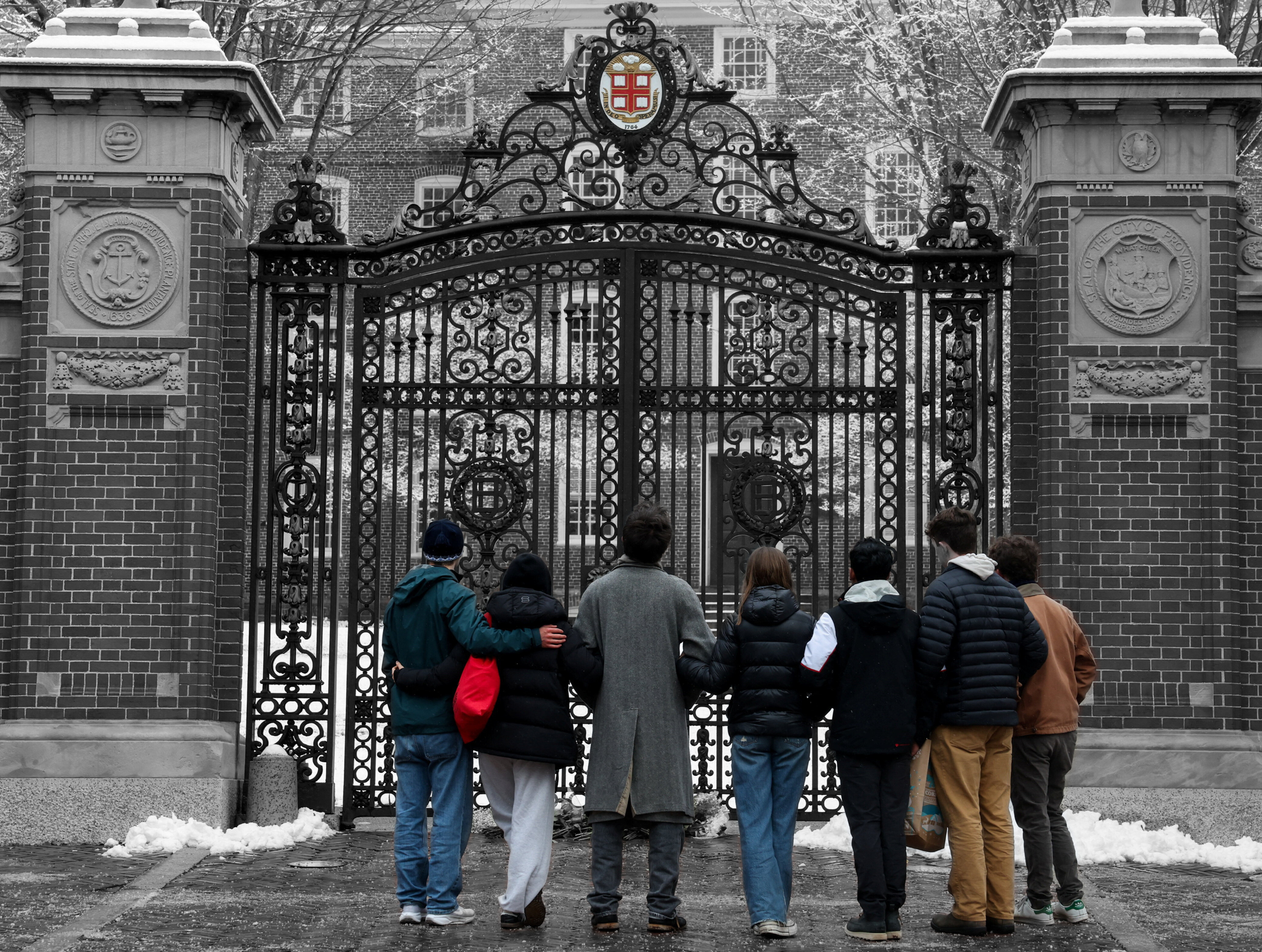
The shooting at Brown University. On Saturday, a gunman killed two Brown University students and wounded at least nine others in an attack on the university campus in Providence, Rhode Island. According to authorities, the shooter entered a classroom where students were reviewing for a final exam and opened fire before fleeing. The suspect has not been caught, and a manhunt is underway.
The shooting began shortly after 4:00 PM ET in the Barus and Holley engineering building, where an introductory economics class was wrapping up a final exam review session. Eyewitnesses said that a masked man burst into the room and started shooting while shouting something unintelligible. The shooter had left the building by the time first responders arrived. Providence Police issued a shelter-in-place order while law enforcement searched for the shooter, and the order remained in effect until early the next morning.
On Sunday, FBI Director Kash Patel wrote on X that authorities had detained a person of interest at a hotel in Rhode Island based on a tip provided to the Providence Police. Later that day, however, Providence Mayor Brett Smiley (D) announced that there was insufficient evidence to justify the person’s continued detainment and that he would soon be released. On Monday, authorities released photos and video of a new person of interest, described as a 5’8” male with a stocky build. The FBI is offering a $50,000 reward for information leading to the shooter’s arrest and conviction.
The two students killed were Ella Cook and MukhammadAziz Umurzokov. Cook was a 19-year-old sophomore from Alabama majoring in French and mathematics-economics who was vice president of the Brown College Republicans. Umurzokov was an 18-year-old freshman from Virginia majoring in biochemistry and neuroscience whose family immigrated to the United States from Uzbekistan when he was a child.
Much remains unknown about the shooting and the suspect. Authorities say they do not know how the shooter accessed the first-floor classroom and have not confirmed the weapon he used, though they believe it was a handgun. Furthermore, the Providence Police Department’s video-monitoring system was not linked to any video feeds at Brown University on Saturday, leaving them unable to track the shooter in real time as he left the scene.
Today, we’ll share views from the left, right, and the Brown community. Then, Managing Editor Ari Weitzman gives his take.
What the left is saying.
- Many on the left see the shooting as the latest example of gun violence in America.
- Others criticize FBI Director Patel for his communications about the event.
In The Philadelphia Inquirer, Will Bunch said the shooting “is a gutting reminder that no one is safe until we tackle America’s gun crisis.”
“The only real difference [in this shooting] from Uvalde or Leland, Miss., was a personal one: Picturing mentally the moments of horror inside the building where college friends like my junior and senior-year roommate and my girlfriend learned to build everything from artificial limbs to nuclear power plants, just blocks from the newsroom where I’d toiled until 2 a.m. putting out the Brown Daily Herald,” Bunch wrote. “Is a shooting on an Ivy League campus bound to get more media attention than one at an HBCU homecoming, let alone a working-class community? Sure, but a mass shooting at Brown is also a grim reminder of a cross that we all bear — every class, race, and religion — in a nation that’s jumped onto the wrong track.”
“Donald Trump, after honing his uncanny knack for making things worse by posting and un-posting incorrect information on Truth Social, told reporters on a tarmac that ‘all we can do right now is pray for the victims, and for those that were very badly hurt.’ No, Mr. President, that is not all you can do,” Bunch said. “You could, for starters, ask Congress to ban the kinds of assault weapons that aren’t used to hunt deer yet are all too effective at mowing down college students or grade-schoolers — something that actually happened, imperfectly but with positive results, in this country from 1994 until 2004.”
In Lawfare, Olivia Manes and Benjamin Wittes asked “why can’t Kash Patel shut up?”
“At 11:38 a.m. EST [on December 14], Patel tweeted an apparent breakthrough in the case… No breakthrough in the case had taken place,” Manes and Wittes wrote. “A reader who might reasonably have thought that phrases like ‘As a result, early this morning’ and ‘detained a person of interest in a hotel room’ suggested that FBI spadework had resulted in a dawn assault on a hotel room where the killer was holed up, that the investigation had successfully netted a suspect, and that the people of Providence were thus safe, might have missed the fact that the ‘person of interest’ who had been detained quickly turned out to be a person of only very passing interest.”
“It is not correct to say that the FBI director should always keep his mouth shut with respect to pending investigations. There are times when public safety requires communication from the Bureau’s leadership… And yet, in an FBI director, discretion is — most of the time and in most circumstances — the better part of valor. Premature disclosures have civil liberties implications for people who may turn out to be innocent,” Manes and Wittes said. “Perhaps most importantly, they also have credibility implications. Because you can only announce so many times that you’ve caught a suspect in a major case — only to release them — before the word of the FBI to the public, and to the courts, starts being meaningless.”
What the right is saying.
- The right pushes back on calls for gun control after the shooting, noting that Rhode Island already has strict gun laws.
- Others say the outstanding questions about the shooting are perplexing and concerning.
In The Washington Examiner, Peter Laffin wrote “Democrats blame guns, not evil, for Bondi Beach and Brown University shootings.”
“The United States and Australia suffered horrific mass shootings over the weekend… Gov. Kathy Hochul (D-NY) referenced both tragedies in an X post Sunday afternoon while decrying the ‘epidemic of gun violence’ and marking the Sandy Hook anniversary. Sen. Cory Booker (D-NJ) also invoked Sandy Hook in response to the Brown shooting, lamenting that ‘we’ve done far too little to stop these recurring attacks,’” Laffin said. “To ascribe fundamental blame to guns or gun laws in either case is deeply disconnected from reality — and cynically manipulative.”
“Rhode Island consistently ranks among the top states for strict firearm regulations according to gun-control advocacy groups, with universal background checks, red-flag laws, an assault-weapons ban, and high-capacity magazine limits. Brown University, meanwhile, is a ‘gun-free zone,’ meaning that good guys with guns are unable to intervene in such instances,” Laffin wrote. “The U.S. famously has more guns in circulation than people, including tens of millions of untraceable firearms on the black market. There is no way to ‘ban guns,’ as progressives like to pretend, or to enact a government buyback program that wouldn’t disarm law-abiding citizens while leaving armed criminals with nonregistered guns.”
In National Review, Jim Geraghty explored the “less-than-reassuring answers in the Brown University shooting.”
“Now, perhaps it’s entirely coincidental that the professor of the class targeted was part of the university’s program in Judaic Studies and had ties to Israel, and perhaps it is also a coincidence that the vice president of the school’s college Republicans is among those killed. Perhaps the shooter is just some nut,” Geraghty said. “But after the assassination of Charlie Kirk and all the post-October 7 antisemitism rampant on college campuses, these are not irrational thoughts about potential motives and why the shooter selected this particular time and place for his rampage.”
“Law enforcement has a difficult job. But, at least according to what we’re hearing from witnesses, an individual brought either ‘a long gun’ or a 9mm handgun onto a college campus on a Saturday afternoon, at some point slipped on a mask, went on a shooting rampage firing more than 40 rounds, killed two people and injured nine more, was at no point confronted by anyone in law enforcement or campus security, managed to not have his face captured by any surveillance camera, and escaped the scene, leaving little or no clue to his identity or motive,” Geraghty said. “It is hard to begrudge the communities of Brown University or Providence for feeling less than safe.”
What the Brown community is saying.
- Students in the Brown community mourn their classmates and describe the shock they feel.
- Others say the sense of safety on campus may be permanently shattered.
In The Free Press, Victoria Zang, a Brown student, described “the night a shooter came to my campus.”
“As students at Brown, our lives are forever changed. We now find ourselves on a list of schools that grows longer by the day — a list no one wants to be on. I’m used to reading about shootings in the news. Every single time, I pray first for the students, and then that my school is not next. I can’t pray for that anymore,” Zang said. “There will be so much to say and do in the aftermath of this day, whether through legislation, self-defense classes, or better security and vigilance in our communities. But in the meantime, I am endlessly grateful to the police, Providence mayor Brett Smiley, the FBI, Brown president Christina Paxson, and everyone who was just as shell-shocked as we were, but who worked nonstop over those dark hours to ensure our safety.
“In a couple weeks, students will return to campus. Nothing will be the same. We’ve lost members of our family. We’ve lost a sense of safety, of assurance that we can go to school without our lives being put at risk. When we think of certain locations on campus — locations that used to be associated only with happiness, friendship, and yes, occasional stress — we will now think of sirens, screaming, and terror,” Zang wrote. “Over time, we will heal. For now, all we can do is stick together. Tonight, at a park in Providence, what was originally meant to be a menorah lighting to ring in the first night of Hanukkah will now also be a ceremony to remember the classmates we’ve lost.”
In The Providence Journal, Nidhi Bhaskar, a Brown alumna and current Brown medical student, wrote about “memories of tranquil days at Brown now shattered.”
“I took my introductory physics course in Barus and Holley, the scene of Saturday’s shooting. I spent many evenings cramming in lecture hall 166, a place now inseparable, in my memory, from the shooting that occurred there yesterday,” Bhaskar said. “Before this week, as I continued to live in Providence through my undergraduate years and then chose Brown again for medical school, I described my beloved Providence as the safest place in the world… This city, and this campus, is not where a senseless tragedy is supposed to happen.”
“I heard from colleagues and mentors at Rhode Island Hospital, preparing to receive victims in an emergency department that was already inundated on a Saturday night. And, like everyone else, I watched and waited as confusion and chaos parlayed into answers and devastating news,” Bhaskar wrote. “And yet it does happen over and over again in communities all around the world. Rhode Island’s gun laws are among the strongest in the nation, and still, violence found its way here. A new law is yet to go into effect banning automatic rifles, but in our nation alone, there have been over 390 mass shootings this year. And that is not something that thoughts and prayers are going to change.”
My take.
Reminder: “My take” is a section where we give ourselves space to share a personal opinion. If you have feedback, criticism or compliments, don't unsubscribe. Write in by replying to this email, or leave a comment.
- These shootings are so common that we’ve developed a “right way” to react.
- Be frustrated, express empathy, don’t jump to conclusions (advice that applies to the FBI director, too).
- Depressingly, I doubt one more shooting is going to inspire a change.
Managing Editor Ari Weitzman: We’ve gone through this so many times we have the “right reaction” down to a checklist. First, of course, is the frustration with the fact these shootings are so common and our reactions can be so standard.
Frustration.
Okay, check.
Second, to urge everyone to try to think of the victims and their families first — which is easier said than done. MukhammadAziz Umurzokov, 18 years old, wanted to be a neurosurgeon. Ella Cook, 19, vice president of the College Republicans. Two families forever broken and scarred. Nine other students injured — nine people traumatized by scars they will carry with them, physically and mentally, for their entire lives. Brown University, a campus that will now forever share a sentence with schools like Virginia Tech University, and Columbine High School, and Sandy Hook, Robb Elementary, Parkland High School, and University of Texas, Michigan State, UNLV, and Florida State — a community of students who will now question if they are safe at the school where they are beginning their own independent lives. Faculty and staff, from university president to dining-hall workers, who will require an unknowable amount of time to learn to carry the memory of gunshots or alerts on their phone or the frantic, hurried footsteps of their peers as the horror of what’s unfolding around them sets in.
The human toll. Indescribable, ungraspable — a gray wall in our heads and hearts that protects us from truly feeling what it means to be splintered, fundamentally altered, forever.
Empathy expressed.
Okay, check.
I’m being glib here, but at this point, I can’t help but feel like all the empathy I can muster is futile. I think we all feel it. Even after seeing first-hand the devastation that mass shootings can wreak, I still feel the unavoidable roteness. I can talk about my experience when my cousin was among those killed in the Tree of Life shooting in Pittsburgh in 2018. I can tell you that I know Brown’s campus decently well — I coach the University of Vermont’s ultimate frisbee team, and we travel to Providence every spring for a regional tournament. I can tell you that I know several of the young men who compete on that Brown team personally; they’re good kids, hard-working competitors who make the kids I coach better. They deserve so much more than bullets during finals week. I can tell you all that, I can try my best to access feeling for these kids and this campus and get you to feel the same, and then what? I write my piece, we publish Tangle, then I’ll go about my day. We can link Isaac’s excellent “We are broken” piece, we can grit our teeth until our gums bleed and feel the frustration mount just a little more, and then we will do nothing.
Third is perhaps the most immediately impactful thing we can do, which is to exercise caution and be careful not to jump to conclusions. The deceased are an Uzbeki–American young man and a young woman from Alabama; they, along with those injured, were all attending the same Econ 110 finals review session in the same classroom. Understandably, we have questions: Why this classroom? Was either deceased student targeted specifically? Who was the shooter, and what motivated him?
Right now, a lot of new information is circulating online that may — or may not — be meaningful. Some internet sleuths found that the public profiles of a student were scrubbed online. This person came from a family of Palestinian refugees and discussed how his time on the university’s pro-Palestinian encampment informed his worldview. Laura Loomer, a known merchant of impressionistic truths, alleges that the shooter shouted “Allahu Akbar” before opening fire. The profile of this particular student is magnetic and divisive — if this student is the shooter, he would obviously fit neatly into our culture-war and political debates.
As of right now, though, we don’t know if any of that matters or how much of it is true. The university said in a statement that one of its students was being dangerously doxxed and described any discussion about his involvement as conspiracies, accusations, and speculation. Gait analysis from anonymous keyboard warriors sitting behind monitors isn’t going to tell us whether or not the shooter and this student are the same person. Laura Loomer doesn’t know what happened at the crime scene — we would be wise to wait and listen and learn more before coming up with grander takes that connect the dots to form a picture of the “real” villain of our cultural decay. And even when we get that reliable information, we need to remember that this is one data point in a country unfortunately rich in data points of mass shooters that anyone can now find some trendline to support their priors.
Caution and patience. Check?
Unfortunately not. We can’t say that our top law enforcement leader is exercising appropriate restraint right now.
The morning after the shooting, FBI Director Kash Patel tweeted a long update that included the announcement that a person of interest was in custody. Patel’s implication was that the FBI acted with aplomb, and, as a result of its ingenuity and efficiency, the community could breathe a sigh of relief. But instead, that person of interest was released hours later, inviting questions of why they were detained and whether or not danger continues to lurk around the corner. This is a trend with Kash Patel: speak first, try to perform competence, and then incompetently backtrack later.
This matters because the family and friends and community members of the victims are all looking to our institutions to provide needed reassurance that the broader community — the town, the state, the country, even the federal government — has their back. I can attest to this personally; in the immediate aftermath of the 2018 synagogue shooting, watching authorities give boring but measured press conferences provided a bizarre form of comfort. When the FBI director tweets out messages that give false assurances which are rescinded (not by him, though; the Rhode Island attorney general set the record straight — Patel did not take any accountability), that fractures that confidence. It doesn’t allow a community still actively experiencing this trauma to begin the work of healing. We can, and should, expect better.
For now, we should continue to wait and learn and be skeptical. Double-check what you read online. Don’t spread false information. It may be hard, but it’s a lot easier than what the Brown University community is going through right now. And if you are a member of that community, take care of yourself right now. For whatever it could possibly be worth, know that we, in some abstract way, have your back.
Otherwise, what else is there to do? Stump for gun control or mental-health support or better security or a solution to our culture of extreme polarization or a change to the way we raise and deal with angry young men in our country? That all sounds great, but you’ve heard those pleas before — we’ve written some of them ourselves. No legislation or change or reckoning with our culture is coming any time soon. Today it’s Brown University, tomorrow it will be somewhere else.
Take the survey: Do you think the number of mass shootings in the U.S. will change? Let us know.
Disagree? That's okay. Our opinion is just one of many. Write in and let us know why, and we'll consider publishing your feedback.
Your questions, answered.
Q: Just wanted to shoot a message asking about the Uyghurs in Xinjiang and what new developments have occurred in the (I believe) four years since it was last featured on Tangle. Is there a greater level of certainty around what was done or is being done? I assume the imprisonments have not stopped, but I haven’t heard about it from my news sources in a while.
— Levi from Cambridge, MA
Tangle: Since we covered the atrocities in China in February and August 2021, two notable developments have occurred. First, the United Nations released an assessment of China’s treatment of its Muslim Uyghur population in the Chinese autonomous regions of Xinjiang and Tibet, concluding that the Chinese government has committed human-rights violations in the name of counter-extremism and counterterrorism. Second, in August 2024, the UN updated its assessment to conclude that the policies that drew its initial condemnation remained in place.
According to the State Department, China’s human-rights abuses against the Uyghur population include arbitrary mass detention, forced labor, population control, and religious persecution. Meanwhile, China has opened the region up to diplomatic tours that have been described differently by different visitors. The Syrian and Iranian ambassadors to China said in 2022 that the government was making remarkable steps towards modernization and called the allegations against China lies. Others, including a Uyghur returning from abroad and a delegation from Princeton University, said the visits were transparent propaganda.
Reliable statistics of Uyghurs detained and killed at the hands of the government are inaccessible due to the Chinese Communist Party’s control of information. However, Genocide Watch describes China’s treatment of the Uyghur population as an ongoing genocide. Lastly, one more development is drawing attention to this situation: The Trump administration detained a Chinese citizen who fled the country after gathering information about the human-rights violations, and that person is now at risk of being deported back to China.
Want to have a question answered in the newsletter? You can reply to this email (it goes straight to our inbox) or fill out this form.
Under the radar.
On Tuesday, authorities in Massachusetts announced that Massachusetts Institute of Technology (MIT) Professor Nuno F.G. Loureiro had been shot and killed at his home on Monday night. Originally from Portugal, Loureiro taught nuclear science, engineering and physics at MIT, and he directed the school’s Plasma Science and Fusion Center, one of its largest labs. The Norfolk County District Attorney’s Office said that there have been no arrests made in the case, calling it “an active and ongoing homicide investigation.” In a statement, MIT President Sally Kornbluth said, “This shocking loss for our community comes in a period of disturbing violence in many other places.” The New York Times has the story.
You're probably overpaying for half the things you buy.
Your car insurance, credit cards, Amazon purchases — companies are banking on you not noticing.
We found a list of ways to stop getting ripped off and start pocketing that money instead.
Some could save you thousands. See which ones apply to you.
Numbers.
- 1764. The year Brown University was founded.
- 7,272. The number of undergraduate students at Brown.
- 3,130. The number of graduate students at Brown.
- 17. The number of mass killings in the United States in 2025 as of December 2, according to the Mass Killing Database. Mass killings are defined as incidents where four or more people are intentionally killed in a 24-hour period.
- 393. The number of mass shootings in the U.S. in 2025 as of December 15, according to the Gun Violence Archive. Mass shootings are defined as shootings that injure or kill four or more people, not including the shooter.
- 2. The number of mass shootings in Rhode Island since 2020, according to the Sandy Hook Promise Action Fund.
- 75. The number of school shootings in the U.S. in 2025 as of December 13, according to a CNN analysis.
- 43. Of those shootings, the number that were on college campuses.
The extras.
- One year ago today we covered Biden’s mass clemency.
- The most clicked link in yesterday’s newsletter was the ad in the free version for 10 hidden Amazon Prime benefits.
- Nothing to do with politics: Azaleas are beautiful, but the Azalea Society of America’s website leaves at least a little bit to be desired.
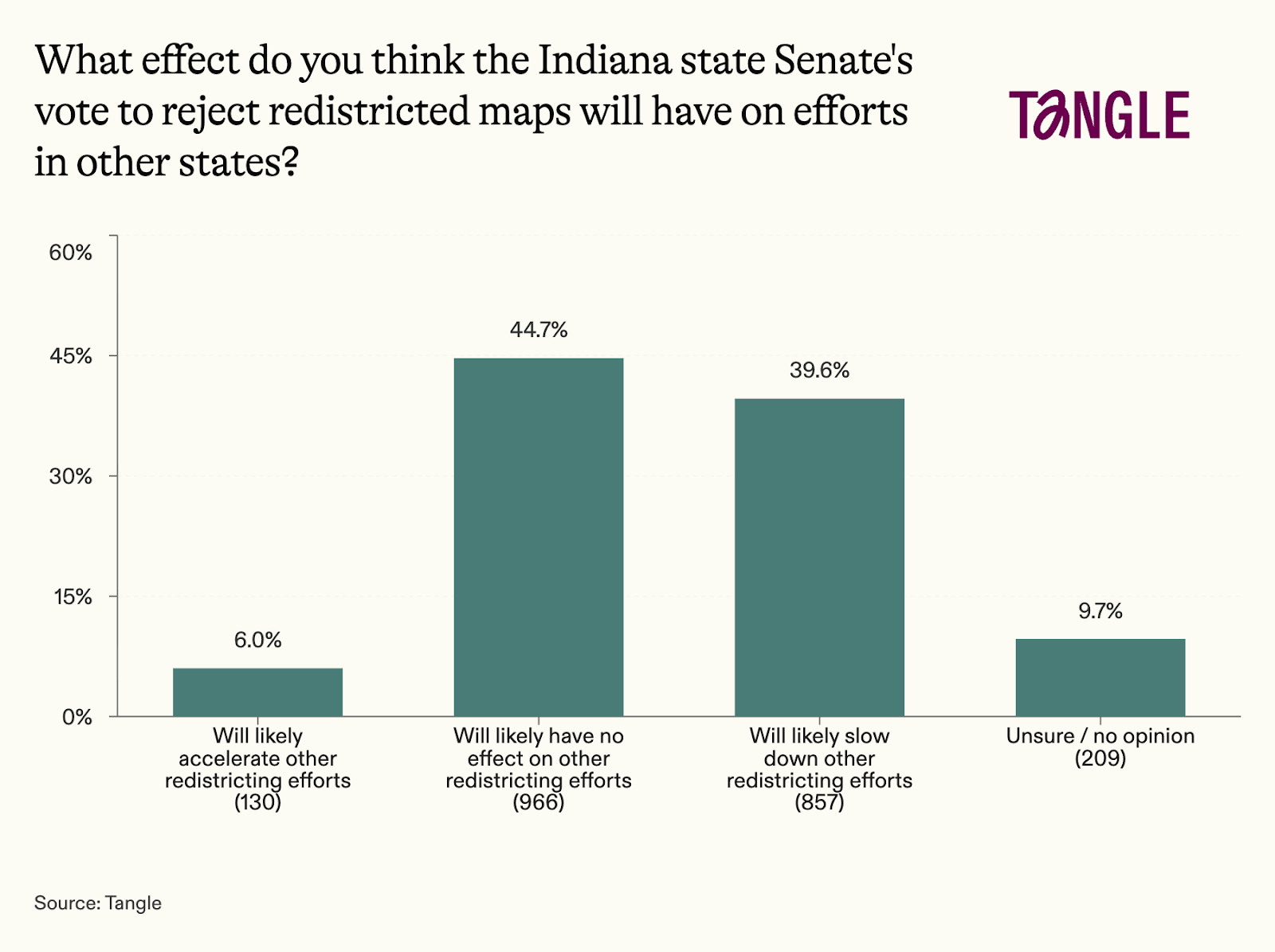
- Yesterday’s survey: 2,162 readers responded to our survey on Indiana rejecting Trump’s redistricting effort with 45% saying it will likely not have an effect on other efforts. “I don’t think it will have an impact, but I wish it would,” one respondent said. “As an Illinoisan who has often made Indiana the butt of political jokes, I couldn’t be more proud of our neighbor!” said another.
Have a nice day.
Scimitar-horned oryx, a species of antelope native to the Sahel–Sahara region of North Africa, were once widespread before being designated “extinct in the wild” in 2000. At the same time, the Sahara Desert has expanded, reducing available cropland and potentially leading to food and water shortages. However, following a decades-long effort to reintroduce the species to parts of the Sahara, researchers have found early signs that the oryx may also help slow desertification: Vegetation seems to improve where the oryx is introduced, and researchers are examining whether the animals’ grazing and seed dispersal could be contributing to this. “Without them, you’re missing something fundamental from the ecosystem,” conservation scientist Tania Gilbert said. The BBC has the story.
Member comments