
I'm Isaac Saul, and this is Tangle: an independent, nonpartisan, subscriber-supported politics newsletter that summarizes the best arguments from across the political spectrum on the news of the day — then “my take.”
Are you new here? Get free emails to your inbox daily. Would you rather listen? You can find our podcast here.
Today’s read: 15 minutes.
While we were away.
We hope you had a restful holiday — and are perhaps continuing your relaxation through this week. The news cycle, of course, did not slow down, and we published a rundown of the major stories from the past five days in yesterday’s Sunday edition. You can read it here.
Reminder: We are publishing normal editions today and tomorrow, then will round out the week with some special editions to mark the end of 2025.
Quick hits.
- President Donald Trump and Ukrainian President Volodymyr Zelensky met at Trump’s Mar-a-Lago residence on Sunday. Both leaders described the talks positively but said further negotiations were needed to finalize a peace plan to end the Russia–Ukraine war. Prior to the meeting, Trump spoke with Russian President Vladimir Putin over the phone, telling reporters that the Russian leader “wants Ukraine to succeed.” (The meeting)
- The man charged with planting pipe bombs outside the Republican and Democratic National Committees the night before the January 6, 2021, Capitol riots confessed to investigators, according to a court filing. The man reportedly said that he wanted to “speak up” for those who believed the 2020 election was stolen and expressed displeasure with both parties, but claimed that he was not trying to prevent lawmakers from certifying Joe Biden’s election victory. (The confession)
- Federal Bureau of Investigation Director Kash Patel said he was allocating additional agency resources to investigate fraud in Minnesota, where members of the state’s Somali community have come under scrutiny for alleged social services fraud. (The investigations)
- Israel formally recognized Somaliland, an autonomous region bordering Somalia that declared independence in 1991 but has not been recognized by most other countries. Somalia, Egypt, and the chairman of the African Union Commission criticized Israel’s decision and rejected the recognition. (The recognition)
- A bomb cyclone is expected to impact large parts of the Midwest and Northeast through Monday night, bringing high winds, blizzards, ice, and rain. (The storm)
Today’s topic.
The 60 Minutes controversy. On Sunday, December 21, CBS announced that it was pulling a scheduled 60 Minutes segment on the Venezuelan men deported to the Terrorism Confinement Center (CECOT) in El Salvador in March. CBS News Editor-in-Chief Bari Weiss decided to delay the segment hours before it was set to air on the long-running television show, saying that it needed additional reporting. 60 Minutes correspondent Sharyn Alfonsi, who reported the segment, criticized Weiss’s decision to “spike” the story as political in a widely reported memo to her colleagues. Shortly thereafter, the streaming app for a Canadian CBS affiliate ran a version of the segment that was shared online in the U.S., sparking debate about Weiss’s justification for the move and broader editorial changes at CBS News.
Back up: The segment focused on CECOT’s treatment of Venezuelan men — who the Trump administration claimed were gang members — after they were transported by the United States to the prison in March. CECOT is the largest prison facility in Central America, and watchdog groups have reported that it routinely violates its prisoners’ human rights. The Trump administration controversially justified the deportations under a 1798 wartime law (the Alien Enemies Act) and mistakenly sent at least one person (Kilmar Abrego Garcia) to El Salvador. All of the Venezuelans sent to CECOT were released and returned to their home country this summer in a U.S.-brokered prison exchange.
In October, Paramount Skydance (the owner of CBS) named Weiss editor-in-chief of CBS News after it acquired The Free Press, a media company she founded in 2021. Weiss previously worked as an opinion editor at The Wall Street Journal and The New York Times, but she resigned from the latter in 2020, alleging a hostile work environment. Paramount’s and Skydance’s merger was approved after CBS’s parent company Paramount settled a lawsuit filed by President Donald Trump against 60 Minutes for $16 million over its editing of an interview with former Vice President Kamala Harris.
After Weiss delayed the segment, Alfonsi criticized the decision to her colleagues, writing, “Our story was screened five times and cleared by both CBS attorneys and Standards and Practices. It is factually correct. In my view, pulling it now—after every rigorous internal check has been met is not an editorial decision, it is a political one. We requested responses to questions and/or interviews with DHS, the White House, and the State Department. Government silence is a statement, not a VETO. Their refusal to be interviewed is a tactical maneuver designed to kill the story.”
Weiss said she delayed the CECOT segment after determining that the story did not feature sufficient original reporting and reporters had not done enough to represent the Trump administration’s perspective. In a memo to 60 Minutes staff, Weiss wrote, “If we’re going to run another story about a topic that has by now been much-covered we need to advance it. Among the ways to do so: does anyone in the administration or anyone prominent who defended the use of the Alien Enemies Act now regret it in light of what these Venezuelans endured at CECOT?” Weiss also pressed for criminal records of the deportees, quotes from Homeland Security Secretary Kristi Noem (who visited the prison in March), and a legal explanation of the removals from the Trump administration.
Today, we’ll share views from the right and left on the controversy, followed by Executive Editor Isaac Saul’s take.
What the right is saying.
- Many on the right say Weiss’s decision upheld basic journalistic standards.
- Some suggest Weiss is correct to question the bias of some 60 Minutes reporters.
- Others argue Weiss’s job is partly to pander to the Trump administration.
In National Review, Noah Rothman wrote about “the 60 Minutes scandal that wasn’t.”
“A casual survey of the social media landscape would lead neutral observers to conclude that Weiss’s decision to spike the segment is the gravest journalistic sin CBS News has ever committed… What’s more, Weiss was accused of having no other motive than to shield the Trump administration, which temporarily deported more than 250 illegal migrants to that detention facility, from deserved censure,” Rothman said. “You can watch it yourself. Those who avail themselves of the opportunity might conclude that Weiss’s concerns about the segment are perfectly valid.”
“The CBS News chief chided reporters for failing to get a single quote from administration officials, even those whom the report impugned… In fact, as Axios reported, the White House, State Department, and the Department of Homeland Security all provided on-the-record comments in response to CBS News’s inquiries, none of which made the air,” Rothman wrote. “That’s how the editorial process works. Stories are flagged and spiked all the time. It’s a common enough occurrence that it’s a wonder that this story about a story ever became a story at all.”
In OutKick, Bobby Burack argued “Bari Weiss is right to question [the] ‘60 Minutes’ CECOT report after a year of editorial blunders.”
“Alfonsi is right that the lack of government participation should not be a reason to cancel a story. However, CBS News says the story was not canceled but delayed… If and when the report airs, we can assess whether the delay resulted in a worthwhile update to the conditions at CECOT,” Burack said. “Moreover, Alfonsi and others must understand that the ‘60 Minutes’ staff no longer has the same benefit of the doubt it once did. Weiss’s memo suggests she felt the story was unoriginal and intended mainly to criticize the Trump administration. That would be consistent with other editorial decisions made in the past year.”
“‘60 Minutes’ has adopted a new standard that blends journalism with an editorial bent, a combination the brand spent decades avoiding. Examples include a favorable report on the German government’s crackdown on speech, a critical essay on Trump’s cabinet members that cited claims about Tulsi Gabbard being a Russian asset, a glowing segment on DEI, and a piece suggesting sympathy for Hamas terrorists by questioning whether hostages were starved due to a lack of resources,” Burack wrote. “Given that track record, Weiss is right to intervene at ‘60 Minutes’ and push the staff toward more original, objective reporting.”
In The Wall Street Journal, Holman W. Jenkins, Jr. said “Bari Weiss delivers for CBS’s parent.”
“If she didn’t know it then, she knows it now. Bari Weiss was hired at CBS News to help deliver its parent Paramount’s hoped-for acquisition of the strategically coveted Warner Bros. movies, streaming and TV empire,” Jenkins wrote. “Notice what I’m not saying. Another editor in chief might have held back the story for all the editorial reasons Ms. Weiss has cited. She might have scuttled the report even if her parent company didn’t have an interest in currying favor with Mr. Trump. But let’s live in the real world… Ms. Weiss was hired by CBS only after the Ellisons launched their sales pitch to Warner’s management, only after they started emphasizing their Trump ties to assure a quick and clean antitrust approval.”
“Grown-ups know what they’re getting into. Ms. Weiss has so far upheld what I will courteously assume was the implicit bargain that landed her the CBS job. Don’t gasp. She knew why she was being hired. Her editorial decisions, even if made for the purest of journalistic reasons, were intended to be factors in the Ellison family’s stalking of the Warner properties,” Jenkins said. “The younger Mr. Ellison, son David, spent $150 million in October to acquire Ms. Weiss by acquiring her news-and-opinion venture, The Free Press. This sum amounts to 0.14% of the family’s latest bid for Warner Bros. It will be money well-spent if it helps secure their prize.”
What the left is saying.
- The left strongly criticizes Weiss’s decision as blatant service to corporate interests.
- Some say the pulled segment will damage public trust in 60 Minutes.
- Others argue Weiss’s justification for delaying the piece is unconvincing.
In The Atlantic, Jonathan Chait wrote “stop defending Bari Weiss.”
“In October, Donald Trump openly boasted that Larry and David Ellison — the father-son duo that now owns Paramount, CBS’s parent company — are ‘big supporters of mine, and they’ll do the right thing.’ He implied that he expected more positive coverage from CBS News and its newly appointed editor, Bari Weiss,” Chait said. “But conservatives are not critical of the maneuvers that placed the network in the hands of businessmen who rely on Trump’s favor, and who are seeking the president’s support in a hostile bid to edge out Netflix to acquire Warner Bros. Discovery. Nor are conservatives concerned about Weiss’s suspicious timing in abruptly shelving a report about the president’s aggressive deportations.”
“Noah Rothman, an anti–anti-Trump conservative… defends Weiss in a column in National Review. The most amazing thing about Rothman’s column, which echoes arguments other conservatives have made on X, is that it does not mention anywhere the abuses of power — Trump’s insistence of favorable coverage from media-owning friends — that led to Weiss running the network,” Chait wrote. “Conservatives would never accept a left-wing government using regulatory favoritism to pressure conservative media into softening their coverage of a Democratic administration. They may delight in the new editorial direction of CBS News, but they cannot defend the process that led to it.”
In TheWrap, Michael Calderone said “Bari Weiss is eroding fragile trust at CBS News.”
“Holding a story for additional reporting or comment happens in newsrooms all the time. But the circumstances surrounding Weiss’ decision are anything but normal. Weiss arrived at CBS News in October with political baggage and no experience in broadcast television. This was Weiss’ first major test as a network executive, weighing the merits of a ‘60 Minutes’ investigative story that might inflame the president — and she bungled it,” Calderone wrote. “Even if Weiss had legitimate journalistic concerns, as she claims… she mishandled them by allowing the piece to be widely promoted for days before abruptly pulling it Sunday evening with little explanation.”
“Weiss may be a novice when it comes to television news, but she isn’t naive about politics. She surely must have known that yanking a hard-hitting story in a haphazard way would cause a firestorm, and be perceived as a political gesture on behalf of Trump, who has had [a] tempestuous relationship with ‘60 Minutes,’” Calderone said. “And holding the story would inevitably turn the spotlight on her and Trump’s relationships with the Ellisons, and how CBS parent company Paramount has responded in the past to the president’s demands.”
In The Guardian, Margaret Sullivan called Weiss’s decision “censorship by oligarchy.”
“The 60 Minutes piece — about the brutal conditions at an El Salvador prison where the Trump administration has sent Venezuelan migrants without due process — had already been thoroughly edited, fact-checked and sent through the network’s standards desk and its legal department. The story was promoted and scheduled, and trailers for it were getting millions of views,” Sullivan wrote. “I’m less bothered by the screw-ups in this situation — for example, the segment is already all over the internet as, essentially, a Canadian bootleg — than I am by [Weiss’s] apparent willingness to use her position to protect the powerful and take care of business for the oligarchy.”
“Weiss insists that the story needs Trump administration comment before it can run. But correspondent Sharyn Alfonsi has argued — eloquently and persuasively — that 60 Minutes repeatedly sought substantive comment and was turned down. In a memorable phrase, Alfonsi charges that if that’s an acceptable reason for spiking a story, it’s tantamount to giving the government a ‘kill switch’ for any story they don’t like. Just refuse to comment, and it dies on the vine,” Sullivan said. “It is also nonsensical of Weiss to suggest… that the piece somehow lacked sufficient newsworthiness because other news organizations had reported on the prison earlier. As if to counter this specious claim, a federal judge this week ordered the Trump administration to submit plans to return the migrants to the US or give them a hearing.”
My take.
Reminder: “My take” is a section where we give ourselves space to share a personal opinion. If you have feedback, criticism or compliments, don't unsubscribe. Write in by replying to this email, or leave a comment.
- Having worked with Bari Weiss before, I don’t think she is in Trump’s thrall.
- Weiss made some good points — 60 Minutes should do more to provide a fresh angle and complete picture.
- However, she also advanced poor arguments and mishandled a delicate situation.
Executive Editor Isaac Saul: I should probably start with a brief disclosure of sorts: I know Bari Weiss in a distant, professional sense.
I’ve never met her in person, but we’ve exchanged emails and direct messages on X, and this year I published a piece in The Free Press that she edited and worked with me on. In many ways, before its acquisition, The Free Press was similar to Tangle (a subscription-based, email-first news outlet). Everyone I know who knows Weiss personally describes her as a thoughtful, kind and ethical boss, colleague, and friend. I’ve had a hard time finding people who’ve spent real time with her and also speak ill of her. And while I have criticized The Free Press for reliably promoting feature pieces that are uniformly anti-progressive and pro-Israel (rather than offering genuine ideological diversity), I admire what she has built, and I respect that she shaped and sold a successful media business that offered something genuinely unique in our news environment.
In fact, my experience working with Weiss does partially inform my view on this controversy. Most relevantly, I do not think she is afraid to criticize the Trump administration; my Free Press piece was critical of Trump while defending Politico against claims that it received improper government funds, and she pushed me to take some arguments further in that direction. The Free Press has been a frequent and effective critic of the Trump administration, and Weiss herself has long been openly critical of the president.
So, when news first broke of this piece being pulled, my instinct was to wait and see. Like many others, I was alarmed by 60 Minutes correspondent Sharyn Alfonsi’s statement, but I didn’t think one reporter’s account of her story getting spiked was undeniable proof of CBS currying favor with the Trump administration. I figured Weiss had her own justification — and probably a reasonable one — to hold the piece.
Having now fully considered Weiss’s explanation, my honest opinion is that she has a few things going for her, while some others make her decision look pretty bad.
First, she’s right that news outlets across the country have covered this story relentlessly, and that the leaked feature did not really add many fresh details or deepen my understanding of what has already been reported. She’s right that 60 Minutes often aims to provide new perspectives, new reporting and a kind of deep, investigative reveal. It’s one of the premier shows in news, and pushing reporters to find that angle here, to me, seems reasonable.
Second, she’s also right to question the value provided by a sequence within the segment featuring students from the University of California, Berkeley’s Human Rights Center, who researched the Salvadoran prison. Weiss applauded the group’s work in her memo, but doubted that a group of college students researching the prison provided an authoritative enough voice to occupy two minutes of a roughly 15-minute cable news segment. I think that’s fair. Like Weiss, I found myself wondering if such valuable time in a segment of this nature could be put to better use than showing a group of students confirming previously known facts about the prison.
Third, pushing her team to get some administration officials to actually sit for an interview is also reasonable. Alfonsi aptly responded that they had been denied such an interview and that you cannot make this a requirement to publish a piece, otherwise a government body can kill a story by simply refusing to comment on it. But, in Weiss’s defense, she didn’t require that, and she offered a few names of people (like Stephen Miller) who have been more than willing to comment publicly and would provide viewers with a panoramic view of the story. She even offered to personally facilitate introductions with those officials. I respect that nudge; an exhaustive push for on-camera interviews is worth the effort, even if the administration refuses it.
Yet other parts of the memo look much worse for Weiss.
First, and most important, is her insistence that 60 Minutes should explain the “genuine dispute” about the Trump administration’s legal argument, and that the administration has argued in court that detainees are due “judicial review.” The administration one time claimed it was “obvious” Tren de Aragua detainees get judicial review, but only after a legal smack upside the head from the Supreme Court — and only after deporting said gang members without judicial review. Mostly, the administration has argued that illegal aliens in the future might get due process, and it has conceded that it should have given judicial review to the detainees in question in the 60 Minutes segment. But the legal argument it most often put forward (in court or in a memorandum from attorney general Pam Bondi) is that those detainees should not get judicial review.
To me, Weiss saying “The admin has argued in court that detainees are due ‘judicial review’ – and we should explain this,” is misleading in a way that belies her ignorance of the story that her own team put together. These were the fundamental issues at hand that drove months of news coverage, including here at Tangle (and also, by the way, at The Free Press).
Second are the details of how Weiss shut the story down. According to several outlets that reported on the decision, Weiss missed many of the initial screenings and only intervened at the very final stages of publication. This, simply put, is just bad management and editorial process. The story was widely promoted on CBS’s social media and network shows, and it was so far along that it was already scheduled for release on a streaming app in Canada (which apparently didn’t get the last minute memo to pull it). In fairness, I know what running a media company is like, and if I were asked to go be the news director of CBS while still running Tangle, I’m sure I’d miss a lot of meetings. On the other hand, that’s the whole problem with the situation Weiss finds herself in, and it’s probably an indication that she needs to choose one job and stick to it.
Third and finally is CBS’s broader business context. Weiss joined CBS with a very clearly stated goal to make it a network trusted by Americans across the political spectrum. But that cannot just mean winning the trust of the right. President Trump has publicly and privately bragged that Larry and David Ellison — CBS’s new owners, and the people who hired Weiss — are huge supporters of his and assured him they would make the outlet more conservative. She is no doubt aware of the optics there, and that Trump has been complaining publicly about CBS not yet giving him the favorable coverage he deserves. Amid all this, CBS’s parent company, Paramount, is competing with Netflix to acquire Warner Bros., and Trump’s government could play a deciding role in the deal. Weiss should, at bare minimum, proceed with caution, knowing how any decision she makes could cause CBS to lose credibility with its existing viewers.
The outcome of all those factors, the fundamental story here, is most concerning of all: Weiss’s memo unjustifiably pushed to advance a legal argument the Trump administration has never made honestly, at the very same time the network is under a great deal of pressure not to upset the Trump administration. To that end, Jonathan Chait (under “What the left is saying”) is 100% correct that the administration, and CBS, have not earned the benefit of the doubt. We should view this skeptically, the same way we would if a friend of a hypothetical President Alexandria Ocasio-Cortez bought Fox News and then hired an editor-in-chief who demanded it change its coverage of her administration.
Personally, I’m skeptical that Weiss would spike a story for overtly political reasons, because I’ve seen how she works when nobody is watching. But the stakes of her every move are obviously different now, and adjusting CBS’s prime-time offerings has far more consequence than changing a few lines in a piece from me on her own independent website. If her goal was actually to limit the reach of this story, she’s only done the opposite (you can watch the segment yourself, and it is worth your time). Whenever the final 60 Minutes piece airs, we should watch it with a critical eye to ensure CBS is continuing to uphold its journalistic mission and applying appropriate skepticism to what those in power say.
Take the survey: What do you think of Weiss’s decision? Let us know.
Disagree? That's okay. Our opinion is just one of many. Write in and let us know why, and we'll consider publishing your feedback.
Your questions, answered.
We're skipping the reader question today to give our main story some extra space. Want to have a question answered in the newsletter? You can reply to this email (it goes straight to our inbox) or fill out this form.
Under the radar.
According to a database maintained by C-SPAN and Purdue University, the 2025 Congress produced the lowest legislative output in the first year of a new presidency over the past 32 years. 38 public laws were enacted this year, compared to 68 in 2021 (the first year of the Biden administration), 76 in 2017 (the first year of the first Trump administration), and 115 in 2009 (the first year of the Obama administration). Congress has only been less productive in one year — 2023 — since C-SPAN and Purdue began tracking legislative output. Additionally, the House set a 21st-century record for fewest votes cast (362) in the first session of a two-year Congress. “I guess we got the big, beautiful bill done,” Rep. David Joyce (R-OH) said. “Other than that, I really can’t point to much that we got accomplished.” The Washington Post has the story.
Numbers.
- 1968. The year 60 Minutes debuted.
- 57. The number of seasons 60 Minutes has aired.
- 8.3 million. The average number of viewers for 60 Minutes episodes in its 2024–25 season, according to Nielsen.
- 2021. The year Bari Weiss launched The Free Press.
- $150 million. The reported valuation of The Free Press in Paramount Skydance’s deal to acquire the outlet.
- 51%. The percentage of Americans with a lot or some trust in information from national news organizations who say they trust CBS News, according to a March 2025 Pew Research survey.
- 14%. The percentage of Americans with not too much or no trust in information from national news organizations who say they trust CBS News.
The extras.
- One year ago today we had just published our 2024 end-of-year note.
- The most clicked link in last Monday’s newsletter was the ad in our free version for Amazon hacks from Finance Buzz.
- Nothing to do with politics: Why your 2000s photos are probably lost forever.
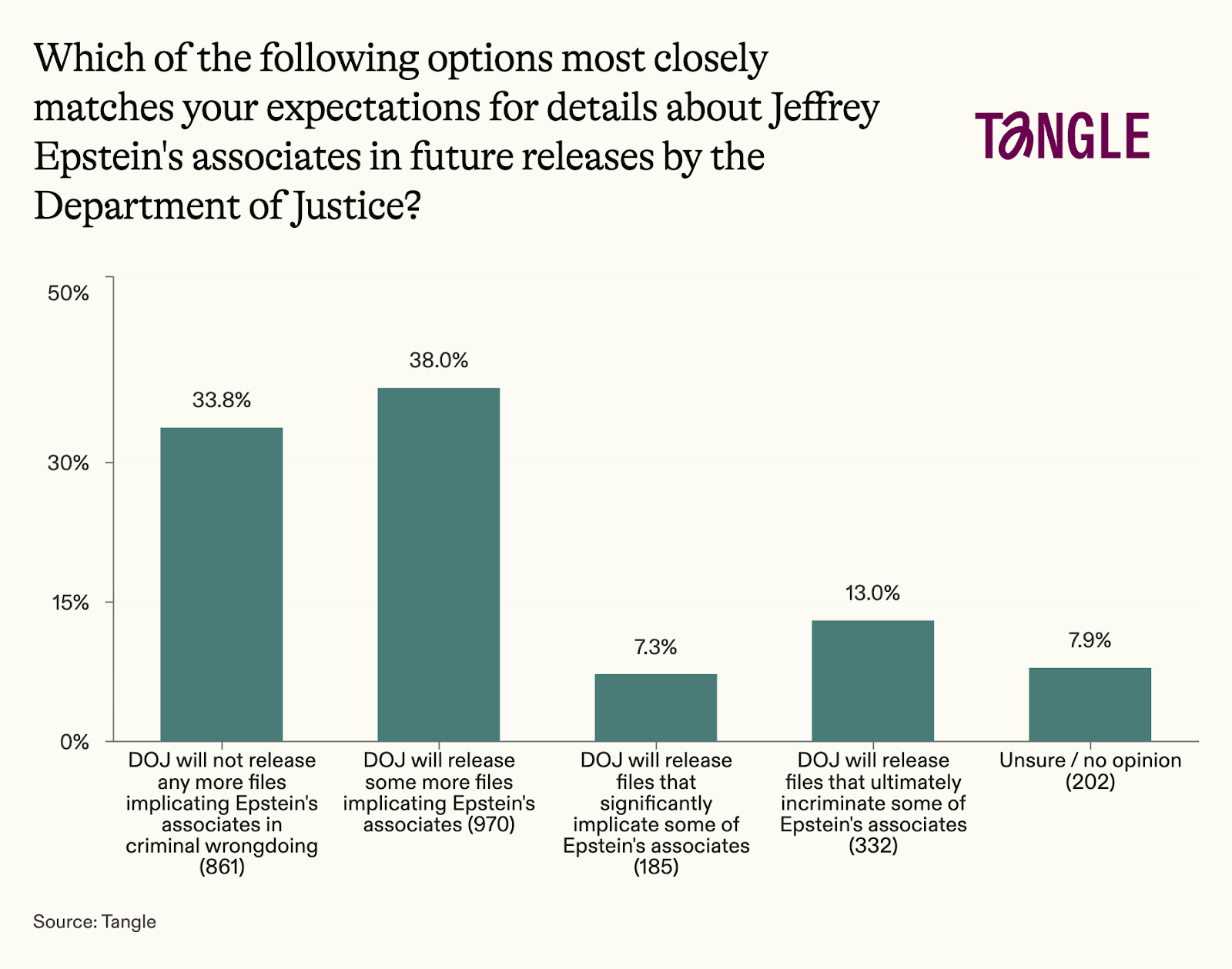
- Monday’s survey: 2,550 readers responded to our survey on Jeffrey Epstein with 38% expecting more files to be released that fall short of incriminating. “The DOJ is withholding any evidence to support implication,” one respondent said. “If there is an active investigation (i.e. classified) then that info will not be released. People need to calm down and let the behind the scenes work,” said another.
Have a nice day.
The Masai giraffe population has declined precipitously in recent decades, but a family at the San Diego Zoo is providing hope for the endangered species. On November 30, the zoo announced that Masai giraffe Mawe had given birth to her first calf; the birth was especially notable because Mawe and Chifu, the calf’s father, were both born at the facility. In a statement, the zoo said, “These births help support the genetic diversity of Masai giraffes and ensure their global population remains strong and healthy.” UPI has the story.

Member comments