


I'm Isaac Saul, and this is Tangle: an independent, nonpartisan, subscriber-supported politics newsletter that summarizes the best arguments from across the political spectrum on the news of the day — then “my take.”
Are you new here? Get free emails to your inbox daily. Would you rather listen? You can find our podcast here.
Today’s read: 15 minutes.
The Only Thing Still Running During a Government Shutdown.
The government might shut down, but your phone should never: Meet the ChargeCard — the Thinnest Wireless Charger on the market. It’s sleek, ultra-thin and tiny enough to fit right in your pocket. Yes, it’s that small! You can now power your phone anywhere without one of those big bulky bricks and long messy cables. Those were cool 10 years ago.
When your phone’s almost dead, the ChargeCard can bring it back to 100% fast — no outlets, no cables, no waiting. Just stick it to the back of your phone magnetically and instantly start charging. Convenient is an understatement!
Our team tested it across NYC, and while others were scrambling for outlets in restaurants and hotel lobbies, we stayed fully charged and on the move. Featured in Forbes, ChargeCard works with both iPhones and Androids.
Yes, things are pretty bad.
Tomorrow, Executive Editor Isaac Saul is going to zoom out on the current political moment and offer a sobering analysis on where we are as a country. It’s not an uplifting piece, but it comes with a call to action and an argument to see this moment clearly for what it is.
See you tomorrow?
It’s finally here: Our third-ever live event is happening in Irvine, California, tomorrow (Friday) night. Isaac will be joined on stage by Editor-at-Large Kmele Foster, Axios reporter Alex Thompson, and The Young Turks co-host Ana Kasparian. Some tickets are still available, and you can grab them here.
Quick hits.
- The Trump administration reportedly lifted a restriction on Ukraine’s use of some long-range missiles provided by Western allies, and on Tuesday, Ukraine struck a Russian explosives and fuel plant using a British-supplied Storm Shadow cruise missile. However, President Donald Trump denied that he had given this authorization. (The report)
- The North Carolina House voted 66–48 along party lines to adopt a new state congressional map that is expected to help Republicans gain an additional seat in the U.S. House. (The vote)
- President Trump said the entire East Wing of the White House is being demolished as part of the construction of a White House ballroom to host state dinners and other events. Before construction began, Trump said the East Wing would not be impacted by the project. (The construction)
- The U.S. military carried out an eighth confirmed strike against an alleged drug trafficking boat, killing two. The strike was in the eastern Pacific off South America, whereas previous strikes targeted boats in the Caribbean. (The strike)
- The Senate voted 54–46 on advancing a continuing resolution to temporarily fund the government and end the shutdown, failing for the 12th time to reach the 60-vote threshold to pass the funding bill. Sen. Jeff Merkley (D-OR) also gave a nearly 23-hour speech on the Senate floor in protest of what he called the Trump administration’s authoritarian actions. (The latest)
Today’s topic.
The Portland National Guard ruling. On Monday, the 9th U.S. Circuit Court of Appeals ruled 2–1 that President Donald Trump can deploy Oregon National Guard troops to Portland, Oregon, finding it was likely that the president had “lawfully exercised his statutory authority” in mobilizing the Guard. The decision lifted District Judge Karin Immergut’s temporary block on the Oregon soldiers’ deployment, and the Trump administration asked the judge to lift a second order barring all federalized National Guard troops from deploying to the city. Immergut gave the state and city of Portland 24 hours to respond to the request.
Back up: On October 4, Immergut (a Trump appointee) issued the temporary restraining order after Oregon and Portland sued to stop President Trump from deploying 200 Oregon National Guard troops to the city to maintain public order. Trump alleged that protests against federal immigration agents had become uncontrollably violent, a claim the city and state denied. Immergut ruled against Trump, finding that his characterization of the situation was “simply untethered to the facts.” On October 5, Immergut issued a second order blocking any National Guard troop deployments to Portland after Defense Secretary Pete Hegseth called up Texas National Guardsmen and attempted to send them to the city.
We covered the initial ruling here.
During oral arguments before the 9th Circuit panel, attorneys for the Trump administration contended that the deployment was necessary to address rising unrest and protect against future violence. The majority of the panel appeared sympathetic to this argument. Conversely, Oregon Assistant Attorney General Stacy Chaffin argued that protests in the city did not meet the definition of a “rebellion” necessary to meet the legal pretext for National Guard deployment.
In its ruling, the majority wrote, “Some of these protests have been peaceful, but many have turned violent, and protesters have threatened federal law enforcement officers and the building,” adding, “Even if the President may exaggerate the extent of the problem on social media, this does not change that other facts provide a colorable basis to support the statutory requirements.”
Judge Susan Graber dissented, writing, “The record contains no evidence whatsoever that… [Immigration and Customs Enforcement] was unable either to protect its Portland facility or to execute the immigration laws it is charged with enforcing.”
Judge Immergut is expected to rule in the coming days on the Trump administration’s request to lift the second temporary restraining order. Furthermore, Immergut has scheduled a trial on the full lawsuit by the state and city for October 29.
Today, we’ll share arguments from the left and right on the 9th Circuit’s ruling, followed by Managing Editor Ari Weitzman’s take.
What the left is saying.
- The left sharply criticizes the decision, suggesting the court was overly deferential to executive power.
- Some say the ruling is a blow to civil liberties.
- Others worry the court is paving the way for more serious authoritarian abuses.
In Slate, Mark Joseph Stern wrote “Trump’s crackdown on Portland is bad enough. One judge has a plan to make it worse.”
“As bad as Monday’s decision was, it could have been far worse. In a concurrence, Judge Ryan Nelson argued that the judiciary has no power at all to review (or halt) a president’s deployment of the National Guard to suppress alleged domestic unrest,” Stern said. “In Nelson’s view, Trump enjoys absolute discretion to send troops into American cities for any reason he deems necessary, and no court may stand in his way.
“It may be tempting to dismiss this argument as Nelson’s audition for a Supreme Court seat. But it must be taken seriously, because it is precisely what the Trump administration is now asking SCOTUS to embrace. And it is wrong from top to bottom,” Stern wrote. “[Nelson] wrote that the current statute ‘uses similar language’ to its predecessors, disregarding Congress’ deletion of a clause that gave more deference to the president. But as Judge Graber pointed out in dissent, today’s statute includes careful limitations on the president’s discretion. And those limits create a ‘judicial responsibility’ for courts to rebuff the president when he deploys the Guard ‘in a situation far divorced’ from what Congress envisioned.”
In Washington Monthly, Garrett Epps criticized the court “greenlight[ing] Trump’s Portland troop surge.”
“The panel’s per curiam opinion upholds a militarized response to this civic impudence by noting that the Department of Homeland Security had to bring in some out-of-state personnel to handle the June demonstrations,” Epps said. “It’s hard to escape the conclusion that the aim of the troop interventions in California, Chicago, and Portland is a massive shifting of the civil liberties goal posts. To this administration and its supporters, protest itself is ‘violence’ and ‘rebellion.’”
“Immergut, a Trump appointee, contemplated facts and law and ruled against the administration — the way we teach in law school that a good judge must sometimes do. Her pains, however, earned her the accusation from Trump aide Stephen Miller of ‘legal insurrection,’” Epps wrote. “Such rhetoric is undoubtedly part of a campaign to intimidate federal judges, Republican or Democratic. And of course, some judges are predisposed to obeisance: Judge Nelson of the panel wrote in a separate opinion that, as far as he is concerned, no court has jurisdiction to review Trump’s order ever, no matter what.”
In Above the Law, Joe Patrice said the appeals court “[laid] a little more track on the authoritarianism express.”
“This decision becomes another collectible in the White House’s effort to string together step-wise court victories toward laying the legal groundwork for unilateral authoritarianism,” Patrice wrote. “That’s really what’s going on here. The administration is fully aware that they don’t need the National Guard to secure ICE from eight hippies. But they’re counting on judges like Nelson and Bade to write opinions establishing that Trump’s subjective assessment of ‘danger’ justifies military deployment.”
“After paying lip service to recent Ninth Circuit precedent clarifying that the White House can’t make unfounded declarations to justify sending troops, the majority strung together a series of anecdotes that amount to little more than ‘there was once a protest’ — regardless of whether it actually prevented law enforcement from functioning — and said that’s enough to make Trump’s decision colorable,” Patrice said. “That’s not legalism, it’s epistemic control: the right to define what counts as a threat, what counts as a rebellion, and what counts as the ability to execute laws.”
What the right is saying.
- The right supports the ruling, saying Trump had sufficient grounds to deploy the Guard.
- Some note the historical rationale for this executive authority.
- Others say the left’s view of deployment power is hypocritical.
In The Washington Examiner, Byron York said the court’s ruling “shows why Trump is right about the National Guard.”
“The anti-Trump world celebrated earlier this month when a federal judge blocked President Donald Trump from federalizing National Guard troops in Portland… Of course, the White House appealed. And now the 9th Circuit Court of Appeals has overturned Immergut, giving the president another victory in the courts,” York wrote. “The new ruling rests on very clear reasoning. There have been extensive and frequent attacks on an Immigration and Customs Enforcement facility in Portland. The president of the United States has the authority to protect federal installations.
“So Trump can order National Guard troops to protect a federal installation that is under attack. It’s a ruling so based in common sense that it should be noncontroversial,” York said. “The key part of the decision is the judges’ recitation of the factual background of the case… ‘“As a result of the destruction caused by protesters” and threats to the building,’ the opinion [said], ‘the Department of Homeland Security was forced to close the facility for more than three weeks, from June 13 to July 7.’ That, of course, ‘significantly impeded’ the work of the federal government.”
In Hot Air, Ed Morrissey wrote about the “Ninth Circuit overturn[ing]” the lower court.
“For the second time this year, the Ninth Circuit has had to reverse a lower court on presidential authority to protect federal buildings and personnel. Earlier this year, Gavin Newsom got handed a defeat over National Guard troops in Los Angeles,” Morrissey said. “Unlike the June ruling in Newsom, today’s decision was not unanimous. Today’s 2-1 ruling did, however, tread the exact same ground as Newsom, specifically the presidential authority of Section 12406. The court went all the way back to the Whiskey Rebellion and Shay’s Rebellion to conclude that an insurrection need not be armed nor organized for the direct overthrow of the government.”
“Judge Nelson offers the historical perspective in his concurrence. The Whiskey and Shay’s Rebellions demonstrated the need for presidential authority to stop insurrections before they grew larger. They also provided a model for proportionate response that Trump’s deployment clearly followed in its small and time-limited mission,” Morrissey wrote. “Nelson’s clarity puts the Portland rioting into that historical perspective, which then demonstrates that Trump has done nothing that even Founding Father presidents did to maintain federal authority and enforcement.”
For the Civitas Institute, John Yoo asked “does federal law extend to Portlandia?”
“In Title 10, Congress delegated the President the authority to call out the National Guard in cases of invasion, rebellion, or resistance to federal law. Portland and Chicago naturally claim that the law only applies in cases of ‘invasion’ or ‘rebellion,’” Yoo said. “But these Democrats conveniently ignore the third ground to call out the National Guard. Congress allows the President to federalize the National Guard when he ‘is unable with the regular forces to execute the laws of the United States.’ As the Ninth Circuit decision found, protestors in Portland have been launching riots to stop ICE and DHS agents from carrying out their duties since early June.”
“Trump critics in Portland and Chicago cannot claim that Presidents lack the authority to call out the troops to protect the national government and enforce federal law. Presidents have used these same authorities to desegregate southern schools in the 1950s after Brown v. Board of Education and to protect civil rights protesters in the 1960s. Those who cheer those interventions cannot now deny the same constitutional authority when it is exercised by a president they oppose,” Yoo wrote. “If critics want the federal government to have the power to enforce civil rights laws against resistant states, they also must concede to President Trump the authority to enforce immigration laws against rioters in the cities of Portland and Chicago.”
My take.
Reminder: “My take” is a section where I give myself space to share my own personal opinion. If you have feedback, criticism or compliments, don't unsubscribe. Write in by replying to this email, or leave a comment.
- Trump’s, and Stephen Miller’s, argument that the National Guard has to quell a rebellion in Portland is ridiculous.
- However, the government has now tapered its argument to say the city needs assistance in executing the laws, which is much more cogent.
- Protesters are also pivoting, and both developments leave me feeling strangely optimistic.
Managing Editor Ari Weitzman: I’m going to go straight to the root of this issue: When President Trump issued his June 7 memorandum authorizing the use of the military to support immigration enforcement, I immediately found the logic absurd. Here’s the reasoning the president marshalled in that memo: “To the extent that protests or acts of violence directly inhibit the execution of the laws, they constitute a form of rebellion against the authority of the Government of the United States.”
This choice of words is significant — and, ultimately, self-defeating. The president wants to say that any protest of the government constitutes a legitimate rebellion against the authority of the government. This simply isn’t true. Even violent protests don’t generally have the aim of overthrowing the U.S. government.
And in case you think I’m being hyperbolic or unfair about the administration’s use of the term “rebellion,” I’m not. I’ll refer you to the arguments being made by White House Deputy Chief of Staff Stephen Miller, who has been constructing the case for use of the military in supporting the administration’s deportation actions that hinges on this definition of rebellion, along with “invasion” and “insurrection.”
There’s no reason to be coy about it: This is the administration’s strategy. Since at least 2023, Miller has argued that Trump could use the military domestically by defining illegal immigration as an invasion and civil disobedience as a rebellion.
Now, Trump is attempting exactly that argument, and he’s running into roadblocks. Because, again, these terms just don’t fit. A wave of illegal immigration is not an invasion, and civil unrest or mass protests are not the same as an insurrection. Judge Immergut saw all of that when she issued her initial temporary restraining order blocking deployments of Oregon National Guardsmen earlier this month — and when she subsequently blocked any deployments to Portland under this line of argument. Because this line of argument simply fails, full stop.
But in the recent appeal, the government did something interesting: They pivoted their argument to something different and more legally defensible. And, in their recent ruling, the 9th Circuit judges seemed to find this new argument convincing.
The majority’s per curiam opinion said that the president can deploy the National Guard if he can make a reasonable claim of any of these three things: an invasion, a rebellion, or violence that inhibits the execution of the laws. That is to say, the government doesn’t have to prove any one of those three things, just show that “the facts provide a colorable basis to support” just one of them.
Furthermore, the president does not have to prove exactly what he claimed in his memo, that disrupting law enforcement constitutes a rebellion. This would make his more bombastic statements about Portland burning down or being a “war zone” immaterial.
Here’s what the opinion said:
All three statutory prongs are the same as to whether prior events may be considered. And the President is entitled, and indeed, duty-bound, to evaluate the entire context of events leading up to a decision to invoke §12406 as part of the constitutional command to “take Care that the Laws be faithfully executed.” Considering the totality of the circumstances, there is a colorable basis for the President’s determination that he is unable with regular forces to execute the laws of the United States.
Second, the district court erred by placing too much weight on statements the President made on social media. The district court interpreted President Trump characterizing Portland as “War ravaged,” as the equivalent of the President “ignoring the facts on the ground.” As such, the district court relied on these statements to disregard other facts that do “reflect a colorable assessment of the facts and law within a range of honest judgment.”
That leads to the question: Do the “facts on the ground” reasonably support the president’s attempt to deploy the National Guard? And remember: It’s not the judges’ job to give a definitive “yes” or “no” to whether they would call in the Guard, just whether or not these facts could reasonably support a determination that the city was unable to execute the law.
In my opinion, a summary of the facts could easily support such a determination. Even Judge Immergut, in a somewhat understated telling, described how protesters’ actions affected law enforcement by shutting down ICE's facility in Portland for nearly a month in June. Additionally, what the Department of Homeland Security referred to as “riots” several times in September provoked violent confrontations with protesters. Here’s the 9th Circuit’s summary of the evidence presented to them about the Portland Police Bureau’s (PPB) ability to respond to incidents at the federal building:
In emails summarizing these incidents, PPB officers report that no officers are available to respond to disturbances at the ICE facility (September 16 email explaining PPB has “no officers to go or call” to respond to disturbance at ICE facility); (September 19 email stating the PPB had “few to zero officers available” to address a “verbal disturbance” in front of the ICE building); (September 20 email stating that PPB “would not be able to address the call or make an arrest with the resources we have”).
After reading the new legal argument, and the PPB statements from September, I found myself convinced that the Trump administration is on solid legal footing here. If Judge Immergut sends the appeal back to the 9th District for another review or an en banc ruling (which seems likely), I expect that the judges will be relatively split between those who oppose deployments on the public arguments and those who support it on the 9th District’s recent ruling.
Now, that isn’t to say that I think President Trump is right. First of all, it’s pretty ridiculous that his administration’s best legal argument is to ignore what the president tells us in public. Not to put too fine a point on it, but if we can’t trust what the president is saying — and courts are telling us not to trust what the president is saying — then that’s pretty bad.
Second, legally defensible isn’t the same thing as productive. In Portland, protests had all but died down in August and September before the deployments, which then brought people back to the streets. National Guard deployments, combined with the public statements (that we’re supposed to ignore) and immigration enforcement stunts, are inflammatory. They often dance on the line of what is legal, and in Los Angeles and Chicago, they have provoked more unrest rather than bringing order to an unstable situation. Trump came into office spoiling for a fight — with the courts, with unauthorized migrants, and with protesters. And so far he’s gotten all three.
But, now, something interesting is happening in Portland: Protesters are also pivoting. Instead of giving Trump his fight, Portlanders are now showing up in front of federal buildings in ridiculous inflatable costumes and organizing an “emergency” naked bike ride.
We’ve often criticized ineffectual protesters in Tangle, but I’ve got to say: I love this. Protesters seemed to be legitimately hampering ICE’s ability to perform their functions, and that seemed to be an intentional tactic. Now that Trump is responding with force, they’re pulling the rug — making the president’s whole show of force look excessive and ridiculous. We hear “Portland is burning” and “antifa is trying to overthrow the government,” then the camera pans to a bunch of people dancing in Pokémon costumes. Trump is gifted at controlling media narratives, but I can’t remember a time that protesters have played a gambit that countered him so effectively.
Tomorrow, Isaac’s publishing a sobering piece about the excesses of the current administration. But today, I’m feeling pretty optimistic: The Trump administration is showing signs of abandoning Stephen Miller’s ridiculous legal fancies, the courts are making justifiable rulings, and Portland is providing a template for genuinely effective protest.
Regardless of whether or not the National Guard ever does arrive in Portland, I’d be willing to bet that the worst moments of civil unrest in the city are already in the past.
Take the survey: What do you think of the situation in Portland? Let us know.
Disagree? That's okay. My opinion is just one of many. Write in and let us know why, and we'll consider publishing your feedback.
Your questions, answered.
Q: DOGE website claims savings of $214 billion. You cited savings of $1.4 billion in [Tuesday’s] newsletter. How do we reconcile these numbers?
— Fran from San Miguel de Allende, Guanajuato, Mexico
Tangle: In our edition covering the ongoing government shutdown on Tuesday, we stated that DOGE’s savings were close to $1.4 billion, which is a pretty striking difference from the $214 billion DOGE claims to have saved.
DOGE’s claimed savings have always been somewhat of a moving target. Back in February, The Guardian reported that the agency was claiming savings from cancelled contracts that didn’t actually save the federal government any money. It’s not only erroneously reported that it has saved money that it hasn’t, but reported the totals of its canceled contracts incorrectly, too. Most notably, DOGE reported an $8 million contract as actually being worth $8 billion (then still counted the incorrect amount towards its savings).
As time has gone on, DOGE has continued to make unreliable declarations — usually by claiming savings from contracts that were already paid or claiming the totality of contracts that were partially paid. Our recent reference to $1.4 billion in savings was backed by recent reporting from POLITICO. This is similar to reporting from the Wall Street Journal, which found the real savings would be more like $2.6 billion if spending stayed flat — which it hasn’t.
As a final note, none of that money will go to decreasing the federal deficit. Canceled contracts go back to the agencies that issued them, which are mandated by law to spend the money that Congress has allocated to them.
Want to have a question answered in the newsletter? You can reply to this email (it goes straight to our inbox) or fill out this form.
Under the radar.
On Monday, Northwestern University’s Medill School published its 10th annual State of Local News report, which explores the local news landscape across the United States. This year’s report found that local news sources are continuing to disappear. Among the key results, it found that over 130 local papers shut down in the past year, and close to 40% of all local U.S. newspapers have folded in the past two decades. Furthermore, news desert counties — areas that lack consistent local reporting — increased from 206 to 213 in the past year, leaving approximately 50 million Americans with limited or no access to local news. You can read the report here.
Not All Collagen Is Clean — Here's What to Look For.
Collagen supports joints, skin, and hair — but many formulas hide fillers, hormones, and heavy metals.
NativePath uses just one ingredient: 100% grass-fed, pasture-raised bovine collagen. No additives, GMOs, or sketchy extras. Each scoop delivers Types I and III collagen, hydrolyzed for fast absorption. This is collagen done right.
For a limited time, Tangle readers get 45% off + free shipping.
Numbers.
- 128. The number of arrests at the Immigration and Customs Enforcement facility in Portland, Oregon, between June 9, 2025 and October 2, 2025, according to the Federal Bureau of Investigation’s (FBI) Portland office.
- 27. The number of active and pending FBI investigations into criminal activity at the facility.
- 6,300. The approximate number of vandalism incidents in Portland in 2019, according to Portland Police Bureau data.
- 12,000. The approximate number of vandalism incidents in Portland in 2022.
- 6,800. The approximate number of vandalism incidents in Portland in 2024.
- 58% and 25%. The percentage of U.S. adults who say the president should and should not, respectively, send armed troops only to face external threats, according to an October 2025 Reuters/Ipsos poll.
- 37% and 48%. The percentage of U.S. adults who say the president should and should not, respectively, have the ability to send troops into a state even if its governor objects.
- 83% and 10%. The percentage of U.S. adults who say the U.S. military should and should not, respectively, remain politically neutral.
The extras.
- One year ago today we wrote about Trump’s statements on “the enemy within.”
- The most clicked link in yesterday’s newsletter was the ad in the free version for 14 benefits seniors often don’t know they’re entitled to.
- Nothing to do with politics: A YouTube channel dedicated to giving pop songs the 1950s soul treatment.
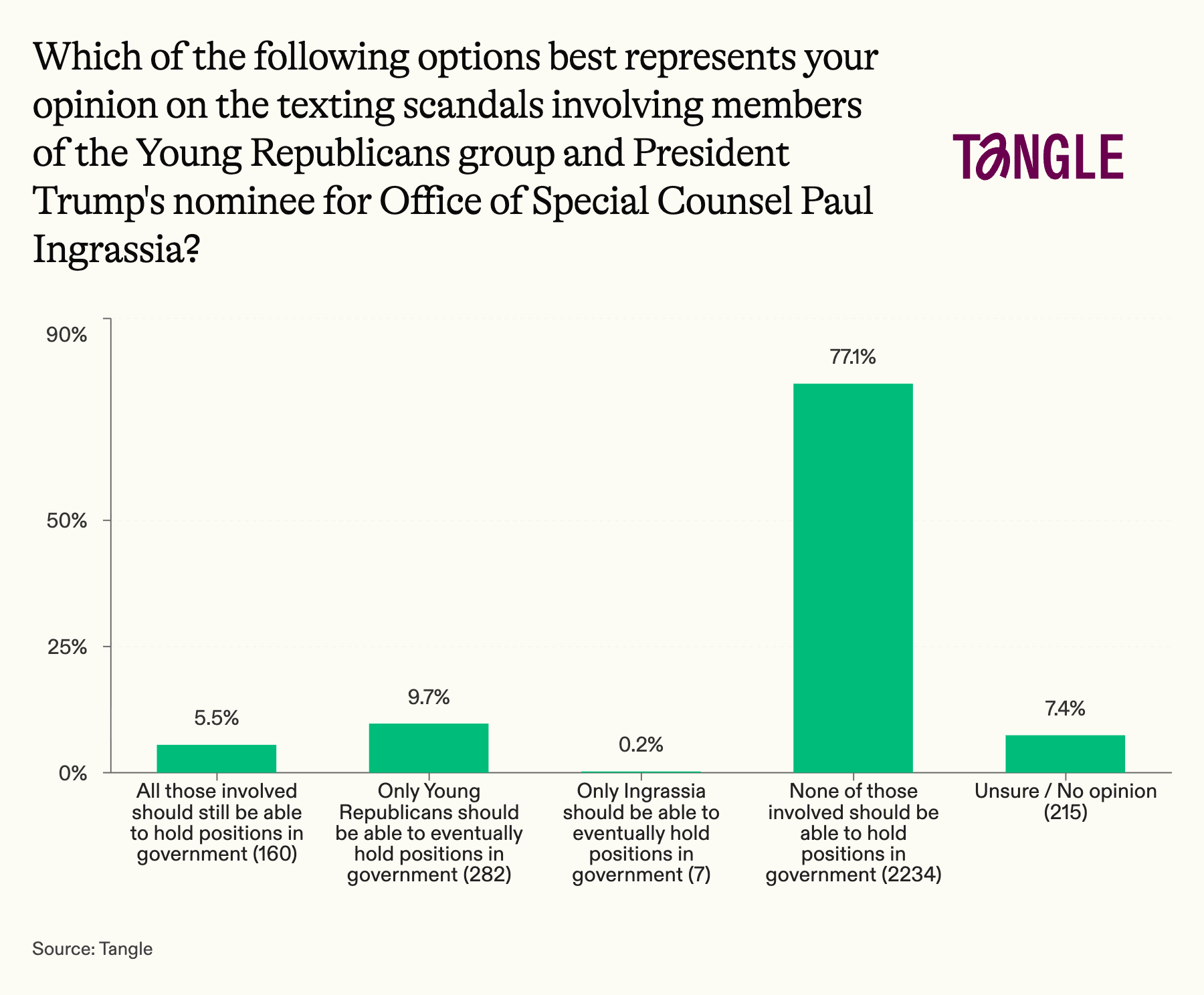
- Yesterday’s survey: 2,898 readers responded to our survey on the recent Republican texting scandals with 77% saying none of those involved should hold government positions. “It makes me sad that in modern times we still have grown adults that think and speak this way and I certainly don't want them leading my government,” one respondent said. “I feel there should be different options if the office is appointed vs elected. No for appointed, yes for elected,” said another.
Have a nice day.
Over 2% of American children suffer from peanut allergies that can lead to dangerous symptoms like hives, respiratory distress, and, in extreme cases, anaphylaxis. However, a new study from Dr. David Hill at the Children’s Hospital of Philadelphia shows that since guidelines for introducing peanuts in infants were implemented in 2017, the rate of peanut allergies in U.S. children has dropped by over 40%. The guidelines date back to 2015, when a landmark study showed that introducing peanuts in small amounts in infancy can greatly reduce the likelihood of developing an allergy. “That’s a remarkable thing, right?” Dr. Hill said. “I can actually come to you today and say there are less kids with food allergies today than there would have been if we hadn’t implemented this public health effort.” The Associated Press has the story.

Member comments