
I'm Isaac Saul, and this is Tangle: an independent, nonpartisan, subscriber-supported politics newsletter that summarizes the best arguments from across the political spectrum on the news of the day — then “my take.”
Are you new here? Get free emails to your inbox daily. Would you rather listen? You can find our podcast here.
Today’s read: 15 minutes.
16 Nearly Secret Things To Do If You Have Amazon Prime
If you shop on Amazon regularly, there’s a good chance you’re leaving real money on the table every single month.
We’ve put together 16 lesser-known Amazon hacks that can unlock serious savings. These tips can help you lower prices, earn cash back, stop paying for subscriptions you don’t use, and avoid common Amazon charges most people never notice.
And the best part?
You don’t need to buy anything new or change how you shop. There’s no complicated setup or learning curve here. These are straightforward, practical tricks you can use right away — whether you shop on Amazon weekly or just a few times a month.
Once you know them, they’re easy to apply every time you check out. Instead of paying full price and moving on, you can start getting more value out of purchases you’re already making.
Predicting the future.
We tend to shy away from prognostication at Tangle. But beliefs about the future are makers of our worldviews, and if those beliefs prove incorrect then they provide hard, empirical data points that show us where our worldviews may be off the mark. Recently, we decided to give ourselves — and our readers — a chance to measure up.
In our last Friday edition of 2025, Isaac put some predictions down on paper that he thinks will happen between now and 2030. But remember: If you want to read the whole thing, you’ll have to become a Tangle member!
Interested in making your own predictions for 2030? Check out this tool, featured in our Sunday edition, created by a Tangle reader!
Quick hits.
- In a meeting between President Donald Trump and Israeli Prime Minister Benjamin Netanyahu at Trump’s Mar-a-Lago residence on Monday, the two leaders praised each other and reaffirmed their alliance. Trump said the U.S. would consider additional strikes on Iran if it attempted to restart its nuclear program and blamed Hamas’s unwillingness to disarm for challenges in implementing the second phase of the Gaza peace plan. (The meeting)
- CNN reported that the Central Intelligence Agency carried out a drone strike earlier this month at a Venezuelan port facility that the U.S. government believed Tren de Aragua gang members were using to store drugs. If confirmed, the strike would be the first known U.S. attack within Venezuela. (The report)
- Russian President Vladimir Putin told President Trump in a phone call that Ukraine conducted a drone attack targeting one of his official residences, and that the incident would change Russia’s position in peace negotiations. Ukrainian President Volodymyr Zelensky denied the accusation, calling it a fabricated story to “justify additional attacks against Ukraine.” (The claim)
- The Thai army accused Cambodia of violating a ceasefire deal signed over the weekend, saying that it detected over 250 drones flying from the Cambodian side on Sunday. In a statement, the army said it would “reconsider” the planned release of 18 imprisoned Cambodian soldiers as a result of the alleged incursion. (The latest)
- A federal judge blocked the Trump administration from ending temporary protected status for South Sudanese nationals living in the United States while a lawsuit challenging the revoked protections proceeds. (The ruling)
Today’s topic.
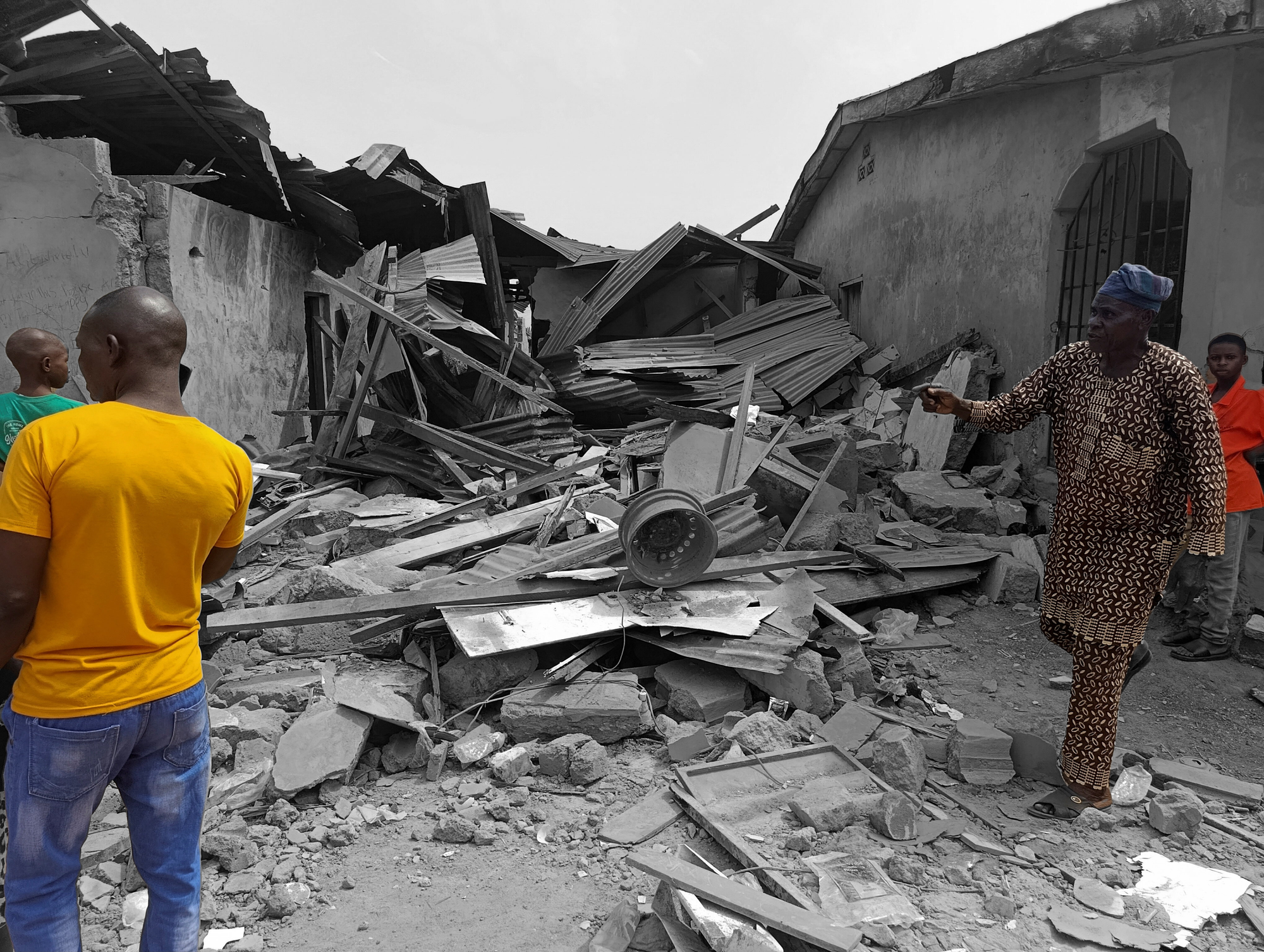
The Nigeria bombings. On Thursday, December 25, President Donald Trump announced that the United States Africa Command conducted strikes on Islamic State (IS, or ISIS) targets in the state of Sokoto in northwestern Nigeria. According to a military official, a U.S. Navy ship in the Gulf of Guinea fired over a dozen Tomahawk cruise missiles, hitting insurgents in two IS camps. The strikes were conducted with the consent of the Nigerian government, and no civilian casualties have been reported.
Back up: Several religious and political extremist groups operate in Nigeria, including al-Qaeda and Islamic State splinter groups IS–West Africa Province and IS–Sahel Province (the Sahel is a North African region just south of the Sahara that runs through Nigeria). Boko Haram, a self-proclaimed jihadist militant group active throughout the Sahel and designated a foreign terrorist group by the U.S. in 2013, is also based in Nigeria. Though the country is not officially at war, over 12,000 people were killed by violent groups in Nigeria in 2025.
On November 3, the State Department designated Nigeria a “country of particular concern” following alleged religious violence against Christians in the country. Trump also warned jihadist factions in Nigeria to stop attacking the country’s Christian population and directed the Department of Defense to prepare to intervene. The Nigerian strikes are the second attack against ISIS targets in the last two weeks, following a series of strikes in Syria in retaliation for the deaths of two U.S. soldiers and a U.S. interpreter in a terrorist attack.
President Trump announced the strikes in a Christmas Day post on Truth Social. “The United States launched a powerful and deadly strike against ISIS Terrorist Scum in Northwest Nigeria, who have been targeting and viciously killing, primarily, innocent Christians… May God Bless our Military, and MERRY CHRISTMAS to all, including the dead Terrorists, of which there will be many more if their slaughter of Christians continues.”
The location of the strikes in northwestern Nigeria prompted confusion among local residents. Nigeria’s northwest faces banditry, kidnappings and attacks by armed groups; however, religious violence is more of a concern in the country’s northeast. On December 24–25, 2025, an apparent suicide bombing during evening prayers at a mosque in Borno State in northeastern Nigeria killed five and injured more than 30. The Borno attack does not appear to be related to the U.S. strike.
Additionally, some analysts question the Trump administration’s characterization of extremist violence in Nigeria as targeted specifically against Christians. “People of all religions and of all tribes are dying, and it is very unfortunate, and we even know that Boko Haram and ISIS are killing more Muslims than more Christians. So people are suffering from all sorts of backgrounds. This is not specifically targeted at one group or the other,” Massad Boulos, Trump’s Senior Adviser on Arab and African Affairs, said.
Below, we’ll get into what the left, right, and writers in Nigeria are saying about the recent bombings. Then, Senior Editor Will Kaback gives his take.
What the left is saying.
- The left opposes the strikes, arguing they are a political ploy.
- Some suggest Trump favors foreign military engagement when it suits his domestic priorities.
In MS NOW, Nicholas Grossman said “Trump sending bombs into Nigeria was a Christmas show for his evangelical base.”
“Nigeria has been plagued by sectarian violence, but that violence hasn’t primarily targeted Christians — and certainly not at historically unprecedented levels. America’s logic here isn’t clear, but the strikes appear driven more by Trump putting on a show for his evangelical base than trying to reduce violence in Nigeria or even advance U.S. national interests,” Grossman wrote. “It’s not clear what prompted the timing of the strikes. The U.S. campaign in Yemen came after the Houthis fired at shipping in the Red Sea, and the strikes in Syria followed an ISIS-linked attack in the country that killed three Americans, but there hasn’t been a recent attack on Americans or U.S. interests in Nigeria.”
“This professed concern for persecuted Christians looks absurd in the context of the Trump administration’s policies. For example, the U.S. Department of Homeland Security recently announced the end of Temporary Protected Status for nearly 4,000 people from Myanmar, many of them persecuted Christians,” Grossman said. “But bombing on Christmas did give Donald Trump a chance to tell his base that he’s standing up for Christianity, even as he and many of his Christian supporters, in direct contrast to Jesus’ teachings, openly champion violence, money and cruelty to strangers.”
In November, Joshua Keating wrote in Vox about Trump’s potential “humanitarian intervention, MAGA-style.”
“The Nobel Peace Prize aspirant and advocate of ‘America First’ foreign policy is more than willing to use the threat of military force to accomplish his foreign policy goals, and to interfere in the domestic affairs of other countries, when doing so aligns with his domestic political priorities,” Keating said. “The threat against Nigeria is similar to that against Venezuela, although the latter appears far more likely to actually be carried out. In both cases, the president appears to be contradicting his frequently expressed opposition to military interventionism, but these are interventions linked to the priorities of his political base.”
“Trump is essentially a globalist: someone who believes the US plays an indispensable role on the world stage, and should play a role in solving global crises… But the big difference between Trump and the liberal internationalists or neoconservatives who came before him is the degree to which his foreign interventions are aligned with his domestic political priorities,” Keating wrote. “In the case of Nigeria, it means reviving the supposedly discredited notion of humanitarian military intervention — but only in a case where it aligns with the priorities of one of Trump’s important constituencies.”
What the right is saying.
- The right generally supports the strikes, saying they show America’s enemies that Trump is true to his word.
- Some caution that strikes alone won’t change the situation in Nigeria.
National Review’s editors wrote “Trump targets the Islamic State in Nigeria.”
“Just last month, Trump had raised alarms about the treatment of Christians in Nigeria. Since 2009, estimates say as many as 100,000 Christians have been killed and 19,000 churches have been destroyed. Trump warned that if it didn’t stop, the U.S. ‘may very well go into that now disgraced country, “guns-a-blazing,”’” the editors said. “Trump is right to focus attention on the treatment of Christians in Nigeria, a persistent problem that has gotten insufficient attention. That said, these militant groups thrive in uncovered spaces beset by all sorts of lawlessness.
“The strikes were carried out in cooperation with the Nigerian government, but the sort of sustained government campaign on the ground it would likely take to reestablish order is not immediately in the offing. Nor, presumably, would we have the appetite to participate in such an effort,” the editors wrote. “The Christmas strikes are yet another sign that rather [than] being a quasi-isolationist, like some of his most vociferous supporters, Trump is a hyperactive foreign-affairs president. He makes lots of threats, more than he ever carries out, but enemies completely discount them at their peril.”
The Wall Street Journal editorial board argued “stopping the growth of ISIS in Africa will require more than bombing from afar.”
“Skeptics are taking issue with Mr. Trump’s ‘framing’ of the strike as intended to save Christian lives, and no doubt that framing is aimed at evangelical Christian audiences who support Mr. Trump in the U.S. But it’s not as if the terrorists aren’t killing others in Nigeria and across much of the Sahel region. The terrorists are a justifiable target,” the board said. “It’s also encouraging that the U.S. and Nigerian governments say they worked together on the strikes. This suggests local cooperation that is essential to stopping the growth of ISIS and al Qaeda offshoots.”
“The U.S. has carried out similar attacks in Somalia for years, as it also has in Yemen and Pakistan at times in the last 25 years. This is a long-time fight, and periodic bombing raids won’t end the threat any more than Bill Clinton’s missiles from a distance stopped Osama bin Laden in the 1990s,” the board wrote. “Dismantling the jihadist threat will take more sustained involvement with regional governments that are themselves threatened by Islamic radicals. That means sharing intelligence and perhaps deploying U.S. special forces on the ground if need be. The U.S. learned the hard way in 2001 that a distant jihadist group can carry out or inspire attacks on the American homeland.”
What Nigerian writers are saying.
- Some Nigerian writers say the strikes could undermine Trump’s efforts to protect Christians.
- Others argue the U.S. intervention is welcome after years of government inaction.
In The Guardian, Onyedikachi Madueke suggested the strikes “may only fan the flames of insurgent violence.”
“Ironically, it was Trump’s redesignation of Nigeria as a ‘country of particular concern’ in November that deepened Muslim–Christian tensions. Many northerners, who are predominantly Muslim, blamed southern Nigerians for championing a narrative that ultimately resulted in US sanctions and international stigma,” Madueke said. “The geographic and operational focus of the strikes has complicated the ‘Christian genocide’ framing. Sokoto is the spiritual heartland of Islam in Nigeria, but armed violence in the area disproportionately affects Muslim communities. By contrast, attacks against Christian farmers are most prevalent in north-central states such as Benue and Plateau.”
“The strikes against IS came at a time of public fatigue with insecurity caused by insurgency, terrorism, banditry and communal violence. Nigerians were ready to accept almost any intervention that promised relief,” Madueke wrote. “Despite the support, Nigeria’s insecurity will not be resolved through airpower alone. Airstrikes may yield short-term tactical gains, but they risk generating longer-term strategic setbacks. Framing the intervention as the defence of persecuted Christians may strengthen extremist narratives of foreign ‘crusader’ aggression, potentially attracting more external funding and support for jihadist groups.”
The This Day editorial board wrote about “the strike on terror in Nigeria.”
“The Christmas Day strike on terrorist targets in Sokoto State is a bold undertaking with many positive meanings. The collaboration between Nigeria’s armed forces and their United States’ counterparts is a strategic gain. The identification of ISIS as the target of the strike brings Nigeria’s campaign in line with the global thrust of counter-terrorism,” the board said. “This campaign has seen the US collaborate with governments in diverse countries to go against ISIS terrorists. To this extent, the involvement of the US in the Sokoto strike is part of the global anti-ISIS campaign that has been waged in the aftermath of the 9/11 attacks in the US.
“Whatever may be the shortfalls of this specific strike, it is a fitting but long overdue diplomatic signal to all terror merchants, sponsors and foot soldiers in Nigeria that their days are numbered. However, it is crucial to dispel the dangerous strands in narratives surrounding the strike,” the board wrote. “It was not targeted at any faith. Nor was it designated to derogate any section of the country. Instead, it is aimed at eroding and ultimately eliminating the capacity of ISIS and affiliates like Boko Haram to continue destabilising Nigeria by perpetuating insecurity through terrorism.”
My take.
Reminder: “My take” is a section where we give ourselves space to share a personal opinion. If you have feedback, criticism or compliments, don't unsubscribe. Write in by replying to this email, or leave a comment.
- Even if we take Trump’s justification at face value, the strikes don’t make sense.
- Violence in Nigeria isn’t targeted specifically at Christians, and these strikes won’t stop them.
- An actual solution would look a lot different than what the administration is doing now.
Senior Editor Will Kaback: As has been apparent for some time, President Trump’s promise to “put an end to endless wars” has become one of his most hollow campaign statements. While the airstrikes in Nigeria are not the same as full-scale wars like Afghanistan or Iraq, they are part of a pattern of consistent, intermittent military operations. Simultaneously, the administration’s explanation fits an equally distressing pattern of incoherency.
After a year of covering the second Trump administration, I find myself viewing the president’s actions through what I call an “even if” lens: The administration takes a bold and unusual action, experts criticize or question it, and White House officials (or the president) deploy arguments about why this action represents a critical national interest. The justification seems hard to square, but even if you take the administration’s rationale at face value in these cases, the corresponding action still doesn’t make sense.
The strikes against alleged drug boats near Venezuela are a perfect example. The administration calls this a national security issue, and says it is taking bold action to protect Americans from “narco-terrorists” bringing deadly drugs into the country. Set aside the flaws in this justification (e.g., these boats are primarily trafficking cocaine, which is a significant threat but much less pressing than synthetic opioids) and take it at face value. Even if the administration wants to stop the flow of cocaine into the country, it doesn’t make sense to prioritize Venezuela, which isn’t a major trafficking hub, or to rely on airstrikes over proven Coast Guard interdiction efforts, or even to focus on the Caribbean when most drugs from Venezuela are transported through the Pacific.
This exercise typically reveals the administration’s ulterior motive. You can repeat it for a litany of issues: tariffs, the National Guard deployments, overtures about annexing Greenland, and now the Nigeria strikes.
Trump said that the strikes were against Islamic State terrorists who have been “targeting and viciously killing, primarily, innocent Christians at levels not seen for many years, and even Centuries!” It’s true that Christians have regularly been attacked and killed by jihadist terrorists, particularly by Muslim herders competing with Christian farmers over land; but that initial claim is deeply flawed — mostly because Christians are far from the only victims of spiraling regional violence. As the 2025 U.S. Commission on International Religious Freedom report on Nigeria stated, “Those targeted include Christians, Muslims, traditional practitioners, and humanists.” Case in point: Just last week, terrorists bombed a crowded mosque in Nigeria’s northeastern Borno state, killing five people; in August, a separate mosque attack killed 50.
According to data from Armed Conflict Location & Event Data, approximately 53,000 civilians in Nigeria have been killed in targeted political violence since 2009. Between 2020 and 2025, Christians were targeted in 385 attacks, resulting in 317 deaths; comparatively, Muslims were targeted in 196 attacks, resulting in 417 deaths. In other words, the Trump administration is taking an extremely narrow view of the situation, a view that’s been explicitly challenged by Trump’s own senior adviser on Arab and Middle Eastern affairs.
Still, taking Trump’s justification at face value: Even if Christians in Nigeria face an outsized threat from terrorist groups, and even if the administration had articulated a clear reason to protect this specific group, these strikes don’t seem to help persecuted Christians at all.
Airstrikes — even a protracted campaign of airstrikes — are not going to put an end to extremist violence in Nigeria’s north. As The Wall Street Journal editorial board wrote (under “What the right is saying”), “The U.S. has carried out similar attacks in Somalia for years, as it also has in Yemen and Pakistan at times in the last 25 years… periodic bombing raids won’t end the threat.” Time and time again, in every administration since the fall of the Berlin Wall, the U.S. government has tried to achieve its goals through brute military force. Time and time again, it has failed. There’s no reason to believe Nigeria will be any different.
Almost a week later, whether the Christmas strikes have had any impact is still unclear. While a local official of a town near the bombings in Sokoto said that he believed the strikes killed some terrorists (an assessment the U.S. shares), the number of casualties is still unconfirmed. At the same time, residents of villages in Sokoto said they observed bombs landing in empty fields and expressed confusion about who or what was being targeted. Meanwhile, the U.S. and Nigerian governments are relaying competing stories about the results of the strikes.
All of this ambiguity underscores the broader problem: The administration communicated no clear goal for this operation, and no clear theory of success. Even the best-case outcome — say, dozens of terrorists killed and their bases destroyed — changes little about the reality on the ground. This conflict spans an entire region (of which Northern Nigeria is only a part) comprising hundreds of millions of people, complicated histories, and struggling governments and militaries.
This strike doesn’t resolve the situation — so what is our endgame? Keep up the bombings until the Defense Department determines Nigerian Christians have been sufficiently protected? Expand our military operations throughout the Sahel to try to crush the widely dispersed terrorist groups? For that matter, why is it the purview of the United States to protect Christians abroad, and how could we possibly do that without ensnaring our military into more forever wars? The only answer to these questions is that the premise — Trump’s justification — is wrong.
If you put aside Trump’s justification, there is a conceivable case for U.S. involvement in Nigeria. The Islamic State affiliates operating in the country are part of a broader regional insurgency that has destabilized large swaths of the Sahel. Left unchecked, these groups can strengthen cross-border networks and further erode already fragile governments. A future in which these groups attempt to project violence beyond the region, including against the U.S., is not difficult to imagine. Addressing this situation might be possible, but only if the U.S. committed to aiding the Nigerian government in the long term, through economic assistance, intelligence sharing, and, yes, joint military activity.
That isn’t happening in Nigeria. Yes, Thursday’s strikes were carried out in coordination with the Nigerian government, but the Trump administration hasn’t shared any plans for a more substantive engagement. On the contrary, Trump threatened to pull aid to the country in November if it continued to “allow the killing of Christians.”
As I said earlier, when the “even if” test fails, it implies an ulterior motive at play. In this case, the strikes are best explained as a political ploy rather than a genuine attempt to defend a persecuted religious group abroad. In the months leading up to the Christmas strikes, the administration positioned itself as a defender of Christians worldwide, willing to take action where others weren’t. This message obviously appeals to the Republican evangelical base and, more broadly, voters who want to see tangible action against Islamic terror groups. It’s reminiscent of Trump’s designation of white South Africans as special refugees that granted priority admittance to the U.S. — in a vacuum, he can point to evidence of persecution to justify the decision, but the rationale falls apart when you consider the situational context.
Again, the question here is not about whether Christians are being persecuted in Nigeria. They are. The problem is that the Trump administration has myopically chosen to focus on a small issue that it thinks it can sell to its base, and that its response to that issue is narrow, incoherent, and untethered from any discernible strategy for its actual resolution. If the administration continues down this path, the most likely outcome is not the protection of vulnerable communities, but another open-ended U.S. military engagement justified on tenuous grounds. That is precisely the kind of “endless war” Trump once promised to end.
Take the survey: What do you think of the strikes in Nigeria? Let us know.
Disagree? That's okay. Our opinion is just one of many. Write in and let us know why, and we'll consider publishing your feedback.
Your questions, answered.
Q: Our constitution doesn’t mandate 2 parties, right? Why does our current state of affairs work this way (having a formal position for “Senate Majority Leader” for example)?
— Karan from Metuchen, NJ
Tangle: Correct, the Constitution does not specify anything about having a two-party system. In fact, the country’s founders saw political parties (what they called “factions”) as a corrosive force that our leaders should work to avoid. As the political historian Richard Hofstadter wrote in The Idea of a Party System, “The Founding Fathers were men who had been trained in the political tradition that regarded parties as evil, divisive, and destructive. They believed that parties were incompatible with the public good and that they endangered the very existence of republican government.”
However, as Hofstadter also wrote, “The party system was not created by men who believed in it, but by men who found that they could not govern without it.” Subsequent leaders came to the conclusion that governing was going to be impossible without forming some political parties, so our governance system evolved to incorporate them.
The positions of majority and minority leaders evolved gradually in the late 19th and early 20th centuries. By the 1910s, both parties adopted the practice of electing conference chairs who acted as floor leaders, and within a decade or so, these leaders came to look a lot like they do in our modern-day politics. Rules specifying bipartisan leadership are defined in the Rules and Procedures that Congress has developed over time since the Constitution was first enacted in 1787. Those rules can change, but the simple explanation for their existence is that Congress found they could not govern without a party system — and that they should define rules for themselves that acknowledge this reality.
Want to have a question answered in the newsletter? You can reply to this email (it goes straight to our inbox) or fill out this form.
Under the radar.
During President Trump’s meeting with Israeli Prime Minister Benjamin Netanyahu on Monday, the president and his top advisers reportedly requested that the Israeli leader change his policies on the West Bank, where settler violence has escalated in recent years. Netanyahu’s government has allowed Israeli settlers to expand their settlements in the occupied territory, often forcibly displacing Palestinians. While Trump previously lifted Biden-era sanctions on settlers who commit violence, his administration has reportedly grown concerned that rising tensions in the West Bank could imperil the Gaza peace deal. In a press conference after the meeting, Trump said, “I wouldn’t say we agree on the West Bank 100%, but we will come to a conclusion on the West Bank.” Axios has the story.
How to Stop Overpaying on Amazon (16 Hidden Tricks)
If you shop on Amazon regularly, you're likely leaving money on the table. We've compiled 16 lesser-known Amazon hacks that help you lower prices, earn cash back, and avoid hidden charges—using tools already built into Amazon.
No new purchases or habit changes needed. Just straightforward tricks that add up to real savings.
Numbers.
- 240 million. The approximate population of Nigeria.
- 56% and 43%. The approximate percentage of Nigeria’s population that is Muslim and Christian, respectively, as of 2020, according to estimates by the Pew Research Center.
- +32% and +25%. The percent change in Nigeria’s Muslim and Christian populations, respectively, from 2010–2020.
- 2. The number of Islamic State-linked camps that were hit in last Thursday’s strikes in northwestern Nigeria, according to the Nigerian government.
- 16. The number of GPS-guided munitions deployed by the U.S. military in the attack.
- 12,000. The approximate number of attacks on civilians from 2020–2025 in Nigeria, according to data from ACLED, an independent conflict monitoring group.
- 20,000. The approximate number of people who died as a result of those attacks.
- 5%. The percentage of those attacks classified as expressly religiously motivated.
The extras.
- One year ago today we were on break and had just published our 2025 end-of-year note.
- The most clicked link in yesterday’s newsletter was warning of inclement weather for parts of the country on Monday night.
- Nothing to do with politics: See Americans’ predictions for 2025 from 1998.
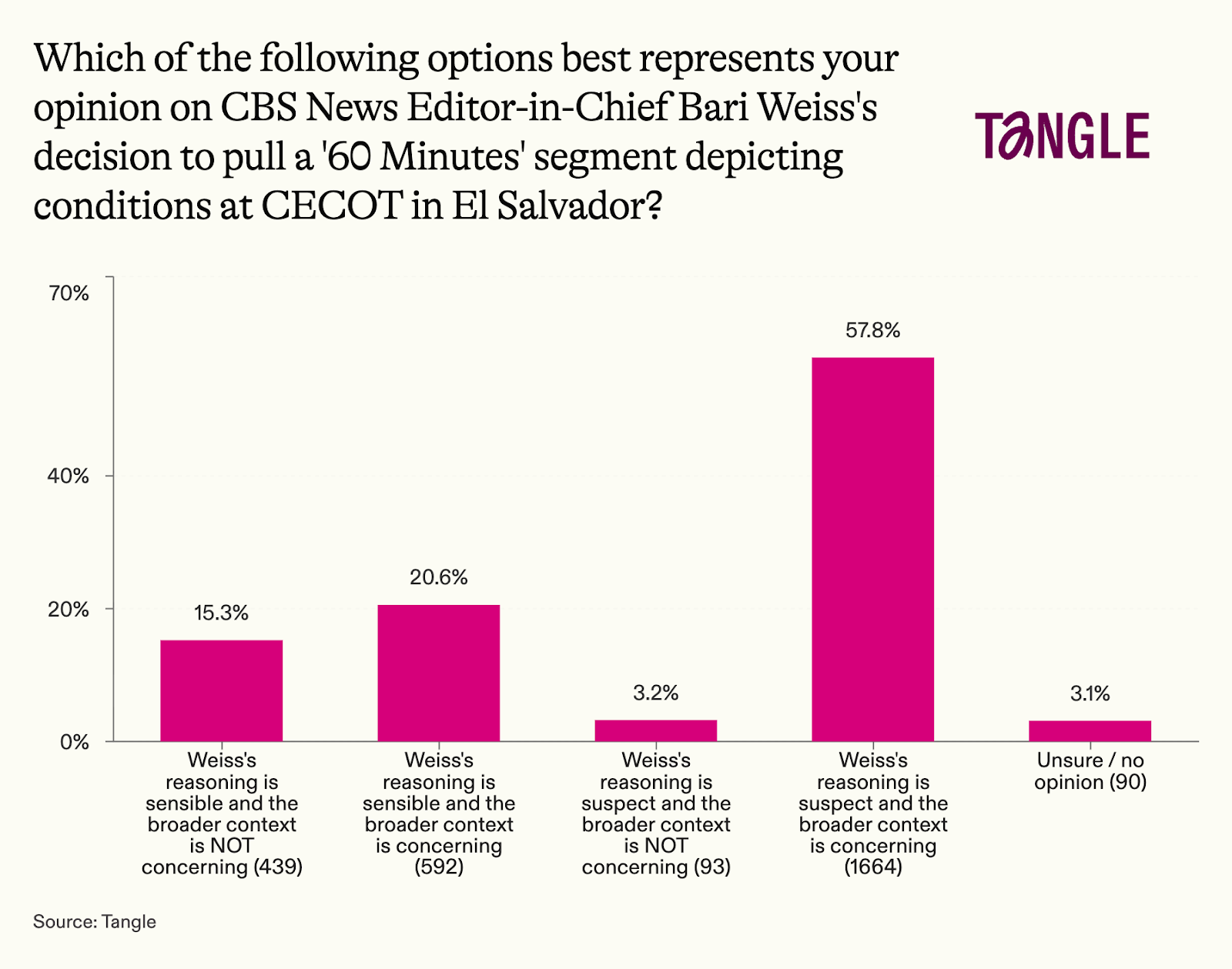
- Yesterday’s survey: 2,878 readers responded to our survey on Bari Weiss’s decision to pull a 60 Minutes piece on CECOT with 58% finding her reasoning suspect and the broader context concerning. “I won’t watch any news program on CBS until Weiss proves her credibility to my satisfaction. Too bad, because I rarely missed viewing 60 Minutes for years,” one respondent said. “While it’s impossible for any editor or journalist to be completely free of bias, I believe Weiss consciously strives for unbiased journalism. This represents a clear improvement over the former leadership at CBS News, and I trust Weiss’s judgment on this one,” said another.
Have a nice day.
Commercial driver’s licenses can cost up to $7,500, money that Maryland resident Carmen DeBerry didn’t have. But DeBerry was able to get her CDL, and a job as a delivery driver, with a scholarship from an unlikely source: metal band Metallica’s All Within My Hands charity. The charity has donated more than $10 million to workforce education, primarily through trade school and community college grants. DeBerry got a chance to meet the band before a concert in Landover, Maryland, where she told them how much the scholarship meant to her. “We get to go make some people smile out there, deliver the goods by playing songs that saved us in our lives,” the band’s lead singer James Hetfield said. “To get a one-on-one heart-to-heart with somebody whose life you’ve changed, it changes mine.” CBS News has the story (and the video).
Member comments