
I'm Isaac Saul, and this is Tangle: an independent, nonpartisan, subscriber-supported politics newsletter that summarizes the best arguments from across the political spectrum on the news of the day — then “my take.”
Are you new here? Get free emails to your inbox daily. Would you rather listen? You can find our podcast here.
Today’s read: 14 minutes.
Why does ChatGPT know THAT about you? Erase it.
A quick search might reveal more than you’d expect: your address, phone number, mortgage details — even your family members. Creepy, right?
The real problem? It’s not just marketers poking around. Identity thieves, scammy data brokers, and shady AI scrapers are all in the mix. Even ChatGPT knows everything about you.
That’s where Incogni comes in. Their Unlimited Plan scrubs your sensitive info from data broker sites so it doesn’t show up in Google searches or AI chat responses.
Fast, affordable, and automatic. No tedious forms. No awkward calls. Just fewer strangers knowing your business.
Use code TANGLE for an exclusive 55% off. Because privacy shouldn’t be optional.
*Our sponsors help keep Tangle free — thank you for supporting them when you feel they could be useful to your life.
19 predictions for the future.
In 2021, Executive Editor Isaac Saul published 19 predictions about the coming years in U.S. politics. Today, all but one have been proven right or wrong. In tomorrow’s Friday edition, Isaac will review his near-final scorecard on those predictions and offer 19 new ones, covering the 2026 midterms, 2028 presidential race, the Supreme Court, foreign conflicts, and more.
Reminder: You’re on our free mailing list, and to unlock the full Friday edition you’ll be asked to subscribe. This is a great week to join Tangle — we’re in the midst of a drive to convert 3,500 new subscribers in a week, and we’re almost a third of the way there. For just $4.91/month, you can become a member now.
Quick hits.
- The Labor Department announced the consumer-price index for November rose 2.7% from the year prior, lower than economists’ expectations of a 3.1% increase. The report was delayed due to the recent government shutdown, and inflation numbers for October were not delineated in the report. (The numbers)
- Dan Bongino, the deputy director of the Federal Bureau of Investigation, announced he will resign from his position in January. (The resignation)
- The House of Representatives voted 216–211 to pass a package of Republican-proposed healthcare provisions, including funds for cost-sharing reductions, pharmacy benefit manager industry reforms, and expanded association health plans. The bill does not include an extension of the enhanced Affordable Care Act subsidies that expire at the end of this year. (The vote)
- Former Special Counsel Jack Smith spoke to lawmakers in a closed-door deposition before the House Judiciary Committee on his investigations into potential criminal conduct by President Donald Trump. Smith reportedly told members that his investigation had “developed proof beyond a reasonable doubt” that Trump criminally conspired to overturn the results of the 2020 election. (The deposition)
- The Senate voted 77–20 to pass the National Defense Authorization Act, the annual defense policy bill that this year authorizes approximately $900 billion in Defense Department spending. The bill includes a 3.8% pay raise for all service members, bars transgender women from participating in women’s athletic programs or activities at military service academies, and withholds part of Defense Secretary Pete Hegseth’s travel budget until the Pentagon shares footage of strikes on alleged drug boats in the Caribbean with lawmakers. (The bill)
Today’s topic.
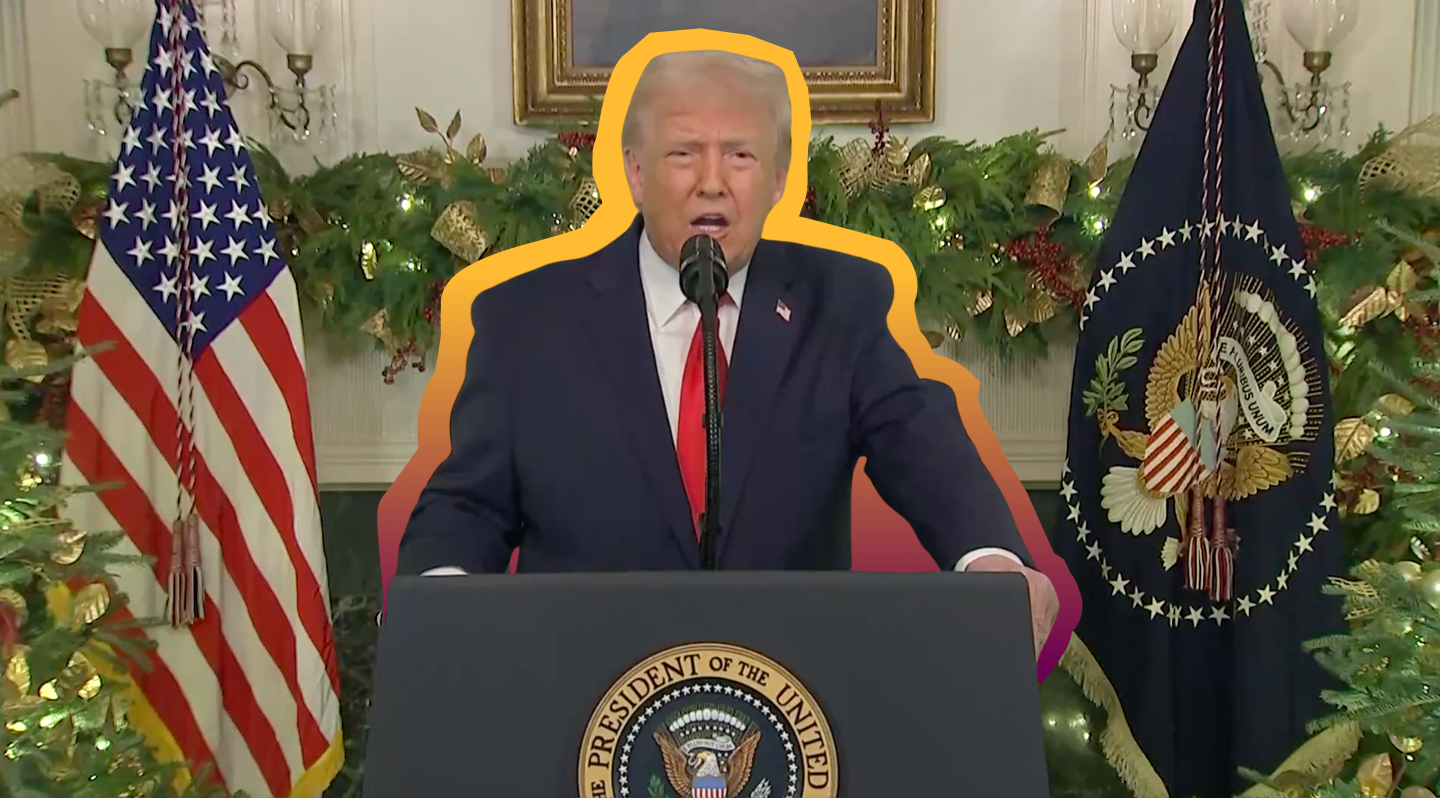
Trump’s national address. At 9 PM ET on Wednesday, President Donald Trump delivered an address from the White House highlighting what he views as the major accomplishments of the first year of his second term and criticizing his predecessor, former President Joe Biden, for the country’s ongoing issues. In the 18-minute address, Trump mainly focused on his immigration and economic agendas, and he announced a $1,776 “warrior dividend” for members of the military. Notably, he did not address the United States’s rising tensions with Venezuela.
The speech came amid persistent voter concerns about the price of everyday goods. While inflation is significantly lower than its peak in the second year of the Biden administration, it remains higher than the Federal Reserve’s target rate of 2%.
President Trump began the address outlining what he saw as the failures of the Biden administration, blaming his predecessor for high levels of inflation, immigration, and crime. Trump then dedicated the majority of the address to his administration’s actions on these issues, claiming that he had largely resolved them and followed through on his campaign promises.
“The last administration and their allies in Congress looted our Treasury for trillions of dollars, driving up prices and everything at levels never seen before,” Trump said. “I am bringing those high prices down and bringing them down very fast.”
The president also announced $1,776 payments for approximately 1.45 million military service members, which he called a “warrior dividend.” A White House spokesperson described the dividend as a one-time housing supplement for eligible service members that the Defense Department allotted $2.6 billion to fund, appropriated by the One Big Beautiful Bill passed earlier this year. “Nobody deserves it more than our military. And I say congratulations to everybody,” Trump said.
Other than this payment, Trump did not make any concrete announcements. However, he did discuss two upcoming changes: TrumpRx, a government website offering prescription drugs at lower prices, and a new pick for the next Federal Reserve chair to be announced “soon.”
Many Republicans praised the speech, particularly the payments to military servicemembers. Sen. Katie Britt (R-AL) posted on X, “Securing our border, protecting women’s sports and bringing costs down for working families is just the start. The best is yet to come!”
Democrats uniformly criticized the address, pushing back on Trump’s claim that he has brought down consumer prices. “President Trump’s speech just showed he lives in a bubble completely disconnected from the reality everyday Americans are seeing and feeling,” Senate Minority Leader Chuck Schumer (D-NY) said. “People are feeling squeezed harder and harder every day and tonight Donald Trump took a victory lap.”
Today, we’ll get into what the right and left are saying about Trump’s speech. Then, Executive Editor Isaac Saul gives his take.
What the right is saying.
- Many on the right say Trump rightly touted his major first-year accomplishments.
- Some criticize the tone of the speech.
- Others express relief that the address was benign.
In PJ Media, David Manney wrote “panic is what the left wants to see.”
“Democrats responded to President Donald Trump’s year-end address by insisting he sounded panicky, defensive, and even scared. That claim spread quickly across the left, only to collapse under basic listening. President Trump spoke like a president reviewing progress, not a man searching for cover,” Manney said. “Trump’s address carried a tone of control; he moved methodically through accomplishments from the first 11 months of his presidency. Border enforcement tightened, inflation cooled, and domestic energy production rebounded. Foreign adversaries recalculated.
“Some on the left labeled the speech desperate; others, fearful. Those descriptions revealed more about wishful thinking than reality. Leaders under stress tend to overtalk. Trump summarized, closed decisively, and moved on. Projection fills gaps when momentum fades. Calm leadership unsettles opponents who rely on chaos narratives. When Trump avoids drama, critics need to invent it,” Manney wrote. “Results speak louder than tone parsing. Jobs, prices, borders, and global posture matter. Voters weigh those realities, not just for performative concern over delivery style.”
In The Washington Examiner, Peter Laffin said the address “utterly lacked human touch.”
“The bizarre and disorienting White House speech, delivered by a growling, red-faced Trump, failed to make news that some had anticipated on economic policy or Venezuela. Instead, Trump recycled a familiar litany of grievances and boasts,” Laffin wrote. “Without a raucous crowd to hiss at the mention of his adversaries or cheer at his accomplishments, Trump zipped through his remarks unnaturally. Was America being lectured? Being given a pep talk? A dressing down?”
“Worst of all for Republicans, bracing themselves for a tough midterm election in 2026, Trump forgot to offer even a hint of empathy for people struggling to make ends meet. The speech utterly lacked a human touch, which Trump normally achieves by taking the pulse of a room and making spontaneous comments that rev emotions,” Laffin said. “Alone in a room brightly decorated for Christmas, his zingers lacked oxygen. Much of Trump’s power stems from the perception of being hailed and revered by the masses. His handlers should never let him give another speech in a room by himself. It’s the smallest he’s ever looked.”
In Reason, Elizabeth Nolan Brown called the speech “blessedly pointless.”
“Was this going to be an evening for routine presidential puffery, or for offering to cut tariff ‘rebate checks’ to all Americans? Or, perhaps, for announcing an attack on Venezuela? Rumors about both of the latter had been swirling. Thankfully, they were wrong,” Brown wrote. “When Trump suddenly announced this week that he would be addressing the nation live from the White House on Wednesday evening, it understandably spurred a little trepidation. But the only thing we had to fear was an insanely inflated annual performance review.”
Trump “[sang] the praises of his tariffs, pledging to send all soldiers $1,776 ‘warrior dividends’... That was the most concrete plan offered, despite the fact that the White House had been pitching this speech as an opportunity for Trump to tease upcoming policies. We got some vague nods to housing policy plans and lowering health care costs. But again and again, the speech just came back to Trump bashing the Biden administration and singing his own praises,” Brown said. “And thank goodness. It was a perfectly pointless speech, and that’s the best we could have hoped for.”
What the left is saying.
- The left roundly criticizes the speech, suggesting Trump came off as desperate.
- Some note the president’s false claims about the state of the economy.
- Others say Trump’s attempts to blame others fell flat.
In Vox, Zack Beauchamp explored “the revealing pointlessness of Trump’s primetime speech.”
“President Donald Trump’s speech on Wednesday night had no grave significance. In fact, there didn’t seem to be much of a point at all,” Beauchamp wrote. “The speech was a jumble of his usual false or even impossible claims — like a promise to reduce prescription drug costs by an impossible 400 percent — smashed together in no particular order. The speech began with a discussion of the cost of living, a subject he would drop and then return to as if just remembering that it was the number one reason his polls were low.”
“The White House is staring down abysmal poll numbers, a series of schisms inside the GOP and among the conservative elite, and looming midterm elections where Democrats appear poised to make massive gains. So what can they do? Try other stuff and see if something, anything, might work to turn the ship around. Like, say, a televised address where the president just talks — yells, really — at the country for 20 minutes,” Beauchamp said. “The fact that they needed to try such a desperate move at all is notable. It is the latest sign, among many, that the wheels are coming off the Trump train.”
In CNN, Stephen Collinson wrote “Trump’s dark Christmas story doubles down on a political error.”
“Presidents often ask television networks for airtime for a prime-time address at epochal moments — when they are about to take the nation to war, or after tragedies,” Collinson said. “In 2003, President George W. Bush came before the nation to announce that ‘at this hour, American and coalition forces are in the early stages of military operations to disarm Iraq.’ In January 1986, President Ronald Reagan mourned seven astronauts lost in the Space Shuttle Challenger disaster in sublime language, saying they’d ‘slipped the surly bonds of Earth to touch the face of God.’ Trump’s Yuletide message lacked such poetry. Instead, he shouted out a seasonal dose of his most dystopian rhetoric.”
“He rattled off a list of statistics, claiming that prices were falling fast, that wage growth was spiking upwards and that millions of Americans were far better off than they were when he took office. Much of this data was exaggerated or wrong. The president also ignored that the year-over-year inflation rate is exactly the same as when he took office,” Collinson wrote. “Grocery prices aren’t down across the board. Millions of Americans are getting huge price hikes for health insurance because his administration has failed to find a solution for expiring enhanced Obamacare premiums. And the unemployment rate just hit a four-year high, with sluggish wage growth further souring the public’s mood.”
In The Guardian, David Smith suggested Trump “is feeling the chill of opinion polls.”
“Surrounded by Christmas trees and garlands before a fireplace, Donald Trump on Wednesday gave a convincing rendition of Ebenezer Scrooge, the elderly miser who despises Christmas and blames everyone but himself,” Smith said. “The president has repeatedly referred to ‘affordability’ as a Democratic hoax. On Wednesday he conceded that prices remain high while arguing that the nation was ‘poised’ for an economic boom… By way of example, he claimed a sharp drop in gasoline prices, even though a White House graphic displayed by Fox News as he spoke showed only a slight decline in the national average.”
“The speech also revealed Trump’s need for a reliable foil. Over the years Barack Obama, Hillary Clinton, Joe Biden and Kamala Harris have been useful antagonists for a man and movement defined less by what they are for than what they are against,” Smith said. “Good luck with that. In truth, Biden has been gone 11 months and people don’t think much about him any more. Trump needs a new punching bag but Democrats do not have an obvious leader for him to target.”
My take.
Reminder: “My take” is a section where we give ourselves space to share a personal opinion. If you have feedback, criticism or compliments, don't unsubscribe. Write in by replying to this email, or leave a comment.
- Trump’s speech recycled talking points from his rallies and offered almost nothing new.
- His energy was flat, and the warrior dividend doesn’t strike me as a good idea.
- I am glad that we aren’t escalating with Venezuela, at least for now.
Executive Editor Isaac Saul: When the Tangle team met Wednesday to discuss today’s edition, we weighed topics like the Venezuelan oil tanker blockade, the House vote on Obamacare subsidies, and the latest jobs numbers. However, I said we should cover Trump’s address. My calculation was simple: Either Trump would use the rarely tapped bully pulpit of a national address to make a major announcement, or he would go on total defense. Both choices would make for headline news.
Ahead of the speech, speculation increased that the president would announce a major offensive in Venezuela. The blockade of Venezuela’s oil tankers was headline news, and Tucker Carlson said a declaration of war was coming. I didn’t think that was very likely to happen on Wednesday night, but I also felt like something had to be up. This was Trump’s second national address of his second term. Surely, he’d use it for something big. Russell Nystrom, our social media manager, was on the other side: “It’s a nothing burger,” he said. “I think it’s just going to be a year in review speech.”
It turned out Russell was right.
From the very beginning, Trump’s national address seemed off.
“Good evening, American,” he said, stumbling on the opening line (unless he was just talking to me, which I would have appreciated). The rest of the address was little more than a stitched-together version of his typical stump speeches injected with some fresh “data,” new claims about his administration’s accomplishments, and one significant announcement. He spoke a lot about the failures of the Biden administration, the border crisis, and the worst inflation in 50 years. He hit all his campaign notes: He said he stopped “transgender for everyone” and the tide of migrants from “insane asylums,” and he asserted the United States is now the “hottest” country on earth, according to every single world leader he speaks to.
What to do with a speech like this? My instinct, as a reporter, is to fact-check it, which we should spend at least a few minutes doing: Trump claimed inflation has dropped significantly on his watch, which is false. Inflation was at 3% at the time of his speech, the same as when Biden left office (though the official benchmark fell to 2.7% this morning). He claimed gasoline is under $2.50 per gallon, which is only true if you are cherry-picking prices well outside the normal range. The Department of Energy, which provides the standard metric for gas prices, reports the average price of a gallon is $2.90 — in line with AAA’s national average. The president also claimed drug prices have been cut by “400, 500, and even 600 percent.” I’ve never been a great math student, but unless we’re now getting paid for our prescription drugs, that’s simply not possible.
On top of all this, unemployment is now at 4.6% — the highest rate since September of 2021. It isn’t hard to understand why Trump is grasping, exaggerating, and lying: Before his address began, CBS News’s most recent polling shows that 63% of Americans described the economy as “bad.” Trump, now infamously, has given himself a grade on the economy of “A-plus-plus-plus-plus-plus” (five plusses, for those counting at home). Voters disagree; Trump’s handling of the economy has never polled lower than it does right now.
This left a lot of people — including me — very confused about what, exactly, we were watching. “That was perhaps the most pointless primetime presidential address ever delivered in American history,” The Daily Wire’s Matt Walsh, a bona fide Trumper, said on X. Jon Favreau, the former Obama aide, said, “I’d be in favor of the networks giving Trump a primetime slot to speak like this at least once a week.”
I have a theory of my own about last night, but it’s not particularly creative: Trump feels the urge to drive the narrative again. From my vantage point, he looked like someone who didn’t want to be doing what he was doing. The speech was loud and rushed, without the usual playfulness or “weaves” that he has become known for. He seemed frustrated that he needed to make a speech at all, that not everyone was hearing each and every word and buying it wholesale.
Consider what he wants to divert attention away from. Republicans are coming off a very bleak series of elections that do not bode well for the 2026 midterms. Two National Guard troops and an interpreter were just killed in Syria. Trump’s rather deranged post mocking the death of filmmaker and actor Rob Reiner, who was violently murdered in his own home, was widely panned, even by characters like Nick Fuentes. His premier economic policy, tariffs, might be on the ropes at the Supreme Court. The Epstein files saga is ongoing. Infighting among the right seems to be everywhere: Trump vs. Marjorie Taylor Greene, Candace Owens vs. TPUSA and Erika Kirk, Ben Shapiro vs. Tucker Carlson. Vanity Fair just published an article compiling 11 on-the-record interviews with Trump’s chief of staff deriding the administration’s handling of USAID, tariffs, and deportations. Now his administration appears to be laying the rhetorical groundwork to defend a war with Venezuela over oil, an unthinkable proposition for the people who voted for Trump in large part as a rebuke of our forever wars in the Middle East and other foreign entanglements.
To the degree that Trump’s speech last night delivered actual news, it was this: a “warrior dividend” of $1,776 (in honor of the nation’s founding year) to 1,450,000 military service members. Back-of-the-napkin math puts the cost of such a proposal at nearly $2.6 billion. I had a lot of immediate questions, like: Why are we spending the tariff revenue that is supposed to address our exploding deficit? Did Congress approve this? And how are the 340 million other Americans going to react to being left out? I got some answers. Congress appropriated $2.9 billion for the Defense Department that could be used to supplement a housing entitlement, which the Defense Department is now going to disburse as a one-time basic allowance for eligible service members, according to an administration official.
Still, handing out billions is an odd choice for the president at a time when the country is spending more money than it’s taking in and so many Americans could also use help.
On healthcare, Trump made a similar, albeit more vague, announcement: Direct cash to Americans so they can buy their own health insurance. There is little detail about how large these checks would be, and more than anything the president’s healthcare “plan” was a reminder that there still isn’t one. Years after promising a replacement for Obamacare, Trump still has zero details; just vague promises that Americans will get cash to buy insurance.
Watching the speech, and realizing how much of it I could recite from Trump’s rally playbook, a thought occurred to me: Does this still work? Trump, for a long time, thrived on novelty. We hadn’t ever really seen a politician like him. But the lines feel tired and rehearsed now, and the people are hungry for results. If last night’s speech was supposed to be a reset going into the new year, I don’t think it’s going to move the needle. If it was designed to make Americans worried about affordability feel better, I think it was a near disaster, full of denials about people’s experiences and forceful insistence that the administration is doing what it promised. It’s the same mistake President Biden made, except now people have had another year of living in the conditions they’d prefer not to be in.
As the address came to a close, I felt mostly relieved that Trump hadn’t announced an escalation with Venezuela — and wondered why the speech had happened at all.
Take the survey: What did you think of Trump’s speech? Let us know.
Disagree? That's okay. Our opinion is just one of many. Write in and let us know why, and we'll consider publishing your feedback.
About those boat strikes.
The U.S. military activity in the Caribbean has everyone asking the same question: Are we about to go to war with Venezuela? In our latest YouTube video, we give an in-depth breakdown of the naval force deployed to the Caribbean, the Trump administration’s potential justifications for war, and whether that rationale passes the sniff test. You can check it out here!
Your questions, answered.
Q: I expect we’ll have a lot of ‘freshmen’ in the House and Senate after the midterms. What is the onboarding process for those new members? Is there any effort to mingle them so bipartisan relationships can form? If not, is there any way to influence it so we can get more folks working together?
— Kathy from Wilmington, DE
Tangle: Formally, freshmen in Congress are welcomed under a process called New Member Orientation. This process includes sessions run by nonpartisan congressional staff (like the House chief administrative officer) and party leadership, and it covers practical topics like ethics and security briefings, parliamentary procedure, assistance with hiring their staff, regulatory compliance in running their offices, and even the actual (random) assignment of offices itself.
This process can change depending on the party leadership in Congress, and it doesn’t feature any emphasis on fostering bipartisan communication — but they do go through the process together, so mingling across the aisle can happen organically. While new members are getting oriented, they participate in routine ceremonies to begin the new Congress that start with their swearing in and continue to the election of the chamber’s leadership and adoption of official policies.
As we don’t have a ton of information about how the parties orient new members themselves, it would be difficult to influence this process from the outside. However, we do know there’s a lot more to learn than what the standard process teaches. For instance, a new member of Congress needs to learn the ropes of what may be the most immediate post-election priority: fundraising.
Want to have a question answered in the newsletter? You can reply to this email (it goes straight to our inbox) or fill out this form.
Under the radar.
On Tuesday, representatives from western states met at the Colorado River Water Users Association’s conference in Las Vegas, Nevada, to discuss proposals for a new management plan for the Colorado River. The river serves as a critical water supply for seven states, and a federally imposed deadline for these states to submit an initial agreement recently passed (the current operating guidelines will expire at the end of 2026). California, which receives the largest allocation of Colorado River water, presented its own framework, suggesting releases from the Lake Powell reservoir between Utah and Arizona in return for “equitable and sufficient water contributions” from other states. Negotiations are ongoing, but California’s buy-in will be critical to reaching a comprehensive agreement. “California has the biggest stake on the Colorado River,” Colorado River Board of California Chairman JB Hamby said. “We have the greatest agricultural production in the basin, with the greatest population in the basin, serving half of those who depend on Colorado River water.” The Nevada Current has the story.
Data Brokers Are Selling Your Info. Stop Them.
Search your name online. You'll find your address, phone number, even mortgage details — all available to identity thieves, scammers, and AI scrapers like ChatGPT.
Incogni's Unlimited Plan automatically removes your sensitive data from broker sites so it stops showing up in searches and AI responses. Fast, affordable, zero hassle.
Use code TANGLE for 55% off.
Numbers.
- 14. The number of times President Trump referenced “prices” in Wednesday’s address.
- 5. The number of times President Trump referenced “inflation.”
- 1. The number of times President Trump referenced “affordability.”
- 7. The number of times President Trump referenced former President Joe Biden.
- 4. The number of national addresses or statements President Trump has delivered since his second inauguration.
- 1.28 million. The approximate number of active military members who will receive a $1,776 dividend from the Trump administration.
- 174,000. The approximate number of reserve military members who will receive the dividend.
- 36% and 57%. The percentage of U.S. adults who approve and disapprove, respectively, of President Trump’s handling of the economy.
- 37% and 33%. The percentage of U.S. adults who say the Democratic Party and the Republican Party, respectively, is the party to better handle the economy.
The extras.
- One year ago today we wrote about Trump’s settlement with ABC News.
- The most clicked link in yesterday’s newsletter was the Susie Wiles interview for Vanity Fair.
- Nothing to do with politics: How ancient curses are helping to build a Celtic dictionary.
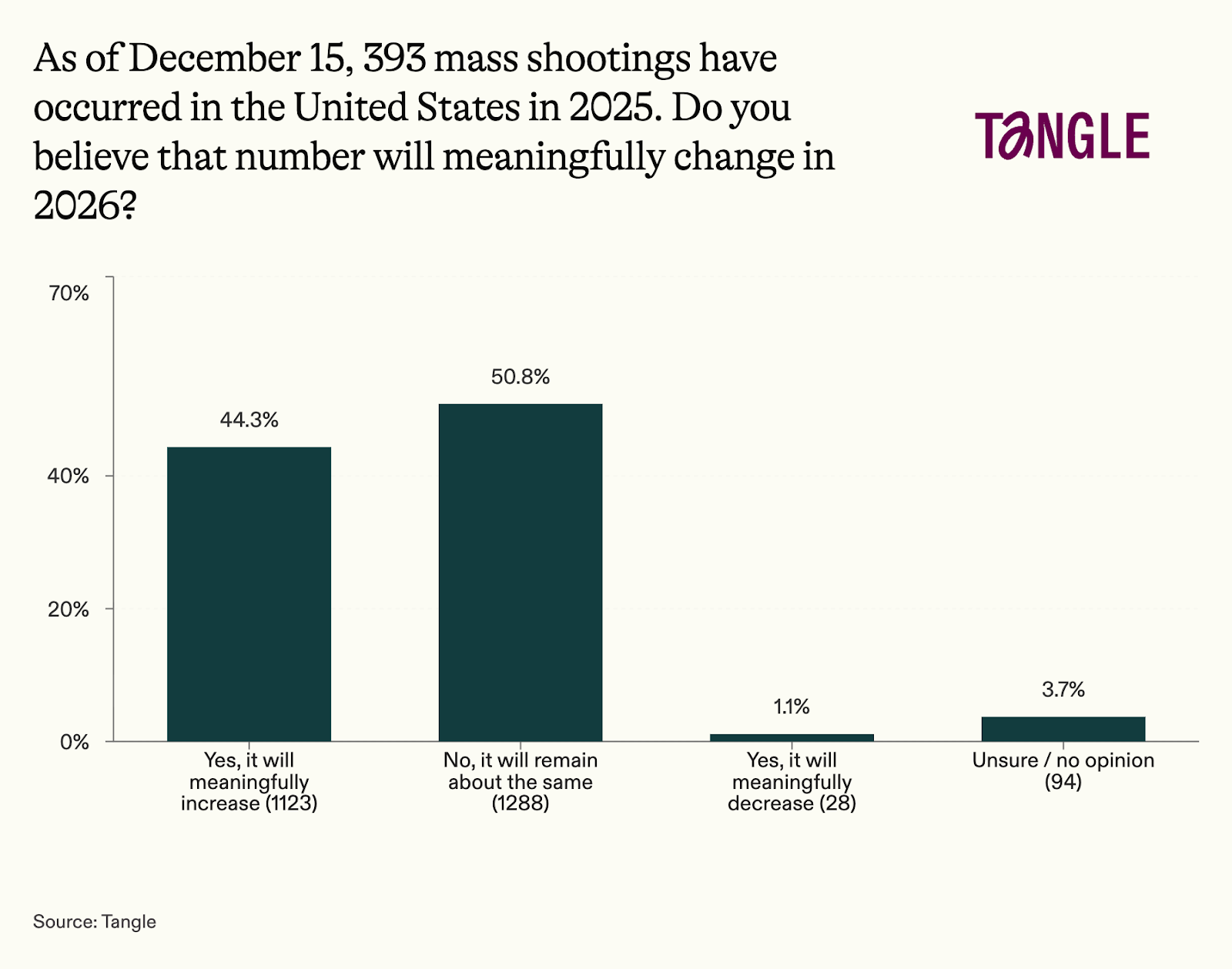
- Yesterday’s survey: 2,533 readers responded to our survey on mass shootings with 51% saying they think the total number will remain about the same in 2026. “Unarmed citizens are sitting ducks for bad actors. See Australia and Brown,” one respondent said. “If evil didn’t have access to guns the numbers would decrease,” said another.
Have a nice day.
Lyme disease affects roughly 500,000 Americans annually, and it can cause longterm health effects like arthritis, nerve damage and heart problems, among others. At the recent International Genetically Engineered Machine (iGEM) competition in Paris, France, a group of students from Lambert High School in Suwanee, Georgia, presented a novel approach to detecting the disease earlier than any current method. The student team developed a test that uses the gene-editing technology CRISPR to isolate a protein generated by the Lyme infection, allowing for easier detection. The students hope that this approach can eventually be used in an at-home test kit to help detect Lyme in the first two weeks of infection, when treatment is most effective. Their work earned them second place at this year’s iGEM competition. CBS News has the story.

Member comments