
I'm Isaac Saul, and this is Tangle: an independent, nonpartisan, subscriber-supported politics newsletter that summarizes the best arguments from across the political spectrum on the news of the day — then “my take.”
Are you new here? Get free emails to your inbox daily. Would you rather listen? You can find our podcast here.
Today’s read: 15 minutes.
Unknown Number Calling? It’s Not Random
The BBC caught scam call center workers on hidden cameras as they laughed at the people they were tricking.
One worker bragged about making $250k from victims.
The disturbing truth?
Scammers don’t pick phone numbers at random. They buy your data from brokers. Once your data is out there, it’s not just calls. It’s phishing, impersonation, and identity theft.
That’s why we recommend Incogni: They delete your info from the web, monitor and follow up automatically, and continue to erase data as new risks appear.
Try Incogni here and get 55% off your subscription with code TANGLE.
Our annual survey.
Over the holiday break, we sent out an end-of-year survey to learn more about the Tangle community and offer you a chance to give us feedback as we chart a course for 2026 and beyond. The survey takes about five minutes to complete and asks questions about Tangle’s content, format, coverage choices, and more (as well as a few questions about you). If you’ve already taken it, thank you! Please do not take it more than once. If not, please consider doing so this week.
For those who fill it out and leave their email, we’re offering a chance to win a $500 gift card and free Tangle merchandise. The survey closes on Monday, so make sure to take it soon if you want to be entered into the drawing.
Quick hits.
- Venezuelan leader Nicolás Maduro pleaded not guilty to narcoterrorism, gun, and drug charges at his first court appearance in New York City. Maduro said he was unlawfully kidnapped by the United States and that he was still the leader of Venezuela. (The appearance) Separately, many members of the United Nations Security Council criticized the U.S. for its operation to capture Maduro, suggesting the operation violated international law. (The meeting)
- The Centers for Disease Control and Prevention announced changes to its vaccine recommendations for children, advising that children receive vaccines for 11 diseases instead of the previously recommended 17. (The change)
- Defense Secretary Pete Hegseth said he will seek to demote Sen. Mark Kelly’s (D-AZ) military rank over Kelly’s participation in a video telling U.S. service that they can refuse illegal orders. Kelly said he will fight the attempt at demotion. (The move)
- Secret Service agents detained a man who allegedly damaged property at Vice President JD Vance’s home in Ohio while Vance and his family were away. The man is charged with vandalism, obstruction of official business, criminal damaging or endangering, and criminal trespass. (The arrest)
- The Corporation for Public Broadcasting’s board of directors voted to dissolve the corporation, which provided funding to NPR, PBS and local radio and TV stations, following Congress’s vote to cut its federal funding in July. (The shutdown)
- BREAKING: Rep. Doug LaMalfa (R-CA) passed away at age 65. LaMalfa had represented California’s 1st Congressional District since 2013. (The passing)
Today’s topic.
The latest on the Minnesota fraud investigations. On Monday, Minnesota Gov. Tim Walz (D) announced he is ending his reelection campaign for a third term. In his announcement, Walz cited the state’s ongoing fraud scandals as the basis for his decision, saying, “Every minute I spend defending my own political interests would be a minute I can’t spend defending the people of Minnesota against the criminals who prey on our generosity and the cynics who prey on our differences.” The governor and 2024 Democratic vice presidential candidate has come under increasing scrutiny for his handling of the fraud schemes, which were concentrated in the state’s Somali-American community and have drawn national attention in recent weeks.
Back up: The Minnesota fraud investigations began during the Biden administration, and Attorney General Merrick Garland’s Justice Department brought the first charges in September 2022. The investigations centered on stolen federal funds for a child-nutrition program, an autism services program, and an affordable housing service, for which over 70 defendants have been charged (several have already pleaded guilty). In November 2025, the conservative magazine City Journal published a report on the fraud, claiming the stolen funds were partially directed to the Somali-based terrorist group Al-Shabaab.
We covered the fraud cases here.
In late December, conservative YouTuber Nick Shirley released a video — amplified by Elon Musk and Vice President JD Vance — that purported to show a series of publicly funded Minnesota daycares operated by members of the Somali community without any children present at the time he showed up. Shirley claimed that the centers shown in the video had defrauded the government of over $110 million, but several allegations have since been questioned: One day care said that Shirley visited outside of its operating hours, while another appeared to be operational, contrary to Shirley’s claim that it was empty.
Separately, a federal prosecutor suggested in December that half or more of the $18 billion in federal funds that supported 14 Minnesota-run programs since 2018 may have been stolen. The video renewed national interest in the fraud schemes and state officials’ handling of the cases.
In particular, the Trump administration has sharply criticized Walz and launched federal investigations into the fraud, as well as immigration actions against the Somali community. In a post on Truth Social, President Trump wrote, “Much of the Minnesota Fraud, up to 90%, is caused by people that came into our Country, illegally, from Somalia. ‘Congresswoman’ Omar, an ungrateful loser who only complains and never contributes, is one of the many scammers.”
On Tuesday, the Trump administration said it will freeze $10 billion in funding for child care and other programs in five states controlled by Democrats, including Minnesota. Separately, Homeland Security Secretary Kristi Noem said that agency officials were conducting a fraud investigation in Minneapolis, and the agency reportedly plans to deploy up to 2,000 agents to the area as part of an immigration crackdown.
On December 19, Gov. Walz told reporters that he was “accountable” for the fraud and pledged to “fix it.” That week, state prosecutors announced new investigations into 14 state programs designed to disburse Medicaid funds and new charges against alleged perpetrators. However, state officials also pushed back on claims about the scale of the fraud, with Minnesota Department of Human Services Deputy Director John Connolly saying, “We don’t have evidence in hand to suggest that we have $9 billion in fraud in these benefits over the last seven years.”
Today, we’ll share perspectives on the fraud cases from the left and right, followed by Managing Editor Ari Weitzman’s take.
What the left is saying.
- The left acknowledges the significance of the fraud schemes but argues Republicans are using the story for ulterior motives.
- Some push back on the latest claims about the scale of the fraud.
- Others say that demonization of Somalis is wrong, but the community must also take ownership of real issues.
In MS NOW, Paul Waldman wrote “Minnesota child care fraud is MAGA’s new obsession.”
“Why was Trump suddenly interested in allegations of fraud that have been under investigation for years by federal and state authorities and, for the record, have nothing to do with Rep. [Ilhan] Omar?” Waldman asked. “If you think it’s because some Somali Americans have been involved and Trump wants to foment racist and anti-immigrant hatred, then you’re absolutely right. That’s not subtext, it’s text. Trump couldn’t be more clear on that score. He has referred to Somali immigrants as ‘garbage.’ But it’s also a vivid illustration of how the right-wing propaganda machine works. It doesn’t matter whether a story is new, or whether the allegations made are true.”
“Minnesota is just one state where that kind of fraud seemed to accelerate after 2020. Since 2022, the federal government and Minnesota’s state government have undertaken sweeping investigations of fraud in nutrition and child care programs, resulting in dozens of criminal convictions,” Waldman wrote. “Many of the people convicted have been Somali American. But the most significant of those convictions is probably that of Aimee Bock, a white woman who was the ringleader of a scheme that defrauded $250 million from nutrition programs. Does Bock’s case prove white women are inherently inclined toward criminality and should be removed from the country so we can finally be safe from the danger they pose?”
In her newsletter Weaponized, Caroline Orr Bueno said “Nick Shirley’s Somali daycare fraud video is bullsh*t.”
“Shirley‘s video has now been pretty thoroughly taken apart by numerous news organizations, and many of his core claims have been debunked or at least called into serious doubt. In one case, Shirley arrived when the facility was closed. In another instance, security footage from the daycare center shows children being dropped off on the same day Shirley was there claiming that no children were anywhere to be seen. In two other cases, Shirley showed up to non-operational child care facilities,” Bueno wrote. “While there have been proven and prosecuted cases of fraud in publicly-funded programs in Minnesota, Shirley’s video doesn’t prove that it’s happening at the daycares he went to.”
“Shirley’s video also featured one of the defining characteristics of orchestrated disinformation, which is the use of selective editing rather than fabrication. The video includes footage taken at real daycare centers,” Bueno said. “The deception emerges from what is left out: things like comparative data, explanations of editorial choices, and context about how common (or uncommon) fraud actually is across childcare providers of all backgrounds. He also failed to mention things like what time he visited the facilities and what the operating hours are.”
In The Minnesota Star Tribune, Badeh Dualeh explored “what Somalis must do in the face of suspicion and insults.”
“[Trump’s] simplistic stereotyping was uncalled for, and it is not right to call any human being garbage. But it is true that the Somalis involved in large-scale fraud should face the consequences of their poor choices… And it is true that we Somalis need to ask ourselves what role we may have played in becoming the target of such hostile criticism,” Dualeh wrote. “Just like everyone else, Somalis need to take responsibility for their behavior. It’s time to stop blaming others for our wrong choices. Blaming is self-sabotage; it keeps us stuck in our problems and prevents us from taking steps toward solutions.”
“Many Somalis lived through decades of state collapse, with corrupt and violent conditions. We saw how rules were enforced unfairly and were used to harm rather than protect people. This experience with broken systems and injustice created rule skepticism,” Dualeh said. “When we face barriers to adjustment such as poverty, social exclusion or discrimination, we must take the high road. Many of us have. Research consistently shows that most immigrants are law-abiding and often commit less crime than native-born citizens. Yet a minority of Somalis who have failed to integrate have chosen to engage in fraud or corruption. They have given us all a bad name.”
What the right is saying.
- The right welcomes Walz’s announcement, saying he failed as a leader due to subservience to identity politics.
- Some suggest the fraud cases underscore the risks of unchecked immigration.
- Others say vast welfare systems are to blame, not immigrants.
In Fox News, David Marcus wrote “Tim Walz’s White guilt finally ends his career.”
“Gov. Tim Walz will not seek a third term leading the Gopher State. In the end, the massive scale of Somali fraud that went unchecked under his nose was just too much to recover from. Bad news on the Somali front snowballed fast for Walz, with reports that as much as $9 billion — with a ‘b’ — was pilfered by members of the migrant community, while the governor appeared to do little but protect the thieves,” Marcus said. “Walz might have survived this embroglio had he taken it more seriously as the scandal broke, but the intrepid work of independent journalist Nick Shirley, whose shocking videos of empty daycare centers receiving millions from taxpayers, were likely the final straw.”
“Ultimately, Walz decided to blow up his political career rather than be accused of racism by accurately addressing the broad, systemic fraud rampant in Minnesota’s Somali community… Watching Walz struggle to wish away one of the biggest fraud scandals in American history was more awkward than watching him try to load a shotgun. In both cases, he seemed to be trying to sell something to voters that even he didn’t really believe,” Marcus wrote. “This is also a tragic day for the members of the liberal media who spent weeks defending Walz’s shambolic handling of the Somali scandal, telling us it was no big deal and that it happens everywhere.”
In his newsletter, Erick-Woods Erickson explored what Nick Shirley uncovered.
“[Shirley] showed up at Somali child care centers in Minnesota and discovered, despite those entities getting millions in federal dollars, they actually had no children present. Even if some of the claims Shirley made were not quite as he claimed, which some say, he still exposed a rampant system of corruption, waste, fraud, and abuse,” Erickson said. “What is most notable is how progressives are simply screaming racism because they do not want to acknowledge a conservative argument is true. In fact, so much of what is happening with immigration is progressives simply willing the stories not to be true so they do not have to confront their own policy failures.”
“I am encouraged, in this case, the Department of Justice and FBI are rounding people up for the fraud in Minnesota. But we need more and more indictments. We need deportations. We need massive exposure in such a way that the Democrats cannot hide from it. We need a public campaign in Congress to change the laws, if necessary, and highlight Democrat opposition to those legal changes if they oppose them,” Erickson wrote. “Frankly, we need Donald Trump to hop Air Force One over to Minnesota and do a press conference so the national news networks cannot ignore the story.”
The Wall Street Journal editorial board said “Minnesota’s fraud problem isn’t immigrants.”
“While Gov. Tim Walz and Somali migrants may be easy political targets, the GOP will let this scandal go to waste if it fails to explain how vast government welfare payments have become an invitation for fraud and abuse,” the board wrote. “Minnesota’s varieties of government fraud are prompting welcome scrutiny of its welfare system. Visitors to the state government website could mistake it for an internet scam because it advertises so many handouts—cash, housing support, child care, food, emergency assistance and more. These are on top of federal transfer payments.”
“With so much money and so many programs, this vast system is an open vault for scammers — especially when politicians are loath to police fraud because doing so might be called ‘racist’ or ‘anti-poor.’ But it’s also corrupting for beneficiaries who have an incentive to remain on the dole rather than build an independent life,” the board said. “Republicans complain about fraud, but too few want to tackle the perverse incentives that allow it to flourish. Annual government transfer payments have increased by some $1.7 trillion to $4.9 trillion since the start of the pandemic, roughly double the rate of inflation. Minnesota’s problem isn’t immigrants. It’s the welfare state that corrupts them.”
My take.
Reminder: “My take” is a section where we give ourselves space to share a personal opinion. If you have feedback, criticism or compliments, don't unsubscribe. Write in by replying to this email, or leave a comment.
- We’re all just playing “Trump’s Big Game,” which inevitably distracts us from addressing the root problem.
- We should try dissecting this issue without talking about Trump and focus on the facts.
- Large government programs need oversight, and political leaders can’t ignore issues because they may aid their opposition.
Managing Editor Ari Weitzman: One of the most consistent aspects of President Trump’s governing style is how his solution to a problem completely devours giving any attention to the root problem itself.
It’s Trump’s Big Game. It invigorates his supporters, it frustrates his opponents, and it confuses everyone else in between.
It starts with a real issue that has been publicly reported on but doesn’t gain purchase across the political spectrum (the way something like the Epstein files grabbed public attention). Then, a right-leaning outlet makes the issue a cause célèbre, adding in a healthy, editorialized dash of urgency. That story makes its way to President Trump, who takes the most divisive aspects of the narrative and dials them up to 11. Democrats get caught in a trap, decrying Trump’s response without acknowledging the problem, allowing Republicans to hammer them for not caring about the root issue. But is Trump’s solution addressing the root issue? Soon, that question becomes the main discussion; Trump’s solution trumps the problem, and now the thing we’re all talking about — again, seemingly unendingly — is Trump.
Trump always wins Trump’s Big Game — he dominates the news cycle and owns the narrative regardless of whether he’s solving the problem at the center of the media firestorm.
This pattern fits the Christmas Day strikes in Nigeria. It fits the administration’s capture of Maduro. It fits the National Guard deployments and DOGE and the war on universities and can even be drawn back to the singular issue that boosted him to the top of the Republican Primaries in 2015: the border wall.
You’re reading Tangle, so I’m preaching to the choir here, but I’m tired of playing Trump’s Big Game.
Today, let’s see what happens when we decide not to play it.
Senior Editor Will Kaback (a Minnesota native) already discussed both the problem and Trump’s solution with 20/20 vision when we first covered this story in early December, and you should definitely read that piece for the 360-degree view. But let’s leave aside Trump’s treatment of this issue entirely and talk about the problem itself, starting with some basic facts.
First, fraud in Minnesota is real, it’s absolutely massive, and it isn’t new. Reporting on it also isn’t new. Mainstream news outlets like the AP were covering the $250 million Feeding Our Future fraud scheme back in 2022. Former Minnesota fraud investigator and Somali-American Kayseh Magan admirably and aptly discussed how frauds against the state’s Medicaid programs were focused in the Somali community back in July 2024. Now, many perpetrators of these fraud schemes are starting to be brought to justice — as they should be.
Second, this Minnesota services fraud was disproportionately committed by members of the state’s Somali community. That doesn’t mean all of it was (in fact, the person at the center of the Feeding Our Future scheme is a white woman). It doesn’t mean every Somali in Minnesota is complicit (often they were unwitting victims) or that we have to “blanket” the whole community in blame to identify the problem. But it does mean that it’s a problem in the community.
Along with Will’s take from last month, Magan’s 2024 piece should be required reading for anyone hoping to fully understand this issue. To quote Magan, “The conduit for fraud in publicly funded programs are the recipients, who require services. Somali recipients face language and cultural barriers. In an unfamiliar country, they lean heavily on other Somalis. Somali providers are in a position of trust, and some have taken advantage.” Magan went on to describe how opportunists within the Somali community pressured state Democrats and other immigrants, even attempting to bribe the only juror of color in the Feeding Our Future fraud trial, before pleading with members of his community to “cease the leveraging of race and religion to avoid accountability” and urging Minnesotan politicians to “muster the courage to address the systemic fraud in our publicly funded programs.”
Third, Gov. Tim Walz and Minnesota Democrats failed to address this issue. They folded to a combination of social pressures, as The New York Times reported in another foundational piece in November. A former prosecutor told The Times that government officials avoided confronting the issue in the wake of the George Floyd protests, saying that the appearance of racism at the time would be a “career killer.”
Fourth, and finally, fraud is not exclusive to Minnesota. Instead, this story is probably just the first wave as we come to understand how fraudsters siphoned off the firehose of Covid-relief funding. A Government Accountability Office report from 2023 estimated that “the total amount of fraud across all [Unemployment Insurance (UI)] programs (including the new emergency programs) during the COVID-19 pandemic was likely between $100 billion and $135 billion — or 11% to 15% of the total UI benefits paid out during the pandemic.” As a reminder, the highest number any prosecutor has thrown out for the scale of fraud in Minnesota is $9 billion.
And it doesn’t stop there. NBC News reported in 2022 that $80 billion were defrauded from the $800 billion handed out through the Covid-relief Paycheck Protection Program. If you think Gov. Walz will be the only politician to answer for defrauded government funds over the last five years, I’ve got a bridge to sell you.
What can we learn from all this? I’m taking away two big lessons.
Number one: Government programs that aren’t accompanied by careful enforcement and auditing mechanisms are invitations for theft. This is a universal flaw with any government program that’s trying to solve a problem by throwing money at it — this week in France, fraudsters lied about having a fleet of electric buses to loot 12 million euros from a subsidy program. Offering real government assistance requires presence, attention, and a lot of support for investigation and enforcement. That’s what makes government problem-solving so difficult.
Number two: If you’re an elected official, you can’t ignore a problem just because people on the other side of the political aisle are most concerned about it. For Walz, failing to act decisively to audit, reform, and correct the issues in his state’s programs has ended his career as Minnesota governor. Can we take a moment to appreciate how significant that is? He went from the Democrats’ nominee for Vice President to a lame duck governor in the span of roughly a year. It turns out Republicans aren’t the only ones who care about their state’s coffers getting plundered.
Do I think our representatives will learn those lessons? Not while we’re all playing Trump’s Big Game. But there could be hope if we could focus on the facts, delivering justice, and learning the right lessons.
Take the survey: What do you think of the fraud in Minnesota? Let us know.
Disagree? That's okay. Our opinion is just one of many. Write in and let us know why, and we'll consider publishing your feedback.
Your questions, answered.
Q: You published a piece [on December 2] posing the question, “Did the US just commit a war crime?” My question might seem incredibly basic but what is a war crime? Is there a governing body I am unaware of that could enforce a war crime law? Who is actually accountable to whom? What is the point? Is the war crime accusation a legal matter or a purely moral stance wherein the rest of the world gets to look down their noses at the offending country with a collective “tisk tisk?”
— Aaron from Pittsburgh, PA
Tangle: “War crimes” are a little bit of a misnomer — violations of international law aren’t enforced by a multinational, toothsome organization. Instead, war crimes are violations of agreements for conduct in armed conflict that countries agree to in international compact.
War crimes are designated in two ways: Hague Law, which defines inhumane action during combat, and Geneva Law, which defines inhumane actions outside of combat (or hors de combat). The Hague Conventions were first drawn up in 1899 and 1907, and the first Geneva Conventions were drawn up in 1864. Together, they ban militaries from using chemical or biological weapons and from killing combatants who have surrendered or been ejected from sinking aircraft or watercraft. Even though those compacts are relatively modern, rules governing combat have been adhered to for centuries. In 1474, the military leader Peter von Hagenbach was convicted by an ad hoc Holy Roman Empire tribunal for atrocities committed by his soldiers during a military occupation in modern-day Germany.
Today, individuals can be convicted of war crimes by the International Criminal Court (ICC), and according to the Rome Statute, convicted war criminals can serve sentences in any willing country selected by the court. Countries (or cities, in the case of New York Mayor Zohran Mamdani regarding Israeli Prime Minister Benjamin Netanyahu) may or may not have policies of arresting those with arrest warrants from the ICC (see: Russian President Vladimir Putin).
For countries, the consequences are muddy. Allies can reconsider commitments to share intelligence with counterparts they believe have violated international law, as the United Kingdom has done with the U.S. following strikes on boats in the Caribbean. An international determination of a war crime can also lead to revocation of treaties, imposition of sanctions, and broader diplomatic isolation. The same designation can also lead to domestic consequences.
The system is far from perfect. Critics of international law contend that powerful nations (like the United States) often operate outside the bounds of war crime rules while less powerful nations face prosecution for them. Without a “war crime” police force or jail, these consequences can feel like “tisk tisking,” but in practice they can become very consequential.
Want to have a question answered in the newsletter? You can reply to this email (it goes straight to our inbox) or fill out this form.
Under the radar.
One year ago this month, wildfires devastated the Los Angeles area, killing at least 31 people, displacing tens of thousands of others, and destroying approximately 17,000 structures. As the rebuilding process continues, residents are contending with a major hazard: toxic fumes. Ash from the fires contains remnants of incinerated cars, electronics, paints, furniture and other belongings, and some residents have reported nascent health issues like headaches and respiratory challenges. Separately, a report released in November found that six out of 10 homes damaged by smoke from one of the fires have dangerous levels of asbestos, lead, or both. “I don’t feel comfortable in the space,” local resident Nina Malone said, describing the smell of her bedroom as “an ashtray [that] has been sitting around for a long time.” The Associated Press has the story.
Numbers.
- 7. The approximate number of years that Tim Walz (D) has served as governor of Minnesota.
- 363. The number of days until Walz’s term ends.
- 48% and 48%. The percentage of Minnesota adults who approve and disapprove, respectively, of Gov. Walz’s job performance, according to a December 2025 KSTP/SurveyUSA poll.
- $250 million. The amount of money allegedly stolen in the Feeding Our Future fraud scheme in Minnesota.
- 78. The number of people indicted for charges related to the Feeding Our Future scheme.
- 57. The number of people convicted for crimes related to the scheme.
- 92 and 63. The total number of people indicted and convicted, respectively, in large-scale fraud schemes in Minnesota since 2021.
- $185 million. The approximate amount of money that Minnesota receives annually in federal support for child care.
The extras.
- One year ago today we covered the New Year’s attack in New Orleans.
- The most clicked link in yesterday’s newsletter was The Penny Hoarder’s sponsored message in the free newsletter with money-saving tips.
- Nothing to do with politics: The best cities for jobs in 2026.
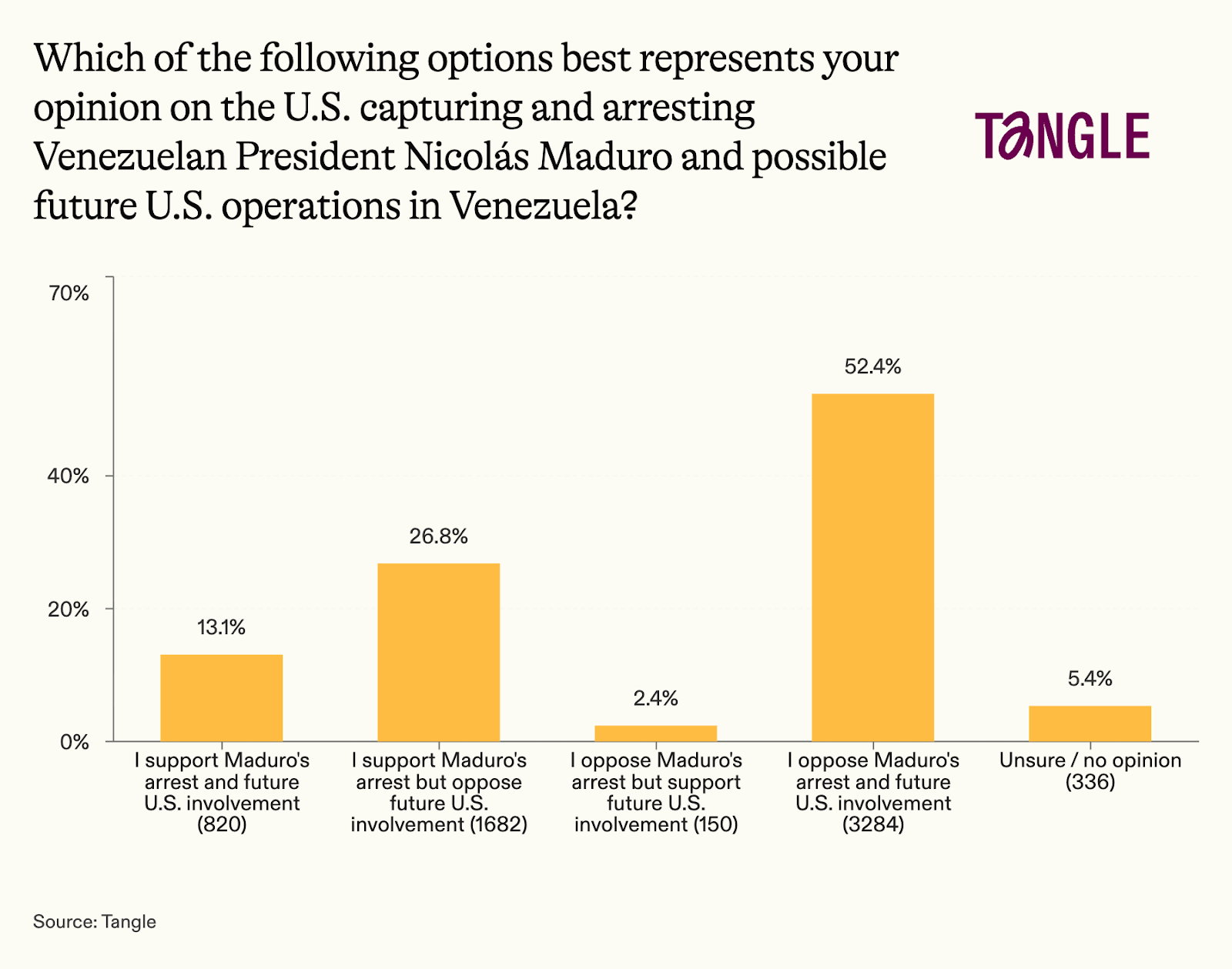
- Yesterday’s survey: 6,272 readers responded to our survey on the U.S. capture of Venezuelan President Nicolás Maduro with 52% opposing Maduro’s arrest and future U.S. involvement. “It feels a lot like the Iraq war but with a LOT more gaslighting,” one respondent said. “Hopefully we have learned our lesson from what happened in Iraq. I trust the President will not let that happen here until I see otherwise,” said another.
Have a nice day.
Charlie Hicks has had the same daily routine for nearly a decade. The Air Force veteran visits the Shrimp Basket in Pensacola, Florida, on his lunch break, orders a cup of gumbo, and watches baseball in the restaurant while he eats. One day in September, however, Hicks didn’t show. After initially making contact with Hicks and learning that he was at home sick, the restaurant stopped hearing back from him. Donnell Stallworth, Shrimp Basket’s chef, decided to check in on Hicks at his apartment and heard a cry for help coming from inside; there, he discovered Hicks severely dehydrated and with broken ribs after a fall. Paramedics transported him to the hospital, where he stayed for two months but fully recovered. “I don’t know what would have happened if Donell hadn’t showed up,” said Hicks, who recently celebrated Thanksgiving with the Shrimp Basket staff and their families. The Washington Post has the story.
Member comments